Ce blog contient des articles issus du livre "Start-Up" et des articles originaux de Hervé Lebret. Le livre est disponible sur Amazon ainsi qu'en version électronique. Pour acheter le livre cliquez ici.

Archives pour le tag ‘Entrepreneur’

Envie d’entreprendre

18 décembre 2008 1 Commentaire »

Vous voulez devenir un entrepreneur, mais vous n’en êtes pas tout à fait sûr? Alors vous vous dites: dois-je quitter un travail bien payé, en pleine récession, lever de l’argent avec 37 cartes de crédit, transformer mon garage en bureau, à côté de mon vieux vélo rouillé et créer ma société? Bien sûr que oui! Se jeter à l’eau apporte la liberté et fait grandir, et l’on atterrit toujours plus accompli. Peur de l’échec? Vous seriez surpris du nombre d’investisseurs qui préfèrent parier sur quelqu’un qui a goûté aux fruits amers de l’échec. En échouant, vous apprenez ce qu’il ne faut pas faire.  Lancez-vous et vous découvrirez qu’il n’y a pas d’échec; vous aurez dégagé l’horizon et ouvert votre esprit et vous vous serez réinventé.

C’est ainsi que Larry Marshall, un serial entrepreneur, commence un article écrit en 2001! Ce n’est peut-être pas aussi sexy que Paul Graham ou Guy Kawasaki, mais en tout cas tout aussi intéressant. Je viens juste de le découvrir ainsi que son blog et je trouve que cela vaut la peine de lire l’article entièrement. Le voici donc extrait intégralement  de  Laser Focus World.

So you want to be an entrepreneur, but you’re just not sure. And you wonder: Should I quit my well-paid job in the middle of a recession, raise money on 37 credit cards, build a lab bench in my garage next to my rusty old bike and start a photonics company? Hell yes! Leaping into the void leads to freedom and growth, which always lands you on a higher plane. Afraid of failure? You’d be amazed at how many investors prefer to back someone who has tasted the bitter fruits of failure. In failing you learn what not to do. Get your skin in the game and there is no failure—you have opened your mind to growth and yourself to reinvention.

As engineers and scientists, we have natural obstacles to overcome if we are to become entrepreneurs. We look at things from the technology perspective and forget the mantra of the marketplace. Open your mind to a market, understand your customer’s problem, then create a solution that puts more cash in his pocket. While technology can enable a new business, it is not necessary. However, knowing your market and the needs of your customers is mission-critical in starting your business.

Too early to market and you run out of money before you generate revenue to sustain your business. Too late and you’re just another “me too” scrambling for the crumbs of the pie dropped by the market leader. But if you read the market right, then you ride the crest of the market wave all the way to success.

Focus, focus, focus
As a photonics person you should understand focus. In a startup your focus must be diffraction limited—do one thing and do it better than everyone else. With limited resources, the only way to produce enough force to penetrate the market is to focus all your weight on a single point. Don’t wear blinders. You must be aware of and respond to changes in the market. But focus is the key. Pick the one product you think will sell. Talk with your customers to define your product. Make sure that your customers want to buy it. Then, when you have defined it, engineer it, produce it, and sell it fast. Pick the wrong product and you will fail quickly. But try to spread the risk and you will linger in purgatory indefinitely.

Only two things create value in a company—product development and selling (marketing is selling to groups). Research may be the key to your company’s future, but there are bills to pay between now and then. Don’t get into business to do research—find a university and give them some money to do it for you; they’ll do a better job for less money. Your mission is to satisfy a market need and make money in the process. Unfortunately, it is possible to raise money today on the promise of tomorrow’s great technology, but this is a train wreck waiting to happen.

There is another aspect to focus—the customer. Everyone in the company from the janitor to the CEO must focus on the customer. Successful hi-tech companies maximize interactions between their engineers and customers and promote peer-to-peer selling. Customers are not only the source of your revenue, they are also the wellspring of your ideas.

One more thing, answer this question: Do I want to change the world (even a little), or do I just want to get rich quick? Those who start businesses because they want to create something new and better don’t always succeed, but those who are just in it for the buck almost never do. The fire inside your belly sustains you through the ordeal, but greed alone will not.

Did I mention focus?

Raising money
After funding startups in several ways, including using credit cards (37 of them, and in a recession too), friends and family, corporate backing, and venture capitalists (VCs), I have these observations. Bootstrapping and incubation work extremely well if you are smart enough to see far ahead of the market—then you can afford to trade time for money. You can raise an “angel” round to finance your prototype development and line up some real customers before you give away half the company raising venture financing. Although a VC will want 40% to 50% of the equity in the first round of financing (regardless of how much money you raise), if you can’t see more than two years into the future, get VC money (see “Making the pitch,” this page).

Venture capitalists add value beyond mere money. Their portfolio of companies can contain your future customers, their name should greatly leverage your cash, and their networks will open doors through which you could not otherwise pass. If you are a diamond in the rough, they will polish you until you shine, but if you don’t shine they’ll find another rock that will. And whoever gives you money, be it your brother, your barber, an angel, or a VC, make sure you like each other—you’ll go through a lot together in the years to come. Remember: you always need much more money than you think.

How do VCs decide which businesses to fund? Ask yourself how you decide to lend money to a friend. Trust. A VC trusts character, experience, team, and the quality of the idea. The idea will attract them, but the team will hook them. Venture capitalists invest in people first and ideas second. The market will change after you are funded and unless the team responds with better ideas, the business will fail. Startups have a wonderful ability to respond rapidly to change, and this, I believe, makes them the new-product development engines of industry.

Building the team
So what makes a great company? A great team. Clearly, a great CEO surrounds himself with people whose skills complement his own. Technical excellence alone is insufficient justification to hire any individual. It is better to have a well-coordinated team of good players than an ungainly group of outstanding individuals. As a founder you must set the tone for your company and recruit people who share your vision, goals, and ideals. Hire the best people you can find wherever you can find them. And always be on the lookout for your own replacement—after all, don’t you want the best people running your company?

When you start hiring skilled people, many of them will want to “make the move to management.” Few of them are capable. A great manager gathers information first, and then takes decisive action. A great inventor makes leaps of faith based on intuition, and is usually a frustrating manager. A great entrepreneur is a mix of the two. Understand that many people want to be managers but few should be—management is not about ego. It is about serving your subordinates in any way that better enables them to do their job, and then getting the hell out of the way so they can do it.

Even the best team players are working for a paycheck. So, share the wealth. Pay people what they are worth, not what you can get them for. Generally, compensate those who contribute to future value—scientists and engineers—in stock, and those who generate immediate value (sales) in cash. If everyone is an owner of your business they will take pride in it, nurture it, and ensure its success.

And remember, you are the lynchpin of your team. Surround yourself with quality advisors on technology, marketing, and business. These are peers, colleagues, and friends. But most important, find an experienced startup CEO who has built companies like yours before and who is still actively doing it, and make him your mentor.

Build more than a better mousetrap
As technologists we often are fooled into thinking that if we simply create a better technology, the market will be ours. A business creates solutions for which customers pay. So if better technology creates a better solution, then the world will beat a path to your door, right? Wrong! Technologically, visible diodes were a quantum leap from HeNe lasers, yet it has taken 10 years for them to replace the HeNe. It’s much harder than you think to displace an entrenched technology. You need substantial improvements, better cost structure, or both. Cash in the pocket is the customer’s bottom line—if you keep more in theirs, they will put some in yours. There is a fixed amount of cash being spent in any given industry. If you want a portion of that cash, either you can take market share from competitors, or capture cash that is paid to others (lifecycle costs, for example), or (ideally) grow the market by adding functionality. This is the crux of any new business.

In my second business, we created a revolutionary solid-state laser technology to replace the ion laser. We could produce several watts of green laser output from an all-solid-state box the size of a cigar case. This was a big improvement over ion lasers, but only to people who worried about 3-phase power, water-cooling, portability, and lifetime. It turned out that, for many people, other benefits of ion lasers that we had never considered outweighed these problems. We persevered, though, and ultimately found a niche in the medical market creating the world’s first miniature portable photocoagulator. Customers loved it. We also replaced copper vapor lasers in dermatology. Again the customers loved it. But we forgot to grow the market. We had made a box that didn’t need a new tube every few years. It worked so well, that once we sold a unit we never saw that customer again. Your new product should not only offer greater functionality at a lower price—it also needs to grow the market.

Running your business
The marketplace is a crucible that burns away all irrelevancies and leaves one pure product—profit. If you don’t make money, your business will fail, and no amount of excuses can save you. No excuses is a core principle of business. Keep your commitments! If you tell Wall Street you will make $1/share earnings—do it. If you fail, have a recovery plan and be sure to eliminate the source of the failure. The market hates failures, but it hates excuses more.

The market rewards results, not effort. As R&D people we learn there is no such thing as failure; even a null result is valuable. Not in business. If you spend a year working on a contract that then goes south, you just wasted a year. You failed to generate revenue and you took food out of the mouths of your team. You should be shot! I hope you had a backup plan.

As your company grows, it will change. Businesses tend to excel at only one thing, but that thing evolves over the life of a business. A typical cycle would be technology, then execution, then manufacturing. JDS Uniphase (JDSU; San Jose, CA) is a great example—it penetrated the market with a great technology, gaining knowledge and experience that enabled the company to execute better than everyone else, and ultimately developed a world-class automated manufacturing system that produce long-lived quality products at a lower price. Now JDSU has fine-tuned a process that allows it to buy new technologies and quickly integrate them into that finely tuned manufacturing machine—that’s an ability that’s hard to beat.

Are you the CEO?
I’ve been lucky enough to report directly to several different types of CEOs whose backgrounds were technical, sales, marketing, and engineering. The two best were technical and marketing. The latter person had a natural advantage over the others in that he valued technology for its ability to reach the customer, not as something of intrinsic worth. He was customer-focused and hired great technology people (I like to think I was one of them) to create his vision.

The technology person was a truly visionary CEO. He immersed himself in his customers’ market. He spent a lot of time working alongside his customers to understand their needs, and thereby won both their trust and their business. He understood their problems and solved them. If you can do this too, you will win! So what are you waiting for?

ACKNOWLEDGMENTS
I have been fortunate enough to learn from some outstanding people and I thank them here: Josh Mackower, Milton Chang, Ted Boutacoff, Don Hammond, Bill Lanfri, Walter Koechener, Paul Davis, Bob Anderson, Robert Haddad, Bob Byer, and Dan Hogan.

ABOUT THE AUTHOR
Larry Marshall is the CEO of Lightbit Corp, a next-generation telecommunications components startup. He has angel-invested in three startups, and personally done three others, including Light Solutions Corporation, which merged with Iris medical, and went public as Iridex, in February 1996 (Nasdaq:IRIX; Mountain View, CA). Marshall is an active inventor, holds nine patents protecting 16 commercial products, and has over 100 publications and presentations. He is chairman of the OSA Conference on Advanced Solid State Lasers, is an editorial advisory board member to Laser Focus World, and is on the board of directors of two telecommunications startups. Larry Marshall is founder and CEO of Lightbit Corp. P.O. Box 20453, Stanford, CA 94309; e-mail: larry@lightbit.com.

_______________________________

Making the pitch
When you write your business plan and pitch to a venture capitalist, you only need to answer seven basic questions:

  1. What problem or need will you solve or serve?
  2. Who are your customers?
  3. How much will they pay?
  4. What is your product?
  5. How much will it cost to build and sell?
  6. Who are your competitors and how will you beat them (barriers to entry or exit)?
  7. How big is the payoff and when will it happen?

Your single-page executive summary should answer these questions and is likely to be the only part of your plan an investor actually reads. Write concisely and honestly.

When you write your business plan remember that a little bit of “hype” goes a very long way—the wrong way. And don’t believe your own hype. If you claim, for example, that “there are no competitors” or that “they are inferior,” you are actually telling investors that you are either a genius or a fool (and they will assume the latter). It’s actually pretty easy to sell a story and there have been some great cons. But if you do sell a story you’ll spend the next several years building a business doomed to fail—and who wants to do that?

It is hard to be honest with your own ideas, so take them for a test drive with friends. Surround yourself with quality business advisors who are not afraid to tell you the truth and you can quickly separate the lemons from the gems.

Né pour grandir

4 décembre 2008 Commentez! »

Je viens de lire un rapport intitulé “Born to Grow – How to Harness Europe’s most innovative entrepreneurs

Rien de fondamentalement nouveau, mais il représente une excellente synthèse de recommandations à direction de l’Europe et j’ai mis en gras celles qui me semblent essentielles. Je ne fais pas l’effort de les traduire…

  • Teach the values of innovation and entrepreneurship in our schools
  • Celebrate successful entrepreneurs – in prizes and the media
  • Break the barrier between business and technical universities
  • Organise researchers to work across scientific disciplines
  • Train young researchers and managers for global growth – and flexibility
  • Adopt policies to encourage innovation clusters around universities
  • Create “free innovation zones” to speed growth in selected clusters
  • Support the role of large companies in cluster-development
  • Give priority to creating “lead markets” for innovation
  • Free information flows – with online portals, benchmarking and patents
  • Target tax incentives and other financing aids to growth companies
  • Tout aussi importantes, voici les caractéristiques des entrepreneurs de croissance (page 11):

    Originality. The greatest entrepreneurs have a better idea: a novel product, service or process that fills a need.

    Adventurousness. In the generally risk-averse culture of Europe, it’s rare to find an entrepreneur with the will to quit a cushy job and gamble the future on an idea.

    Dedication. Rigor and determination are hotwired into the best entrepreneurs – and that comes naturally to many scientists and engineers.

    Ambition. International business success comes easier if the entrepreneur’s plan is global from the
    start.

    Humility. Perhaps the rarest, but most important, trait in a high-growth entrepreneur is the ability to recognise one’s personal limitations – and seek help from others, rather than try to
    run the whole show.

    In the nurture of a high-growth entrepreneur:

    A thriving ecosystem. Businesses don’t grow in vacuums; they need networks of suppliers, researchers and customers.

    Financial backing. It takes money for a start-up to grow from minnow to whale; and deeppocketed, deeply engaged investors are critically important.

    A big, open market. A company needs plenty of room for manoeuvre – and some of the brightest entrepreneurial stars have profited when old, regulated markets started to open up.

    Big brothers. For many start-ups, it helps to grow in the shelter of big corporations that create their
    own ecosystems. Examples: Risto Siilasmaa, whose F-Secure antivirus company thrived in the 3,500-company world created around mobilephone giant Nokia; and Peter Bang and Jesper Balser, whose Danish business-process software firm Navision grew up in Microsoft’s programming environment – and was later bought by it.

    En compagnie des géants

    26 novembre 2008 1 Commentaire »

    J’avais lu In the Company of Giants en 1997 juste avant de devenir capital-risqueur. Puis, lorsque j’ai commencé à relire des livres sur les entrepreneurs, je n’ai simplement pas pu retourver l’ouvrage et j’ai du utiliser le réseau des revendeurs d’Amazon. Il est aussi intéressant que d’autres mentionnés dans mes posts passés (Once You’re Lucky, Betting it All, Founders at Work).

    Je vous laisse faire le lien entre les noms et les photos!

    Steve Jobs: “In the early days, we were just trying to hire people that knew more than we did about anything and that wasn’t hard because we didn’t know a lot. Then your perspectives are changing monthly as you learn more. People have to be able to change.”

    T. J. Rodgers (Cypress Semiconductor): “the standard entrepreneurial answer is frustration. You see a company running poorly, you see that it could be a whole better. Intel and AMD were arrogant. If you think about it, any billion dollar company, that has so much money to spend on R&D should be unassailable. But the large companies routinely cannot crunch little companies so something’s got to be wrong.”

    Gordon Eubanks (Symantec): “What makes a company successful is people, process, product, and passion. You must have great people and product and passion balanced by process.”

    Steve Case (AOL): “Do something you really love, you are passionate about. Take a long-term view, be really patient. There are going to be bumps on the road.”

    Scott Cook (Intuit): “People [customers] won’t tell you what they want. Often they can’t verbalize it because they don’t understand things they’ve not seen. You must understand fundamental motivations and attitudes.”

    Sandy Kurtzig (ASK): “I did not see it as incredible risk. Many entrepreneurs would tell you why it was obvious to do what they did. When you have nothing, you have nothing to lose. That’s why so few entrepreneurs can do it a second time. Even Jim Clark did not really start Netscape or Jobs did not really start Pixar. They funded it. You need other people to be hungry… Believe in yourself, surround yourself with good people, be willing to make mistakes, don’t get wrapped up in your success. You are still the same person you were when you started.”

    John Warnock and Charles Geschke (Adobe): “Actually there was the very first business plan, then there was the second business plan, and then the third business plan; we never actually wrote the third business plan.”

    Michael Dell: “It did not seem risky to leave school because I was already earning obscene amounts. The worst thing that could happen is I would return to school. The greater risk was to stay at school.”

    Charles Wang (Computer Associates): “Managing is not just telling people what to do, but it is leading by doing. Know your strengths and weaknesses and complement yourself. Be realistic and objective. Surround yourself with great people.”

    Bill Gates: “It’s mostly about hiring great people. We are [in 1997] 18,000 people and still the key constraint is bringing in great people. We naively thought there were guys who could tell us we weren’t doing things the best way.”

    Andy Grove: “I can’t look at a startup as an end result. A startup to me is a means to achieve an end.”

    Trip Hawkins (Electronic Arts): “You don’t have an objective, rational process. You need a certain amount of confidence. There are many things that you don’t know will go wrong. If you knew in advance all the things that could go wrong, as a rational person, you wouldn’t go into business in the first place.”

    Ed McCracken (Silicon Graphics): “My venture capital friends tell me that many of the ideas they’re seeing for new businesses are coming from people under 26 years old.”

    Ken Olsen: “Business school’s goal today is to teach people to become entrepreneurs. I think it’s a serious mistake. You learn first how to be a team member, then a leader.”

    Bill Hewlett: “It was 1939 and it was no time to start a company. It was probably the supreme optimism of youth.” and “It’s not all due to luck, but certainly a large percentage of success is. We were in the right place at the right time. We were lucky and we had wonderful teachers and mentors. HP didn’t start in a vacuum.”

    Les pensées d’un entrepreneur Suisse en Californie

    19 novembre 2008 Commentez! »

    A la suite d’une longue conversation téléphonique avec un Suisse basé dans la Silicon Valley, celui-ci m’a envoyé ses réactions. Je les ai trouvées très intéressantes. Je vous laisse en prendre connaissance:

    “Ça me démoralise un peu de voir que les choses n’évoluent que lentement (c’était malheureusement déjà mon impression)…

    Du cote philosophique, je réfléchissais dans la voiture que l’un des problèmes est le niveau de confiance. Aux US, tout le monde est élevé dans la culture du “tout est possible”, “rêve américain”, parfois au point ou cela devient stupide et énervant… Au contraire, en Suisse, on veut tout bien faire et on est dans la culture du “c’est pas possible”, “je sais pas faire”. En fait, pour être entrepreneur, il ne faut pas avoir peur de faire les choses de manière imparfaite, de faire des choses dans des domaines que l’on ne connait pas bien, et rapidement en plus (c’est l’oppose du spécialiste Suisse qui est très pointu et très centre sur les détails “travail bien fait”)… En résumé d’apprendre de nouvelles choses sur le tas:

    - Comment lever de l’argent: Par où commencer?
    - Comment négocier un contrat d’investissement
    - Comment aborder les partenaires
    - Négociation
    - Comment travailler avec des recruteurs, des avocats, des clients…
    - Comment monter et manager un groupe
    - Comment engager des commerciaux (pour un ingénieur). Au fait: ça fait quoi le marketing, les ventes, les opérations?
    - Comment creer un nouveau produit – schedule, spécification, qualification, etc…
    - Ou trouver des distributeurs pour le produit? Comment choisir les bons?
    - etc…

    Tout ça s’apprend pas a l’école pour un ingénieur (je sais même pas ce qui est vraiment couvert de manière pratique dans un MBA). En fait je sais pas si ça peut s’apprendre dans une cours a l’université… Pour moi, un entrepreneur, çà n’arrête pas de faire des choses nouvelles, assez mal la première fois, et de s’améliorer au cours du temps. Il faut a la fois ne pas avoir l’attitude négative/défaitiste qui fait que l’on ne tente jamais des choses difficiles/risquées, sans aller a l’oppose et ne se lancer que dans des projets irréalistes. Il y a une “fine line”
    entre l’arrogance (il faut quand même connaitre ses limites) et le dynamisme d’un bon entrepreneur…

    Bien sur, le fait que la formation des ingénieurs ne comprenne aucune introduction au Marketing, a la comptabilité, au aspects légaux n’aide pas. (Mais c’est le cas au US aussi)”

    Hier, j’étais à Grenoble pour une table sur les Nouveaux Conquérants:

    Le sujet était exactement le même: la nécessité de la confiance en soi, de la passion, de l’enthousiasme pour affronter l’incertitude.

    A propos de “Once you’re lucky, Twice you’re good”

    3 novembre 2008 Commentez! »

    Voici le troisième que je signale sur ce blog concernant les entrepreneurs high-tech. En fait, il s’agit même du quatrième si j’inclus Inside Steve’s Brain (qui par contre ne décrivait qu’un seul entrepreneur). Les deux précédents contenaient une série d’interviews d’entrepreneurs célèbres, à savoir Betting it all and Founders at Work. La beauté (et sans doute aussi la faiblesse) de Once you’re lucky, twice you’re good est que le thème choisi est le web2.0 : cette nouvelle étape du développement de l’Internet est-elle une bulle spéculative ou bien une  révolution en marche ? Il est sans doute trop tôt pour juger mais l’auteur Tracy Lacy (qui apparaît dans un autre post) est assez convaincue qu’il s’agit d’une révolution.

    lacy_book_web.jpg

    C’est un beau livre car il montre à nouveau la richesse des connections individuelles. Je l’illustre plus bas à la manière d’autres réseaux de relation que vous trouverez dans mon livre. Cette fois, Paypal et ses fondateurs semble être le tronc commun à de nombreux entrepreneurs. Faichild avait joué un rôle similaire aux débuts de la Silicon Valley dans les années soixante, puis Apple, Sun, Cisco plus tard.

    webnetwork.gif

    Un autre sujet intéressant concerne les investisseurs. Il y a une idée à la mode selon laquelle la capital-risque ne fut pas présent à la naissance du web2.0. Les business angels qui furent les entrepreneurs 1.0 auraient fait leurs propres expériences. La situation est plus complexe comme le montre le tableau qui suit. Greylock, CRV, Accel mais aussi Benchmark ou Sequoia sont très actifs.

    Enfin, l’ouvrage montre que les entrepreneurs sont des passionnés. Je ne peux qu’encourager à la lecture de l’épilogue assez fascinant sur l’enfance de Max Levchin. Il faut toujours des légendes dans ces histoires et celle-ci est assez belle.

    web20funding.gif
    Référence: Crunchbase et sites web des start-up.

    Un livre sur les entrepreneurs

    29 septembre 2008 Commentez! »

    Après avoir lu Founders at Work de Jessica Livingston, je me suis plongé dans un ouvrage plus ancien de Michael Malone.

    bettingitall.JPG

    C’est le même principe, à savoir 16 interviews d’entrepreneurs high-tech. Sa lecture est enrichissante. En voici quelques extraits:

    Larry Ellison sur l’incertitude:

    When everyone said a relational database would never be commercially viable, the reckless guy said “maybe everyone’s wrong – maybe I will take a chance with my career and with my cash.” It’s not a rational process.Larry Ellison à nouveau à propos des entrepreneurs: “I saw outside managers brought into a lot of companies who then made things dramatically worse. I think I was the best person for the job, I knew the company better than anyone else. I knew the technology, the products and the markets. My heroes are people who do not follow convention. It’s difficult to innovate when you are like anybody else.”T. J. Rodgers sur la Silicon Valley: “One of the things that Silicon Valley successful is companies think just about wanting to succeed. It is also a meritocracy. What makes us so special and different is no Java code or biotechnology, it is that we’re truly capitalists. About Europe and Japan: We’re moving at light speed relative to the Japanese, who probably still have a committee working on the problem and the Europeans, who are trying to work it out politically. ”Tom Siebel à propos de la chance: “If you look at the core of many success stories, it’s not great visionaries, not great technology, not great entrepreneurs, it’s pretty bright people who found themselves in the right place at the right time and managed not to foul up the opportunity.”Gordon Moore sur la Silicon Valley. “I really measure the thing that’s become Silicon Valley from Shockley in 1956. There were earlier technology companies – Hewlett Packard and Varian – but they were more like established companies on the East Coast. Shockley introduced some instability in the system. ”

    Si vous voulez en savoir plus, à vous de le lire…

    A suivre:  “Once you’re lucky…” et “In the Company of Giants

    La Silicon Valley est-elle en danger?

    5 septembre 2008 Commentez! »

    Voici une interview vidéo sur la Silicon Valley. Elle est inquiétante et je ne peux pas être en total désaccord: l’industrie high-tech murit si bien que l’innovation pourrait y être moins critique. Les VCs sont en crise même s’ils l’admettront pas ouvertement. La prise de risque disparait. “Engineers are gun shy of start-ups”. Quel terrible message…

    Bien sûr on peut aussi réagir car ceci n’est pas nouveau. : Silicon Valley Fever est un livre de 1984 qui décrivait déjà très bien les ennuis des start-ups et des ingénieurs. On a régulièrement entendu la complainte “trop d’argent pour trop peu d’opportunités”.

    Quoi qu’il en soit, je vous laisse découvrir, apprécier, voire commenter.

    PS: merci à Andre M. pour avoir attirer mon attention sur ce document.

    La composante humaine de l’équation capital-risque.

    21 août 2008 Commentez! »

    Un post intéressant de Fred Wilson pose la question du remplacement nécessaire des fondateurs par du management expérimenté « The Human Piece of the Venture Equation ». Je n’ai pas pu m’empêcher de réagir à son post puisqu’il s’agit de mon sujet favori : la passion dans les start-up. Voici ce que j’ai écrit.Le sujet est en effet passionnant. Comme ancien étudiant dans la Silicon Valley et comme ancien VC, j’ai vu beaucoup, beaucoup de start-up et de fondateurs. Mon intuition est que dans un monde idéal, le fondateur devrait être CEO aussi longtemps que possible. Laissez-moi faire une analogie (que j’utilise souvent) : une start-up est un bébé dont les fondateurs sont les parents. A moins qu’ils en soient totalement incapables, ils auront la responsabilité de son éducation. De nombreux « spécialistes » les assisteront (enseignants, médecins, etc.). Et bien sûr, ils feront des erreurs parfois mortelles. Cela ne veut pas dire pour autant qu’ils doivent le/la contrôler indéfiniment. Ca n’est pas du tout souhaitable (pour les parents du moins !). Et laissez-moi ajouter, mais peut-être suis-je devenu trop conservateur, que deux parents/fondateurs sont la formule idéale pour le bébé/start-up.

    Je suis donc en accord avec la remarque de Wilson “nothing can replace the entrepreneur’s passion and vision for the product and the company. If you rip that out of the company too early, you’ll lose your investment. I think it’s best to wait”. J’ai publié Start-Up juste avant de lire “Founders at Work”, l’excellent livre de Jessica Livingston. J’ai essayé d’élargir la perspective car je ne suis pas sûr que l’Internet et le Web2.0 aient fondamentalement changé le problème. Oui, vous pouvez bâtir plus vite et à moindre coût mais Hewlett et Packard avaient un peu plus de 25 ans quand ils fondèrent HP en 1939. Gates, Jobs et Dell ne sont pas les premiers gamins des start-up. Il ne s’agit pas que d’ordinateurs et de logiciels. Je crois qu’il s’agit de passion, qui est peut-être plus importante encore que l’expérience. Il s’agit de mon intuition et sans doute des études approfondies seraient utiles à l’analyse. La Passion est un des mes sujets préférés.

    Un dernier point. Faut-il remplacer le CEO quand “the CEO’s job goes from managing the product, writing a little code, doing customer support, and raising money to managing people and teams, processes and priorities.” Je n’en suis pas sûr. Je suis en accord avec cette remarque, mais aussi avec ce que Wilson dit plus tard quant au rôle du CEO dans la définition de la vision et de la stratégie. Ne peut-on pas demander aux autres managers dont le COO de maîtriser les processus ? Quand Logitech fut en difficulté, son fondateur, Daniel Borel, confia les rênes à un nouveau CEO, ancien homme de marketing chez Apple. C’est au moins sur le marketing qu’il redessina Logitech. L’histoire bien sûr unique de Steve Jobs a des similitudes (« Inside Steve’s Brain » est une autre lecture intéressante.)

    Il est difficile de résoudre l’équation capital-risque et elle inclut de nombreux éléments contre-intuitifs. Elle n’est ni blanche, ni noire. Vous avez besoin de passion et d’expérience et par définition, on retrouve rarement les deux ingrédients chez la même personne. Voilà un autre argument pour l’utilité d’avoir deux fondateurs. Google a parfaitement résolu l’équation avec la venue d’Eric Schmidt car il n’y a aucun doute que les deux fondateurs restent essentiels pour leur start-up.

    Y a-t-il une recette pour l’entrepreneuriat?

    17 juin 2008 1 Commentaire »

    Les étudiants de l’Ecole Hôteliere de Lausanne qui ont un goût naturel pour la gastronomie m’ont posé la question récemment. Je me suis inspiré de Paul Graham et de Steve Jobs pour en fournir les ingrédients. Le texte en anglais est disponible en pdf. Voici la réponse (en anglais également) …

    stvoi.gif

    Is there a recipe for entrepreneurship?

    “Launching a start-up is not a rational act. Success only comes from those who are foolish enough to think unreasonably. Entrepreneurs need to stretch themselves beyond convention and constraint to reach something extraordinary.” Vinod Khosla, founder of Sun Microsystems

    Europe is aware that it is not as efficient with entrepreneurship as the USA, and Silicon Valley is the extreme illustration of the American model. Google, Yahoo, Apple, Cisco, Oracle, Intel are only a few examples. What are ours? What did we do wrong? My answer is that we have not bet on passionate individuals ready to take risks and face uncertainty: young people who may fail but will learn from their mistakes.

    If you are not convinced or surprised with the argument, let me quote some Silicon Valley icons. Steve Jobs said about Silicon Valley success: “There are two or three reasons. You have to go back a little in history. I mean this is where the beatnik happened in San Francisco. It is a pretty interesting thing…You’ve also had Stanford and Berkeley, two awesome universities drawing smart people from all over the world and depositing them in this clean, sunny, nice place where there’s a whole bunch of other smart people and pretty good food. And at times a lot of drugs and all of that. So they stayed… I think it’s just a very unique place.”

    The main investor in Apple, Steve Jobs’ company, Don Valentine adds: “Founders are genetically impossible by choice. There were only two true visionaries in the history of Silicon Valley. Steve Jobs and Bob Noyce [Intel’s founder]. Their vision was to build great companies… Steve was twenty, un-degreed, some people said unwashed, and he looked like Ho Chi Min. But he was a bright person… Phenomenal achievement done by somebody in his very early twenties… Bob was one of those people who could maintain perspective because he was inordinately bright. Steve could not. He was very, very passionate, highly competitive.” By the way, Bob Noyce mentored Steve Jobs.

    Let me add one more quote by another investor, Tom Perkins: “The difference is in psychology: everybody in Silicon Valley knows somebody that is doing very well in high-tech start-ups; so they say to themselves “I am smarter than Joe. If he could make millions, I can make a billion”. So they do and they think they will succeed and by thinking they can succeed, they have a good shot at succeeding. That psychology does not exist so much elsewhere,”

    Quotes may not be any proof, but consider the age of the Silicon Valley entrepreneurs: Steve Jobs was 21, the Google founders were 25, the eBay founder was 28, and the Yahoo founders were 27 and 29. Do not think this is linked to the Internet. Mister Hewlett and Packard were 26 and 27 in 1939 when they founded HP. Founders often come also as a team of two; many are foreigners, immigrants who have something to prove, “hungry people”.

    But if we would try to find a recipe, a recipe that Europe could use to bake fresh Entrepreneurs for their economies, what would it be? Paul Graham, an entrepreneur whose blog, www.paulgraham.com, is a must-read, has his strange advice: two main ingredients are needed, rich people and “nerds”. In my recent book, “start-up”, I use his advice for my very own recipe:

    - Take rich people and nerds.

    - Do not add any bureaucracy, do not add concrete.

    - In order to attract and keep enough nerds/cooks in a place, there is a need for a large and nice plate.

    A university is a good choice, it needs personality, and it needs to be creative. Not only on its campus, but also in its surroundings, so that the ingredients feel comfortable in the plate.

    - The ingredients should be fresh, i.e. they should be young and dynamic.

    Graham also mentions liberal environments, which, he claims, tolerate strange and brilliant individuals. [Read again what Jobs said above about SV].

    - Then the ingredients have to be put in the oven for a very long time.

    Silicon Valley began in 1957. It took ten years, even twenty years, to make this region successful; it is about the time it takes to grow infants into adults.

    - The oven should not be too hot, so that the desire is not killed, then the temperature should be increased to maintain the enthusiasm.

    A temperate, pleasant climate is therefore necessary.

    If all the conditions are in place, the result will probably be interesting.

    Lausanne has many assets to become such a place. Lausanne has EPFL, Unil, EHL, IMD. It has rich people. It has a nice climate and nice food, a rich cultural environment. So what we “just” need is the desire to try. Of course, ideas and projects have to be well managed. But first and foremost, we need young people, not afraid of being ambitious. As a final word, I think we should also take more inspiration from Silicon Valley. First, visit the place and understand it better; second, invite back the Europeans who live over there and have experienced this unique culture. We have to learn from them. So you have my recipe for entrepreneurship. The recipe for success is more an Art than a Science and listen again to what Steve Jobs said in 2005 at the first graduate diploma ceremony he ever attended: “Stay foolish, stay hungry.”

    Sources:

    Paul Graham and Silicon Valley
    http://www.paulgraham.com/siliconvalley.html

    Steve Jobs at Stanford
    http://news-service.stanford.edu/news/2005/june15/jobs-061505.html

    “Start-up, what we may still learn from Silicon Valley
    http://www.startup-book.com

    Capitalisation : Kelkoo

    6 mai 2008 2 Commentaires »

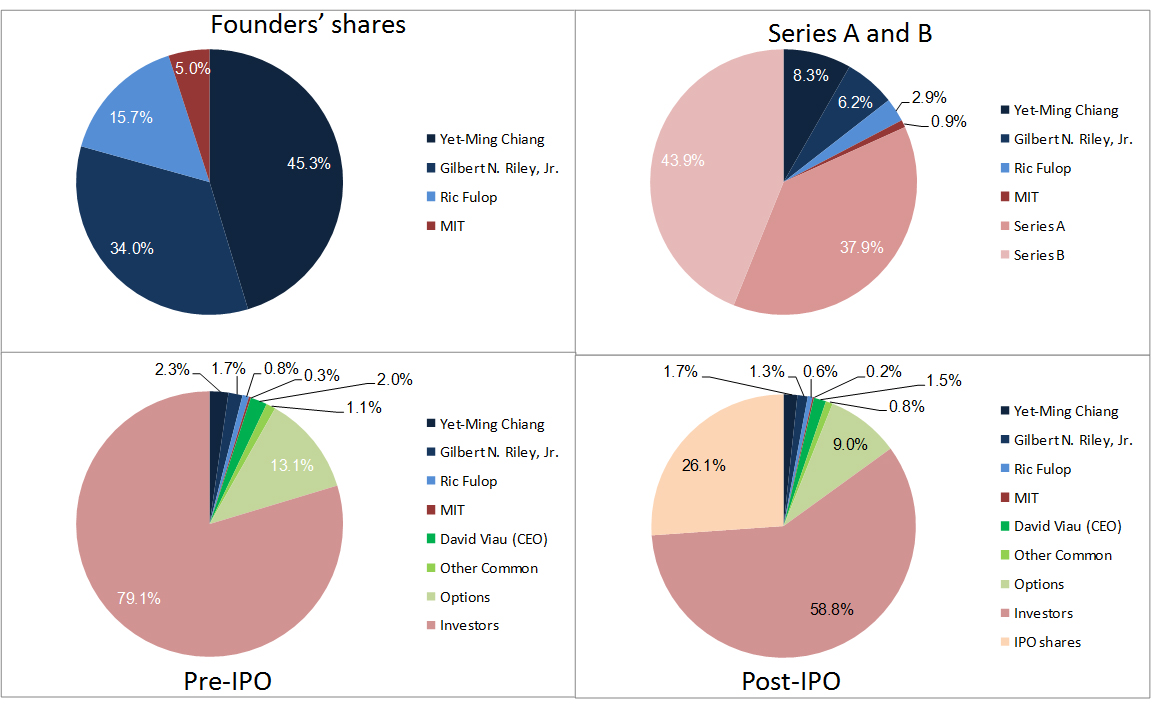
    Kelkoo est un cas d’étude passionnant. La société fut une pour ne pas dire la success story de l’Internet français voire européen. Elle fut acquise par Yahoo pour €475M en 2004. Elle fut extrêmement ambitieuse dès ses débuts et elle eut une stratégie paneuropéenne assez étonnante en attaquant l’Espagne, le Royaume-Uni et la Scandinavie par une série de croissances externes : DondeCom, Shopgenie et ZoomIT. Kelkoo leva environ €45M en moins d’un an ! Il y eut donc pour les fondateurs une série de dilutions, liées aux trois tours de financement A, B et C et à ces trois acquisitions.

    La table de capitalisation et les figures ci-dessous montrent l’évolution des chiffres. J’ai bien conscience que ces tableaux sont riches en information mais si le lecteur veut bien me suivre, je pense que ces données sont d’intérêt. Commençons par le tableau du bas, qui donne la liste des tours de financement. En 1999, Kelkoo est créée par cinq fondateurs (Chappaz, Lopez, Amouroux, Odin and Mercier) et immédiatement financée par 2 capitaux-risqueurs (« VCS ») : Banexi et Innovacom. Les deux fonds investirent €1.5M en décembre 1999 (round A), puis un peu plus de €4M en mars 2000 (round B). Première subtilité, il y eut un stock split entre les deux tours : chaque action pre-round A donna 50 actions post round B ; ceci explique que le prix par action de €24.67 est en fait équivalent à environ €0.50. Pour le round B, le prix par action fut de €1.45. Les cinq fondateurs s’étaient réparti les actions initiales sur la base 1/3 pour Chappaz, 1/3 pour Lopez et le delta entre les trois autres fondateurs. Mais des options furent allouées à Chappaz et Mercier lors du tour B, sans doute pour rééquilibrer différemment ces parts. Les « camemberts » donnent donc une répartition différente. Dominique Vidal n’est pas un fondateur mais travaillait chez Banexi où il travailla à l’investissement dans Kelkoo avant de rejoindre Kelkoo comme directeur général. Il reçut initialement 338’000 actions environ, puis reçut d’autres actions avec le temps, mais je ne connais pas le nombre exact (il s’agit d’une simple estimation dans son cas). Enfin, un plan de stock-options fut aussi mis en place pour les employés, leur donnant alors virtuellement 19% de Kelkoo. Nous ne sommes qu’en mars 2000 et déjà l’évolution de la capitalisation est riche en données. On peut donc lire le tableau soit avec le nombre d’actions (partie droite) soit en proportion du total de la société partie gauche).

    (Cliquer sur les images pour agrandir ou télécharger)

    kelkoo.gif

    La situation se complexifie avec les acquisitions de Kelkoo. Tout d’abord DondeCom (Espagne) et ShopGenie en juin 2000. Le partage fut d’environ 50-50 entre Kelkoo et les nouveaux arrivants. Egalement en juin 2000, Kelkoo lève son troisième tour (round C) pour un total de €30M ; en septembre 2000, elle lève €6M de plus aux mêmes conditions. Initialement, le prix par action était de €1.99. Mais il y avait une condition à ce prix : Kelkoo devait fournir une sortie, une liquidité aux investisseurs en 2001 ou le prix serait ramené à €1.70. Kelkoo n’eut ni IPO ni M&A fournissant une liquidité aux investisseurs, ils reçurent donc de nouvelles actions pour diminuer le prix initial. Ceci implique donc que la valorisation de Kelkoo était alors de €96M et que les investisseurs du troisième tour possédaient 37% de Kelkoo. Il ne reste plus qu’à mentionner la dernière acquisition de Kelkoo, ZoomIT en Scandinavie pour un peu moins d’un tiers du total de Kelkoo.

    Yahoo acheta Kelkoo pour €475M ce qui implique un prix par action de €5.7 en admettant que le nombre total d’actions soit correct. La dernière colonne donne donc la valeur des actions par actionnaire (mais elle n’indique pas combien ses actions coutèrent. Il faudrait déduire le coût pour obtenir le profit avant impôt). Comme je l’ai toutefois mentionné pour les cas précédents (Skype, mysql), ces données ne sont jamais faciles à garantir. Je ne dois pas être très loin de la réalité mais les augmentations successives de capital n’indiquent pas toujours combien d’options furent réellement exercées et donc transformées en actions. J’ai toutefois acheté sur le registre du commerce français une dizaine de documents qui décrivent de manière précise cette histoire. Ils sont mal seule source d’information pour bâtir tous ces tableaux. L’histoire de Kelkoo est très bien racontée dans le livre « Ils ont réussi leur start-up » chez Village Mondial. Pierre Chappaz est aujourd’hui CEO de Wikio et tient un excellent blog, Kelblog. Pierre Chappaz fit aussi une passionnante présentation de son histoire à l’EPFL en 2005.

    Références : www.euridile.fr

    (Cliquer sur les images pour agrandir ou télécharger)

    kelkoo-share.gif