This blog contains original articles as well as articles from the book "Start-Up", by Hervé Lebret, which exists both in English and French. It is available on Amazon as well as in electronic versions. To buy it, click here.

Posts Tagged ‘Start-up’

So you want to be an entrepreneur

Thursday, December 18th, 2008 2 Comments »

So you want to be an entrepreneur, but you’re just not sure. And you wonder: Should I quit my well-paid job in the middle of a recession, raise money on 37 credit cards, build a lab bench in my garage next to my rusty old bike and start a [...] company? Hell yes! Leaping into the void leads to freedom and growth, which always lands you on a higher plane. Afraid of failure? You’d be amazed at how many investors prefer to back someone who has tasted the bitter fruits of failure. In failing you learn what not to do. Get your skin in the game and there is no failure—you have opened your mind to growth and yourself to reinvention.

This is how Larry Marshall, a serial entrepreneur, begins an article he wrote in 2001! Maybe not as sexy as Guy Kawasaki or Paul Graham, but certainly as interesting. I just discovered this and his blog yesterday and I thought it is worth reading it entirely. So here is the full paper taken from Laser Focus World.

So you want to be an entrepreneur, but you’re just not sure. And you wonder: Should I quit my well-paid job in the middle of a recession, raise money on 37 credit cards, build a lab bench in my garage next to my rusty old bike and start a photonics company? Hell yes! Leaping into the void leads to freedom and growth, which always lands you on a higher plane. Afraid of failure? You’d be amazed at how many investors prefer to back someone who has tasted the bitter fruits of failure. In failing you learn what not to do. Get your skin in the game and there is no failure—you have opened your mind to growth and yourself to reinvention.

As engineers and scientists, we have natural obstacles to overcome if we are to become entrepreneurs. We look at things from the technology perspective and forget the mantra of the marketplace. Open your mind to a market, understand your customer’s problem, then create a solution that puts more cash in his pocket. While technology can enable a new business, it is not necessary. However, knowing your market and the needs of your customers is mission-critical in starting your business.

Too early to market and you run out of money before you generate revenue to sustain your business. Too late and you’re just another “me too” scrambling for the crumbs of the pie dropped by the market leader. But if you read the market right, then you ride the crest of the market wave all the way to success.

Focus, focus, focus
As a photonics person you should understand focus. In a startup your focus must be diffraction limited—do one thing and do it better than everyone else. With limited resources, the only way to produce enough force to penetrate the market is to focus all your weight on a single point. Don’t wear blinders. You must be aware of and respond to changes in the market. But focus is the key. Pick the one product you think will sell. Talk with your customers to define your product. Make sure that your customers want to buy it. Then, when you have defined it, engineer it, produce it, and sell it fast. Pick the wrong product and you will fail quickly. But try to spread the risk and you will linger in purgatory indefinitely.

Only two things create value in a company—product development and selling (marketing is selling to groups). Research may be the key to your company’s future, but there are bills to pay between now and then. Don’t get into business to do research—find a university and give them some money to do it for you; they’ll do a better job for less money. Your mission is to satisfy a market need and make money in the process. Unfortunately, it is possible to raise money today on the promise of tomorrow’s great technology, but this is a train wreck waiting to happen.

There is another aspect to focus—the customer. Everyone in the company from the janitor to the CEO must focus on the customer. Successful hi-tech companies maximize interactions between their engineers and customers and promote peer-to-peer selling. Customers are not only the source of your revenue, they are also the wellspring of your ideas.

One more thing, answer this question: Do I want to change the world (even a little), or do I just want to get rich quick? Those who start businesses because they want to create something new and better don’t always succeed, but those who are just in it for the buck almost never do. The fire inside your belly sustains you through the ordeal, but greed alone will not.

Did I mention focus?

Raising money
After funding startups in several ways, including using credit cards (37 of them, and in a recession too), friends and family, corporate backing, and venture capitalists (VCs), I have these observations. Bootstrapping and incubation work extremely well if you are smart enough to see far ahead of the market—then you can afford to trade time for money. You can raise an “angel” round to finance your prototype development and line up some real customers before you give away half the company raising venture financing. Although a VC will want 40% to 50% of the equity in the first round of financing (regardless of how much money you raise), if you can’t see more than two years into the future, get VC money (see “Making the pitch,” this page).

Venture capitalists add value beyond mere money. Their portfolio of companies can contain your future customers, their name should greatly leverage your cash, and their networks will open doors through which you could not otherwise pass. If you are a diamond in the rough, they will polish you until you shine, but if you don’t shine they’ll find another rock that will. And whoever gives you money, be it your brother, your barber, an angel, or a VC, make sure you like each other—you’ll go through a lot together in the years to come. Remember: you always need much more money than you think.

How do VCs decide which businesses to fund? Ask yourself how you decide to lend money to a friend. Trust. A VC trusts character, experience, team, and the quality of the idea. The idea will attract them, but the team will hook them. Venture capitalists invest in people first and ideas second. The market will change after you are funded and unless the team responds with better ideas, the business will fail. Startups have a wonderful ability to respond rapidly to change, and this, I believe, makes them the new-product development engines of industry.

Building the team
So what makes a great company? A great team. Clearly, a great CEO surrounds himself with people whose skills complement his own. Technical excellence alone is insufficient justification to hire any individual. It is better to have a well-coordinated team of good players than an ungainly group of outstanding individuals. As a founder you must set the tone for your company and recruit people who share your vision, goals, and ideals. Hire the best people you can find wherever you can find them. And always be on the lookout for your own replacement—after all, don’t you want the best people running your company?

When you start hiring skilled people, many of them will want to “make the move to management.” Few of them are capable. A great manager gathers information first, and then takes decisive action. A great inventor makes leaps of faith based on intuition, and is usually a frustrating manager. A great entrepreneur is a mix of the two. Understand that many people want to be managers but few should be—management is not about ego. It is about serving your subordinates in any way that better enables them to do their job, and then getting the hell out of the way so they can do it.

Even the best team players are working for a paycheck. So, share the wealth. Pay people what they are worth, not what you can get them for. Generally, compensate those who contribute to future value—scientists and engineers—in stock, and those who generate immediate value (sales) in cash. If everyone is an owner of your business they will take pride in it, nurture it, and ensure its success.

And remember, you are the lynchpin of your team. Surround yourself with quality advisors on technology, marketing, and business. These are peers, colleagues, and friends. But most important, find an experienced startup CEO who has built companies like yours before and who is still actively doing it, and make him your mentor.

Build more than a better mousetrap
As technologists we often are fooled into thinking that if we simply create a better technology, the market will be ours. A business creates solutions for which customers pay. So if better technology creates a better solution, then the world will beat a path to your door, right? Wrong! Technologically, visible diodes were a quantum leap from HeNe lasers, yet it has taken 10 years for them to replace the HeNe. It’s much harder than you think to displace an entrenched technology. You need substantial improvements, better cost structure, or both. Cash in the pocket is the customer’s bottom line—if you keep more in theirs, they will put some in yours. There is a fixed amount of cash being spent in any given industry. If you want a portion of that cash, either you can take market share from competitors, or capture cash that is paid to others (lifecycle costs, for example), or (ideally) grow the market by adding functionality. This is the crux of any new business.

In my second business, we created a revolutionary solid-state laser technology to replace the ion laser. We could produce several watts of green laser output from an all-solid-state box the size of a cigar case. This was a big improvement over ion lasers, but only to people who worried about 3-phase power, water-cooling, portability, and lifetime. It turned out that, for many people, other benefits of ion lasers that we had never considered outweighed these problems. We persevered, though, and ultimately found a niche in the medical market creating the world’s first miniature portable photocoagulator. Customers loved it. We also replaced copper vapor lasers in dermatology. Again the customers loved it. But we forgot to grow the market. We had made a box that didn’t need a new tube every few years. It worked so well, that once we sold a unit we never saw that customer again. Your new product should not only offer greater functionality at a lower price—it also needs to grow the market.

Running your business
The marketplace is a crucible that burns away all irrelevancies and leaves one pure product—profit. If you don’t make money, your business will fail, and no amount of excuses can save you. No excuses is a core principle of business. Keep your commitments! If you tell Wall Street you will make $1/share earnings—do it. If you fail, have a recovery plan and be sure to eliminate the source of the failure. The market hates failures, but it hates excuses more.

The market rewards results, not effort. As R&D people we learn there is no such thing as failure; even a null result is valuable. Not in business. If you spend a year working on a contract that then goes south, you just wasted a year. You failed to generate revenue and you took food out of the mouths of your team. You should be shot! I hope you had a backup plan.

As your company grows, it will change. Businesses tend to excel at only one thing, but that thing evolves over the life of a business. A typical cycle would be technology, then execution, then manufacturing. JDS Uniphase (JDSU; San Jose, CA) is a great example—it penetrated the market with a great technology, gaining knowledge and experience that enabled the company to execute better than everyone else, and ultimately developed a world-class automated manufacturing system that produce long-lived quality products at a lower price. Now JDSU has fine-tuned a process that allows it to buy new technologies and quickly integrate them into that finely tuned manufacturing machine—that’s an ability that’s hard to beat.

Are you the CEO?
I’ve been lucky enough to report directly to several different types of CEOs whose backgrounds were technical, sales, marketing, and engineering. The two best were technical and marketing. The latter person had a natural advantage over the others in that he valued technology for its ability to reach the customer, not as something of intrinsic worth. He was customer-focused and hired great technology people (I like to think I was one of them) to create his vision.

The technology person was a truly visionary CEO. He immersed himself in his customers’ market. He spent a lot of time working alongside his customers to understand their needs, and thereby won both their trust and their business. He understood their problems and solved them. If you can do this too, you will win! So what are you waiting for?

ACKNOWLEDGMENTS
I have been fortunate enough to learn from some outstanding people and I thank them here: Josh Mackower, Milton Chang, Ted Boutacoff, Don Hammond, Bill Lanfri, Walter Koechener, Paul Davis, Bob Anderson, Robert Haddad, Bob Byer, and Dan Hogan.

ABOUT THE AUTHOR
Larry Marshall is the CEO of Lightbit Corp, a next-generation telecommunications components startup. He has angel-invested in three startups, and personally done three others, including Light Solutions Corporation, which merged with Iris medical, and went public as Iridex, in February 1996 (Nasdaq:IRIX; Mountain View, CA). Marshall is an active inventor, holds nine patents protecting 16 commercial products, and has over 100 publications and presentations. He is chairman of the OSA Conference on Advanced Solid State Lasers, is an editorial advisory board member to Laser Focus World, and is on the board of directors of two telecommunications startups. Larry Marshall is founder and CEO of Lightbit Corp. P.O. Box 20453, Stanford, CA 94309; e-mail: larry@lightbit.com.

_______________________________

Making the pitch
When you write your business plan and pitch to a venture capitalist, you only need to answer seven basic questions:

  1. What problem or need will you solve or serve?
  2. Who are your customers?
  3. How much will they pay?
  4. What is your product?
  5. How much will it cost to build and sell?
  6. Who are your competitors and how will you beat them (barriers to entry or exit)?
  7. How big is the payoff and when will it happen?

Your single-page executive summary should answer these questions and is likely to be the only part of your plan an investor actually reads. Write concisely and honestly.

When you write your business plan remember that a little bit of “hype” goes a very long way—the wrong way. And don’t believe your own hype. If you claim, for example, that “there are no competitors” or that “they are inferior,” you are actually telling investors that you are either a genius or a fool (and they will assume the latter). It’s actually pretty easy to sell a story and there have been some great cons. But if you do sell a story you’ll spend the next several years building a business doomed to fail—and who wants to do that?

It is hard to be honest with your own ideas, so take them for a test drive with friends. Surround yourself with quality business advisors who are not afraid to tell you the truth and you can quickly separate the lemons from the gems.

Equity split in start-ups

Thursday, October 30th, 2008 3 Comments »

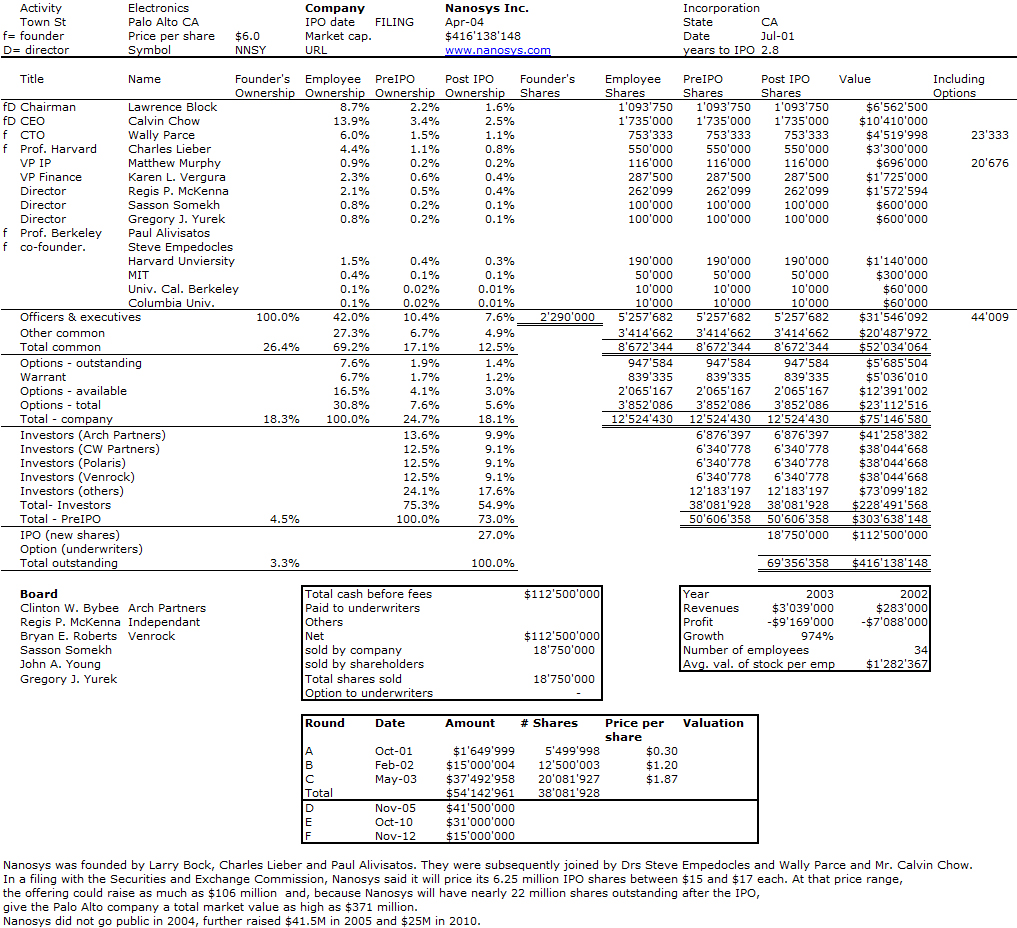
Following a few case studies I posted earlier this year (Kelkoo, Skype, mysql), here is a more generic analysis about the process of equity splitting. The document is a pdf file I have used a number of times with students, entrepreneurs and I think it is helpful even if not new. At the end, there are also cap tables of other famous and less famous start-ups.

equity.gif

From the inception where a few founders share the initial equity between them to the exit (IPO or M&A) through a possible number of financing events, shares of a start-ups will be shared, distributed among founders, employees and investors. It is one of the most important decisions in a company’s life and should be handled with care.

US and UK Biotech: Growth and Form

Thursday, October 23rd, 2008 Comment »

Another interesting illustration about the differences between America and Europe: growth in the US and UK biotech. The full account can be found in Nature Biotechnology and my friend Andre mentioned the blog Corante where he read about it.

corante.gif

The conclusion of this blogger is:

“What I found interesting about the editorial, though, wasn’t these conclusions per se – after all, as the piece goes on to say, they aren’t really a surprise [...] No, the surprise was the recommendation at the end: while the government agency that ran this study is suggesting tax changes, entrepreneur training, various investment initiatives, and so on, the Nature Biotechnology writers ask whether it might not be simpler just to send promising UK ideas to America.

Do the science in Great Britain, they say, and spin off your discovery in the US, where they know how to fund these things. You’ll benefit patients faster, for sure. They’re probably right about that, although it’s not something that the UK government is going to endorse. (After all, that means that the resulting jobs will be created in the US, too). But that illustrates something I’ve said here before, about how far ahead the VC and start-up infrastructure is here in America. There’s no other place in the world that does a better job of funding wild ideas and giving them a chance to succeed in the market.”

The Next Google?

Monday, July 28th, 2008 Comment »

There’s been plenty of activity in search in the recent years so entrepreneurs are apparently not afraid of Google. Today, a new one appeared, with a lot of Venture Capital: cuil. What is most remarkable is that the founders left Google… good luck!

cuil.jpg

Not related is the release of Ilog being acquired by IBM for $340M. Ilog was one of the European success stories. After the acquisition earlier this year of mysql by Sun, another European company is acquired by an American giant…

ilog.jpg

About the origins of innovations

Monday, July 28th, 2008 Comment »

An interesting article about the origins of innovations was recently published. It looks at the R&D 100 Awards as a way to analyze where innovations come from. There is an interesting analysis about the evolution of economy in general such as:

- Changes in the Place of Scientific Knowledge:

- the old distinction between “basic science” and “applied science” is becoming obsolete,

- a high degree of consensus that successful technological innovation now requires the assembly and management of multidisciplinary teams,

- IBM, Xerox and others may have been the locus of great innovations, but these firms sometimes failed to exploit radical innovations.

- Dramatic shifts in oligopoly capitalism due to new challenges:

- mounting competition from foreign firms,

- shifts in government regulatory policies,

- impact of computerization,

- shifts in consumer taste away from standardized products,

- shifts within the financial markets.

- The 80′s efforts to:

- increase the commercial impact of research such as the Bay Dohle Act,

- finance precompetitive R&D (SBIR),

- provide technical support to business firms,

- support consortia (SEMATECH).

As a result, there has been a shift in the origins of major innovations as illustrated below.

fortune500inno.gif

I would have thought that the shift was in favour of universities and start-ups. The study shows that interdisciplinary collaborations as well as the Federal Laboratories have become the major source of innovations. “Research efforts that involve cooperation between two or more different organizations similarly weaken this hierarchical constraint on thinking outside the box.”

The end of the article is a discussion of the reasons why Fortune 500 companies have been less effective at innovating. Factors seem to be:

- big corporations facing relentless pressures from the financial markets have been forced to cut back on expenditures that do not immediately strengthen the bottom line,

- the rise of computers and the Internet, have made it much easier for small firms to enter markets previously dominated by large firms,

- a change in the employment preferences of scientists and engineers… “it seems quite possible that many talented scientists and engineers have voted with their feet and have left work in corporate labs in favor of work at government labs, university labs, or smaller firms,”

And the authors are quite convinced the USA has returned to “Edison’s model, i.e. successful research organizations, public or private, developing a highly productive mix of internal and external projects.”

As a conclusion, “In the United States, there is no central plan for innovation, and different federal agencies engage in support for new technologies often in direct competition with other agencies. The federal government has created a decentralized network of publicly funded laboratories where technologists will have incentives to work with private firms and find ways to turn their discoveries into commercial products.” There is thus a combination of decentralized networks and targeted federal programs, similar to the venture capital model where many ideas will fail but a small number will succeed. “The enormous gains from the small percentage of winners are more than enough to cover the losses from the others.”

Founders at Work

Monday, June 2nd, 2008 1 Comment »

Another great book, so great I decide to write this post even if I have not finished reading it: Jessica Livingston in Founders at Work has interviewed 32 entrepreneurs about their story. The lessons are convincing, fascinating. Without asking for copyright, I copy here some quotes. The book is just a pleasure to read even if sometimes the Q&A are too specific about the start-up, but I assume it is part of the exercise. A Must-Read.

foundersatwork.jpg

Paul Buchheit, creator of Gmail about Risk Taking

As I say, for people, it depends on their situation if they can take that risk of joining a startup or moving to a new city if they don’t live in the right place. For me, I was actually single at the time, I didn’t have a mortgage, so the idea of joining a little startup that may well be destroyed was just like, “That will be fun.” Because I kind of thought, “Even if Google doesn’t make it, it will be educational and I’ll learn something.” Honestly, I was pretty sure AltaVista was going to destroy Google.

Mike Ramsay, founder of Tivo about Silicon Valley

I was curious to see what’s the attitude of a typical startup in Scotland compared to here. I found that they are just culturally a whole lot more conservative and cautious. And somewhat lacking in self-confidence. You come over here and . . . I had a meeting recently with a couple of early 20-year-olds who have decided to drop out of Stanford because they got bored, and they are trying to raise money to fund their startup. They believe they can do it, and nothing’s going to hold them back. They have confidence, they have that spirit, which I think is great and is probably unique to this part of the world. Being part of that for so long, for me, has been very invigorating.

Joshua Schachter, founder of del.icio.us about implementing

But the guy who says, “I have a great idea and I’m looking for other people to implement it,” I’m wary of—frequently because I think the process of idea-making relies on executing and failing or succeeding at the ideas, so that you can actually become better at coming up with ideas.

and about VCs

In general, I found VCs to be significantly politer than the folks I worked with. The worst they did was not call me back. I’d never hear from them again. Brad Feld does a nice blog talking about how the VC process works. He says they never call you back to say no—they don’t want to close the door in case they want to open it again, but they don’t want to actually give you a response. Very few VCs actually said, “Sorry, we’re not interested.”

Craig Newmark, founder of craiglist on the definition of start-up

“in the conventional sense, we were never a startup. In the conventional sense, a startup is a company, maybe with great ideas, that becomes a serious corporation. It usually takes serious investment, has a strategy, and they want to make a lot of money.”

Cap. Table: Kelkoo

Tuesday, May 6th, 2008 Comment »

Kelkoo is a great case study. It was one, not to say the, success story of the Internet in France and even in Europe. It was acquired by Yahoo for €475M in 2004. It was extremely ambitious from its foundation and had an amazing pan-European strategy thanks to acquisitions in Spain, the UK and Scandinavia: DondeCom, Shopgenie and ZoomIT. Kelkoo raised more than €45M in less than 12 months! Therefore the founders faced a huge dilution linked to three rounds of financings and these three mergers & acquisitions (“M&As”).

The capitalization table and the figures below show the evolution of the numbers. I am aware that these data are dry, tough to read, but if the reader accepts to follow me, he or she may find them of interest. Let us begin by the last table which describes the financing rounds. In 1999, Kelkoo was founded by five individuals (Chappaz, Lopez, Amouroux, Odin and Mercier) and immediately financed by two venture capitalists (“VCs”): Banexi and Innovacom. The two funds provided €1.5M in December 1999 (A round) and then a little more than €4M in March 2000 (B round). There is an important detail to notice: there was a 1 to 50 stock split between the two rounds; it explains the huge difference in the numbers as well as the fact that the price per share of €24.67 of the A round is equivalent to €0.50 after the split. The price per share of the B round was €1.45. The five founders had shared their stock as 1/3 to Chappaz, 1/3 to Lopez and the remaining between the three others. However options were granted to Chappaz and Mercier at B round to give a new founders’ balance. The pies below give therefore different ratios. Dominique Vidal is not a founder but was working with Banexi when Kelkoo was founded. He joined the founders to become a managing director and received initially 338’000 shares. He received more shares with time but the final number is not known (so I make an assumption in his case). Finally a stock-option plan was created to incentivize employees. Those had virtually 19% of the company at round B. We were only in March 2000 and the data are already complex. The capitalization table can be read on the right part with number of shares or on the left part as percent of the company.

(Click on pictures to enlarge or download)

kelkoo.gif

The situation is even more complex with the acquisitions. First DondeCom (Spain) and ShopGenie (UK) in June 2000. Kelkoo kept about 50% of the shares and the new entrants the other 50%. Also in June 2000, Kelkoo raised its C round of €30M. In September another €6M were raised with the same terms. Initially the price per share was €1.99. But there was a major condition: Kelkko had to provide an exit, a liquidity event to the investors in 2001 or the price per share would decrease to €1.70. There was no IPO or M&A for Kelkoo, i.e. no exit, so that the investors received free shares to reduce the price per share. This implies a valuation of €96M for the C round and the investors of that round owned 37% of Kelkoo. Then came the ZoomIT acquisition, which gave a little less then 30% to the new comers.

Yahoo bought Kelkoo for €475M meaning a price per share of €5.7 if the reader accepts that the total number of shares is correct. The last column therefore gives the value of their shares for all stockholders (but it does not indicate it much these cost; this cost would have to be deducted to know the profit before tax). I can not be too far from real numbers but as I said with my previous examples (Skype, mysql) these numbers are never sure at 100%. The capital increases are however well described in documents from the register of commerce that I bought for this study. The exact number of exercised shares is however unsure. These documents were my only source of information for this study. The history of Kelkoo is also written in the book “Ils ont réussi leur start-up” at Village Mondial (Pearson France). Pierre Chappaz is today the CEO of Wikio and is also the author of an excellent blog, Kelblog. Finally, Pierre made a great presentation of his stroy at EPFL in 2005.

Source: www.euridile.fr

(Click on pictures to enlarge or download)

kelkoo-share.gif

Stanford and Start-Up

Tuesday, April 29th, 2008 Comment »

soe1.gif

Is there anything nicer than being interviewed by your Alma Mater. The Stanford School of Engineering asked me why I wrote “Start-Up” and for whom. You will find it on the Stanford SOE web site. I tried to explain that the book is not (only) about the innovation infrastructure which failed in Europe but (mostly) about the need to encourage young individuals in taking more risks. A debate about nature and culture which I develop at length in the book.

Cap. table: Skype

Thursday, April 17th, 2008 3 Comments »

Following the mysql case, here is the Skype capitalization. Skype was founded in November 2003 and acquired by eBay in September 2005 for about $2.6B. The deal was complex as it had a cash component as well as an equity one and because there was an upside potential, up to $4B. The SEC document said “Skype shareholders were offered the choice between several consideration options for their shares. Shareholders representing approximately 40% of the Skype shares chose to receive a single payment in cash and eBay stock at the close of the transaction. Shareholders representing the remaining 60% of the Skype shares chose to receive a reduced up-front payment in cash and eBay stock at the close plus potential future earn-out payments which are based on performance-based goals for active users, gross profit and revenue.” In October 2007, eBay announced the final earn-out to be $530M. I consider here the acquisition was $2.6B.

The two founders, Janus Friis (Danish) and Niklas Zennström (Swede) were the previous founders of Kazaa and had created a holding company, Maitland Holdings, which would own their founder’s shares in Skype. It is not clear if other people had shares in Maitland and I made the assumption that the team of Estonian early developers (Toivo Annus, Jaan Tallinn, Pritt Kasesalu and Ahti Heinla) had such shares but it is possible they had options only. Because the sharing is unknown, I plainly assume that the two founders had about 40% each and the Estonians shared equally the remaining 20%. This is not fully consistent with SEC documents where the Estonians seem to have 5.6% of the eBay shares at acquisition. But I could not find hard facts. However the number of common shares, stock options and preferred A and B shares comes from Legilux, the Luxembourg register of commerce and is therefore correct (see sources below).

Skype had two main rounds and also a seed round before the creation of the company (a convertible loan). The Legilux documents help is assuming that Skype raised €600k of seed money in 2002-2003 with Bill Draper and other angels, its first round of €1.5M in Nov. 2003 (led by Mangrove and Bessemer) and a €14.5M B round in March 2004 (led by DFJ and Index Ventures). The number of shares and the amounts in each round imply in each case a specific price per share.

Skype seemed to have a strong board with its investors, Tim Draper (DFJ), Danny Rimer (Index) and Mike Volpi (Cisco). Volpi later became CEO of Joost, Friis and Zennström’s new venture. Skype had about 200 employees at acquisition; its revenues were $7M in 2004 and expected to be $60M in 2005.

Click on pictures to enlarge or download

skype.gif

skype-share.gif

Sources: SEC, Legilux, Kazaa and Skype, Eestit Ekspress

Next posts: Kelkoo, Addex.


Nurturing Science-based Ventures

Monday, April 14th, 2008 Comment »

Nurturing Science-based Ventures – An International Case Perspective by Seifert, Ralf W., Leleux, Benoît F., Tucci, Christopher L.

nsbv.jpg

A new book about start-ups has recently been published and it is mainly centered on Swiss (including EPFL) ventures. The authors do indeed have a strong knowledge of this environment as they are faculties from IMD or EPFL. What is unique with this book is that it does not describe success stories only, but also failures or not famous firms. Indeed failures are often better lessons than successes. You do not always know why you succeed and it may be easier to understand a failure. The authors have built their book as a process and describe in detail the development of start-ups; they begin with the opportunity recognition (chapter 1), they follow with writing a business plan (chapter2), financing a start-up (chapter 3), growing a company (chapter 4) to finally harvesting value creation (chapter 5). The final chapter is dedicated to corporate entrepreneurship (“Intra-preneurship”). I have not read it yet (it is more than 700 pages!) but the numerous case studies (more than 20) look rich and detailed. It is not the first book on the subject but it might be the first one with such a focus on European start-ups.