
Category Archives: Start-up data

Nurturing Science-based Ventures

Nurturing Science-based Ventures – An International Case Perspective by Seifert, Ralf W., Leleux, Benoît F., Tucci, Christopher L.

nsbv.jpg

A new book about start-ups has recently been published and it is mainly centered on Swiss (including EPFL) ventures. The authors do indeed have a strong knowledge of this environment as they are faculties from IMD or EPFL. What is unique with this book is that it does not describe success stories only, but also failures or not famous firms. Indeed failures are often better lessons than successes. You do not always know why you succeed and it may be easier to understand a failure. The authors have built their book as a process and describe in detail the development of start-ups; they begin with the opportunity recognition (chapter 1), they follow with writing a business plan (chapter2), financing a start-up (chapter 3), growing a company (chapter 4) to finally harvesting value creation (chapter 5). The final chapter is dedicated to corporate entrepreneurship (“Intra-preneurship”). I have not read it yet (it is more than 700 pages!) but the numerous case studies (more than 20) look rich and detailed. It is not the first book on the subject but it might be the first one with such a focus on European start-ups.
Cap. table: mysql

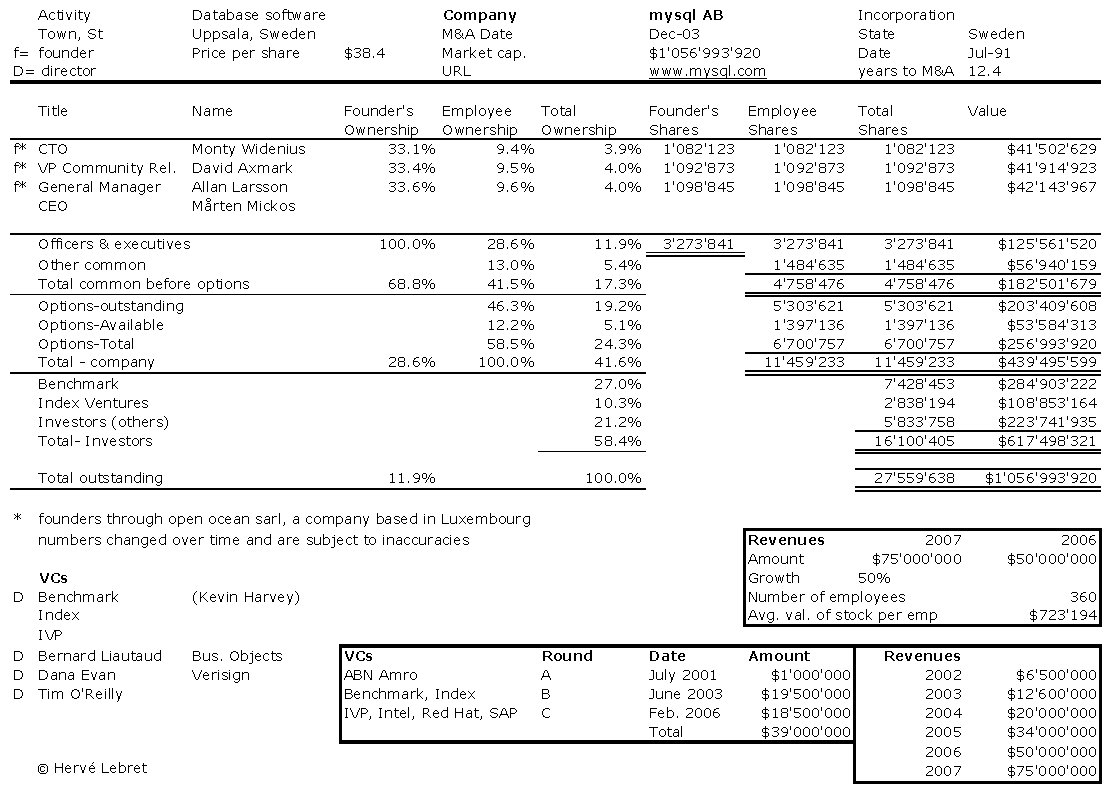
As a follow-up to my recent post on Scandinavia, I begin, with mysql, a series of posts which are close to Chapter 3 “Founders of start-ups”: it is quite interesting to analyze the capitalization table of a start-up at an exit event (IPO or M&A). Entrepreneurs and employees may learn there what to expect in terms of dilution because of investors, stock-option plan. The recent acquisition of mysql by Sun Microsystems for $1B shows that there are European success stories. Interestingly enough, mysql follows Skype, another Swedish start-up. Also of interest, let me add that founders were Swedes but not only (Danish for Skype and Finnish for mysql). Luxembourg was used as a base for the founders’ equity. The article “Focus on Sweden” recently published by the Library House in Cambridge shows the importance of Scandinavia and the Baltic countries. You, reader, may not remember, but Scandinavia had very nice success stories such as Navision, Qeyton, Altitun. The Trolltech acquisition by Nokia recently is another even if smaller example.

Let me come back to mysql. In the same way I built data about many success stories in chapter 3 and 8 of “Start-Up”, here is some data point about mysql: mysql (as a project) was formed in 1987 by three founders, two Swedes and a Finn: David Axmark, Allan Larsson and Michael “Monty” Widenius who had worked together in the 80’s. Marten Mickos, their CEO, joined the company in 2001. In 2001, mysql also raised its first round ($1M) led by ABN Amro. It then raised $19.5M in June 2003 with Benchmark and Index. In February 2006, a final round of $18.5M was led by IVP, and included Intel, Red Hat, SAP. Though an open-source company, mysql generated revenues through support, maintenance. The growth is impressive. (Disclaimer: the numbers are subject to errors as the company was private and did not communicate about its revenues. I found these numbers on the web)

Year Revenues
2002 $6’500’000
2003 $12’600’000
2004 $20’000’000
2005 $34’000’000
2006 $50’000’000
2007 $75’000’000

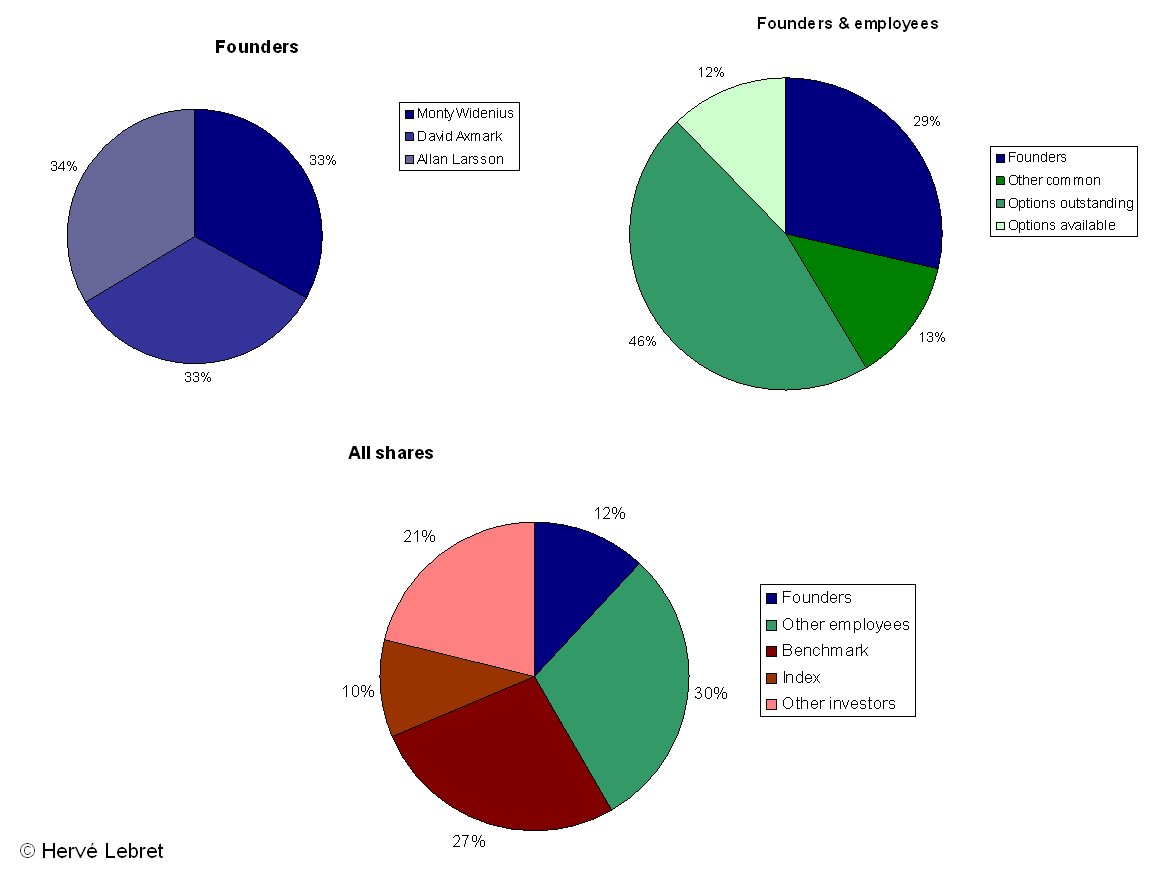
The board of the company included strong personalities such as Bernard Liautaud, founder of Business Objects and Tim O’Reilly. Finally, the capitalization table at the time of acquisition is probably not far from the one below. I had to use different (public) sources to build the table but just as with revenues, these numbers might be subject to errors.

Click on pictures to enlarge or download

mysql.gif

mysql-share.gif

Sources: Di.se Legilux

Next posts should be about Skype, Kelkoo, Addex.