All this should have remained in French only, but I felt a need to translate the French post of yesterday… In his latest and more than magnificent novel, Himintungl yfir heimsins ystu brún (“Planets above the World’s Edge”, Benedikt, Reykjavík, 2024) and in French, Corps célestes à la lisière du monde, Jón Kalman Stefánsson writes on page 190 this verse from Catullus “Pedicabo ego vos et irrumabo” hastening to add “a verse that I will not have the audacity to translate here”.
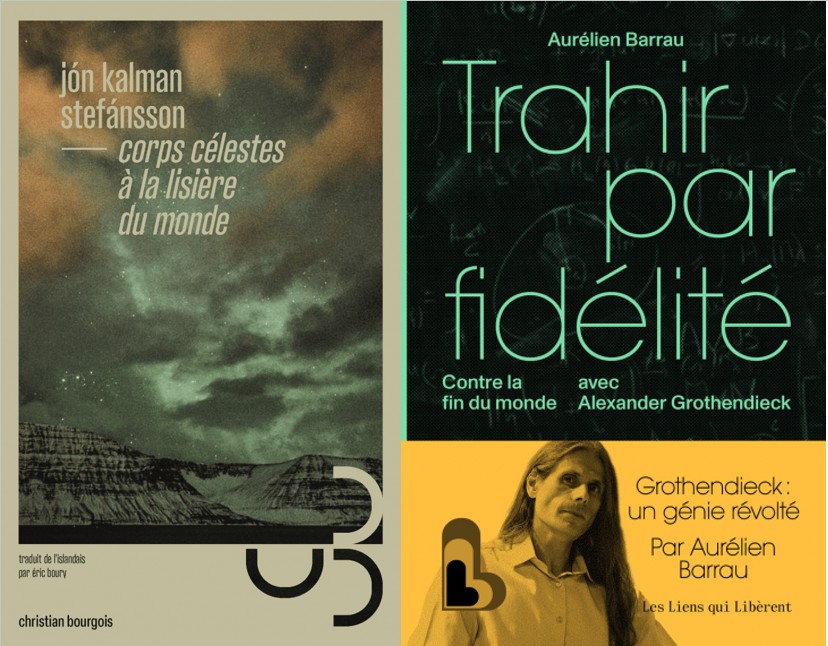
What unites here the tenth novel translated into French by my revered Icelander with the essay Betraying Through Loyalty (Trahir par fidélité), written by Aurélien Barrau and subtitled Against the End of the World with Alexander Grothendieck (more on the 20th-century mathematician here), could well be another quote translated from Icelandic by Eric Boury.
La vérité importe-t-elle plus que l’Amour ?
Voici les questions
Does truth matter more than love?
These are the questions
The two authors share this tragic preoccupation which I found again by a strange coincidence in a third reading in recent days, that of What if Stefan Zweig could speak… by Camille de Toledo (Et si Stefan Zweig pouvait parler… here in pdf) and I could have cited for the umpteenth time that of Wilhelm Reich in Listen Little Man, which you will find without too much difficulty on this blog with its search engine.
But before returning to Grothendieck (I will not write anything more about the Icelandic novel which can be read without any hesitation), I will add some visual memories of this break away from work.
It’s very difficult to give an overview of Aurélien Barrau’s excellent essay, written in such a distinctive style. I wrote (in French only) about this author last year regarding his vision of scientific research as a poetic and revolutionary act. He revisits similar themes in his analysis of Alexander Grothendieck’s choices, leading one to wonder if he wasn’t not only the greatest mathematician of the 20th century, but rather the greatest mathematician in the history of the discipline. In the introduction, page 16:
“Grothendieck is a lord in rags. A prince in tatters. Poor by choice and alone by necessity. Modest by inclination but misunderstood by obligation.
Perhaps he was a genius in spite of himself, thanks to a deep and persistent wound.
Touched by grace and faithful to beauty, whatever the cost.
Angel and poet. Saint and martyr. Revolutionary and scholar.”
Page 29: “Normal mathematicians can sometimes painfully reach the summit of a mountain, thanks to superhuman efforts from the valley floor, but Grothendieck flew from one peak to another.”
Page 19: “Grothendieck not only saw from a higher vantage point, he saw different colors, he heard different melodies, he discerned the elsewhere in the here that no one had yet been able to imagine.”
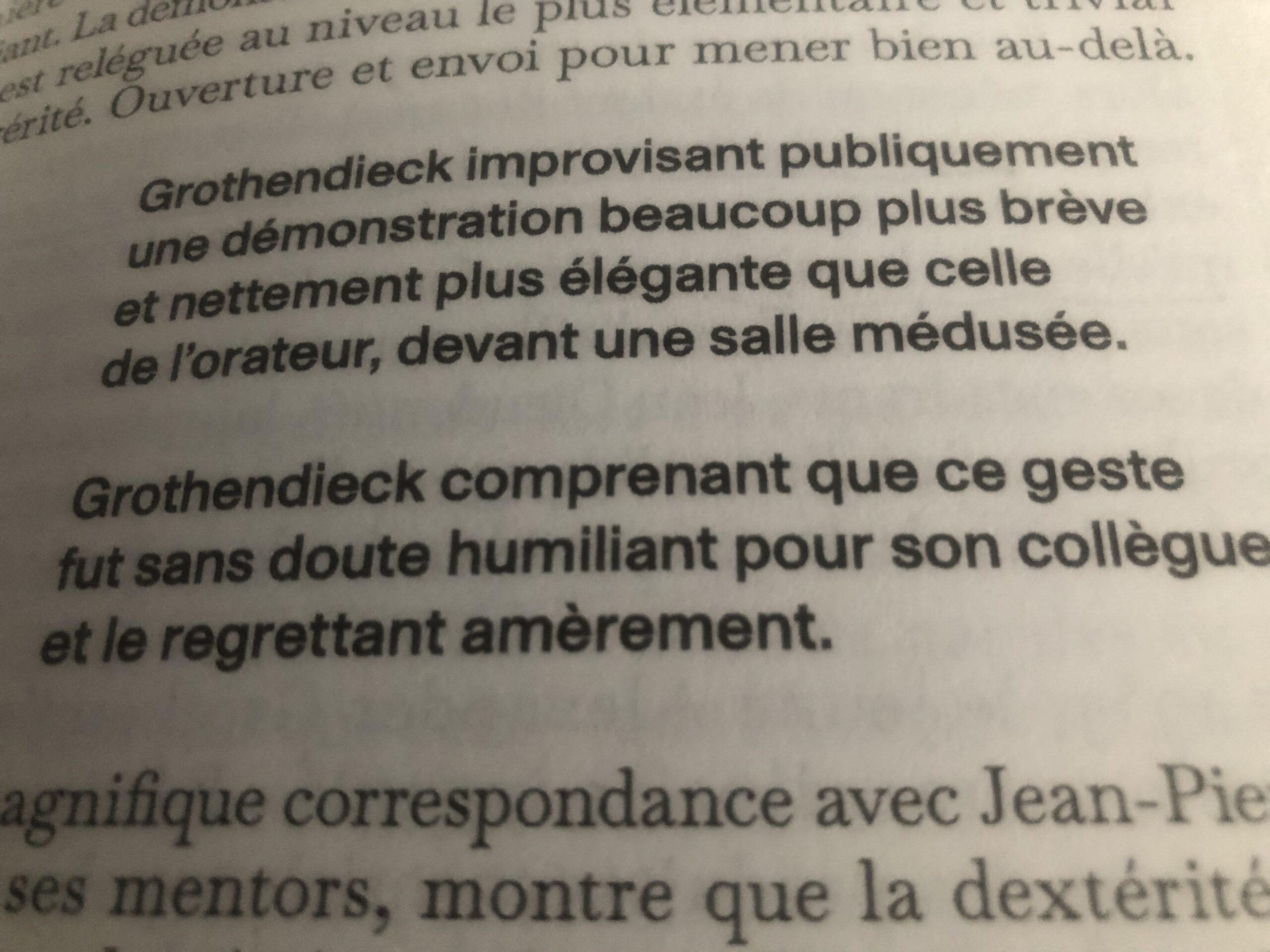
Page 27: “Grothendieck publicly improvising a demonstration much shorter and distinctly more elegant than the speaker’s, before a stunned audience. Grothendieck understood that this gesture was undoubtedly humiliating for his colleague and bitterly regretted it.”
Stefansson, Zweig and Grothendieck are brought together here in the fundamental and ultimately tragic idea that truth, beauty and love are inseparable and perhaps too often irreconcilable…
Stefansson, Zweig et Grothendieck sont réunis ici dans l’idée fondamentale et finalement tragique que vérité, beauté et amour sont indissociables et peut-être trop souvent inconciliables…
One can also delve deeper into Grothendieck’s work with the lecture “Grothendieck’s Thousand and One Mathematical Pages” by Bertrand Toen (in French):
or by listening to Alain Connes:
– on France Culture in the Scientific Conversation: What kind of man was Alexandre Grothendieck? Quel homme fut donc Alexandre Grothendieck ?
– The legacy of Alexandre Grothendieck. With Alain Connes.
Post-Scriptum of the next day : The reader who has arrived here might wonder why such recent posts about topics that have little to do with technological innovation and startups. For twenty or even thirty years, I tried to remain a technician, not to say an expert, on these subjects. But I am forced to acknowledge that this topic touches on many others, from sociology to psychology, including politics, the arts, and the sciences. I cannot escape them. This latest post is perhaps even more mysterious because of its title. It also reminds me, in a completely different vein, of Maurice Pialat’s famous remark, “If you don’t like me, I can tell you that I don’t like you either.”
Montaigne has become my guide, my compass. In these extraordinary times, there is no better source of inspiration and reflection. I would be curious to know if Jón Kalman Stefánsson counts him among his influences. Reverend Pétur, the main character in *Celestial Bodies at the Edge of the World*, is too close to Montaigne for the question not to arise quickly.
For the past few days, I have been reading one of the last Essays, De la physionomie (Book III, Essay 12). Here is the note from the edition prepared by Bernard Combeaud: “This essay revolves entirely around the problematic relationship between appearance and being. Most of the places where we can display or disguise what we value, what we think we are worth, what we think as well as what we disguise: our words, our customs, our gestures, our actions, our physionomie, our writings, but also clothing, haughtiness, ostentation, culture, or philosophy, which we flaunt at will in one’s speeches or books, in the form of quotations, will be successively invoked here. The emblem of this chapter is the figure of Socrates, with his outwardly “vile form” and his inwardly beautiful soul. But no less emblematic here are the peasants bent over after their work, who know how to die so simply, they whom philosophy has never prepared for such a moment. Or even the author’s own good looks, which saved his life on two occasions when he fell victim to trickery amidst the turmoil of the Wars of Religion. Monstrous civil wars, where injustice appears as justice, where values are overturned, for then appearances can only deceive universally. Thus, it appears that none of the artifices we rely on can guide us as surely as nature. This is somewhat like Montaigne’s philosophical testament.”
That says it all…