Monthly Archives: August 2017

Stanford and Startups

Stanford is in the top2 universities with MIT for high-tech entrepreneurship. There is not much doubt about such statement. For the last ten years, I have been studying the impact of this university which has grown in the middle of Silicon Valley. After one book and a few research papers, here is a kind of concluding work.
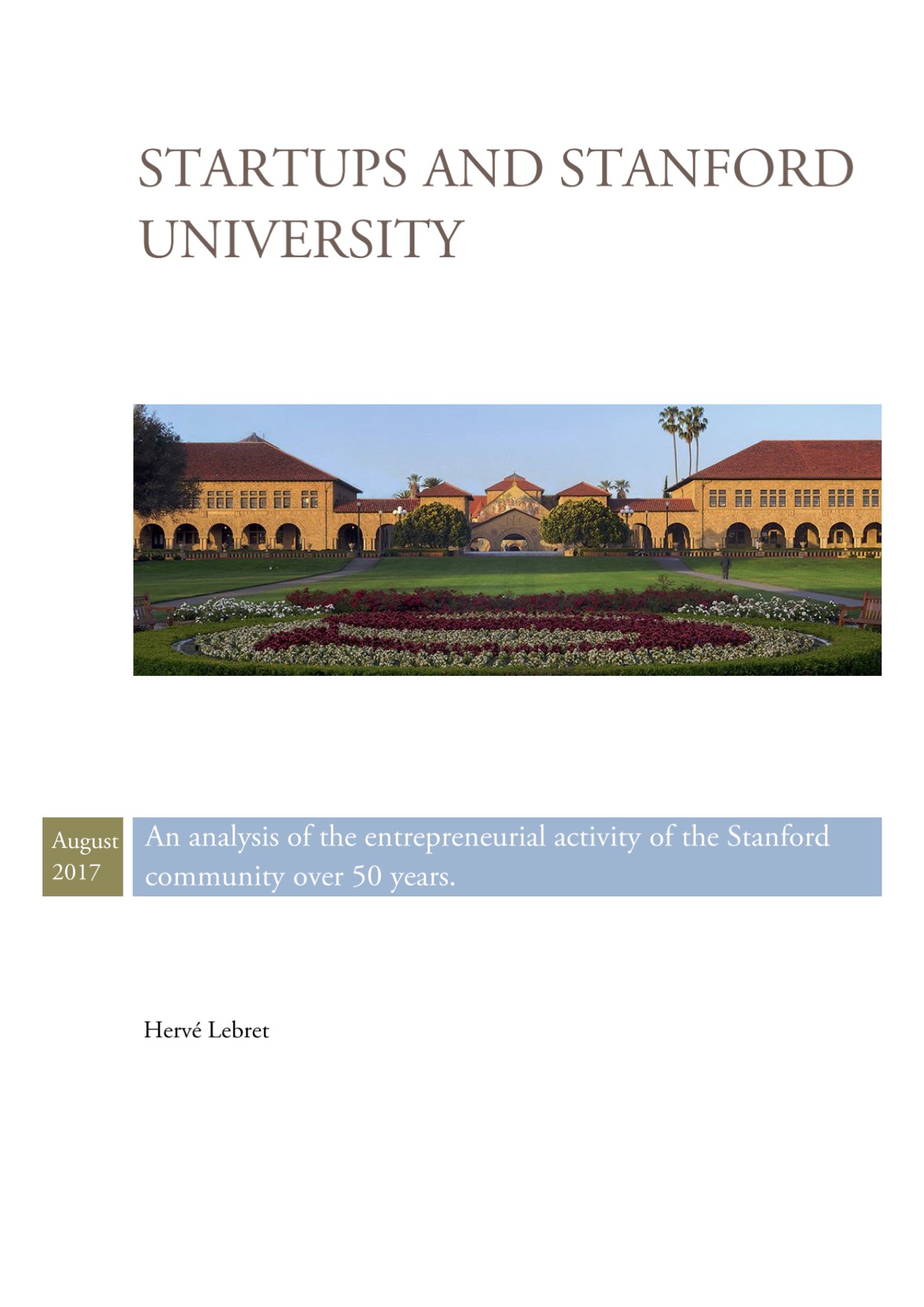
A little less than 10 years ago, I discovered the Wellspring of Innovation, a website from Stanford University listing about 6’000 companies and founders. I used that list in addition from data I had obtained from OTL, the Stanford office of technology licensing as well as some personal data I had compiled over years. The report Startups and Stanford University with subtitle “an analysis of the entrepreneurial activity of the Stanford community over 50 years”, is the result of about 10 years of research. Of course, I did not work on it every day, but it has been a patient work which helped me analyze more than 5’000 start-ups and entrepreneurs. There is nearly not storytelling but a lot of tables and figures. I deliberately decided not to draw many conclusions as each reader might prefer one piece to another. The few people I contacted before publishing it here twitted about it with different reactions. For example:

Katharine Ku, head of OTL has mentioned another report when I mentioned mine to her: Stanford’s Univenture Secret Sauce – Embracing Risk, Ambiguity and Collaboration. Another evidence of the entrepreneurial culture of that unique place! I must thank Ms Ku here again for the data I could access thanks to her!

This report is not a real conclusion. There is still a lot to study about high-tech entrepreneurship around Stanford. With this data only. And with more recent one probably too. And I will conclude here with the last sentence of the report: “How will it develop in the future is obviously impossible to predict Therefore a revisited analysis of the situation in a decade or so should be very intersting.”

Mathematics – Not Merely Good, True and Beautiful

“It’s not the marbles that matter. It’s the game.” Dutch proverb

“In mathematics, the art of proposing a question must be held of higher value than solving it.” Cantor

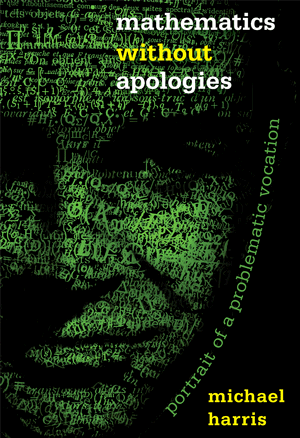
Mathematics can be made simple, even obvious; and beautiful, and even useful. Just read my previous post about Ian Stewart’s 17 Equations That Changed the World. But there are other more provocative views. You just need to read Michael Harris’ mathematics without apologies.

Harris is certainly not as easy to read as Stewart. But it is as (maybe more) enriching. His Chapter 3 for example is entitled Not Merely Good, True and Beautiful. In this world of increasing pressure to justify the usefulness of science, the author fights back. “There is now a massive literature on the pressures facing university laboratories. These books mostly ignore mathematics, where stakes are not so high and opportunities for commercial applications are scarce, especially in the pure mathematics.” [Page 55]

But even Truth seems to be at stake.“If one really thinks deeply about the possbility that the foundations of mathematics are inconsistent, this is extremely unsettling for any rational mind” [Voevodsky quoted on page 58] and a few lines before “Bombieri recalled the concerns about the consistency, reliability, and truthfulness of mathematics that surfaced during the Foundations Crisis and alluded to the ambiguous status of computer proofs and too-long proofs.”

Finally Harris mentions some confusion about Beauty quoting Villani: “The artistic aspect of our discipline is [so] evident” that we don’t see how anyone could miss it.. immediatley adding that “what generally makes a mathematician progress is the desire to produce something beautiful.” Harris then quotes an art expert advising museum-goers to “let go of [their] preconceived notions that art has to be beautiful”. [Page 63]

Harris adds that “the utility of practical applications, the guarantee of absolute certainty and the vision of mathematics as an art form – the good, the true and the beautiful, for short – have the advantage of being ready to hand with convenient associations, though we should keep in mind that what you are willing to see as good depends on your perspective, and on the other hand the true and beautiful can themselves be understood as goods.” [Pages 63-4]

The short answer to the “why” question is going to be that mathematicains engage in mathematics because it gives us pleasure. [Page 68]

Maybe more in another post…

Instead of another post, here is a short section extracted from page 76 and added on August 27:

The parallels between mathematics and art

“Here the presumed but largely unsubstantiated parallel between mathematics and the arts offers unexpected clarity. Anyone who wants to include mathematics among the arts has to accept the ambiguity that comes with that status and with the different perspectives implicit in different ways of talking about art. Six of these perspectives are particularly relevant: the changing semantic fields the word art has historically designated; the attempts by philosophers to define art, for example, by subordinating it to the (largely outdated) notion of beauty or to ground ethics in aesthetics, as in G. E. Moore’s Principia Ethica, which by way of Hardy’s Apology continues to influence mathematicians; the skeptical attitude of those, like Pierre Bourdieu, who read artistic taste as a stand-in for social distinction ; the institutions of the art world, whose representatives reflect upon themselves in Muntadas’s interviews ; the artists personal creative experience within the framework of the artistic tradition ; and the irreducible and (usually) material existence of the art works themselves.
Conveniently, each of these six approaches to art as a mathematical counterpart: the cognates of the word mathematics itself, derived form the Greek mathesis, which just means “learning”, and whose meaning has expanded and contracted repeatedly over the millennia and from one culture to another, including those that had no special affinity for the Greek root; the Mathematics of philosophers of “encyclopedist” schools; school mathematics in its role as social and vocational filter; the social institutions of mathematics with their internal complexity and heir no-less-complex interactions with other social and political institutions; the mathematicians personal creative experience within the framework of the tradition (the endless dialogue with the Giants and Supergiants of the IBM and similar rosters); and the irreducible and (usually) immaterial existence of theorems, definitions and other mathematical notions.”

Maybe more in another post…

How much do you know (and love) about mathematics?

A tribute to Maryam Mirzakhani

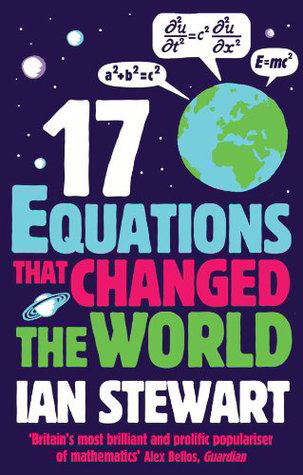
From time to time, I mention here books about science and mathematics that I read. It is the first one I read by Ian Stewart. Shame on me, I should have read him a long time ago. 17 Equations That Changed the World is a marvelous little book that describe the beauty of mathematics. A must read, I think

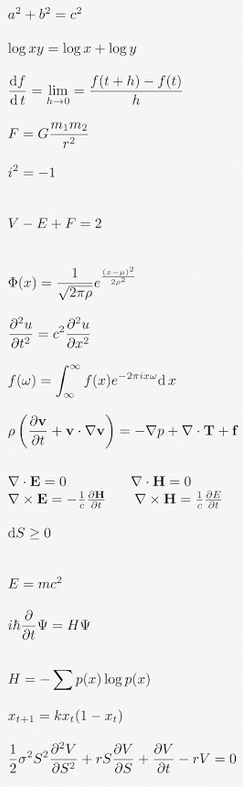
So as a little exercise, you can have a look at these 17 equations and check how much you know. What ever the result, I really advise to read his book! And if you do not, you can have a look at the answers below…

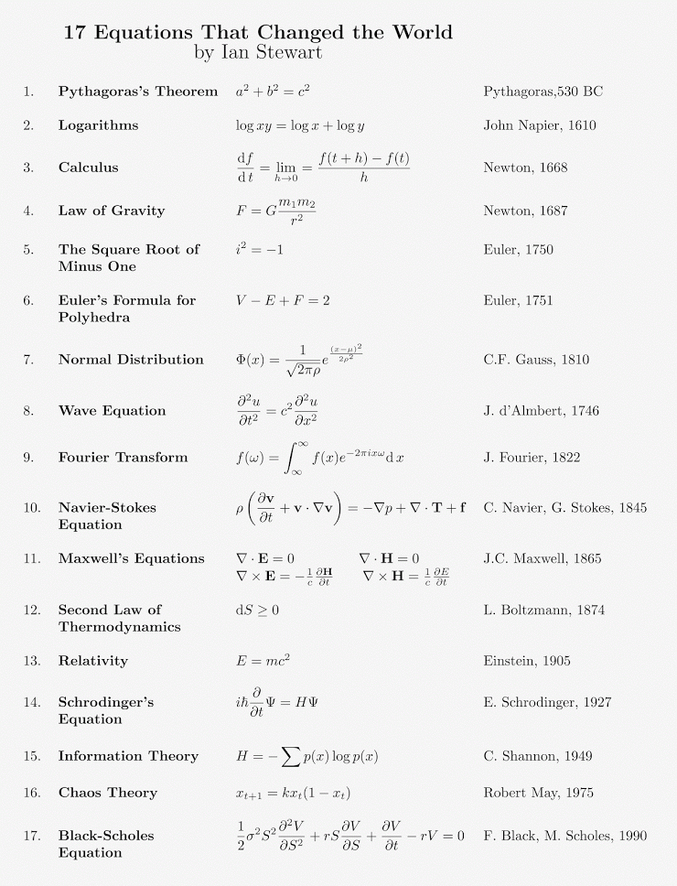
And here is more, the names of the equations and the mathematitians who who discovered them (or invented them – depending on what you think Math is about).