This is the title of a recent article by The New Yorker. The full article is here. it begins with a rather remarkable claim : “There are a handful of truly monumental collective achievements in our history: Machu Picchu, the Great Wall of China, the Pyramids of Giza, and perhaps, if we’re being generous, the Roman aqueducts. Modern global civilization has made one contribution to this eternal pantheon. It is not the moon landing. It is the semiconductor supply chain.”
What is also remarkable in the article is the illustration of a unique ecosystem. Thousands, probably hundreds of thousands of people have contributed to that industry. Initially in Silicon Valley has shown below, in the 60s, 70s and 80s. Today, it is an international ecosystem. the article describes that a design may begin in Silicon Valley at Apple or nVidia, is then produced in Taiwan at TSMC with the unique expertise of Dutch company ASML.
TSMC stands for Taiwan Semiconductor Manufacturing Company. It was founded by Morris Chang who had worked at Texas Instruments before. ASML stands for Advanced Semiconductor Materials Lithography. It was founded in 1984 in part as a spin-off of Philips. Today the industry is totally intertwined in-between the three continents with quite a few geopolitical implications and risks.
The end of the article includes “The main thing people don’t understand is that semiconductors are the most complicated things people do.” […] “Rockets are simple.” […] “It’s just so much harder. Rockets are an amazing accomplishment, yes. We don’t have a rating scale for complexity, but rockets are maybe a five or a six.” […] “Semiconductors are an eleven.” […] And yet we take it for granted that we can build them. We shouldn’t. The chief determinant of that unlikely success has been not individual genius in the lab, or individual prowess in the boardroom, but collective planning and coördination at a breathtaking scale. Globalization has become tainted in our eyes, as if it necessarily constitutes a zero-sum enterprise. And its mercenary form—which is also its most common form—has indeed inflicted harm. But the global semiconductor supply chain reflects an alternative pathway. It has united its participants in the pursuit of something profoundly difficult that could not have been achieved in the absence of intercontinental solidarity. […] Stonehenge has frequently been investigated as a technological mystery. We look at the enormous rock slabs retrieved from far-off sites by archaic peoples and can’t help but suspect that these ancients availed themselves of some precocious technology lost to history—a present from aliens, perhaps. But we know how they built it. There isn’t any mystery. They gathered as many people and animals as they could, and distributed ropes, and together they hauled those tremendous slabs a great distance. This didn’t diminish their achievement. It made it, if anything, even more sublime.
This article stroke me. I know well the semiconductor industry as it was in part built with startups, hence the name Silicon Valley. Usually, time induces erosion, fossilisation as also nicely shown in the second figure. The semiconductor shows the opposite. It is at the origin of the personal computer, the mobile phone, the Internet and for better or worse Artificial Intelligence. Sometimes a little bit of history and high-level vision helps and I thank the New Yorker often for that kind of perspectives.
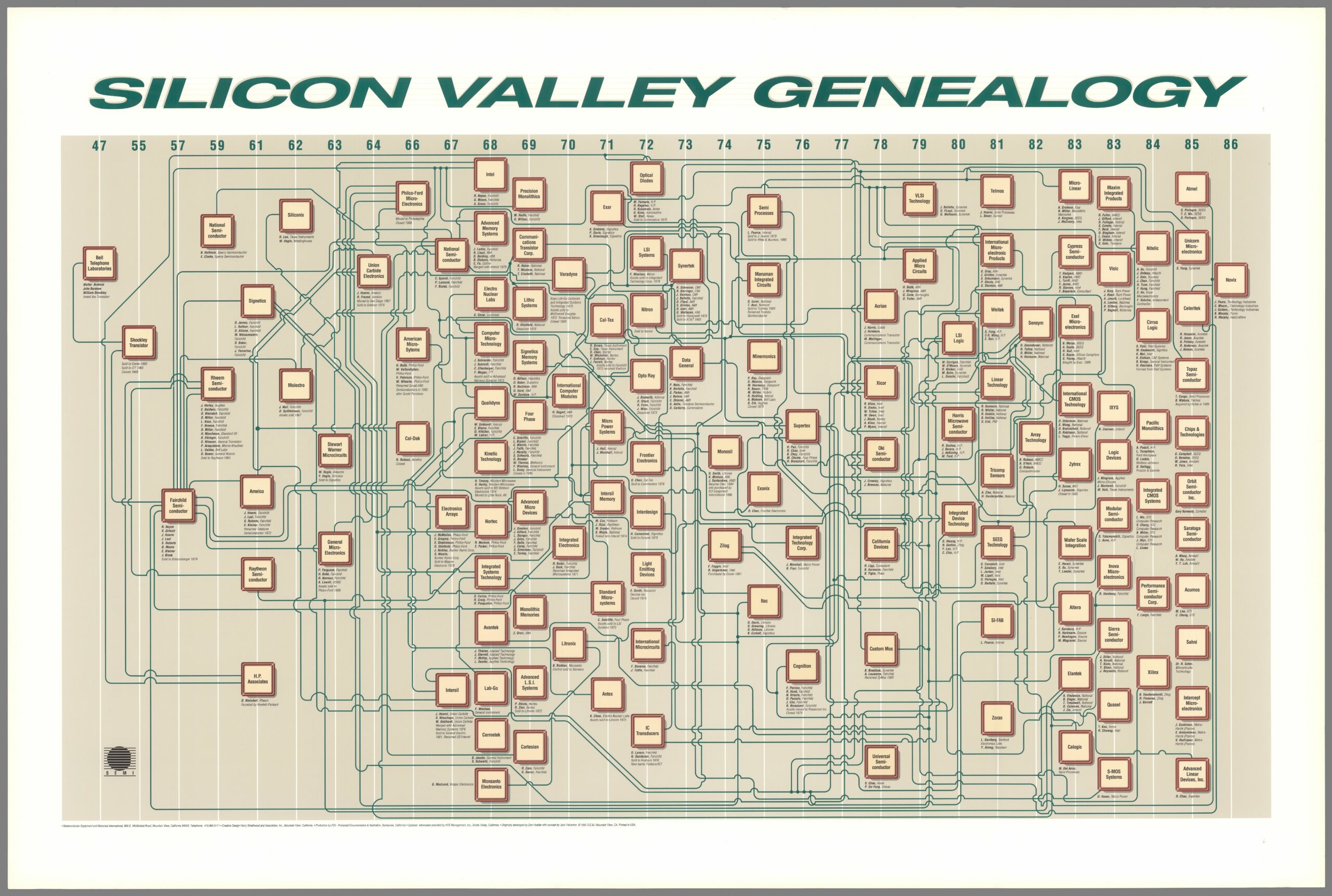
“Fig. 1: A chart for the business ecosystem as it evolved in Silicon Valley. As with so many “new” innovations they have close roots to a successful predecessor, or build right on the foundations of the previous infrastructure, and indeed the first company shown is “Bell Telephone Laboratories” in 1947. From the great intellectual pool of inventors and scientists at Bell came numerous important figures like Claude Shannon, or William Shockley, and it was Schockley that would help anchor tech in the South Bay Area. From his firm would flee the disaffected employees, the “traitorous eight”, as Shockley called them, to found “Fairchild Semiconductor”, and from there on new firms would sprout and momentum would build. This chart well documents the explosive growth throughout the 1960’s and 70’s, and the businesses of the 1980’s that still persist today (Atmel, Xilinx, etc). A great look at the hardware based underpinnings of early Silicon Valley and how it branched and changed.” (Curtis Bird, 2022)
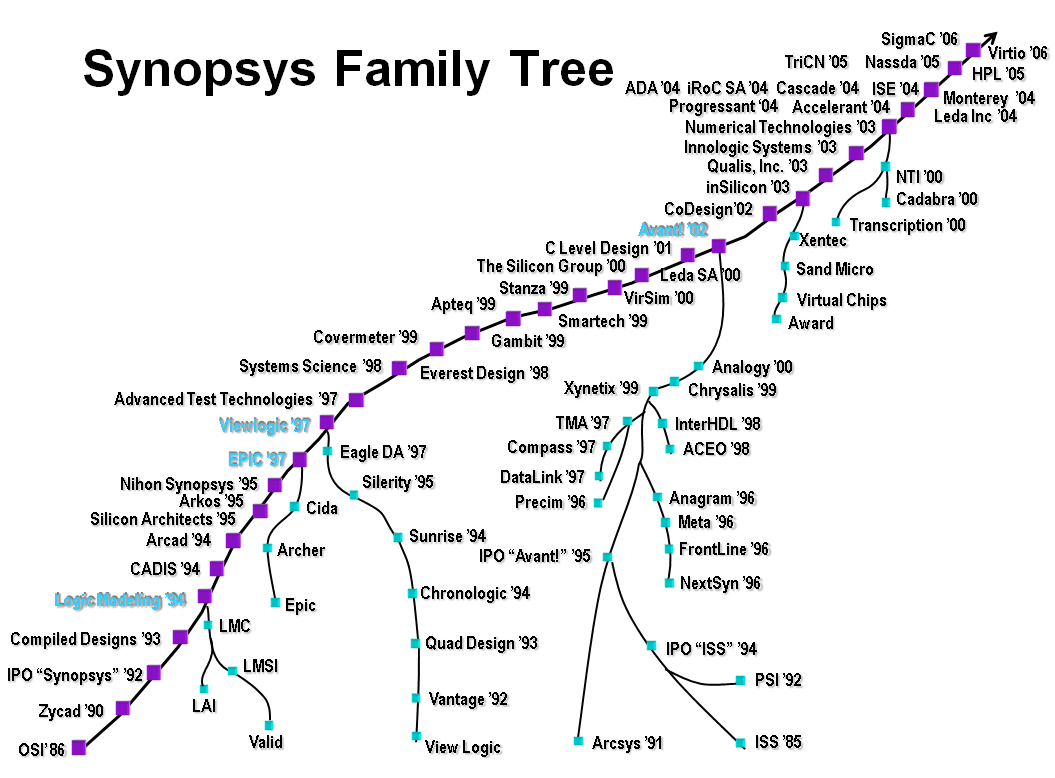
Fig. 2: This comes from a presentation by Aart de Geus, EPFL Alumni and CEO of Synopsys. More here. The adult age of innovation means processes, experienced managers so you need to survive the tornadoes that Geoffrey Moore describes so well. Aart de Geus summarizes these permanent metamorphoses through a parallel management of teams, customers, investors, products and their cycles, but also managers, leaders, implementation. All these things are interdependant and it is often underestimated. In a talk he gave to EPFL in 2007, he showed the history of Synopsys acquisitions in the form of the animal below! His sense of humour was certainly very useful. This sense of humour hides the humbleness of the individual who succeeded without giving any lesson. If there is one lesson in all this, is that you must try, be curious and flexible. Success may come.