This blog contains original articles as well as articles from the book "Start-Up", by Hervé Lebret, which exists both in English and French. It is available on Amazon as well as in electronic versions. To buy it, click here.

Posts Tagged ‘Europe’

Going public when you are not a US start-up - part 2/4: Envivio

Wednesday, June 8th, 2011 1 Comment »

Envivio follows my recent post on another start-up with European roots, Transmode. Envivio has similarities and differences. Both have roots in the Telecom industry, Transmode with Ericsson and Envivio with France Telecom. Both were founded in 2000, 11 years before the IPO or filing.

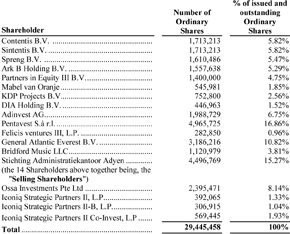
Both had complex financing rounds, including “down rounds”. You can see that in the Transmode case, the price per share went from $5.5 in the B round to $1 in the C round. These down rounds are usually terrible for founding teams. And indeed, there is not much info about Transmode founders.

Envivio had raised $41M until 2008 and the price per share increased steadily to $2 per share. Difficult to give precise dates for the rounds, but the investors were a combination of corporate investors (France Telecom, Intel, Bertelsman, Philips), and financial (Global Accelerator, Crédit Lyonnais - now Crédit Agricole). Then the G round in 2008 was a down round at $1.25 and the H round, less than 2 years later, even lower at $0.34. With such events, it is not surprising to discover that the investors own 87% of the company before the IPO. Obviously, this would have been very dilutive to the founder, Julien Signes, without the possibility of granting new (stock option) shares that you discover in the right column.

There is another interesting difference with Transmode: Envivio is filing to go public in the USA, it is indeed an American start-up, and not much shows its French roots (the R&D is based in Rennes, Britanny though). Even if Julien Signes studied and worked in France initially, he worked also for France Telecom in San Francisco and I would be curious to know if this had an impact in his entrepreneurial path. I asked him and am waiting for an answer, but it is possible that Envivio is not allowed to communicate in the pre-IPO period.

It is one my thesis that Europeans who had a US experience have digested better the start-up dynamics (whether they moved to the USA and became entrepreneurs there - De Geus, Bechtolsheim, Brin - or they became entrepreneurs in Europe but had lived in the USA - Liautaud, Borel, Haren). This does not prevent European high-tech start-ups to exist and succeed, but I have to admit, the numbers are not exactly the same.

Again, because the company is not public yet, I had to guess what the price per share might be at IPO. I have put a small price, using multiples of market cap. to revenues of 7x. I will make an update when I know more…

Next: Alibaba

NB: an explanation from the filing on the issuance of incentive shares: “In September 2008, we sold 1,532,372 shares of Series G1 convertible preferred stock and 13,359,323 shares of Series G2 convertible preferred stock for $1.25 per share and received total consideration of an aggregate of $15.9 million. Also in September 2008, we converted the outstanding principal balance of our outstanding convertible promissory notes in the amount of approximately $8.9 million plus accrued interest in the amount of approximately $0.2 million into 467,628 shares of Series G1 convertible preferred stock and 6,829,154 shares of Series G2 convertible preferred stock simultaneously with our Series G financing. In June 2010, we sold 895,502 shares of Series H1 convertible preferred stock, 18,487,298 shares of Series H2 convertible preferred stock, 7,775,801 shares of incentive Series 1 common stock and 87,170,915 shares of incentive Series 2 common stock for $0.3351 per unit and received total consideration of approximately $6.5 million. In connection with this Series H financing, all outstanding shares of Series B, C, D, E and F convertible preferred stock converted into shares of common stock. Also in June 2010, we converted the outstanding principal balance of our outstanding convertible promissory notes in the amount of $1.0 million plus accrued interest in the amount of approximately $4,800 into 2,998,571 shares of Series H2 convertible preferred stock simultaneously with our Series H financing. The number of Incentive Shares to be issued was based on the series of the outstanding convertible preferred stock held by each Series H participant as follows: at a rate of 107.430618 shares of common for each share of the Series B, 77.588779 shares of common for each share of Series C, 1.492092 shares of common for each share of Series D, 1.865115 shares of common for each share of Series E, and 3.073709 shares of common for each share of Series F. As a result, the Company issued 94,946,716 Incentive Shares with the shares of Series H convertible preferred stock issued during the Series H financing.”

Going public when you are not a US start-up - part 1/4: Transmode

Tuesday, June 7th, 2011 Comment »

I was studying recent IPO filings and discovered (more by accident than on purpose), that some of these companies were not US-based. I wanted first to know more about Chinese success stories, Baidu and Alibaba, and at the same time heard of Envivio’s filing and Transmode IPO. Envivio has roots in France (just as Sequans which I also studied a few weeks ago) and Transmode is based in Sweden.

I remember visiting Transmode during my days with Index. Transmode was and is a start-up in the Telecom sector, providing solutions for fiber-based local networks. The company just went public on the Stockholm stock exchange, 11 years after its IPO. The prospectus was in Swedish so that the data should be handled with care! An interesting element of information, if we agree high-tech is a global business.

The cap. table that you just discovered shows the history of the company has probably not been simple. Transmode has raised $45M since 2002 but this is the “new” Transmode, which is the outcome of the merger of Lumentis, another Swedish start-up with the old Transmode. At the time of merger the combined entities had raised $61M. There is money available in Europe, no doubt. They were 7 founders in each firm, but none appears in the Transmode IPO filing.

Investors owned 76% of the start-up before the IPO, 56% after the sale of 25% of the company to the public. With about 700M Swedish Kronas in revenues (about $100M), the company is valued 2x its annual revenues. Nice but not great. Still a sign that high-tech is viewed more favorably than during the last decade.

Next: Envivio.

Europeans and Silicon Valley

Tuesday, April 19th, 2011 1 Comment »

Silicon Valley is well known for its immigrants, particularly those from Asia (India, China, Taiwan, Korea, etc). AnnaLee Saxenian is famous for her books on the topic. The European migrants are lesser known and I think it is a little unfair. Let me first illustrate it with famous examples and then with statistical data.

I have been using this picture for some years now to show that Europe also counts famous Silicon Valley migrants that should be used better as role models. Do you know them? Take a little time to check how many you know and then have a look at the answer.

First row

On the top left, here are the famous Traitorous Eight, the founders of Fairchild in 1957 who can be considered as the fathers of Silicon Valley. Jean Hoerni was from Switzerland, Eugene Kleiner from Austria, and Victor Grinich’s parents from Croatia (he was born Grgunirovich). You may want to know more at http://www.startup-book.com/2011/03/02/the-fathers-of-silicon-valley-the-traitorous-eight.

On the right is Pierre Lamond, founder of National Semiconductor and then a partner with Sequoia Capital. As you may imagine, he is a specialist of semiconductors. More at http://en.wikipedia.org/wiki/Pierre_Lamond.

Then comes Andy Bechtolsheim, from Germany. A founder of Sun Microsystems and a business angel in Google (there is the legend he wrote a $100k to Google whereas the company did not exist yet ; a good investment, worth more than $1B a few years later !). http://en.wikipedia.org/wiki/Andy_Bechtolsheim

Finally on the top row is Michael Moritz, from Wales. He was a journalist with Time Magazine when Don Valentine hired him at Sequoia. A good choice, just for two investments he made, Yahoo and Google… http://en.wikipedia.org/wiki/Michael_Moritz

Second row

Philippe Kahn is probably less famous except in France where he was an icon in the 80’s. He left his motherland when he understood his work would not be appreciated and flew as a tourist in 1982 to the USA. A few months later, he founded Borland. http://en.wikipedia.org/wiki/Philippe_Kahn

The Dutchman is Aart de Geus. He did his undergrad at EPFL where I work and his PhD in the USA. He is the founder and current CEO of Synopsys, the leader in Electronic Design Automation (6’700 employees, $1.4B in revenue). http://www.startup-book.com/2009/12/11/a-european-in-silicon-valley-aart-de-geus/

Andy Grove flew Hungary under the Communist regime and arrived in New York without speaking English. He can be considered as a founder of Intel and would later become its CEO. http://en.wikipedia.org/wiki/Andrew_Grove

Third row

Pierre Omidyar, half French, his family has Iranian roots but he was born in Paris, moved to the USA when he was 6… founder of eBay. http://en.wikipedia.org/wiki/Pierre_Omidyar

Serguei Brin, founder of Google, born in Moscow, also moved in the USA when he was 6. http://en.wikipedia.org/wiki/Sergey_Brin

Edouard Bugnion, from Switzerland, is a founder of VMware. More on http://www.startup-book.com/2010/03/16/a-swiss-in-silicon-valley/

The last examples have more of a Europe-USA-Europe background:

The three founders of Logitech are Daniel Borel, Pierluigi Zappacosta and Giacomo Marini. “The idea for Logitech was spawned in 1976 at Stanford University, in Palo Alto, Calif. While enrolled in a graduate program in computer science at Stanford, Daniel Borel and Pierluigi Zappacosta formed a friendship that would become a business alliance. While completing their education, Borel, a Swiss, and Zappacosta, an Italian, identified an opportunity to develop an early word-processing system (therefore the name which means Software Technology in French). The pair spent four years securing funding and eventually built a prototype for the Swiss company Bobst.” The rest is history.
http://en.wikipedia.org/wiki/Daniel_Borel
http://en.wikipedia.org/wiki/Pierluigi_Zappacosta
http://en.wikipedia.org/wiki/Giacomo_Marini

Some similarities with the next story: Bernard Liautaud studied at Stanford before working for Oracle in Europe. A founder of Business Objects with Denis Payre who moved very early in the USA as he had understood that IT = USA. http://en.wikipedia.org/wiki/Bernard_Liautaud

Pierre Haren, founder of Ilog, got his PhD at MIT. No Silicon Valley here but Pierre told me once the importance of the American culture in his entrepreneurial venture. http://en.wikipedia.org/wiki/ILOG

I finish with Loic Lemeur, a friend of Sarkozy, who has left France to launch Seesmic in SV. One of the latest European migrants who show that the flow never stops. http://www.startup-book.com/2010/06/21/why-silicon-valley-kicks-europes-butt

:-) or :-( ?

Now the stats. One could always argue that those were only a few examples / exceptions. The table which follows is in my book but comes indirectly from a study by AnnaLee Saxenian. She and her co-authors analyzed where were SV foreign entrepreneurs coming from.I do not think they had compiled Europe as a group which I did from her data. The result is quite impressive because Europe is very similar to China or India. I am not sure this is that well known…

Source: AnnaLee Saxenian et al. “America’s New Immigrant Entrepreneurs” Duke University and UC Berkeley, January 2007.

A Swiss (European) way for entrepreneurship?

Friday, October 8th, 2010 1 Comment »

With my seventh contribution to the Créateurs newsletter, I stay in Switzerland again with two succesful SMEs. Enjoy!


There is a recurrent debate in the world of high-tech start-ups: and if the American model of fast growth supported by aggressive venture capital was not adapted for European or Swiss entrepreneurs? Two examples may contribute to the discussion: Sensirion and Mimotec.

In my contribution to Créateurs last time, I had focused on Swissquote, which has become a magnificent success story, without that venture capital, which is so much criticized these days. Mimotec is an EPFL spin-off with 24 employees and about CHF10M in revenues. The company provides micro technologies for the watch industry. Mimotec was founded in 1998 by Hubert Lorenz who told his start-up’s story during a recent venture ideas conference at EPFL. It is a clear example of organic growth, a steady growth even if not exponential.

Sensirion is probably more impressive. Founded also in 2008, it is an ETHZ spin-off and it sells pressure sensors, another field of expertise in Switzerland. In an article published for the MEMS 2008 conference, Felix Mayer, Sensirion’s co-founder and CEO, described the growth model of his company. Here is an extract: “The Europeans - especially the Swiss - do not go for the big thing! They rather start small and put one foot in front of the other. A characteristic of the European and Swiss mentality is not to promise high returns for a business idea based on an immature new technology. The European way is rather to start with the own money, to try to find customers, and to grow with the earnings. The Americans, as far as I can tell, follow the motto: “Shoot for the moon. Even if you miss, you will land among the stars”. This means: to go for the new big thing, write down a promising business plan, and raise money to realize it. Hunting for potentially high gains means, on the other hand, to take a higher risk. The United States have more of a high risk culture. However, if you fail, you also get a second chance. Europe is different in this respect”.

Mayer adds that because the financial means are lacking, the European entrepreneur will be more challenged to target the very big markets. Therefore he believes in an intermediate path which will not generate Google-like companies, but leaders in their niche. Thanks to the patient support from a business angel and then from its customers, Sensirion can be proud in 2010 of its 180 employees (the revenue numbers are not public as the start-ups is still privately held). I should however add that it took Sensirion six years before ti could fund its growth through its profits; its business angel was apparently critical to its success.

Is there a model that Europe may follow without just copying the Silicon Valley way? Yes, if we notice that very few companies could reach the size of Logitech or Actelion for example. Whatever the success of an Hubert Lorenz or a Felix Mayer, I cannot help expressing again the same thing I did in my book Start-Up. Why should not Europe ambition the same large success the USA experience in addition to our mid-size stories. Don’t you think the Americans do not have companies similar to Mimotec and Sensirion, in addition to Google or Apple? Criticizing venture capital might be an easy way and I prefer quoting an American entrepreneur on investors: “You can’t live with them, you can’t live without them” And let us not forget that Google has today about 20’000 employees and it was founded in… 1998. There is no doubt that our culture and financial support is not made to produce our own Google but I seriously believe that we should not be afraid of having large ambitions instead of criticizing an American model which also has great assets.

Give back to the community

Tuesday, June 29th, 2010 1 Comment »

My sixth article in the newsletter Créateurs about high-tech success stories: Swissquote. I am leaving Silicon Valley after purely American stories with Adobe & Genentech, then followed by Europeans in SV (Synopsys, VMware) to talk about a pure Swiss success!

Mark Bürki and Paulo Buzzi are the two founders of one of the nicest Swiss (not to say European) success stories: Swissquote. No link to Silicon Valley, no venture capital, an exception to what I am used to promote. “Just a” local online bank launched in 1997 as a spin-off of a software service company, Marvel, which was founded in 1990. Bürki and Buzzi did not launch their start-up in a Garage like HP, Apple or Google; worse, it was in a cellar! The beginnings were not easy, salaries were not always guaranteed…

The USA played a role however. At a conference in Boston, the two founders discovered a new promising platform: the Internet. Sitting at a tiny booth, the founder of an unknown start-up, Amazon. Later, a contract with the IOC, the International Olympic Commitee, for the design of their web site, gave the much needed cash to Marvel. Marvel had also specialized in financial applications and Bürki could see the potential of the Internet for the consumer of stock and financial news.

With a Zurich-based bank as a financial partner, Marvel launched Swissquote in 1997. The beginnings were very encouraging and at that time, most investment banks were competing for the fast-growing start-ups to be quoted on stock exchanges. Swissquote went public in 2001 with less than CHF20M in sales and a huge loss. The future would not be as nice as the pre-IPO boom and the burst of the Internet bubble threatened the mere existence of the company. But Bürki and Buzzi were not part of the mass of entrepreneurs who disappeared as fast as shooting stars. Decisions were tough, many employees were fired but Swissquote survived. In 2009, its sales were about CHF100M with a net profit of CHF35M, and its market capitalization was nearly CHF600M.

In August, and then in November 2006, I had invited the two founders to share their entrepreneurial experience on the EPFL campus. They had explained the importance of a vibrating ecosystem, as they had enjoyed it in Lausanne during their studies, years before. “When we were students in computer science”, Bürki noticed, “the sixty or so students in the department belonged to about twenty different nationalities”, a diversity that can be found in the best technology clusters. Without any business training, they learnt how to manage a company with two hundred people. The two founders are convinced that you learn these things by doing. Two founders. Another important topic. Your co-founder can challenge you with the right questions that a lonely founder may not solve easily.

Bürki also mentioned the vital role of the dream by quoting, in a rather surprising manner, Che Guevara: “Be Realistic, Ask for the Impossible.” As a reminder of their beautiful years at EPFL and also as a sign of their success, Marc Bürki and Paolo Buzzi took in 2008 a typically American decision by creating an endowed chair in quantitative finance.

Europe vs. USA: growth in IT and Biotech

Monday, June 14th, 2010 Comment »

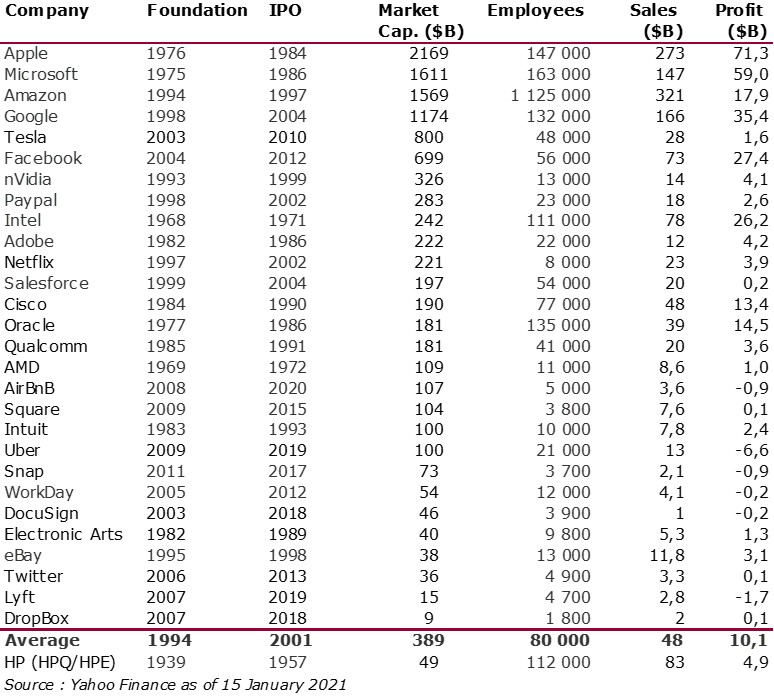
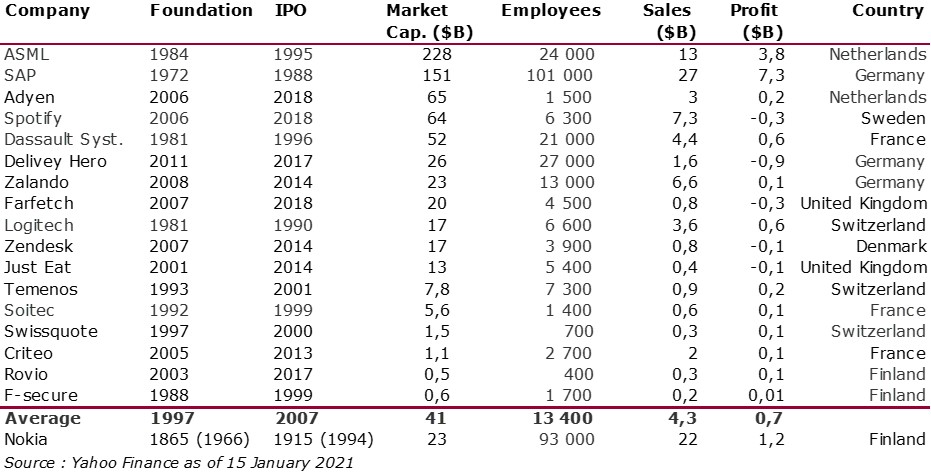
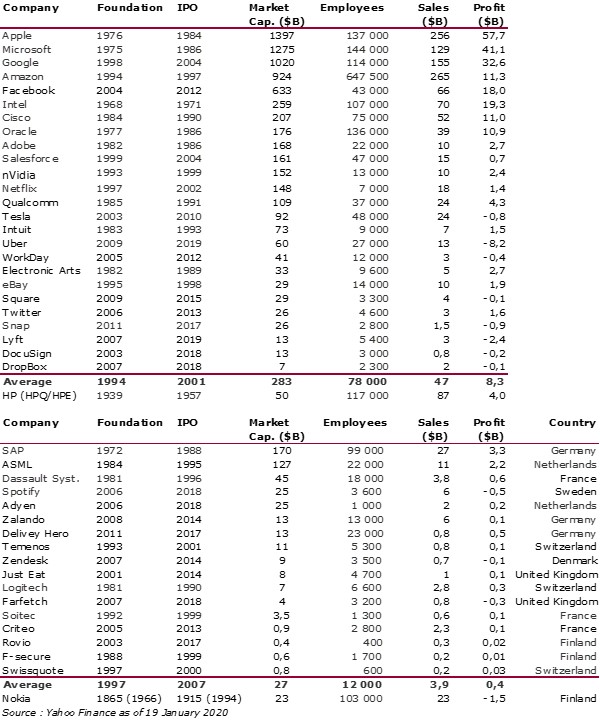
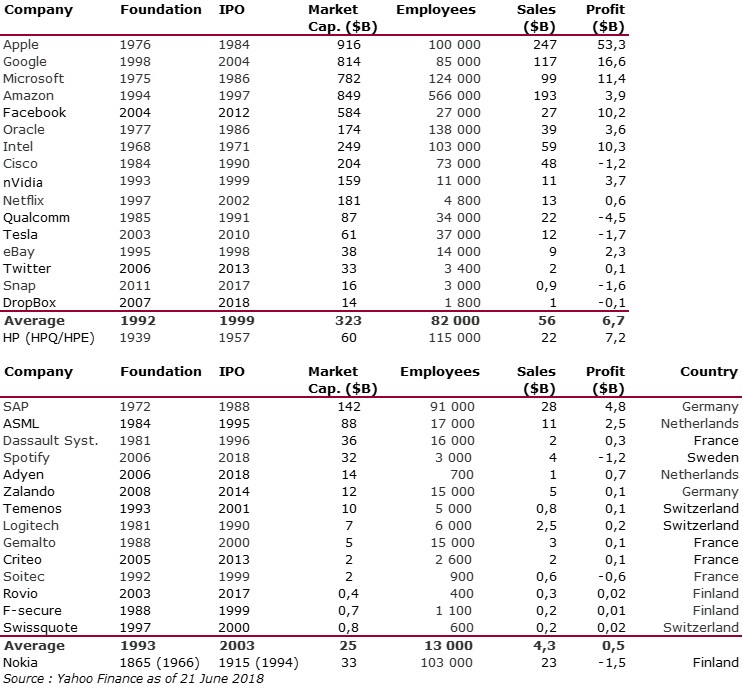
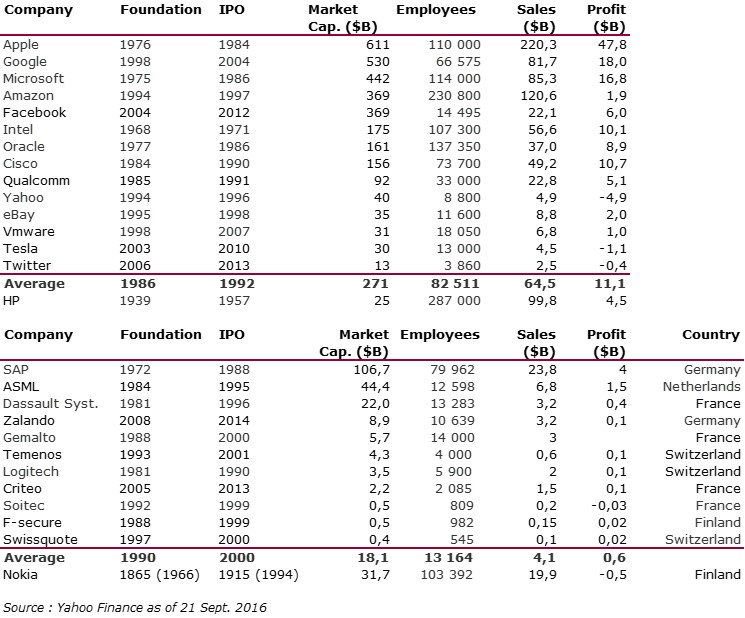
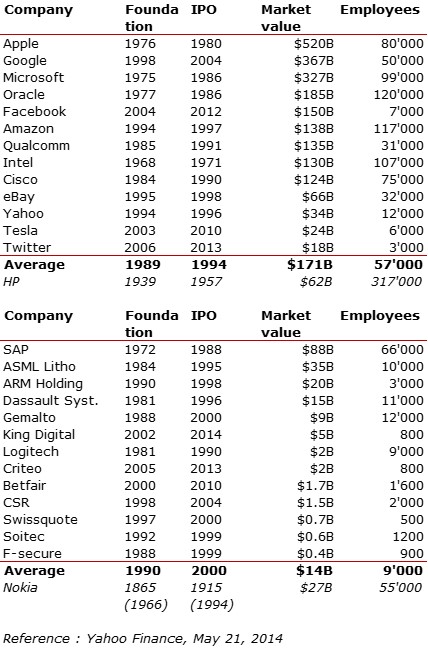
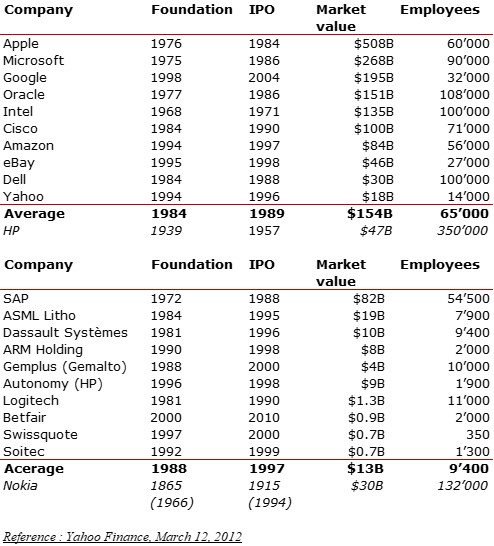
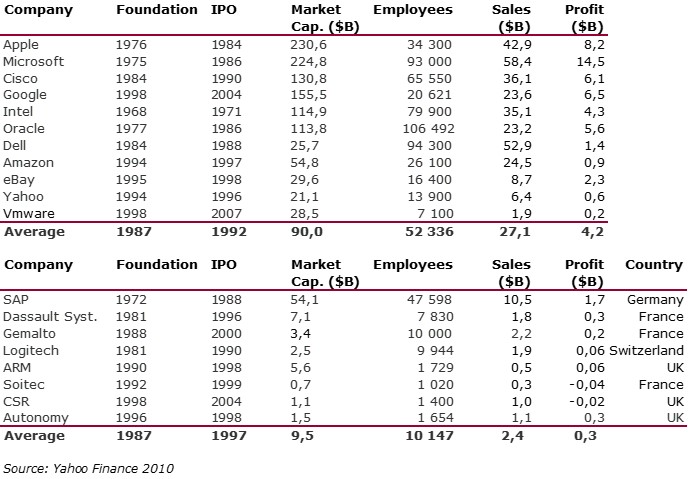
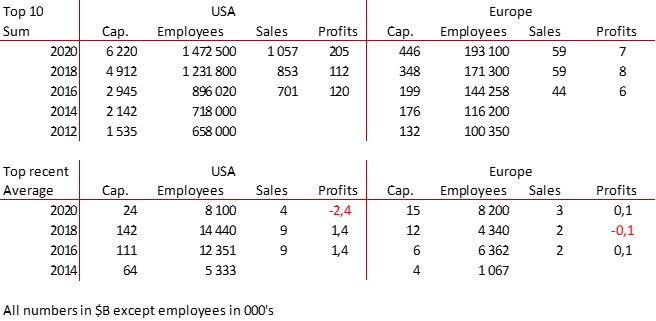
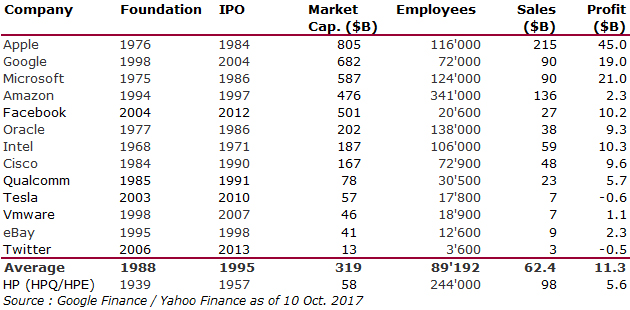
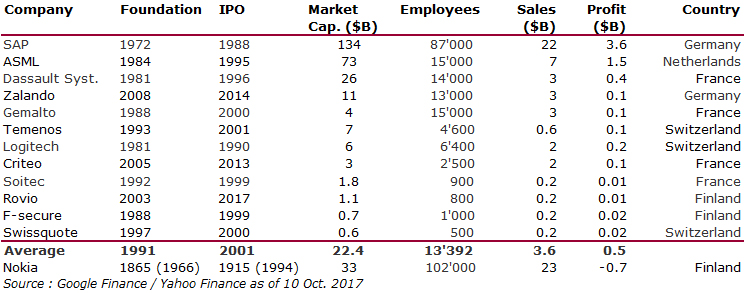
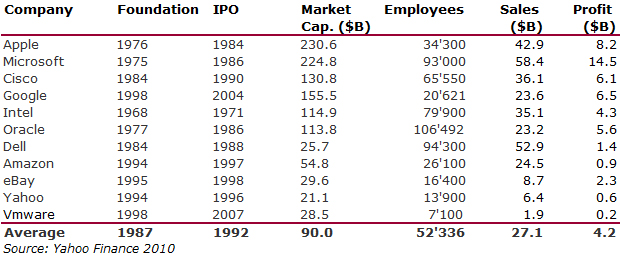
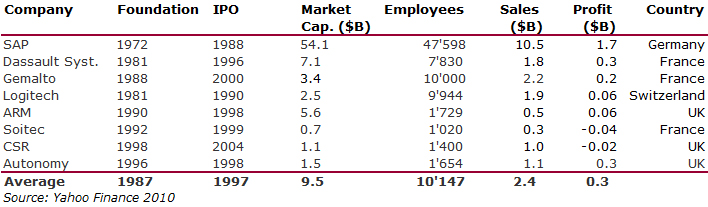
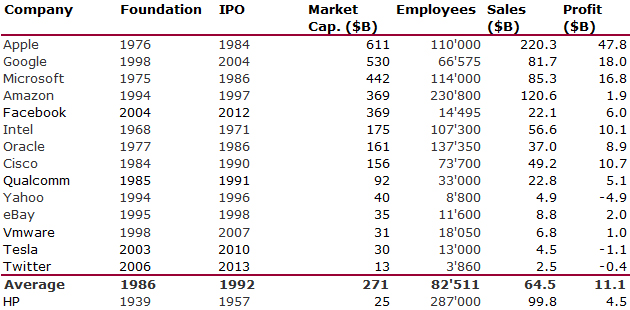
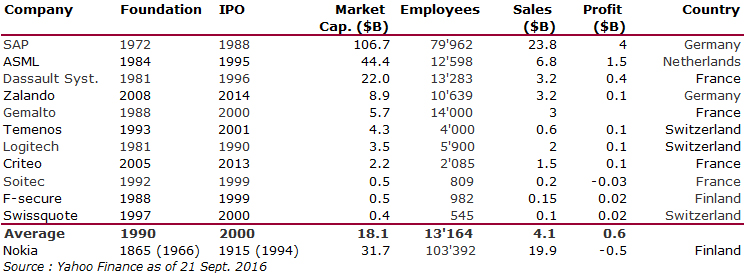
It is an exercise I usually like to use as an introduction to high-tech entrepreneurship: give me the name of 10 big sucess stories, and I mean (for example) the name of 10 public companies, which were founded as start-ups in the last 40 years. Usually, it is quite easy to give American names, and more difficult to find European ones. So the tables below give such names for IT first and for biotech second.

I had done the exercise in my book in 2007 but some companies such as Business Objects or Sun Microsystems have been acquired. Here I add the sales and profit numbers to the market caps and the number of employees.

What is striking I think, in addition to the difference in order of magnitudes is the difference between foundation to IPO year. Biotech is slightly different, though I am not sure it is fundamentally different… It is however interesting to notice that time to IPO is much more similar between the two continents in biotech than it is in IT.

A European in Silicon Valley, Aart de Geus

Friday, December 11th, 2009 1 Comment »

Here is my fourth contribution to Créateurs, the Geneva newsletter, where I have been asked to write short articles about famous success stories. After women and high-tech entrepreneurship, Adobe and Genentech, here is Aart de Geus, founder of Synopsys.

Aart de Geus was born in the Netherlands in 1954. At the age of 4, he moved with his parents to french-speaking Switzerland and in 1978, he graduated from EPFL, the Swiss Institute of technology in Lausanne (where I currently work). He then moved again to the USA and got his PhD from the Southern Methodist University in Texas. After a few years with General Electric (GE), he founded Synopsys in 1986, raised $15M of venture-capital before Synopsys went public (in 1994). In 2008, Synopsys had 5′600 employees, $1.3B in sales and a $3B market capilalization.

According to him, « Everybody from Europe who comes to the U.S. or Canada is looking to discover something ». In his case, when he arrived to the USA, he was lucky in being assigned as a graduate student to Ron Rohrer “He took a liking to me. […] Rohrer essentially gave me the freedom to do whatever I wanted within the graduate school research facilities”. Rohrer became his mentor. He learnt how to manage a team, a know-how he changed in a management style. “everybody counts on the team and there’s always a role for everybody, which produces an ecosystem that manages itself.” He recognizes it is as much luck as destiny.

He also shows how difficult it is to predict anything: “In fact, I’ll tell you a story. In 1978 or ‘79, I attended a conference in Switzerland of leaders in the field of electronics, or microelectronics. They all agreed on 2 things. Number 1, electronics was going to be a big deal and would move forward for many years to come. Number 2, one micron was the hardest barrier that we would never move across. And [laughing again], those same people who made the predictions are the ones who made 22 nanometers happen!” and he adds: “The lesson here: whenever one predicts the end of something in high tech, there’s always a twist or new perspective that makes a new breakthrough possible.”


Aart de Geus, a born entrepreneur?

The art of metamorphosis…

Aart appreciates complexity and metamorphosis. Everything is important and everything changes. In the early days of a start-up, ideas and people matter. When you have an idea, what do you do? “First, you write a business plan. Then, you ask, is it ethical? Is it okay to do that? How do you go about planning the business so as not to go up against GE?” Well, according to Aart, “there’s a simple answer. You write a business plan and propose it to GE. After all, it was clearly their IP. Period.” GE not only backed the idea but invested in it. Money and values are essential at that stage.

But the baby has to grow. The teenager will have to develop the products, sell them to customers. This may be a tough crisis. Does Aart feel lucky to have survived? “Luck favors the well prepared,” and added that a fortuitous combination of management, graduate students, geographic location, viable business plan, and marketing expertise were augmented by having the “right technology at the right time.”


Back to EFPL in 2007.

… with the risk of becoming a dinosaur !

The adult age means processes, experienced managers so you need to survive the tornadoes that Geoffrey Moore describes so well. Aart summarizes these permanent metamorphoses through a parallel management of teams, customers, investors, products and their cycles, but also managers, leaders, implementation. All these things are interdependant and it is often underestimated. In a talk he gave to EPFL in 2007, he showed the history of Synopsys acquisitions in the form of the animal below! His sense of humour was certainly very useful. This sense of humour hides the humbleness of the individual who succeeded without giving any lesson. If there is one lesson in all this, is that you must try, be curious and flexible. Success may come.

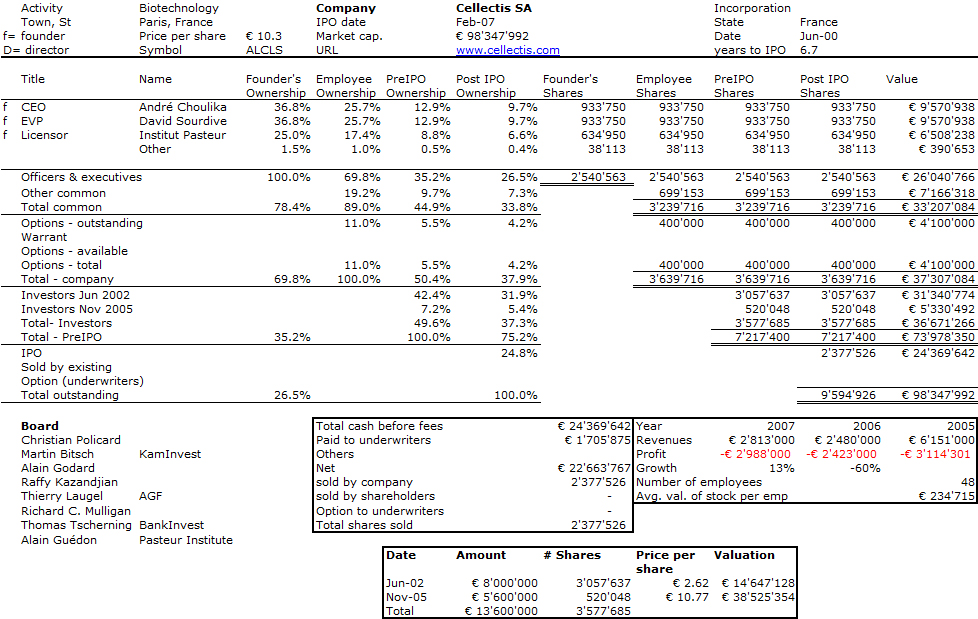
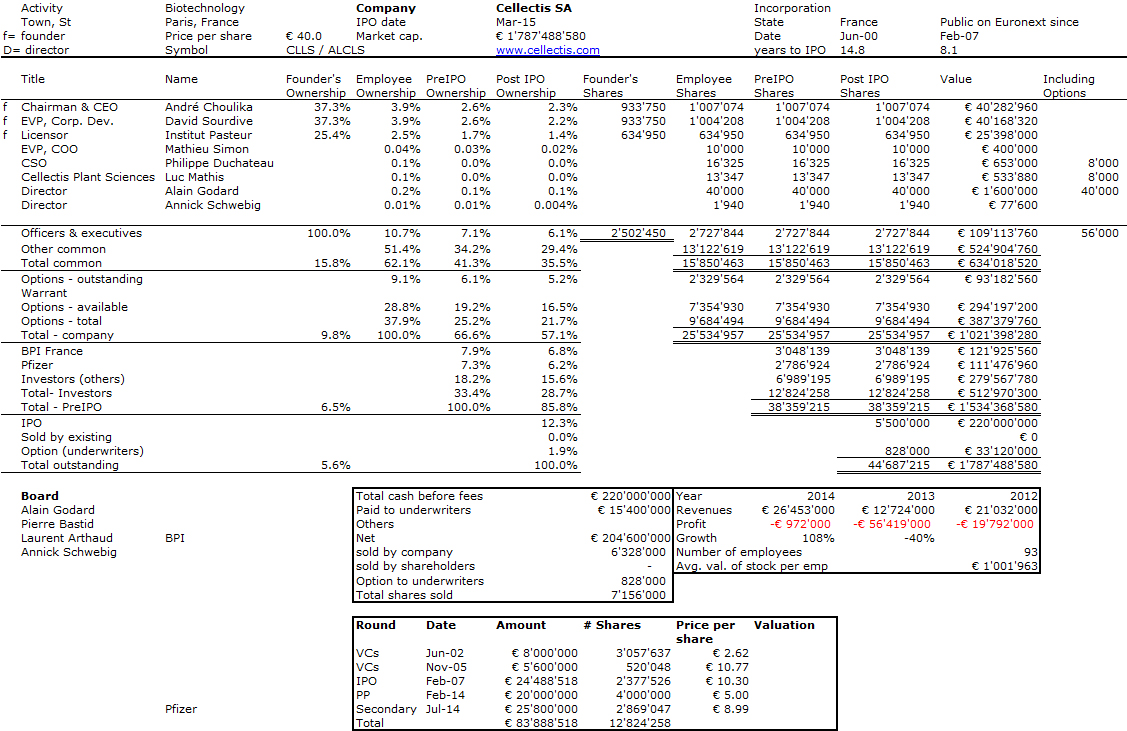
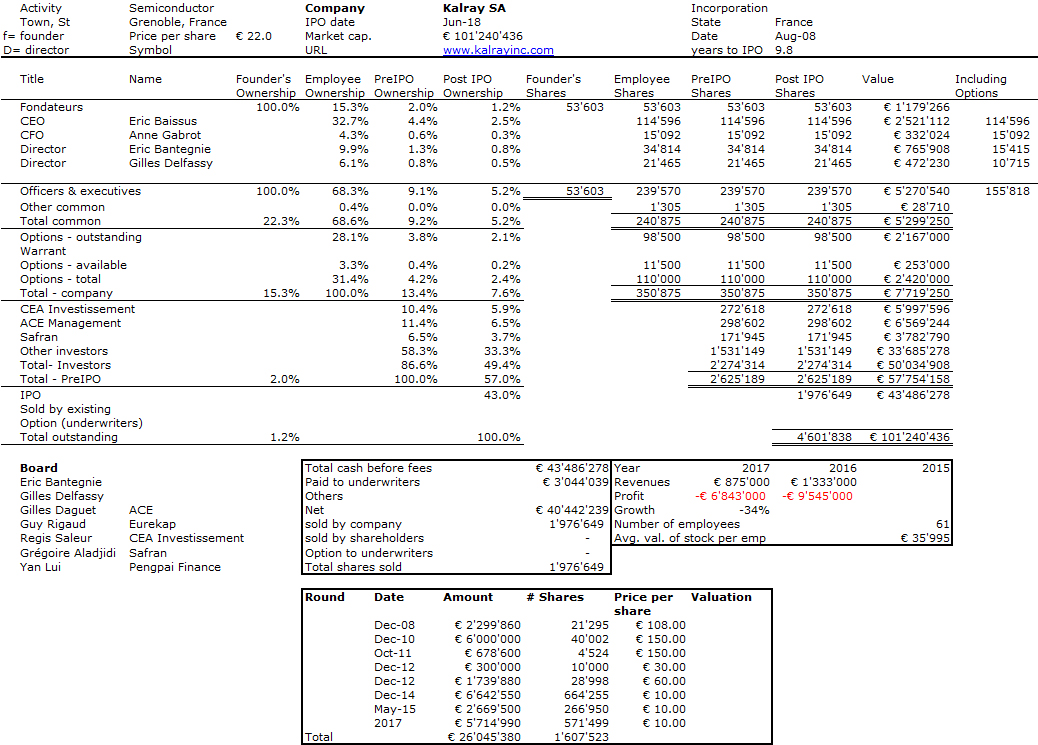
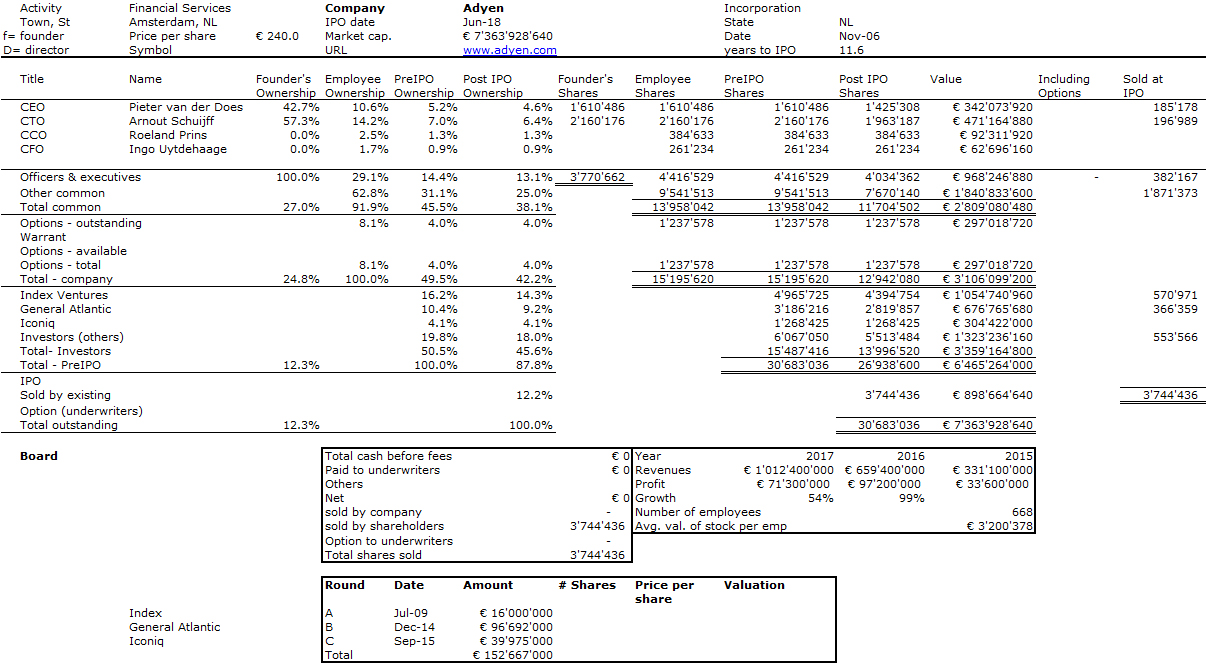
As usual, I finish with my beloved capitalization table and charts.

Sources :
-Aart de Geus at l’EPFL (vpiv.epfl.ch)
-Peggy Aycinena (www.eetimes.com)
The Aart of Analogy is alive and well at Synopsys -2001
The Aart of Analogy Revisited -2009

Next article: A Swiss in Silicon Valley

The Ultimate Cure, a great novel

Wednesday, January 28th, 2009 2 Comments »

Not only is The Ultimate Cure a good novel which describes the start-up life, the venture capitalists and what it costs to be an entrepreneur (and it reminds me of Po Bronson’s The First $20 Million Is Always The Hardest) but it is also a great novel, about human nature and what drives us in life. Here it reminds me of Swiss rising star, Martin Suter and his psychological thrillers. Most importantly, it is a great pleasure to read.

Author Peter Harboe-Schmidt has done a really nice “oeuvre”. Here is just a small piece:

“Take your start-up as an example. Why did you do it? If you analyzed the pros and cons for doing a start-up, you’d probably never do it. But your gut feeling pushed you on, knowing that you would get something very valuable out of it. Am I right?”
Martin speculated on why he was so drawn to a world that at times could appear to be no more than sheer madness. Like a world parallel to real life with many of the same attributes, just much more intense and fast-moving. People trying to realize a dream in a world of unpredictability and unknowns, working crazy hours, sacrificing their personal lives, rushing along with all those other technology based start-ups. Medical devices, Internet search engines, telecommunications, nanotechnologies and all the rest competing for the same thing: Money. To make the realization clock tick a little faster.
“Funny you should say that,” Martin finally said. “I’ve always thought of this start-up as a no-brainer.I never tried to justify it in any way.”

The thoughts of a Swiss entrepreneur based in Silicon Valley

Wednesday, November 19th, 2008 2 Comments »

Following a long phone conversation with a Swiss entrepreneur based in Silicon Valley, I received from him an email where he put his thoughts. They are indeed quite interesting and he authorized me to publish them:

“It’s a bit depressing to see that things change slowly (I had that intuition already)…

On a philosophical standpoint, I was thinking while driving my car that one of the issues is self-confidence.In the USA, everyone is raised with the idea that “anything is possible”, the “American dream”, to the point that it is sometimes stupid and annoying… On the contrary, in Switzerland, anyone wants to do things well and the culture is more about “this is not possible” or “I do not know how to do this”. But to be an entrepreneur, you must not be afraid of trying, of being far from perfect, of doing things in fields you do not master and sometimes even “quick and dirty”. It is the opposite culture of the Swiss craftsman who is a perfectionnist, the “travail bien fait”)… In summary, it is important to learn by doing things such as:

- Who to raise money, where to begin?
- How to negotiate a shareholder and investor agreement?
- How to deal with partners?
- Learn how to negotiate
- How to work with Head Hunters, Lawyers, Customers…?
- How to build and manage a team? - How to hire a sales team (a tough thing for an engineer). By the way, what are marketing, sales, operations?!!

- What about productization, schedule, specs, qualification?
- Where to find distributors?
- etc…

All this can not be taught in schools, I am not sure it is covered in an MBA. I am not conviced it can be taught anywhere. According to my experience, an entrepreneur does not stop doing new things, quite badly the first time and hopefully better and better with time. One should not have the negative attitude of never trying difficult and risky ventures, which does not mean one should launch or fund unrealist projects… There is a fuzzy line between arrogance (one should know its own limits) and dynamism of a good entrepreneur.

It is certainly a bad thing that engineering schools do not provide enough about marketing, accounting, legal elemts in the curriculum. But this is also true in teh USA, by the way!”

I was yesterday in Grenoble for a round table on the Nouveaux Conquérants:

The topics that were discussed were very similar to the comments above: self confidence, uncertainty, risk taking, passion, and success & failure.

US and UK Biotech: Growth and Form

Thursday, October 23rd, 2008 Comment »

Another interesting illustration about the differences between America and Europe: growth in the US and UK biotech. The full account can be found in Nature Biotechnology and my friend Andre mentioned the blog Corante where he read about it.

corante.gif

The conclusion of this blogger is:

“What I found interesting about the editorial, though, wasn’t these conclusions per se – after all, as the piece goes on to say, they aren’t really a surprise [...] No, the surprise was the recommendation at the end: while the government agency that ran this study is suggesting tax changes, entrepreneur training, various investment initiatives, and so on, the Nature Biotechnology writers ask whether it might not be simpler just to send promising UK ideas to America.

Do the science in Great Britain, they say, and spin off your discovery in the US, where they know how to fund these things. You’ll benefit patients faster, for sure. They’re probably right about that, although it’s not something that the UK government is going to endorse. (After all, that means that the resulting jobs will be created in the US, too). But that illustrates something I’ve said here before, about how far ahead the VC and start-up infrastructure is here in America. There’s no other place in the world that does a better job of funding wild ideas and giving them a chance to succeed in the market.”