Author Archives: Hervé Lebret

US and UK Biotech: Growth and Form

Another interesting illustration about the differences between America and Europe: growth in the US and UK biotech. The full account can be found in Nature Biotechnology and my friend Andre mentioned the blog Corante where he read about it.

corante.gif

The conclusion of this blogger is:

“What I found interesting about the editorial, though, wasn’t these conclusions per se – after all, as the piece goes on to say, they aren’t really a surprise […] No, the surprise was the recommendation at the end: while the government agency that ran this study is suggesting tax changes, entrepreneur training, various investment initiatives, and so on, the Nature Biotechnology writers ask whether it might not be simpler just to send promising UK ideas to America.

Do the science in Great Britain, they say, and spin off your discovery in the US, where they know how to fund these things. You’ll benefit patients faster, for sure. They’re probably right about that, although it’s not something that the UK government is going to endorse. (After all, that means that the resulting jobs will be created in the US, too). But that illustrates something I’ve said here before, about how far ahead the VC and start-up infrastructure is here in America. There’s no other place in the world that does a better job of funding wild ideas and giving them a chance to succeed in the market.”

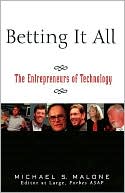
Betting It All

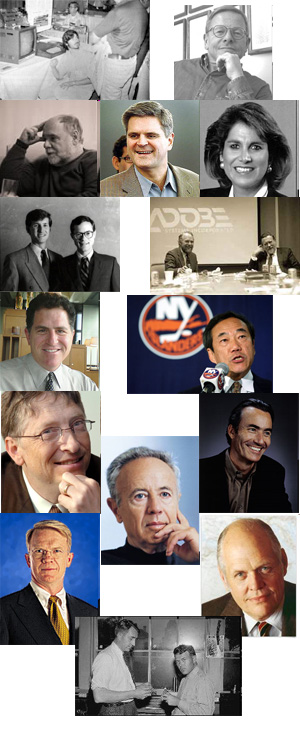
After reading Founders at Work by Jessica Livingston, I dived into an older book by Michael Malone. It has the same concept, i.e. interviews of 16 famous technology entrepreneurs. And it is worth reading.

bettingitall.JPG

It is full of great lessons so let me quote a few:

Larry Ellison about uncertainty:

When everyone said a relational database would never be commercially viable, the reckless guy said “maybe everyone’s wrong – maybe I will take a chance with my career and with my cash.” It’s not a rational process.Larry Ellison again about entrepreneurs: “I saw outside managers brought into a lot of companies who then made things dramatically worse. I think I was the best person for the job, I knew the company better than anyone else. I knew the technology, the products and the markets. My heroes are people who do not follow convention. It’s difficult to innovate when you are like anybody else.“T. J. Rodgers about Silicon Valley: “One of the things that Silicon Valley successful is companies think just about wanting to succeed. It is also a meritocracy. What makes us so special and different is no Java code or biotechnology, it is that we’re truly capitalists. About Europe and Japan: We’re moving at light speed relative to the Japanese, who probably still have a committee working on the problem and the Europeans, who are trying to work it out politically. ”

Tom Siebel about luck: “If you look at the core of many success stories, it’s not great visionaries, not great technology, not great entrepreneurs, it’s pretty bright people who found themselves in the right place at the right time and managed not to foul up the opportunity.”

Gordon Moore about Silicon Valley. “I really measure the thing that’s become Silicon Valley from Shockley in 1956. There were earlier technology companies – Hewlett Packard and Varian – but they were more like established companies on the East Coast. Shockley introduced some instability in the system. ”

If you want to learn more, read it…

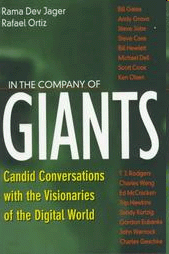
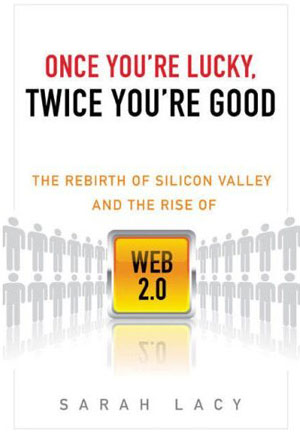
Next should be “Once you’re lucky…” and “In the Company of Giants

Aart de Geus receives the Kaufman Award

I recently talked about EDA here. Aart de Geus, a European, a Dutch native who studied at EPFL in Lausanne, was just awarded Kaufman Award, the Nobel prize in EDA. One of the articles has been published by EDN News

0915degeus_100.jpg

Aart de Geus is one the Silicon Valley’s icons. He came to EPFL in 2007 where he made a superb presentation about Synopsys history. >

When, in another interview, he was asked about why the USA, he said Europeans are on a quest as if they could not find in Europe what they are looking for…

Concerning EDA, there is a full chapter in my book where I tried to show that EDA is the perfect illustration of Silicon Valley dynamics, of its ups and downs.

Google’s First Steps

An interesting interview of the Google founders dated 1998!

googl-pagebizcard.jpg

Quite interesting lessons:

About the network of people: “Sergey: Basically, we talked to our advisers and other faculty whom we knew. And they just pointed us to other people. Pretty soon, we had investors, we had a lawyer, we had everything that we needed.

About risk taking: “Larry: Silicon Valley is a little bit different. There’s not so much risk to us. If you fail in starting your company, you’re actually more fundable. You may have failed for some reason not involving yourself at all, just [due to] some random factors... Sergey: The main risk is really our time. We’re working much, much harder than we would in a normal job. It’s not a 40 hour a week job.”

more…

Is Silicon Valley in trouble?

A scary video interview about Silicon Valley and I can not fully disagree: the IT industry is maturing so innnovation may be less relevant than it has been.The VC industry is in trouble though it will not admit it. Risk taking is disappearing. “Engineers are gun shy of start-ups”. What a terrible message.

Of course, there is hope: this is not new… Silicon Valley Fever is a 1984 book which already described the troubles start-ups and engineers could experience. People always claimed there were too few deals for too much money.

Whatever, enjoy and comment if you wish…

PS: thanks to Andre M.  for drawing this video to my attention!

Innovation in Europe

I just read two reports about innovation. The one in French is very deep (see my post on the French part of the blog). The one in English is also full of interesting lessons and learning. “What is the right strategy for more innovation in Europe? Drivers and challenges for innovation performance at the sector level” was published last June by the Austrian Institute of Economic Research. (Direct link to pdf file)


 innova.jpg


The authors try to differentiate innovation with sectors and geography (economic advancement.) For example “The data show that firms in economically less advanced member states are less likely to be innovators than firms in countries with more developed economies such as Germany or Sweden, and if they are innovators they are more likely to be technology users.” and “It has also proposed a new classification of industries that is based on the characteristics of entrepreneurship and a broad concept of innovation that transcends the conventional R&D-based classifications.”


I like some of the conclusions such as “Knowledge acquisition from external sources is of particular importance in sectors with large shares of technology users, whereas R&D activities are important in sectors where firms that are technology producers prevail. […] For firms based in countries that are at a distance from the world technological frontier, technology transfer and non-R&D related innovation activities are extremely important to promote innovation. […] On the other hand, for firms located in countries on or close to the technological frontier, intensive innovation activity is a driver of competitiveness. In order to maintain a competitive edge firms need to invest in R&D, acquire and adapt new technologies.


Of course all this is not obvious and may be counterintuitive. Look at Cisco in the USA, which does A&D more than R&D (they acquire start-ups and then develop). Is Cisco at the Frontier or not?


In terms of national policies, an interesting lesson: “The results show that the impact and the magnitude of these factors vary greatly across industries and countries. In fact, most variables can have either a positive or a negative influence depending on the sector. For the energy sector, the ICT industries and the aerospace industry public R&D subsidies have a positive effect, whereas R&D spending by the government seems to crowd out R&D investment in the textile, chemical and ICT industries.” I see a slight contradiction here but…


Then the authors address the issue of human capital: “Engineering and science skills contribute directly to international competitiveness” and “the returns to higher education will be higher for countries farther away from the technological frontier due to the greater importance of technology transfer and absorptive capacities […] On the other hand, in countries that are on or close to the technological frontier accumulated knowledge and experience are a precondition for sustained innovation performance and growth.”


On the competition side, they explain: “Competition is based on the interplay between the creation of novelty and imitation, i.e. between exploration and exploitation of opportunity. […] Firms that compete mostly with less advanced firms, have an incentive to reduce their risky R&D investments, as they are easily able to keep a competitive advantage over their rivals without incurring the cost of R&D investments. On the other hand, if they compete with firms with similar technological capabilities, they have an incentive to invest more in R&D, as this is a means to explore new opportunities and market niches and therefore set themselves apart from their competitors.


About the gazelles, the fast growing companies: “… a count reveals a significantly higher number of gazelles in the new member states of the European Union than in other EU countries. […] Statistical analyses show that in the more advanced economies of the European Union (continental and northern countries) fast growing firms are mostly of the creative entrepreneurship type and they also have a significantly larger share of turnover from product innovations. For gazelles in the southern European countries and the new member states innovation is much less important.”


Among the challenges for Europe, here are some scary elements:

          There is the danger that firms will increasingly relocate their research activities to countries where conditions concerning human resources and scientific infrastructure are better.

          For technology intensive sectors the problem is that they are not able to hire enough top level science and engineering graduates or attract the best-qualified engineers, scientists and specialists from abroad to their industry. These problems are particularly severe for new and fast growing firms that cannot rely on a long-standing reputation to attract people with top level qualifications and skills.

          For firms carrying out high-risk research, for young and small start-up firms and for firms facing extraordinary growth opportunities the lack of financial resources constitutes a serious problem. New financial instruments tailored to the needs of emerging firms remain underdeveloped in most EU countries.


The Trouble With…

I just finished reading The Trouble With Physics by Lee Smolin. It is a GREAT book. Now what has this to do with innovation and start-ups? Well I see a link:  In my book I refer to Thomas Kuhn, the author of the “structure of scientific revolutions”. Indeed Innovation and Research have similarities in the way they progress. The specific topic he focuses on is the lack of progress in physics. Don’t we have a similar issue with innovation? I also quoted Pitch Johnson, one of the grandfathers of venture capital who wrote: “Democracy works best when there is this kind of turbulence in the society, when those not well-off have a chance to climb the economic ladder by using brains, energy and skills to create new markets or serve existing markets better then their old competitors.”

thetroublewith.jpg

Smolin considers Science needs two ingredients: ethics and imagination. If the established science and scientists prevent the emergence of young people and new ideas, there might be a crisis. It is what he analyses brilliantly in his book. (By the way, his book tells much more, it is a really great book). When Silicon Valley people such as Joe Costello and Richard Newton claimed that Silicon Valley needs to take more risks and that greed is more important than ethics, I see similarities…

The Human Piece of the Venture Equation

An interesting post by Fred Wilson about when ask the founders to step back and entitled “The Human Piece of the Venture Equation“. I added my own comment which is obviously linked to my pet subject: passion in start-ups. Here is what I wrote.

I like this post very much so I’d like to add my own views. As a former student in SV and then as a former VC, I have seen many, many start-up and founders. My intuition is that in an ideal world, the founder should stay as CEO as long as possible. Let me make an analogy: a start-up is a baby; the founders are its parents. Except if the parents are totally incapable of educating a baby, they will hold responsibility for its education. Many “experts” will assist them (teachers, doctors and so on…). And obviously they will make rocky mistakes and sometimes it is deadly. It does not mean they should control the kid’s life forever. Hopefully not! (Though it sometimes happen too…) By the way, let me add also that two parents/founders are better for the kid (am I too conservative?).

So I fully agree with your “nothing can replace the entrepreneur’s passion and vision for the product and the company. If you rip that out of the company too early, you’ll lose your investment. I think it’s best to wait …”

I published “Start-Up” just before reading “Founders at Work” (which is a great book on the subject as you know). In mine, I tried to take a broader perspective as I am not sure the Internet and the Web2.0 have fundamentally changed things. Yes, you can do things quicker and less expensively but Hewlett and Packard were in their mid-twenties when they founded HP in 1939. So Gates, Jobs, Dell are not the first ones. It is not only about software and computing, there is something else. I think passion is more important than experience, but once again this is gut feeling and I agree that deeper studies may be needed. Passion is one of the subjects I have developed.

A final point: do you need to replace a CEO when he “the CEO’s job goes from managing the product, writing a little code, doing customer support, and raising money to managing people and teams, processes and priorities.” I am not fully sure about this. I do not disagree but as you say later, the CEO role is about defining the right vision and strategy. Can not you ask the COO and the other top-level managers to handle processes? When Logitech was in trouble, its founder, Daniel Borel, stepped back and the new CEO was a marketing guy from Apple if I am correct. He redefined the marketing/vision. The unique story of Steve Jobs have similarities (“Inside Steve’s Brain” is another piece of interesting reading).

It is hard to know about the Human Equation and there are many counter-intuitive elements. It is neither black nor white, you need passion and experience and by definition, they are very seldom found in the same individual. It is an argument for teams of two. Google has probably nicely succeeded with Eric Schmidt as there is no doubt the two founders are still critical to the company.

Win, Win, Win

I discovered yesterday the new 2008 Academic Ranking of World Universities done by the Institute of Higher Education, Shanghai Jiao Tong University (IHE-SJTU). Again the USA has the lion share: 8 in the top 10 and 17 in the top 20. Only the UK (Cambridge and Oxford) and Japan (Tokyo) enter the list. You can assess the ranking in more details with the full 500 ranking if you wish.

When I published “Start-Up”, I had a conversation with Christophe Alix, a journalist at Libération who told me that I forgot one thing in my explanations of the US superiority in innovation, i.e. the huge budget of the Pentagon. I certainly do not disagree and address the issue further below with a book I am just reading:

lowen.jpg

“Creating the Cold War University- The Transformation of Stanford” by Rebecca S. Lowen is an interesting book about how Stanford became wealthy in the 50’s and the 60’s thanks to federal money and industry contracts. Frederick Terman, often credited as being the father of Silicon Valley, called it a “Win-Win-Win” situation. The government funded basic and applied research (the difference between the two was often fuzzy) to develop military applications during the Cold War, the industry developed the products from the results of the research (and did not always have to directly fund the research), and companies like H-P, Varian, GE benefited greatly the effort. Finally Stanford became wealthy as well as excellent in research (which it was not in the 30’s).

Lowen explains that “by 1960, the federal government was spending close to $1B for academic research and university-affiliated research centers, 79 percent of which went to just twenty universities, including Stanford, Berkeley, Caltech, MIT, Harvard and the University of Michigan” (page147). In the Shanghai ranking, Harvard is #1, Stanford is #2, Berkeley is #3, MIT is #5, Caltech is #6 and Michigan #18 only.

Money definitely helps. I had however reacted against Alix’ argument as military money can not explain by itself the entrepreneurial spirit that Boston and Silicon Valley developed. Caltech and its JPL laboratory never reached the same start-up activity. But the quality of universities and their wealth is an extremely strong ingredient for successful technology clusters.

Inside Steve’s Brain

Inside Steve’s Brain

The book by Leander Kahney is interesting as it shows how Steve Jobs is unique in the high-tech world. Let me just mention a single example: “But unlike a lot of people in product marketing those days who would go out and do customer testing, asking people what they wanted, Steve didn’t believe in that. He said ‘How can I possibly ask someone what a graphics-based computer ought to be when they have no idea what a graphics-based computer is? No one has ever seen one before’.” …and… “Like Henry Ford once said: ‘If I’d asked my customers what they wanted, they’d have said a faster horse’. ” (pages 63-64).

If you like this, you’ll enjoy the book. Thanks to Jacques for recommending it.