Monthly Archives: May 2018

XXIst Century Utopias according to Libero Zuppiroli

In his latest book, Les utopies du XXIe siècle (The Utopias of the 21st Century) Libero Zuppiroli makes an original presentation of what I call the excessive promises of innovation. I wrote recently a short chronicle about it in Enterprise Romande and Bernard Stiegler makes a much more pessimistic analysis in In the disruption – How not to go crazy? A third very interesting reference is the collective work Emerging Science and Technologies, why so many promises?

Libero Zuppiroli tackles the issue from the perspective of utopias and dystopias, using in the beginning of his book ancient authors of the eighteenth and nineteenth centuries, that show that excessive optimism has always existed and that its realistic, even pessimistic, counterpart has also always accompanied it. Flora Tristan in 1840 mirrors Sadi Carnot’s benefits of the machine in 1824, Marat in 1774 is paralleled to Adam Smith’s economic liberalism in 1776, and Francis Bacon, in 1627, dreamed of never ending scientific and technological progress. The utopian promises are not new!

It is a book that must be read and I will let you discover the analyses of the promises in the fields of information technology, robotics, defense, 3D printers and nanotechnologies, the city and energy, health, and big data. A simple illustration: around 2005, nanotechnologies were seen as an extremely promising market, which would reach 3’000 billion dollars in 10 years. More than 10 years later, the market is around $100 millions…

I fear, however, that Libero Zuppiroli does not have much illusions about the impact of his analyzes. In a note on critical authors (note 119, page 293), he writes, “He is one of these famous intellectual critics whom American society not only tolerates, but also encouraged the birth of. Their critic of the American system is harsh and based on remarkable analyzes, but those who possess the power know that, despite their international reputation, the audience of these intellectuals is limited to a small fraction of people already convinced. Whatever their talent, their influence on the masses of electors will always be much lower than that of teleevangelists.”

But I knew Libero Zuppiroli was playful and his conclusion confirms this to me: this Empire will collapse as previously collapsed the Roman, Napoleonic and Soviet Empires. When? Nobody knows … but it will collapse victim of its Hubris

PS (October 29, 2018): the reader may also be interested in another blog contribution: Dissecting the utopias of the 21st century by Diane Golay.
The Gene by Siddhartha Mukherjee – a Symphony of Research

Progress in science depends on new techniques, new discoveries and new ideas, probably in that order – Sydney Brenner
All science is either physics or stamp collecting – Ernest Rutherford

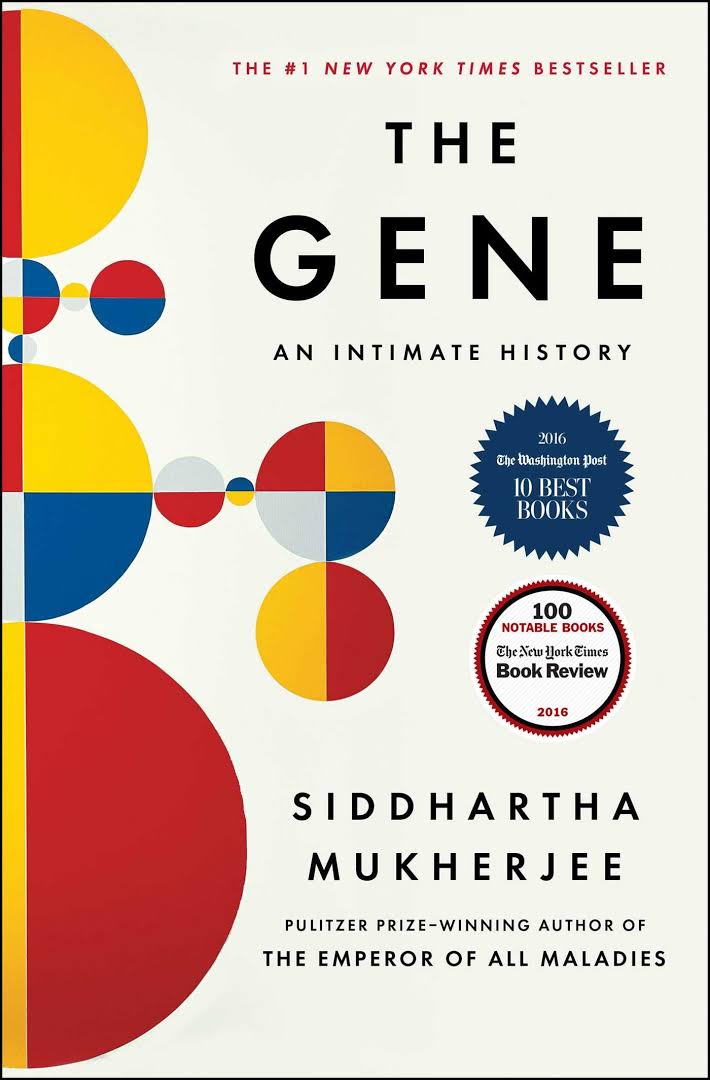
I did not know much about genetics, except my data here and there about biotechnology startups. But thanks to his book The Gene, Siddhartha Mukherjee makes me feel I know much more. His brilliant storytelling is like a symphony, describing the early days of genetics, with Darwin and Mendel and the latest developments of this fascinating science. There are brilliant quotes like the two above, respectively page 202 and 221. And there are marvelous portraits.

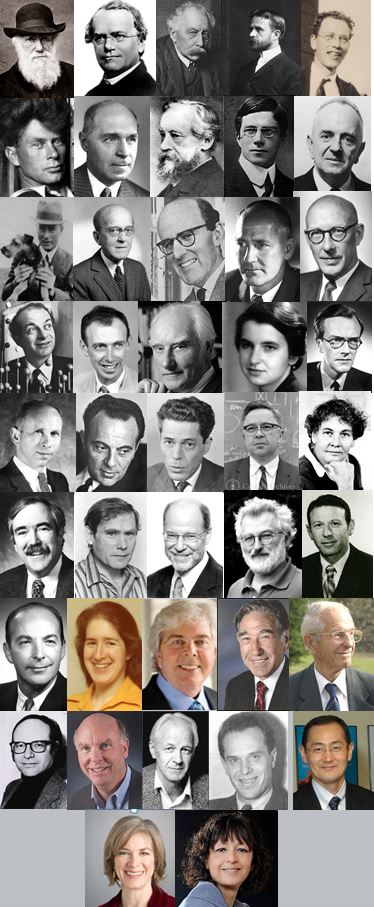
I will only give a few of them, the pictures I mean, as a quiz…

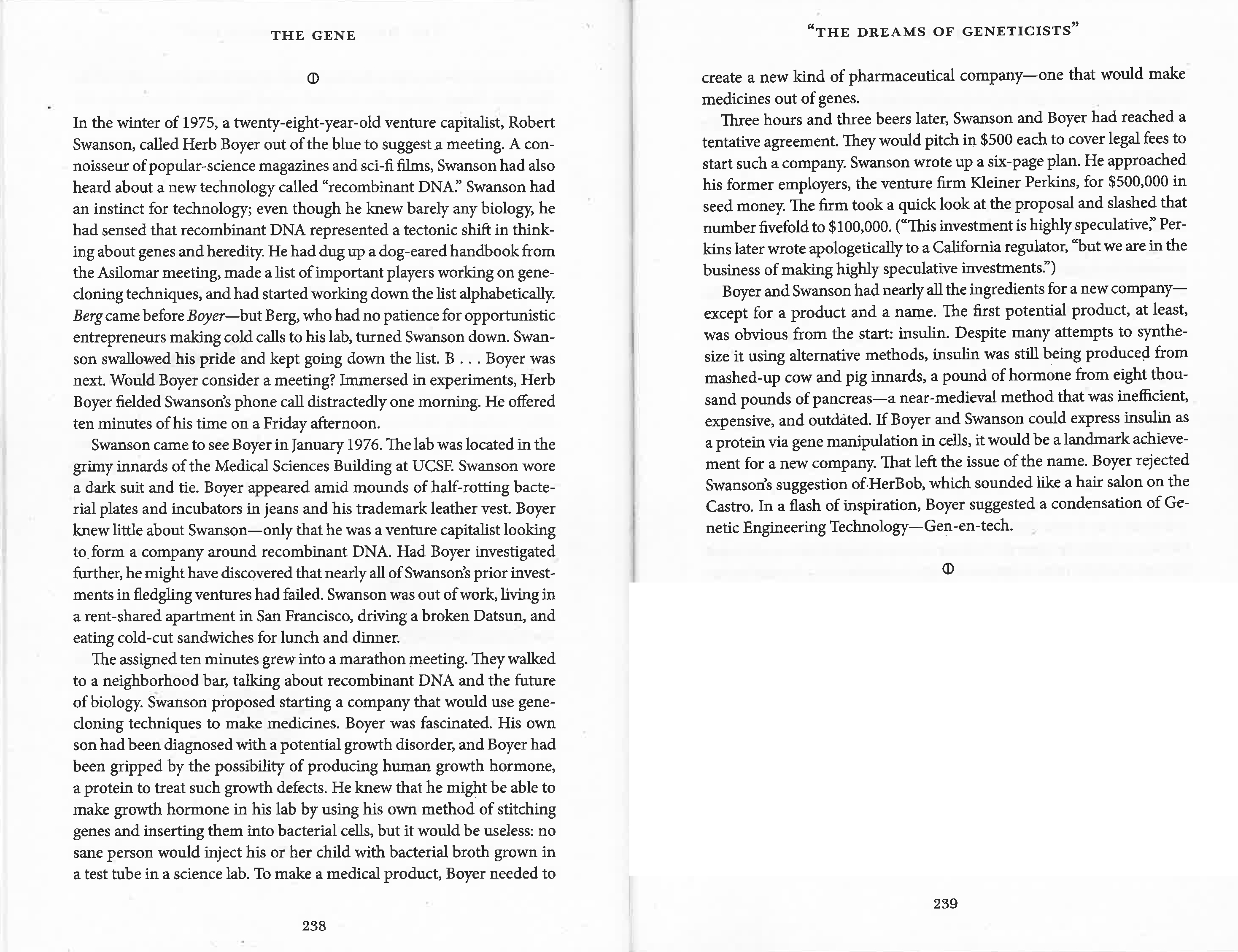
But before letting you discover the names below, here is a short extract from The Gene, a famous anecdote about how Genentech was born…

And a great analysis of what science, technology and biology are:
“Do not be lulled by that description. Do not, gentle reader, be tempted to think – “My goodness, what a complicated recipe!” – and then rest assured that someone will not learn to understand or hack or manipulate that recipe in some deliberate manner.

“When scientists underestimate complexity, they fall prey to the perils of unintended consequences. The parables of such scientific overreach are well-known: foreign animals, introduced to control pests, become pests in their own right; the raising of smokestacks, meant to alleviate urban pollution, releases particulate effluents higher in the air and exacerbates pollution; stimulating blood formation, meant to prevent heart attacks, thickens the blood and results in an increased risk of blood clots to the heart.

“But when non-scientists overestimate complexity – “No one can possibly crack this code” – they fall into the trap of unanticipated consequences. In the early 1950s, a common trope among some biologists was that the genetic code would be so context dependent – so utterly determined by a particular cell in a particular organism and so horribly convoluted – that deciphering it would prove impossible. The truth turned out to be quite the opposite: just one molecule carries the code, and just one code pervades the biological world. If we know the code, we can intentionally alter it in organisms, and ultimately in humans. Similarly, in the 1960s, many doubted that gene-cloning technologies could so easily shuttle genes between species. By 1980, making a mammalian protein in a bacterial cell, or a bacterial protein in a mammalian cell, was not just feasible; it was, in berg’s words, rather “ridiculously simple”. Species were specious. “Being natural” was “often just a pose”. [Page 408] […]

“Technology, I said before, is most powerful when it enables transitions – between linear and circular motion (the wheel), or between real and virtual space (the Internet). Science, in contrast, is most powerful when it elucidates rules of organization – laws – that act as lenses through which to view and organize the world. Technologies seek to liberate us from the constraints of our current realities through those transitions. Science defines those constraints, drawing the outer limits of the boundaries of possibility. Our greatest technological innovations thus carry names that claim our prowess over the world: the engine (from ingenium, or “ingenuity”) or the computer (from computare, or “reckoning together”). Our deepest scientific laws, in contrast, are often named after the limits of human knowledge: uncertainty, relativity, incompleteness, impossibility.

“Of all the sciences, biology is the most lawless; there are few rules to begin with, and even fewer rules that are universal. Living beings must, of course, obey the fundamental rules of physics and chemistry, but life often exists on the margins and interstices of these laws, bending them to their near-breaking limits. The universe seeks equilibriums; it prefers to disperse energy, disrupt organization, and maximize chaos. Life is designed to combat these forces. We slow down reactions, concentrate matter, and organize chemicals into compartments, “It sometimes seems as if curbing entropy is our quixotic purpose in the universe,” James Gleick wrote.” [Page 409]

And now the answer the the picture quiz:

Charles Darwin Gregor Mendel William Bateson Thomas Morgan Alfred Sturtevant
Calvin Bridges Hermann Muller Hugo de Vries Ronald Fisher Theodosius Dobjansky
Frederick Griffith Oswald Avery Max Perutz George Beadle Edward Tatum
Linus Pauling James Watson Francis Crick Rosalind Franklin Maurice Wilkins
Arthur Pardee François Jacob Jacques Monod Edward Lewis Christiane Nüsslein-Volhard
Eric Wieschaus Sydney Brenner Robert Horvitz John Sulston Paul Berg
Arthur Kornberg Janet Merz Herbert Boyer Stanley Cohen Frederick Sanger
Walter Gilbert Craig Venter Allan Wilson Luigi Luca Cavalli-Sforza Shinya Yamanaka
Jennifer Doudna Emmanuelle Charpentier

Virtual Innovations?

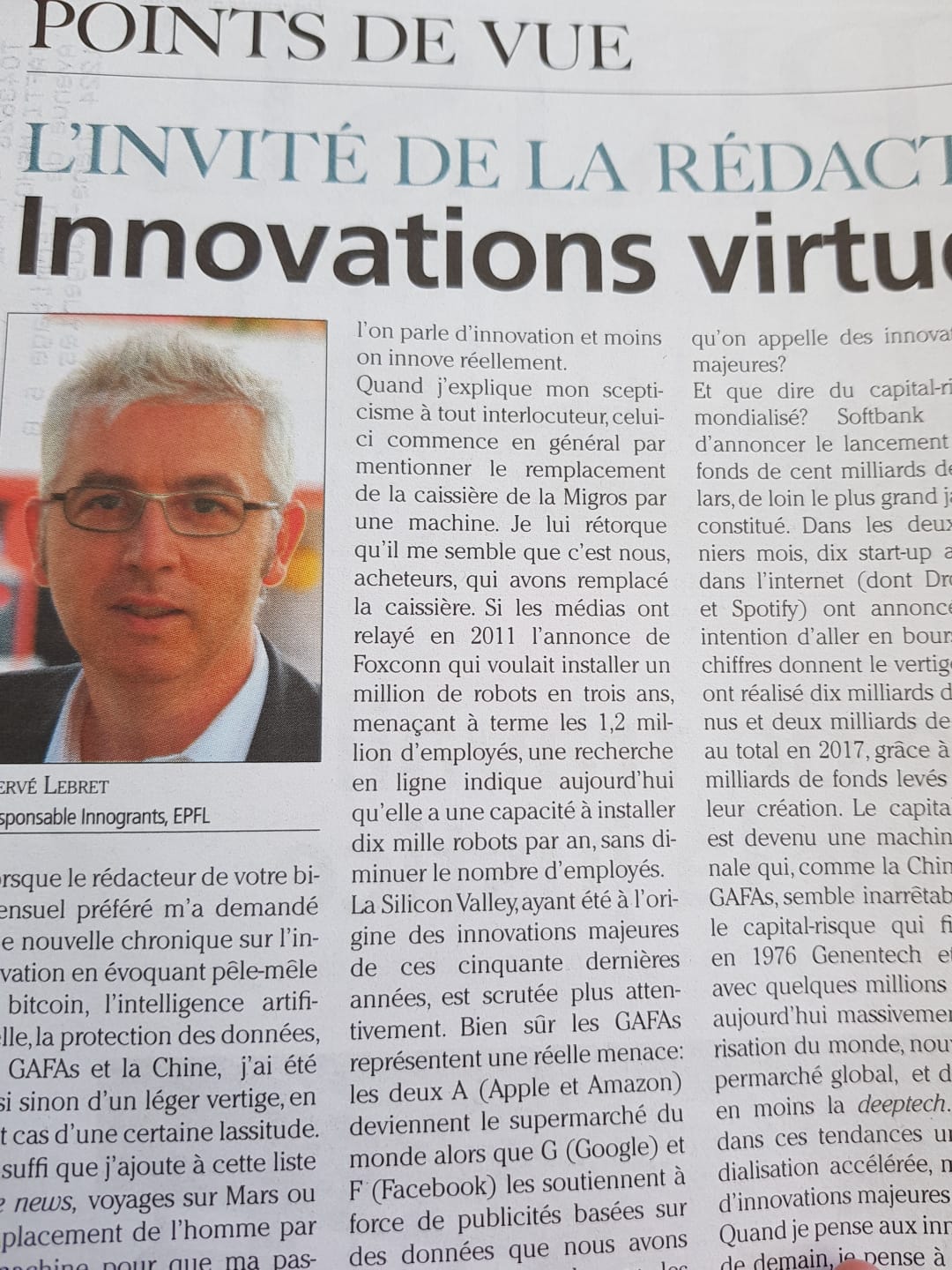
I had not contributed to Entreprise Romande for a while, which might be the reason of my somehow tiredness about the never ending flow of (virtual?) innovations. Here is my translation of my latest contribution…

When the editor of your favorite magazine asked me for a new contribution about innovation, offering me to write about bitcoin, artificial intelligence, data protection, GAFAs or China, I was the victim if not of a slight dizziness, at least of a certain weariness. I just had to add to this list Fake news, Trips to Mars or Replacement of Humans by Machines and my ongoing passion for startups and technological innovation turned into a light nightmare. It seems to me that the more we talk about innovation and the less we really innovate.

When I explain my slight skepticism to anybody, they usually start with the mention of replacing the cashier of the Migros (a “famous” chain of Swiss supermarkets) with a machine. I reply that it seems to me that we, buyers, have replaced the cashier. If the media relayed in 2011 Foxconn’s announcement that it wanted to install a million robots in 3 years, threatening the 1.2 million employees, an online search indicates today that it has a ability to install 10,000 robots a year, and still the same number of employees.

Silicon Valley, having been at the origin of the major innovations of the last fifty years, is scrutinized more attentively. Of course the GAFAs represent a real threat: the two A become the supermarket of the world while the G and F support them by advertisements based on data that we have kindly given them, putting them in a quasi-monopoly situation. But you read well, supermarket, advertising. And that is what is called major innovations?

And what about globalized venture capital? Softbank has announced the launch of a 100 billion fund, by far the largest ever. In the last two months, 10 internet startups (including Dropbox and Spotify) have announced their intention to go public. The figures are dizzying: they generated 10 billion in revenues and 2 billion losses in 2017, thanks to 4 billion of funds raised since their creation. Venture capital has become an infernal machine that, like China and the GAFAs, seems unstoppable. But the venture capital that financed in 1976 Genentech and Apple with a few millions today massively funds the “uberisation” of the world, new global supermarket, and less and less the “deeptech”. I see in these trends an accelerated globalization but few major innovations.

When I think of the innovations of tomorrow, I think of nuclear fusion that will solve our energy problems, research on AIDS or cancer that will rid us of these disasters as we have been able to get rid of previous diseases, I think of disruptive solutions for water, food, mobility. Tom Perkins, Silicon Valley’s big venture capitalist, thought that the innovations of our time were based on three major inventions, the steam engine, the electricity and especially the transistor that made possible all the technologies that seem to threaten us today. But where is the next invention? I recognize myself in Peter Thiel’s phrase: “We wanted flying cars; instead, we had 140 characters. ”

Do not get me wrong, the innovation flow was exceptional in the 20th century and developments continue. In biotechnology, the Crispr-CAS9 technology [1] is as promising as the genetic revolution of the 1970s. Three startups, Crispr Therapeutics, Intellia Therapeutics and Editas Medicine went public in 2016 and promise to cure 10,000 diseases. But today these three companies represent less than $70 million in revenue and more than 200 million in losses in 2017. We do not yet have gene therapy or personalized medicine. Google’s Alphago beat the best go player, but nasty voices ​​say that it’s only the largest computing power and the largest data storage of computers that has allowed such performance, and no particular invention or intelligence . In more complex contexts, the machine is not able to compete with humans. And what will really bring us the multiplication of Big Data? But the promises of some to politicians and others to their shareholders, amplified by the media, are sometimes an insult to intelligence: why parasitize the human spirit with promises of (virtual) innovations sometimes more “abracadabrantesque” one than the others and ultimately disappointing when the real world is sufficiently complex and exciting?

[1] https://www.investors.com/news/technology/crispr-gene-editing-biotech-companies/