Monthly Archives: March 2019

Steve Jobs in Paris in 1984

My friends at INRIA just mentioned to me a short but great interview of Steve Jobs by French Television in 1984, when he was asked if France could have similar start-ups to Silicon Valley. Here is his answer:


Even if you hear more the French translation, you can hear his voice too:
– Research level is good but concrete applications seem to be a problem, and this is an important step for innovation
– This is coming from a lack of companies ready to try
– The risk is seldom taken by large corporations, but by small ones
– You need many small firm with talented students and venture capital
– You also need champions you take as models, that enable saying “innovation is this”
– There is a more subtle problem, a cultural one: in Europe, failure is serious. If you fail in Europe right after university, it follows you for ever. In the USA, we keep failing all the time.
– What you also need is a solid software industry, because software is the new oil. You need hundreds of small firms and then you can dominate an industry.
– You need talented students, a good understanding of technology and encougare young people to create small firms.
– It’s all about private initiative. Big companies should not interfere, neither the government should. We should let entrepreneurs own it.

Thirty-five years later, is the situation different? And if he was still alive, would he say the same things? I let you judge …

Cynthia Fleury : To be Brave is sometimes to Endure, sometimes to Break up

I have already mentioned Cynthia Fleury on this blog, for example some of her books on Transhumanism is Science Fiction. I just read an interview of her on Telerama, Cynthia Fleury : “Etre courageux, c’est parfois endurer, parfois rompre”. It is so great, I just decided to translate it my way…

MesLivres-Cynthia-Fleury

Translated from Juliette Cerf. First published on Telerama on 30/08/2015, updated on 01/02/2018.

A philosopher and a psychoanalyst, she insists on how important it is for anyone to build her or his own destiny. It is a condition to protect democracy.

When she was a young doctoral student in philosophy, Cynthia Fleury dreamed of living on a back seat, to devote herself to research and writing, far from the hubbub of the city … Life decided differently and the young woman learnt with time how to live on stage. To be all round. She is now in her early 40s, used to debates and much appreciated by the media for her sharp speech and clear vision. Cynthia Fleury combines many activities: a researcher in political philosophy and a psychoanalyst, she teaches at the American University of Paris. She is a member of the advisory board of the National Ethics Committee, she is also part of Nicolas Hulot Foundation’s think tank for nature and humankind and she is contributor to the Paris medical and psychological emergency unit (Samu). From these different positions of observation, the philosopher watches the drifts and dysfunctions specific to the individual and democracy, at a time when, because of the crisis, everyone withdraws into oneself. How to cure this? How to bring back into the heart of the collective? It is these questions that she addresses in her new essay, Les irremplaçables (The Irreplaceable), which follows her reflection begun in The Pathologies of Democracy and The End of Courage.

Why this title, The Irreplaceable, which sends the reader towards a literary fiction horizon?

Literature is much more poweful than philosophy since it does not produce a doctrinaire, frozen discourse. With a title of a novel, I wanted to evoke the story of the self, the creative power of each. An irreplaceable being is indeed someone committing to a process of individuation, in other words in the construction of her or his own destiny. The book is published in the Blanche collection by Gallimard, which outside of fiction, has always been known for a tradition of philosophical existentialism, with Jean-Paul Sartre, Simone de Beauvoir, etc. It meant to invest the theme of irreplaceability in an existential and open way, while philosophical theorizing gives a sense of closure. What was at stake was to enter in a dynamic commitment and to create a responsibility for each of us: how does this individual destiny feed a more collective destiny? This is the essential question.

You enroll in the field of political philosophy; democracy is at the center of your thinking.

Yes, and the irreplaceable, at first, were for me the democrats. If I precisely talk about commitment, it’s because I do not live in the illusion of democratic durability. At a time when fundamentalisms, fascisms and populisms proliferate, how can we protect democracy? How do we make sure that individuals are concerned about preserving the rule of law? I realized that any individual who has not worked to develop a fair individuation will not care about preserving democracy. Self-care and concern for the city are intimately linked.

How?

Individuation and democracy work, I think, like a Möbius strip, as the two faces of the same reality. Of course, the rule of law produces the conditions the emergence of an individual, but it does not last if not revitalized, reinvented, reformed by free subjects. If the rule of law remains only a formal reality, it creates huge disappointments that threaten it. It is therefore necessary that it incarnates, and this body of the rule of law is that of the different individuals it gathers. But in recent years, neoliberalism has distorted the rule of law and disintigrated the subjects. The rule of law signs its death sentence: only a well-individuated subject cares about its preservation, and not the alienated subject we meet today.

“The construction of the rule of law is the adventure of this gap between principles and practice.”

You thus evoke the “entropic” drift of contemporary democracies. What is this about?

In thermodynamics, entropy measures the state of disorder of a system: it grows when it evolves towards an increased disorder. However, for thirty years, western democracies experience dynamics of disguise, delirious and unprecedented merchandising, which makes of us interchangeable, replaceable entities, servicing the “growth” idol. Everyone can experience it, whether in the world of finance, consumption, or ecology, through all these phenomena of capture, extreme rationalization, obscene profitability that do not question either their presuppositions nor their expectations. But the expression of democratic entropy is something else, it refers to the internal disorder of democracy, its dysfunctions that are of its very nature. This, Tocqueville has analyzed it perfectly when he defined democracy this way: good principles, theoretically correct and ethically acceptable, which produce perverse effects. The construction of the rule of law is the adventure of this gap between principles and practice.

Could you give an example?

According to Tocqueville, principles change into passions; thus, the passion of the principle of individuation is individualism. The individualistic subject is passionate about himself, self-centered, withdrawn, intoxicated by the intoxication of the self, while the individuated subject sets up a look at the outside world, unfolds and ensures a base, a foundation, which allows her or him to enter into a relationship with what is surrounding. The adventure of irreplaceability, the path to individuation, thus looks like, in many features, that of depersonalization. It’s not about becoming a personality, to put the ego on stage. On the contrary, the challenge is relational: it is a matter of decentering oneself to bind oneself to others, to the world, to meaning.

How to access this individuation?

To give time for oneself is not easily guaranteed. It is a never-ending requirement. To know oneself and to access the quality of being that one owes to the world, the subject must go through three dynamics of knowledge and behavior, which are as many fire tests: imagination, pain and humor. With the first one, the imaginatio vera, the subject produces a true imagination, which is an “agent”, which creates reality. This faculty of soul and heart, at the border of the sensible world and the intellectual world, has an unheard-of power of creation. In this respect, the imaginary, literary space is really the configuration space of reality; it is in no way avoiding reality, as we sometimes think. The imaginary, literary space allows us to verbalize and understand what reality is. The second faculty, pretium doloris, the price of pain, teaches us that the act of thought has a price and that access to the truth can be a painful experience. The trial of Socrates is the very symbol: knowing and knowing oneself mean being at risk.

What about humor?

The vis comica, the comic force, operates an effect of decentering, of distancing which makes the reflexive consciousness arise. The power of humor allows us to grasp the absurdity of reality, as well as our own inadequacy and shortage. While one discovers the absolute inanity, vanity, stupidity of the subject, one manages nevertheless to do something about it. This is essential for the process of individuation, which is primarily a consciousness of shortage, while individualism, infatuated by its pseudo-omnipotence, has totally forgotten that it was short. Individuation is a test of reality, an access to the truth. It is a saying that is obligatory and does not force, and thus renders the subject faithful to herself or himself, irreplaceable. It is a given word, an effort that the individual deploys to bind oneself to the discourse one states.

The brave, at the center of your essay The End of Courage, was already an irreplaceable subject for you?

Yes, irreducible to others, since the brave does not delegate to others the task of doing what is to be done. In The End of Courage, the reconquest of a democratic virtue, I show how ethics of courage are a way to fight against democratic entropy. This virtue, which brings together ethics and politics, is at the same time a tool for protecting the subject and for regulating societies. In the deep intimacy that the brave subject has with his conscience, there is the quality of a public commitment, for others. One can be alone, even against others, when one makes a courageous act, but this gesture always preserves a quality of connection with the community. In everyday life, to be brave is sometimes to endure, sometimes to break up; it may be leaving a job when you are entangled in a perverse situation. On a more historical level, the spectrum goes from political leaders like Nelson Mandela to whistleblowers today.

“There is no democratic project without an educational project”

Individuation, courage: your research intersects with the individual and the collective, psychoanalysis and political philosophy. How did you become a psychoanalyst?

I first started a psychoanalysis at a rather young age, around the age of 17. I did not think about becoming an analyst at all! Then my work as a teacher-researcher in political philosophy focused on the issue of dysfunctions, especially when I wrote Pretium doloris and The Pathologies of Democracy. Reflecting on the suffering at work and on the actions that sometimes accompany it, I have had to collaborate with occupational physicians and clinicians. I wanted to probe more directly the word of the individual. That’s how I became a psychoanalyst. I started my clinical activity in 2007 and have been receiving patients on a regular basis since 2009. I soon realized that the sessions were dedicated to a discourse about reality, society: work, globalization, terrorism, religions, etc. It was necessary to dig to find a discourse about parents, family.

What role does this activity play in your daily life?

I consult every late afternoons as well as weekends. It’s a decisive part of my work today, and it will come even deeper into my writing in the future. I have the feeling that the research I do in the morning or the teaching in the afternoon, in the evening, I hear it formulated in another way, more clinical, as if philosophy suddenly was endowed of a piece of land, while it usually does not. The democratic entropy we were speaking of, I measure its effects every day as a psychoanalyst: individuals feel discouraged, crushed by the rule of law that would be supposed to protect them. To become aware of it is already to extract oneself from it.

Is being a well-publicized philosopher influencing your work as a psychoanalyst?

This necessarily interferes, with very different results depending on the patients. With those who already know you, a phenomenon of transfer precedes you. But the transfer, the emotional projections that the analysed makes on the analyst, is almost magical … Even if this situation requires readjustments, it can be very efficient because it suddenly gives a kind of speed to the analysis, since all the work was done elsewhere. Conversely, there are those who do not know you outside the confessional field of the session and then rediscover you in a field of social and, there, the reactions are diverse. As we are living in an era in need of recognition, it seems to me rather to help; there is also a phenomenon of transfer – my psychoanalyst being recognized, I feel myself caught up in this sphere of recognition. There are misunderstandings, misapprehensions, but it does not really matter, they are always entry points into the analysis. This is very true for young patients under the age of 18, with whom it is always complicated because, if some come by themselves, others do it because their parents want it.

The end of The irreplaceable is devoted to education. Why ?

There is no democratic project without an educational project, both at family level and the social level. As intimate as it is, linked to the irreplaceable love that unites parents and children, education remains the major public enterprise. In this respect, the time of transmission is a very special time, a stretching time. The teachers are well aware of this: you only have two hours, you feel that it is ridiculous, but, in fact, you switch to another space-time which is a symbolic space. There is a click, the beginning of something; attention, empowerment, emancipation, critical awareness. It is in this space that the first fruits of individuation arise. But do not be deceived: it requires work, discipline. Discipline is not submission that transforms us into a sheep, into a link, into a follower: it is a skill, a technical gesture, a way of being, which makes us freer.

Cynthia Fleury in a few dates
1974: Birth in Paris.
2000: PhD in philosophy on the “metaphysics of the imagination”.
2005: Publishes Les Pathologies de la démocratie – the Pathologies of Democracy.
2010: Researcher at the National Museum of Natural History. Publishes La Fin du courage – The End of Courage.
2013: Member of Comité consultatif national d’éthique – Advisory board of the National Ethics Committee.
Wikipedia page (in French).

To read:
Les Irremplaçables, Gallimard, 218 p. €16,90.
La Fin du courage, Le Livre de poche, 192 p. €6,60.

Fascinating data analyses on start-ups by Sebastian Quintero

I just read about Sebastian Quintero’s data analyses on start-ups on his web site Towards Data Science. Thanks Martin H. 🙂 I was really fascinated about his original way of looking at them, their failure rate, the valuation prediction, their runway between rounds, and his Capital Concentration Index or Investor Cluster Score. You should read them.

Of course, it rang strong bells with all the data analyses I have done in the recent past 8see end of the post if you wish)

So as an appetizer to Quintero‘s work, here are a couple of figures taken from his site…

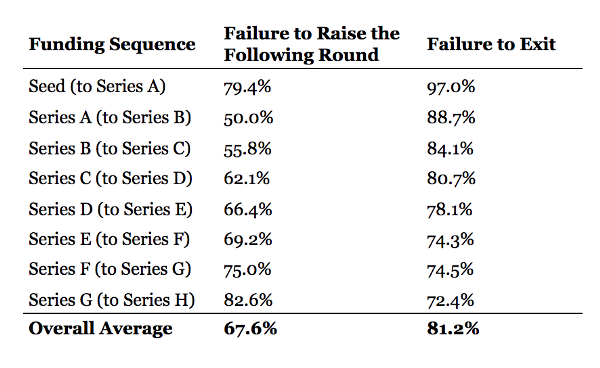
Dissecting startup failure rates by stage

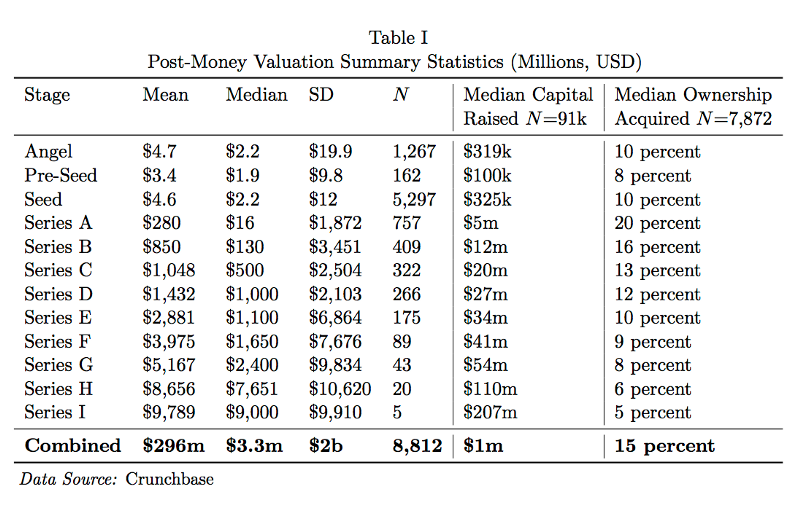
Predicting a Startup Valuation with Data Science

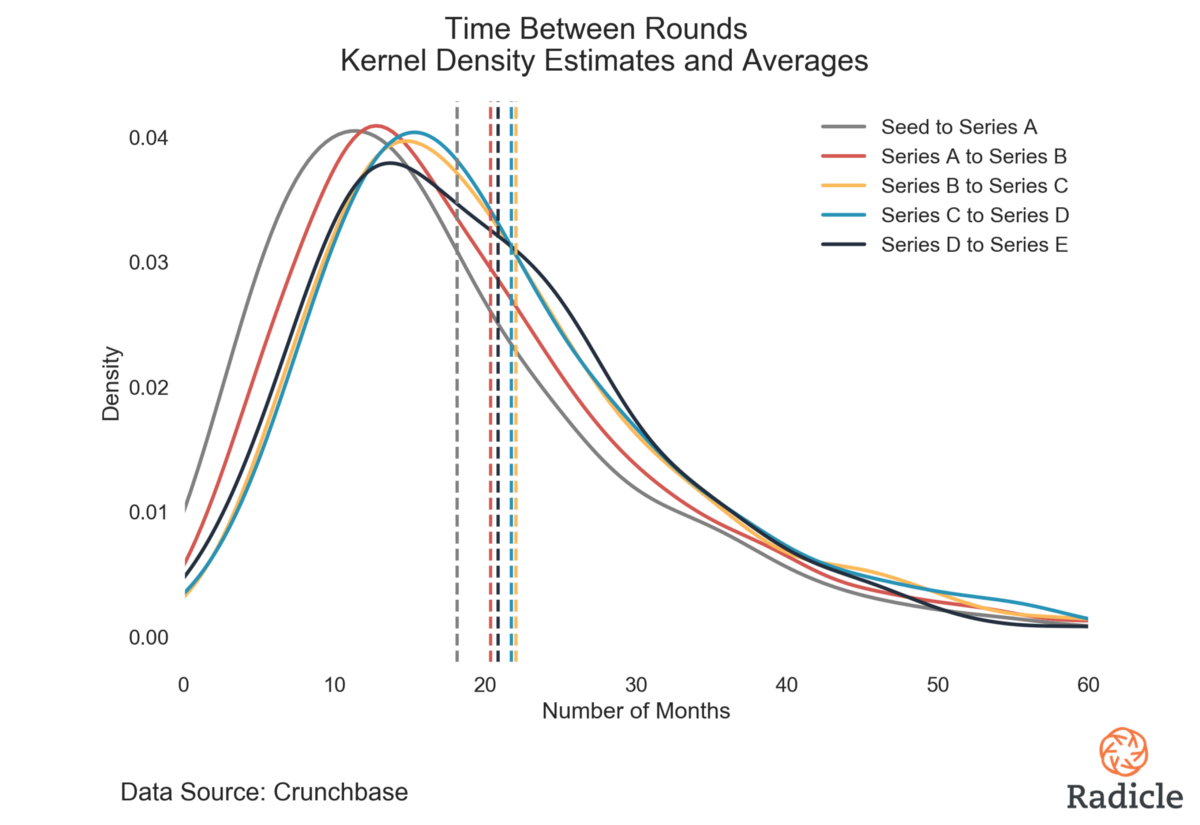
How much runway should you target between financing rounds?

Introducing the Capital Concentration Index™

Where c is the percentage capital share held by the i-th startup, and N is the total number of startups in the defined set. In general, the CCI approaches zero when a sector consists of a large number of startups with relatively equal levels of capital, and reaches a maximum of 10,000 when a sector’s total invested capital is consolidated in a single company. The CCI increases both as the number of startups in the sector decreases and as the disparity in capital traction between those startups increases.

Introducing the Investor Cluster Score™ — a measure of the signal produced by a startup’s capitalization table

As of my own analysis, here are a couple of links…

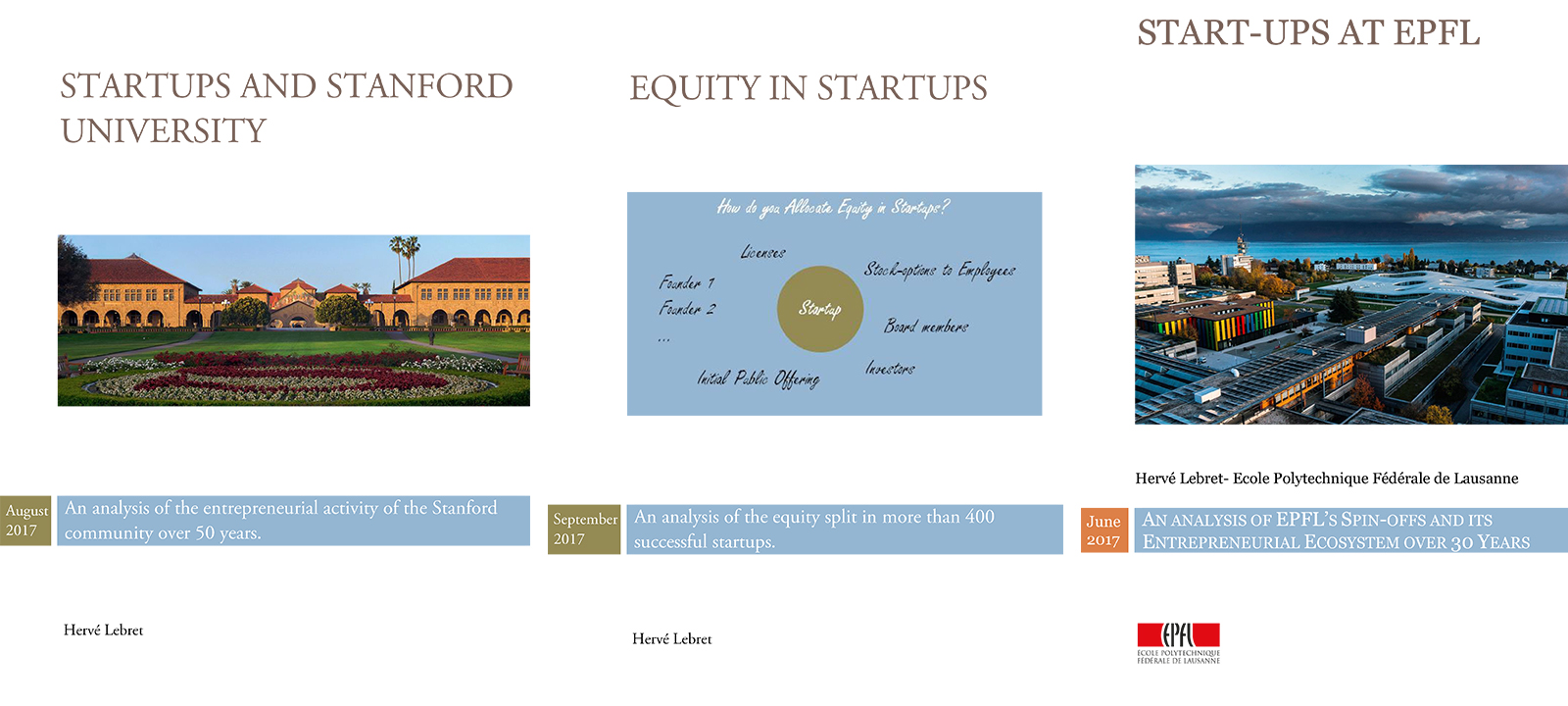
My papers on arxiv:
– Are Biotechnology Startups Different? https://arxiv.org/abs/1805.12108
– Equity in Startups https://arxiv.org/abs/1711.00661
– Startups and Stanford University https://arxiv.org/abs/1711.00644

or on SSRN
– Age and Experience of High-tech Entrepreneurs http://dx.doi.org/10.2139/ssrn.2416888
– Serial Entrepreneurs: Are They Better? – A View from Stanford University Alumni http://dx.doi.org/10.2139/ssrn.2416888
– Start-Ups at EPFL. An Analysis of EPFL’s Spin-Offs and Its Entrepreneurial Ecosystems Over 30 Years https://papers.ssrn.com/sol3/papers.cfm?abstract_id=3317131

Gandhi and Technology, according to Bertrand Jarrige

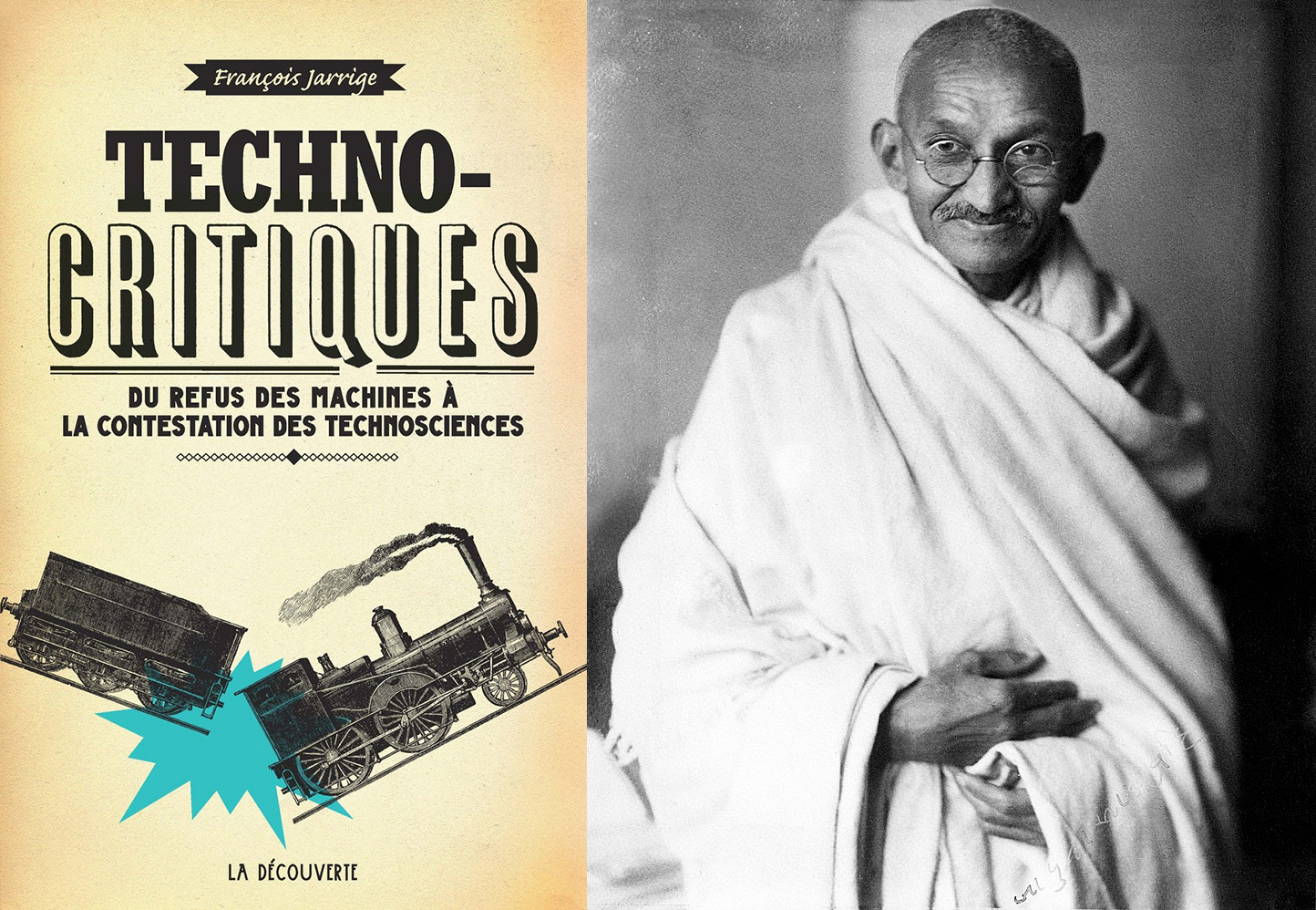
A second post about the excellent Technocritiques – Du refus des machines à la contestation des technosciences after that one: Techno-critics according to François Jarrige. Jarrige surprises me by giving Gandhi‘s views on technology. Fascinating. I (in Fact Goodle translate was a great supporting tool…) translated his full account that you could read in French on pages 192-195.

No one better illustrates the ambivalence of the relationship to technology in the colonial world than Gandhi. If indeed he uses a simple traditional spindle to weave his clothes, he travels by train and uses a watch. The figure of Gandhi deserves attention because criticism of the machine occupies a central place in his speech and action. But if his successors and followers have venerated him for his contribution to India’s political independence, they have rarely taken seriously his criticism of the technical surge and his proposal to restore the local indigenous economy. For Gandhi (1869-1958), the “machine civilization” and the big industry created a daily and invisible slavery that impoverished entire sections of the population despite the myth of global abundance. While some reduce Gandhian thought to a set of frustrated and simplistic principles, others see it as a rich “moral economy”, distinct from both the liberal tradition and Marxism [1].

Born in 1869 in the state of Gujarat, while British rule over India grew and the railway network expanded, Gandhi went to England to study law in 1888, like hundreds of young upper caste Indians. After 1893, he went to South Africa, where he thrived as a lawyer and woke up to politics in contact with racial discrimination. He gradually developed a method of non-violent civil disobedience that will make his celebrity and organize the struggle of the Indian community. On his return to India, after 1915, he organized the protest against the taxes considered too high, and more generally against the discriminations and the colonial laws. During the inter-war period, as a leader of the Indian National Congress, Gandhi led a campaign to help the poor, to liberate Indian women, to encourage fraternity among communities of different religions or ethnicities, for an end of untouchability and discrimination of castes, and for the economic self-sufficiency of the nation, but especially for Swaraj – the independence of India with respect to any foreign domination.

In 1909, Gandhi wrote one of his rare theoretical texts in the form of a Socratic dialogue with a young Indian revolutionary. This text, Hind Swaraj, written in Gujarati before being translated into English, aims first at detaching Indian youth from the most violent fringes of the nationalist movement [2]. The book was banned until 1919. According to Gandhi, these young revolutionaries are indeed the victims of a blind veneration of technical progress and brutal force imported from the Western world. He is therefore gradually extending his political criticism of the industrial and technological civilization itself. Gandhian thought is based on a sharp criticism of Western modernity in all its forms. On the political front, he criticizes the State and defends the ideal of a non-violent democratic society, made up of federated villages and based on the call for voluntary simplicity. He denounces the notions of development and civilization, and the technical surge that founds them, as sources of inequality and of multiple perverse effects. According to Gandhi, “the machine allows a small minority to live on the exploitation of the masses […] indeed the force that moves this minority is not humanity or the love of the like, but envy and greed “. Political autonomy is therefore futile if it is not accompanied by a profound questioning of modern industrial civilization. “It would be foolish,” says Gandhi, “to say that an Indian Rockefeller would be better than an American Rockefeller,” and “we do not have to look forward to the growth of the manufacturing industry.” Gandhi defends the development of self-sufficient local crafts within the framework of village autonomy and a limitation of needs.

Gandhi belongs neither to the Indian neotraditionalist currents that consider the ancient Hindu civilization as intrinsically superior, nor to the camp of the modernizing nationalists seeking to copy the Western world to turn its weapons against the colonial order. He intends to define a third original way. Gandhian thought feeds on multiple sources. In a way, it belongs to the anti-modernist current that developed in Europe at the end of the nineteenth century. He read William Morris and John Ruskin, and was marked by the anarchistic Christianity of Tolstoy [3]. His vision of the world feeds on the intellectual atmosphere of the end of the Victorian era and the ethical and aesthetic critique of the technical and industrial surge that was then developing. Gandhi is neither hostile to science nor anti-rationalist, as it is sometimes written. He first criticizes the way in which scientific discoveries and the use of reason are applied and put at the service of the powerful and exploitation. He criticizes the blind faith of the Western wolrd in material progress and the desire for power embodied in technical surge. He also wants to save England from its own demons. According to him, “mechanization has impoverished India”; it turns factory workers into “slaves”. It is not by “reproducing Manchester in India” that Indians will emancipate themselves from British rule. One of the particularly powerful technical bases of British rule is precisely the development of the railroad: “Without the railroads, the British could not have such a stranglehold on India. “Supposedly to liberate the Indian people, the rail is actually used primarily by the power as an effective tool of mesh and domination.” The railways have also increased the frequency of famines because, given the ease of transportation, people sell their grain and it is sent to the most expensive market” instead of being self-consumed or sold on the closest market. Gandhi tries to link his criticism of big industry and European technologies to his project of political emancipation. It shows that progress leads to a worsening of living conditions, that “civilization” permanently creates new needs that are impossible to satisfy, that it digs inequalities and immerses part of humanity in slavery. For him, this type of civilization is hopeless. The mechanization and globalization of trade is a disaster for India, the mills of Manchester having destroyed the craft industry and the world of Indian weavers: “The machinist civilization will not stop making victims. Its effects are deadly: people let themselves be attracted to it and burn themselves like butterflies in the flame of a candle. It breaks all ties with religion and in fact only derives tiny benefits from the world. [The machinist] Civilization flatters us to better drink our blood. When the effects of this civilization are fully known, we will realize that religious (traditional) superstition is harmless in comparison to that which nimbuses modern civilization.

Gandhian criticism of machinery intrigues much in the inter-war period. It is reflected in his economic program based on the defense of village industries as in its project to “de-mechanize the textile industry”, which appears immediately unrealistic and unrealizable. Moreover, Gandhi’s positions went from total opposition to European machines to a more nuanced criticism: in October 1924, to the question of a journalist, “Are you against all machines?” He replies: “How could I be … [I am] against indiscriminate craze for machines, and not machines as such”. He also rises against those who accuse him of wanting to “destroy all machines”: “My goal is not to destroy the machine but to impose limits on it”, that is to say to control its uses so that it does not affect the natural environments or the situation of the poorest. He ultimately develops a philosophy of limits and control of technological gigantism.

But this discourse provoked a lot of misunderstanding and was gradually erased as a reliquat of obscurantist tradition. The Socialists and with them Nehru himself in his autobiography published in 1936, lament that Gandhi “blessed the relics of the old order”. His analysis of industrial technology was soon marginalized to the independence of the country by the forced modernization project. But Gandhi’s figure also exerted considerable fascination far beyond the Indian peasantry. In the inter-war period, his criticism became a source of inspiration for social movements and thinkers from very different horizons, even as criticism of the “machine civilization” was growing in Europe.

[1] Kazuya Ishi, The socio-economic thoughts of Mahatma Gandhi as an origin of alternative development, Review of Social Economy, vol. LIX, 2001, p. 198 ; Majid Rahnema and Jean Robert, La Puissance des pauvres, Actes Sud, Arles, 2008.
[2] Hind Swaraj, translated in English as Indian Home Rule, and later in French with title Leur Civilisation et notre délivrance, Denoël, Paris, 1957.
[3] Ramin Jahanbegloo, Gandhi. Aux sources de la non-violence, Thoreau, Ruskin, Tolstoï, Editions du Felin, Paris, 1998.

2019, the year of Unicorns IPO Filings: is Lyft the beginning of the end?

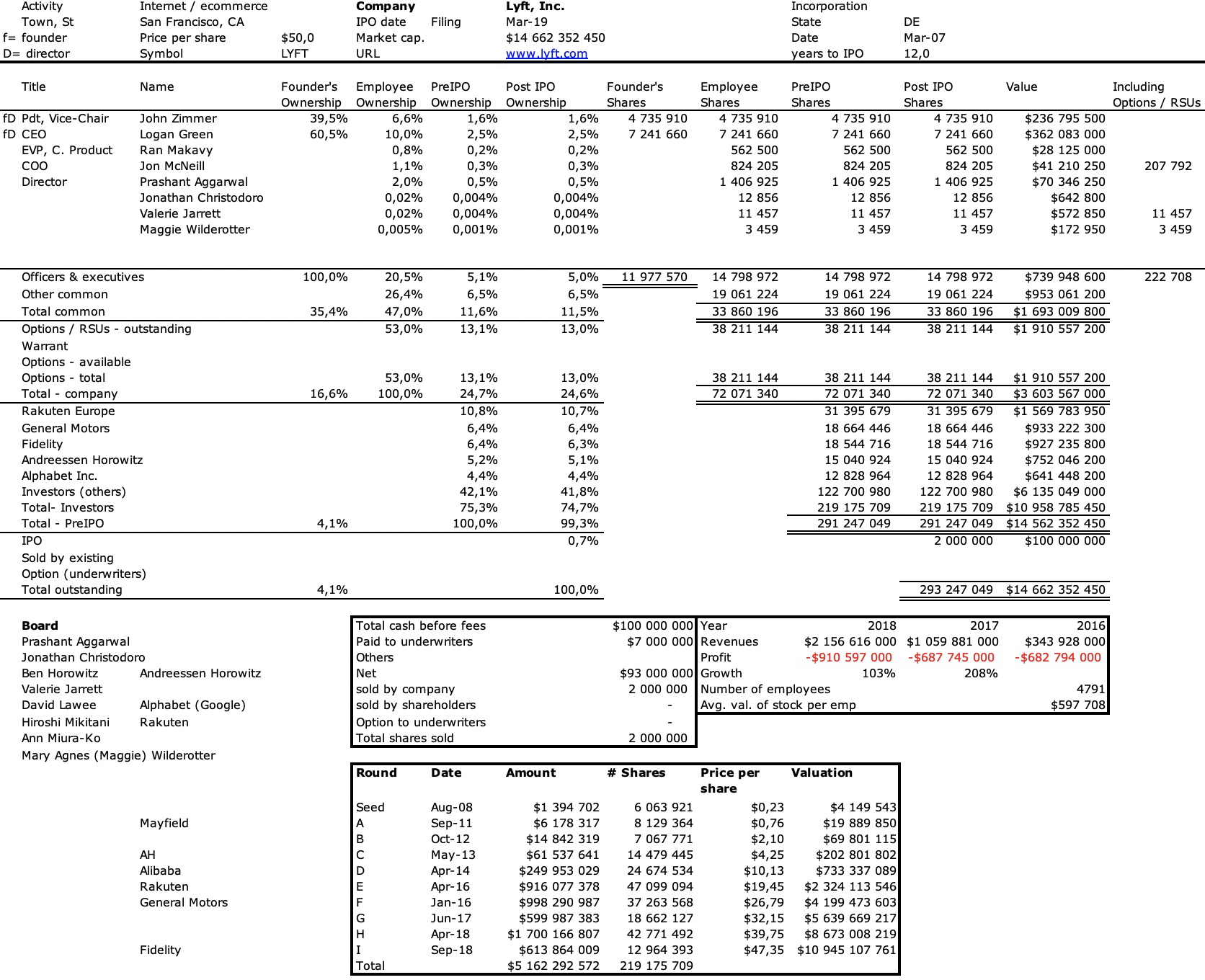
Lyft is the first Unicorn which published its S-1 document, i.e. its IPO filing. Is this good news or bad news? Lyft is impressive, two founders who were 22 and 23 when they co-founded their start-up 12 years ago have reached more than $2B in sales with a little less than 5’000 employees in 2018. This is the good part. The less good piece is it took the company more than $5B in equity investment and the reason is simple: Lyft has lost $900M in 2018, and more than $600M in both 2017 and 2016. This is more than $2B cumulative loss. I assume losses were pretty high in the previous years too. YOu can have a look at the cap. table I built from the S-1:

I read recently an article by Tim O’Reilly: The fundamental problem with Silicon Valley’s favorite growth strategy. O’Reilly has doubts about Reid Hoffman and Chris Yeh’s claiming that Blitzscaling would be the secret of success for today’s technology businesses. “Imagine, for a moment, a world in which Uber and Lyft hadn’t been able to raise billions of dollars in a winner-takes-all race to dominate the online ride-hailing market. How might that market have developed differently?” I have the same doubts about this crazy strategy but who am I to say?…