
Monthly Archives: June 2019

Bill Campbell, the Trillion Dollar Coach (Part II)

A short second post following my recent one, here. Short notes.
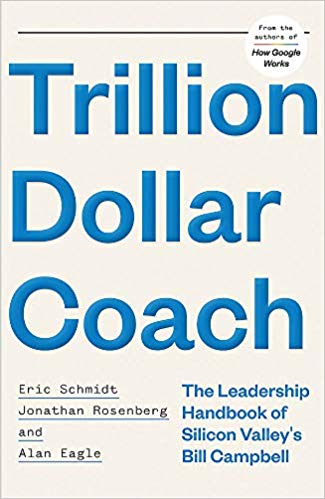
Eric Schmidt and its coauthors emphasize the importance of teams, of people and of products. For example:

“In our previous book, How Google Works, we argue that there is a new breed of employee, the smart creative, who is critical to achieving this speed and innovation. The smart creative is someone who combines technical depth with business savvy and creative flair. […] As we were researching this book and talking to the dozens of people Bill had coached in his career, we realized that this thesis misses an important piece of the business success puzzle. There is another , equally critical, factor for success in companies: teams that act as communities. integrating interests and putting aside differences to be individually and collectively obsessed with what’s good for the company. […] But adhering to these principles is hard, and it gets even harder when you add factors such as fast-moving industries, complex business models, technology-driven shifts, smart competitors, sky-high customer expectations, global expansion, demanding teammates… […] To balance the tension and mold a team into a community, you need a coach, someone who works not only with individuals but also with the team.” [Pages 22-4]

“Bill started his business career as an advertising and marketing guy, then added sales to his portfolio after joining Apple. But through his experiences in the tech world, in his stints at Apple, Intuit, Google, and others, Bill came to appreciate the preeminence of technology and product in the business pecking order. “The purpose of a company is to take the vision you have of the product and bring it to life,” he said once at a conference. “Then you put all the other components around it – finance, sales, marketing – to get the product out the door and make sure it’s successful.” This was not the way things were done in Silicon Valley, or most other places, when Bill came to town in the 1980s. The model then was that while a company might be started by a technologist, pretty soon the powers that be would bring in a business guy with experience in sales, marketing, finance, or operations, to run the place. These executives wouldn’t be thinking about the needs of the engineer and weren’t focused on product first. Bill was a business guy, but he believed that nothing was more important than an empowered engineer. His constant point: product teams are the heart of the company. They are the ones who create new features and new products.” [Pages 67-8]

About teams again, and trust : “Not surprisingly when Google conducted a study to determine the factors behind high-performing teams, psychological safety came out at the top of the list [1]. The common notions that the best teams are made up of people with complementary skill sets or similar personalities were disproven; the best teams are the ones with the most psychological safety, And that starts with trust.” [Page 84]

About talent: Bill looked for four characteristics in people. The person has to be smart, not necessarily academically but more from the standpoint of being able to get up to speed quickly in different areas and then make connections. Bill called this the ability to make “far analogies”. The person has to work hard, and has to have high integrity. Finally, the person should have the hard-to-define characteristic: grit. The ability to get knocked down and have the passion and perseverance to get up and go at it again.” [Page 116]

And finally, may be most importantly, about founders: “He held a very special place in his heart for the people who have the guts and skills to start companies. They are sane enough to know that every day is a fight for survival against daunting odds and crazy enough to think they can succeed anyway. And retaining them in a meaningful way is essential to success in any company. Too often we think about running a company as an operating job, and as we have already examined, Bill considered operational excellence to be very important. But when we reduce company leadership to its operational essence, we negate another very important component: vision. Many times operating people come in, and though they may run the company better, they lose the heart and soul of the company.” [Page 178]

In conclusion, People, People, People.

[1] More details about the study can be found in James Graham, “What Google Learned from Its Quest to Build the Perfect Team” New York Times, February 25, 2016.

The Ideology of Silicon Valley by Fred Turner and Jean-Pierre Dupuy (among others)

Excellent issue of the famous French review Esprit on The Ideology of Silicon Valley. You’ll find contibutions by Emmanuel Alloa, Jean-Baptiste Soufron, Fred Turner, Shoshana Zuboff, Antonio Casilli and Jean-Pierre Dupuy.

I was especially struck by the surprising interview with Fred Turner: Do not be Evil. Utopias, borders and brogrammers. This is in fact a translation from LogicMag, which you can find here: Don’t Be Evil. It is really worth reading! It is his explanation of the roots of Silicon Valley that surprised me the most and how they still influence today this region which in the end is not very ideological, even if the other authors have different points of view.

For example: “It owes its origins to 1960s communalism. A brief primer on the counterculture: there were actually two countercultures. One, the New Left, did politics to change politics. It was very much focused on institutions, and not really afraid of hierarchy. The other—and this is where the tech world gets its mojo—is what I’ve called the New Communalists. Between 1966 and 1973, we had the largest wave of commune building in American history. These people were involved in turning away from politics, away from bureaucracy, and toward a world in which they could change their consciousness. They believed small-scale technologies would help them do that. They wanted to change the world by creating new tools for consciousness transformation.” Then on the influence today: “It varies depending on the company. Apple is, in some ways, very cynical. It markets utopian ideas all the time. It markets its products as tools of utopian transformation in a countercultural vein. It has co-opted a series of the emblems of the counterculture, starting as soon as the company was founded. At other companies, I think it’s very sincere. I’ve spent a lot of time at Facebook lately, and I think they sincerely want to build what Mark Zuckerberg calls a more connected world. Whether their practice matches their beliefs, I don’t know. About ten years back, I spent a lot of time inside Google. What I saw there was an interesting loop. It started with, “Don’t be evil.” So then the question became, “Okay, what’s good?” Well, information is good. Information empowers people. So providing information is good. Okay, great. Who provides information? Oh, right: Google provides information. So you end up in this loop where what’s good for people is what’s good for Google, and vice versa. And that is a challenging space to live in.”

Jean-Pierre Dupuy in “The New Data Science” brilliantly explains there is no data science. Science is about causes, data are more about correlations which can not really help in predictions (I hope I understood his message!). Let me quote one sentence: “The ideology that accompanies big data, meanwhile, announces the advent of new scientific practices that, putting the theoretical requirement in the background, endanger the advance of knowledge and, more importantly, undermine the foundations of a rational ethic.” Really brilliant!

Le bonheur, une idée neuve dans les entreprises ? (selon France Culture)

(Sorry I was too fast, this should have been posted on the French version… where it is also now. For non French-speaking readers, this post is about new management techniques that were born in Silicon Valley…)

J’étais invité ce matin à débattre des méthodes de travail et de management (y compris “l’utilisation du bonheur”) importées de la Silicon Valley. Je mets plus bas (après les tweets) les notes que j’avais prise pour préparer cette émission

Voici les notes que je m’étais préparées.

On ne peut pas mettre dans les même paquet tous les GAFAM. Tout d’abord Amazon et Microsoft qui par coïncidence ne sont pas basées dans la Silicon Valley, mais à Seattle ne sont pas connues pour un management original. Ni Bill Gates, ni son successeur Steve Ballmer, ni Jeff Bezos ne sont connus pour des styles de management innovants. Par contre Google, Apple et Facebook ont sans doute des similarités:
– ce sont des méritocraties et le travail est la valeur “suprême”, plus que le profit, au risque de tous les excès: recherche de performance, concurrence et risque de burn-out. On ne tient pas toujours très longtemps chez GAF
– on y recherche les meilleurs talents (sur toute la planète et sans exclusive, au fond le sexisme et le racisme n’y existent pas a priori)
– le travail en (petites) équipes est privilégié.
Du coup le management a innové pour permettre cette performance et reconnaître les talents (par le fameuses stock options mais aussi une multitude de services pour rendre les gens toujours plus efficaces)

J’aimerais vous mentionner 3 ouvrages (sur lesquels j’avais bloggé pour 2 d’entres eux)
– Work Rules décrit le “people management” chez Google (ils ne parlent “plus” de ressources humaines). L’auteur Lazlo Bock qui fut le patron de cette activité a quasiment théorisé tout cela. Vous trouverez mes 5 posts sur ce livre par le lien: https://www.startup-book.com/fr/?s=bock. C’est un livre en tout point remarquable parce qu’il montre la complexité des choses.

– I’m feeling Lucky décrit de l’intérieur ces manières hétérodoxes de “foncer”. Un pro du marketing montre comment Google a tout chamboulé par conviction / intuition plus que par expérience. https://www.startup-book.com/fr/2012/12/13/im-feeling-lucky-beaucoup-plus-quun-autre-livre-sur-google/

– Enfin un livre hommage sur Bill Campbell vient de sortir écrit par l’ancien CEO de Google Eric Schmidt. https://www.trilliondollarcoach.com. Comme je viens de commencer ce livre, je peux en parler plus difficilement mais il serait dommage d’oublier cette personnalité qui fut le “coach” de Steve Jobs, Eric Schmidt et Sheryl Sandberg, trois personnes majeures pour justement les GAF! Or ce Bill Campbell, décédé il y a 3 ans, fut une personne essentielle à cette culture du travail et de la performance. Ses valeurs sont décrites dans https://www.slideshare.net/ericschmidt/trillion-dollar-coach-book-bill-campbell. Bill Campbell revient de temps en temps sur mon blog pour des anecdotes assez étonnantes. (https://www.startup-book.com/fr/?s=campbell). Par exemple, chez Google on a souvent pensé que les managers étaient inutiles. L’autonomie d’individus brillants devait suffire… mais ce n’est pas si simple! – voir https://www.startup-book.com/fr/2015/09/01/google-dans-le-null-plex-partie-3-une-culture/.

A nouveau excellence des individus et travail en équipe, reconnaissance des talents à qui on donne autonomie, responsabilité(s) avec peu de hiérarchie semble être le leitmotiv… Tout cela on pas pour rendre les gens heureux, mais pour leur permettre d’être plus efficace parce qu’ils sont “heureux” au travail. “People First”. L’objectif c’est de fidéliser, de rendre plus productif, mais c’est aussi une mise en pratique de la confiance en les autres.

Alors comme je l’avais lu chez Bernard Stiegler, à toute pharmacopée sa toxicité. Les excès dans des valeurs conduisent à des abus. Trop de travail, de concurrence, de pression conduit au burnout. J’ai l’impression que la politique et même le sexisme y jouent moins de rôle qu’on pense, même s’il y en a comme partout. Quant au racisme, il me semble limité (et on est aux USA!) Le sexisme est un vrai sujet, mais je vois plus des nerds qui ont peur ou ne connaissent pas les femmes que des “old boy clubs of white men” qui dirigeraient les choses comme je l’ai lu (même si cet élément existe j’en suis sûr). La polémique sur la congélation des ovocytes chez Facebook peut être lue de manière contradictoire j’imagine. J’ai aussi abordé le sujet dans le passé, https://www.startup-book.com/fr/?s=femmes ou https://www.startup-book.com/tag/women-and-high-tech/. L’autre sujet de diversité, est plus clair: il y a tellement de nationalités dans les GAFAs et les startup en général que le racisme est dur à imaginer. Indiens, chinois surtout sont présents et jusqu’au somment (les CEO de Google et Microsoft aujourd’hui). Seule la minorité “African-American” est sans doute sous représentée et on peut imaginer que tout cela est corrélé avec le problème de l’accès à l’éducation (qui existe moins en Asie)

Voilà, c’est déjà beaucoup pour ne pas dire trop… je trouve que commencer par Bill Campbell est une manière simple et efficace d’entrer dans le sujet. Et maintenant que j’y pense tout cela est d’autant plus facilement que vous verrez que mes lectures récentes sont liées au “sens du travail” (Lochmann, Crawford, Patricot) https://www.startup-book.com/fr/?s=travail

Bill Campbell, the Trillion Dollar Coach

I had so often heard of this hidden secret of Silicon Valley that when I read about a book written about him, I had to buy and read it immediately. Which I did. And what about the authors: first and foremost, Eric Schmidt, the former CEO of Google…

I had mentioned Campbell 3 times here:

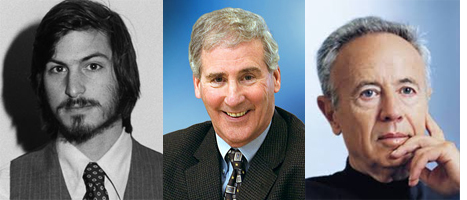
– first in 2014, in Horowitz’ The Hard Thing About Hard Things: there is no recipe but courage. This is there I had Campbell picture just between Steve Jobs and Andy grove.
jobs-campbell-grove

– then in 2015, in Google in the (Null)Plex – Part 3: a culture. This piece is also mentioned in the new book: Google decide management was not needed any more and neither Schmidt, nor Campbell liked it. Here is how it was solved: “The newly arrived Schmidt and the company’s unofficial executive coach, Bill Campbell, weren’t happy with the idea, either. Campbell would go back and forth with Page on the issue. “People don’t want to be managed,” Page would insist, and Campbell would say, “Yes, they do want to be managed.” One night Campbell stopped the verbal Ping-Pong and said, “Okay, let’s start calling people in and ask them.” It was about 8 P.M., and there were still plenty of engineers in the offices, pecking away at God knows what. One by one, Campbell and Page summoned them in, and one by one Page asked them, “Do you want to be managed?” As Campbell would later recall, “Everyone said yeah.” Page wanted to know why. They told him they wanted somebody to learn from. When they disagreed with colleagues and discussions reached an impasse, they needed someone who could break the ties.”

– finally last year, in Business Lessons by Kleiner Perkins (Part II): Bill Campbell by John Doerr.

Not bad references! I am not finished with the Coach. I have never been a fan of coaching and I am probably wrong. Let me just begin. “I’ve come to believe that coaching might be even more essential than mentoring to our careers and our teams. Whereas mentors dole out words of wisdom, coaches roll up their sleeves and get their hands dirty. They don’t just believe in our potential; they get in the arena to help us realize our potential. They hold up a mirror so we can see our blind spots and they hold us accountable for working through our sore spots. They take responsibility for making us better without taking credit for our accomplishments. And I can’t think of a better role model for a coach than Bill Campbell”. [Page xiv]

On the next page, Schmidt explains he may have missed on important point in his previous book (How Google Works) where he emphasized the importance of brilliant individuals, the smart creatives. And this may be the higher importance of teams, as described in Google’s Project Aristotle. I just give a link form the New York Times about this: What Google Learned From Its Quest to Build the Perfect Team. New research reveals surprising truths about why some work groups thrive and others falter.

The first two chapters are devoted to the life of this extraordinary character. A tireless worker, who started as an American football college coach to become the CEO of high-tech companies such as Claris or Intuit before becoming the Silicon Valley star coach. All told on the occasion of his funerals in 2016. If you do not want to wait for my next blog and not buy the book you may want to read the slideshare from the authors, but first you should read his manifesto, it’s the people.

People are the foundation of any company’s success. The primary job of each manager is to help people be more effective in their job and to grow and develop. We have great people who want to do well, are capable of doing great things, and come to work fired up to do them. Great people flourish in an environment that liberates and amplifies that energy. Managers create this environment through support, respect, and trust.

Support means giving people the tools, information, training, and coaching they need to succeed. It means continuous effort to develop people’s skills. Great managers help people excel and grow.

Respect means understanding people’s unique career goals and being sensitive to their life choices. It means helping people achieve these career goals in a way that’s consistent with the needs of the company.

Trust means freeing people to do their jobs and to make decisions. It means knowing people want to do well and believing that they will.