Author Archives: Hervé Lebret

The Next Google?

There’s been plenty of activity in search in the recent years so entrepreneurs are apparently not afraid of Google. Today, a new one appeared, with a lot of Venture Capital: cuil. What is most remarkable is that the founders left Google… good luck!

cuil.jpg

Not related is the release of Ilog being acquired by IBM for $340M. Ilog was one of the European success stories. After the acquisition earlier this year of mysql by Sun, another European company is acquired by an American giant…

ilog.jpg

About the origins of innovations

An interesting article about the origins of innovations was recently published. It looks at the R&D 100 Awards as a way to analyze where innovations come from. There is an interesting analysis about the evolution of economy in general such as:

– Changes in the Place of Scientific Knowledge:

the old distinction between “basic science” and “applied science” is becoming obsolete,

a high degree of consensus that successful technological innovation now requires the assembly and management of multidisciplinary teams,

IBM, Xerox and others may have been the locus of great innovations, but these firms sometimes failed to exploit radical innovations.

– Dramatic shifts in oligopoly capitalism due to new challenges:

mounting competition from foreign firms,

shifts in government regulatory policies,

impact of computerization,

shifts in consumer taste away from standardized products,

shifts within the financial markets.

– The 80’s efforts to:

increase the commercial impact of research such as the Bay Dohle Act,

finance precompetitive R&D (SBIR),

provide technical support to business firms,

support consortia (SEMATECH).

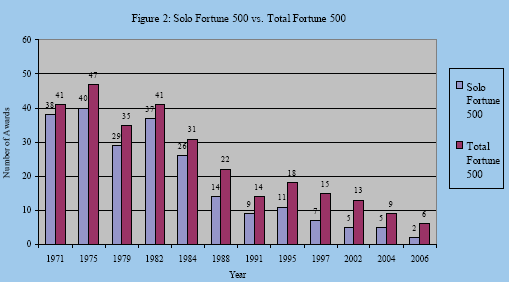
As a result, there has been a shift in the origins of major innovations as illustrated below.

fortune500inno.gif

I would have thought that the shift was in favour of universities and start-ups. The study shows that interdisciplinary collaborations as well as the Federal Laboratories have become the major source of innovations. “Research efforts that involve cooperation between two or more different organizations similarly weaken this hierarchical constraint on thinking outside the box.”

The end of the article is a discussion of the reasons why Fortune 500 companies have been less effective at innovating. Factors seem to be:

big corporations facing relentless pressures from the financial markets have been forced to cut back on expenditures that do not immediately strengthen the bottom line,

the rise of computers and the Internet, have made it much easier for small firms to enter markets previously dominated by large firms,

a change in the employment preferences of scientists and engineers… “it seems quite possible that many talented scientists and engineers have voted with their feet and have left work in corporate labs in favor of work at government labs, university labs, or smaller firms,”

And the authors are quite convinced the USA has returned to “Edison’s model, i.e. successful research organizations, public or private, developing a highly productive mix of internal and external projects.”

As a conclusion, “In the United States, there is no central plan for innovation, and different federal agencies engage in support for new technologies often in direct competition with other agencies. The federal government has created a decentralized network of publicly funded laboratories where technologists will have incentives to work with private firms and find ways to turn their discoveries into commercial products.” There is thus a combination of decentralized networks and targeted federal programs, similar to the venture capital model where many ideas will fail but a small number will succeed. “The enormous gains from the small percentage of winners are more than enough to cover the losses from the others.”

Europe and Silicon Valley

Clearly the topic is hot. Two recent articles address the issue of helping Europe in its efforts. One is in English and was published by the Science-Business Innovation Board. The full text follows. Even if I have some doubts, I agree overall. The other one is in French, was published in Le Monde and can be found on the French version of my blog.

What is interesting is these are both letters signed by credible people. Worth reading.

innovation_100.jpg

Europe needs to focus.

Too many initiatives in the European Union are blunted by lack of clarity – trying to please too many constituencies at once, and in the end pleasing none. Now the EU is about to embark on another policy initiative where clarity and focus are needed. This letter, based on our collective experience in academia, industry and policy, is a plea for single-minded efficiency.

The issue is “cluster” policy – in short: How do you make a Silicon Valley in Europe? After several months of study, the European Commission is due to issue its first formal answer to that question, with a policy statement recommending action to the EU members.

There’s no dispute that clusters of dynamic companies around top-rated universities are vital to economic success. Cambridge, Oxford, Münich, Grenoble, Leuven and Stockholm are all vibrant zones for scientific discovery, technological innovation, and jobs. But large, they are not. Just one US research institution, the University of California–San Francisco in the Silicon Valley cluster, has spawned publicly traded companies with a combined market value of $90 billion – three times the value of Europe’s entire bio sector. China has concentrated resources and tax breaks on three mega-hubs for technology development. Whether by market rule or government fiat, these are clusters big, bold, and concentrated.

By contrast, Europe’s approach is small, timid and diffuse. The EU counts some 2,000 clusters, 70 different national cluster policies, and hundreds of regional programmes. Now it has the opportunity for change. Between 2007 and 2013 the European Union has budgeted €308 billion for structural funds, a type of regional-development “catch-up” funding that can be applied to knowledge networks as easily as to road networks. The EU’s upcoming cluster policy statement, led by Vice President Günter Verheugen, could direct that spending wisely. We urge that it incorporate the following principles:

A CHARTER FOR CLUSTERS

  1. Build on existing strengths. Clusters cannot be planted on bare soil, wherever a politician feels like it. They can only be nurtured in places that have already demonstrated knowledge, skills and growth.
  2. Focus resources. Don’t scatter the money far and wide. Pick just a few of the most promising regions and sectors for support, and provide an environment – family-friendly, multidisciplinary, well-paid – that will attract the brightest minds.
  3. Be open. Encourage the best people, wherever in the world they may be, to work in Europe’s clusters. Promote open competition, among universities, companies and regions, for funding . Promote border-crossing – among people, ideas, scientific disciplines, and industries.
  4. Benchmark, monitor and be transparent. Base funding and regulatory policy, not on the clash of political interests, but on empirical analysis of what’s working and on open competition.
  5. Encourage risk-taking, cross-disciplinary work, bold innovation and experimentation

These are broad principles. One practical idea for implementation is to create Special Innovation Zones in Europe (SIZE).

We urge the EU to designate a few – and we mean just a few – existing clusters to benefit from a new legal status as special innovation zones. It would give them extra cash from that €308 billion structural-funding budget to invest in schools, infrastructure and cultural amenities that attract the world’s top knowledge workers (reversing the “brain drain”) and to stimulate university research, teaching and spin-out company formation. They would get special, temporary dispensation from rules that hamper free movement of people and ideas, such as immigration and labour policies that make it hard for small companies to hire or fire. They could tap seed funding, supported by the EU and managed by investment professionals. They could earn a new, low-tax status reserved for young, innovative companies, and access low-cost, high-quality office space and support services

How would the EU pick these centres of excellence? Through transparent, international, data-based competition, rather than through closed-door, regional politics. Create a council, dominated by non-EU experts on technology, development and education, that weighs competing applications from the regions based on their performance – in hard numbers, per euro spent, of significant inventions, publications, spin-outs, licenses, stock-market flotations, post-doctoral fellows and jobs, and soft analysis of governance, infrastructure, quality of life, and visionary planning. There are already models for this. The newly created European Research Council last year achieved a first: handing out €300 million in research grants based solely on the judgment of international experts. The “cull rate” was ferocious: 97% of applicants were rejected. But the winning 3% were, beyond any doubt, scientifically worthy of funding. If this no-nonsense, expert approach can work in the university sector – interbred and politicized as it is in many EU nations – it can surely work in regional policy.

Time is running out for Europe. The American capital markets, treacherous as they may be, are pouring vast sums into the nation’s technology centres. In South Korea, government investment of $11 billion in the Incheon Free Economic Zone has drawn $49 billion in foreign investment. At the same time, we are all confronted by the urgent problems of global warming and rising energy costs; solutions must be found through research, innovation and entrepreneurship. Unless Europe improves its capacity to innovate, it will miss these opportunities to lead and prosper.

Europe’s politicians cannot afford any longer the luxury of playing big spender to all regions great and small. They need to be bold, brave and selective. They can start with the Commission’s upcoming cluster policy statement.

Signed:

Esko Aho, President, Finnish innovation fund SITRA, and former Prime Minister, Finland

J. Frank Brown, Dean, INSEAD

Jean-Philippe Courtois, President, Microsoft International

Pat Cox, President, European Movement, and former President, European Parliament

Roch Doliveux, CEO and Chairman, UCB

Denis Payre, CEO, Kiala and Co-Founder, Business Objects

Philippe Pouletty, General Partner, Truffle Capital

Alfons Sauquet, Dean, ESADE Business School

Helmut M. Schühsler, Managing Partner, TVM Capital

Harriet Wallberg-Henriksson, President, Karolinska Institutet

Members of the Science|Business Innovation Board

EDA, an industry from Silicon Valley

Penny Aycinena asked me to write a short article in EDA confidential, which summarizes my concerns and hopes about innovation and start-ups. It is published today (June 30, 2008).

eda.jpg

Let me add more here:

The chapter of “Start-Up” which has been the least noticed is Chapter 6. It is one of my favourites though. It is about EDA, which stands for Electronic Design Automation. Today, no architect would design a complex building without software, nor would an automobile engineer. It is exactly the same with digital circuits.

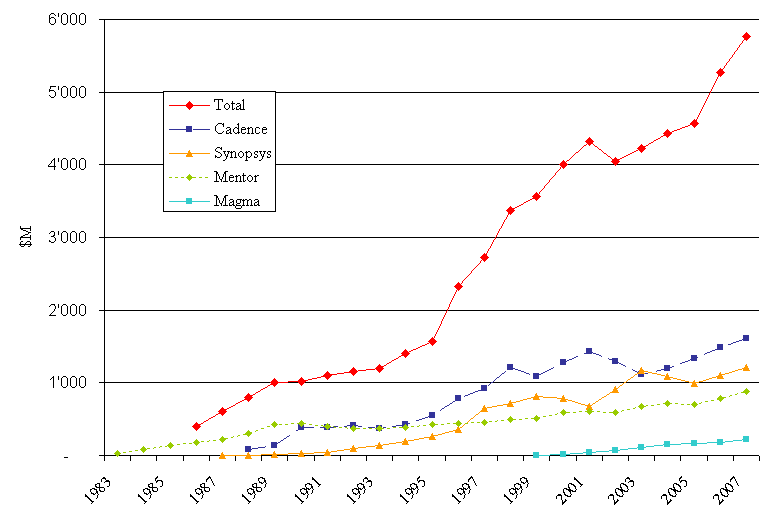
Twenty five years ago, EDA was nearly non-existent. Forty years ago, chips were designed internally (and manually) at IBM, Motorola… and little by little, some new players emerged, tiny start-ups became big and an industry was born. It was more than $5B in revenues in 2007. The typical ebb and flow of start-up creation and acquisition went on for two decades. But since 2001, not much has happened: no IPO, small M&A deals and a few days ago, Cadence, the biggest EDA vendor, announced a hostile acquisition bid against Mentor, the number 3 player. Both companies were founded in the 80s.

eda-market1.gif

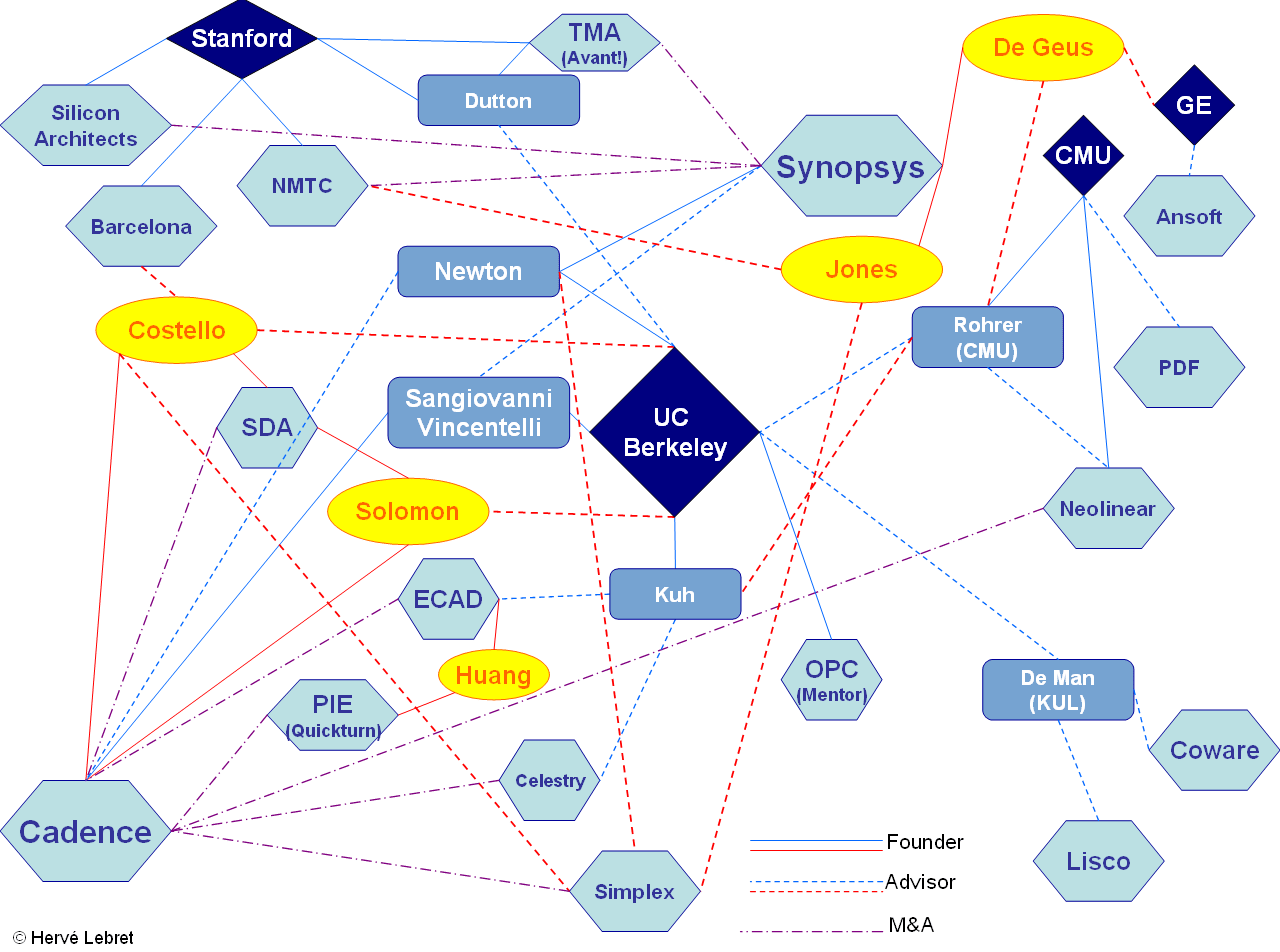
EDA is a good illustration of what Silicon Valley is: a rich network of individuals, academics, entrepreneurs, investors. What is interesting about EDA is that its center is probably Berkeley (rather than Stanford or Sand Hill Road) as the picture below shows. Let me quote again two legends of the EDA field, two recipients of the Kaufman award, the Nobel Prize of EDA:

– “Risk taking in EDA is gone.” Joe Costello

– “If there is a single point I wish to make here today, it is that as a discipline, both in industry and in academia, we are just not taking enough risks today.” Richard Newton

It could be that the maturity of EDA and of Silicon Valley is not such a good sign.


eda-net1.gif

Is there a recipe for entrepreneurship?

Students from the Ecole Hôteliere de Lausanne who naturally have a taste for good food asked me the question recently. I took inspiration from Paul Graham and Steve Jobs to provide the ingredients. The text is available in pdf. Here is the full answer…

stvoi.gif

Is there a recipe for entrepreneurship?

“Launching a start-up is not a rational act. Success only comes from those who are foolish enough to think unreasonably. Entrepreneurs need to stretch themselves beyond convention and constraint to reach something extraordinary.” Vinod Khosla, founder of Sun Microsystems

Europe is aware that it is not as efficient with entrepreneurship as the USA, and Silicon Valley is the extreme illustration of the American model. Google, Yahoo, Apple, Cisco, Oracle, Intel are only a few examples. What are ours? What did we do wrong? My answer is that we have not bet on passionate individuals ready to take risks and face uncertainty: young people who may fail but will learn from their mistakes.

If you are not convinced or surprised with the argument, let me quote some Silicon Valley icons. Steve Jobs said about Silicon Valley success: “There are two or three reasons. You have to go back a little in history. I mean this is where the beatnik happened in San Francisco. It is a pretty interesting thing…You’ve also had Stanford and Berkeley, two awesome universities drawing smart people from all over the world and depositing them in this clean, sunny, nice place where there’s a whole bunch of other smart people and pretty good food. And at times a lot of drugs and all of that. So they stayed… I think it’s just a very unique place.”

The main investor in Apple, Steve Jobs’ company, Don Valentine adds: “Founders are genetically impossible by choice. There were only two true visionaries in the history of Silicon Valley. Steve Jobs and Bob Noyce [Intel’s founder]. Their vision was to build great companies… Steve was twenty, un-degreed, some people said unwashed, and he looked like Ho Chi Min. But he was a bright person… Phenomenal achievement done by somebody in his very early twenties… Bob was one of those people who could maintain perspective because he was inordinately bright. Steve could not. He was very, very passionate, highly competitive.” By the way, Bob Noyce mentored Steve Jobs.

Let me add one more quote by another investor, Tom Perkins: “The difference is in psychology: everybody in Silicon Valley knows somebody that is doing very well in high-tech start-ups; so they say to themselves “I am smarter than Joe. If he could make millions, I can make a billion”. So they do and they think they will succeed and by thinking they can succeed, they have a good shot at succeeding. That psychology does not exist so much elsewhere,”

Quotes may not be any proof, but consider the age of the Silicon Valley entrepreneurs: Steve Jobs was 21, the Google founders were 25, the eBay founder was 28, and the Yahoo founders were 27 and 29. Do not think this is linked to the Internet. Mister Hewlett and Packard were 26 and 27 in 1939 when they founded HP. Founders often come also as a team of two; many are foreigners, immigrants who have something to prove, “hungry people”.

But if we would try to find a recipe, a recipe that Europe could use to bake fresh Entrepreneurs for their economies, what would it be? Paul Graham, an entrepreneur whose blog, www.paulgraham.com, is a must-read, has his strange advice: two main ingredients are needed, rich people and “nerds”. In my recent book, “start-up”, I use his advice for my very own recipe:

– Take rich people and nerds.

– Do not add any bureaucracy, do not add concrete.

– In order to attract and keep enough nerds/cooks in a place, there is a need for a large and nice plate.

A university is a good choice, it needs personality, and it needs to be creative. Not only on its campus, but also in its surroundings, so that the ingredients feel comfortable in the plate.

– The ingredients should be fresh, i.e. they should be young and dynamic.

Graham also mentions liberal environments, which, he claims, tolerate strange and brilliant individuals. [Read again what Jobs said above about SV].

– Then the ingredients have to be put in the oven for a very long time.

Silicon Valley began in 1957. It took ten years, even twenty years, to make this region successful; it is about the time it takes to grow infants into adults.

– The oven should not be too hot, so that the desire is not killed, then the temperature should be increased to maintain the enthusiasm.

A temperate, pleasant climate is therefore necessary.

If all the conditions are in place, the result will probably be interesting.

Lausanne has many assets to become such a place. Lausanne has EPFL, Unil, EHL, IMD. It has rich people. It has a nice climate and nice food, a rich cultural environment. So what we “just” need is the desire to try. Of course, ideas and projects have to be well managed. But first and foremost, we need young people, not afraid of being ambitious. As a final word, I think we should also take more inspiration from Silicon Valley. First, visit the place and understand it better; second, invite back the Europeans who live over there and have experienced this unique culture. We have to learn from them. So you have my recipe for entrepreneurship. The recipe for success is more an Art than a Science and listen again to what Steve Jobs said in 2005 at the first graduate diploma ceremony he ever attended: “Stay foolish, stay hungry.”

Sources:

Paul Graham and Silicon Valley
http://www.paulgraham.com/siliconvalley.html

Steve Jobs at Stanford
http://news-service.stanford.edu/news/2005/june15/jobs-061505.html

“Start-up, what we may still learn from Silicon Valley
https://www.startup-book.com

Innovation: the driving force in business?

The Ditchley Foundation is a strange thing for a non-British I assume. I attended in mid-May a workshop on Innovation where gentlemen (and not many women as it is common in technology) discussed about innovation in a beautiful18th century castle!

ditchley.gif

The discussions were relaxed, friendly but serious and passionate. The main lesson I learnt is that clearly innovation is still seen as a process for established institutions and not really as what start-ups do best. For those interested in a refreshing view on the topic, the synthesis produced by the chairman of Ditchley is of real interest and available online.

An Ode to Disorder

Too much organization harms Innovation

nouveleco.jpg

These are the title and subtitle of a brilliant paper (inFrench only) by Julien Tarby in the Nouvel Economiste dated June 5, 2008. His article echoes my worries about innovation in Europe. His analysis is really interesting. Among other examples, he quotes:

Samuel Kortum et Josh Lerner: 1 euro invested in venture capital has a 10x return over 1 euro spent in the traditional R&D of companies

Pascal Picq, a paleo-anthropologue, who develops the evolution theory applied to the enterprise: start-ups which adapt to survive are Darwinian. “Unfortunately the French education system remains Lamarckian, and considers that organizations improve in a development scheme (administration, big companies). It is the country of the planned projects (planes, trains) and not of disuptions. This culture of the norm does not tolerate variability, trial and error and it induces the development of the [existing] fields of excellence and not the creation of new fields.”

If you read French, and because it is free, you shoud run and download it!

Spain has a passion for Innovation

I had the pleasure to be interviewed on the book “Start-Up” by Doris Obermair. The text is available in Spanish as well as in English in the magazine If… La Revista de Innovation : Más pasión y sueños, menos infraestructura y experiencia (english version)

if.gif

and the video (in English) is available on the web site Infonomia.

infonomia.gif

Finally, I will attend the Ifest conference on July 10-11 to talk about the topic of my book. Because of the diversity of the attendants, I think it will be a great event.

ifest.gif

Founders at Work

Another great book, so great I decide to write this post even if I have not finished reading it: Jessica Livingston in Founders at Work has interviewed 32 entrepreneurs about their story. The lessons are convincing, fascinating. Without asking for copyright, I copy here some quotes. The book is just a pleasure to read even if sometimes the Q&A are too specific about the start-up, but I assume it is part of the exercise. A Must-Read.

foundersatwork.jpg

Paul Buchheit, creator of Gmail about Risk Taking

As I say, for people, it depends on their situation if they can take that risk of joining a startup or moving to a new city if they don’t live in the right place. For me, I was actually single at the time, I didn’t have a mortgage, so the idea of joining a little startup that may well be destroyed was just like, “That will be fun.” Because I kind of thought, “Even if Google doesn’t make it, it will be educational and I’ll learn something.” Honestly, I was pretty sure AltaVista was going to destroy Google.

Mike Ramsay, founder of Tivo about Silicon Valley

I was curious to see what’s the attitude of a typical startup in Scotland compared to here. I found that they are just culturally a whole lot more conservative and cautious. And somewhat lacking in self-confidence. You come over here and . . . I had a meeting recently with a couple of early 20-year-olds who have decided to drop out of Stanford because they got bored, and they are trying to raise money to fund their startup. They believe they can do it, and nothing’s going to hold them back. They have confidence, they have that spirit, which I think is great and is probably unique to this part of the world. Being part of that for so long, for me, has been very invigorating.

Joshua Schachter, founder of del.icio.us about implementing

But the guy who says, “I have a great idea and I’m looking for other people to implement it,” I’m wary of—frequently because I think the process of idea-making relies on executing and failing or succeeding at the ideas, so that you can actually become better at coming up with ideas.

and about VCs

In general, I found VCs to be significantly politer than the folks I worked with. The worst they did was not call me back. I’d never hear from them again. Brad Feld does a nice blog talking about how the VC process works. He says they never call you back to say no—they don’t want to close the door in case they want to open it again, but they don’t want to actually give you a response. Very few VCs actually said, “Sorry, we’re not interested.”

Craig Newmark, founder of craiglist on the definition of start-up

“in the conventional sense, we were never a startup. In the conventional sense, a startup is a company, maybe with great ideas, that becomes a serious corporation. It usually takes serious investment, has a strategy, and they want to make a lot of money.”

PS : June 2024. I published a post about foudners and remembered the notes I used with my students at the time. here they are 16 years later…

Founders at Work - May08