Author Archives: Hervé Lebret

The DNA of Innovation

John Hennessy

They are not many, those who can talk about innovation as well as John Hennessy, President of Stanford University, start-up founder such as MIPS and Atheros, board member of Cisco and Google. He is also a world-renowned specialist in computer science.

In a recent column of the Stanford Magazine, “the DNA of Innovation”, he mentions the three ingredients that are central of a spirit of innovation:

people, a diverse mix of talents and approaches

an environment that promotes risk-taking and innovative thinking

a university must be adept at transferring knowledge to organizations that have the ability to convert that knowledge into something with broader impact.

The full article is worth reading. I also scanned it in pdf format.

Cap. Table: Kelkoo

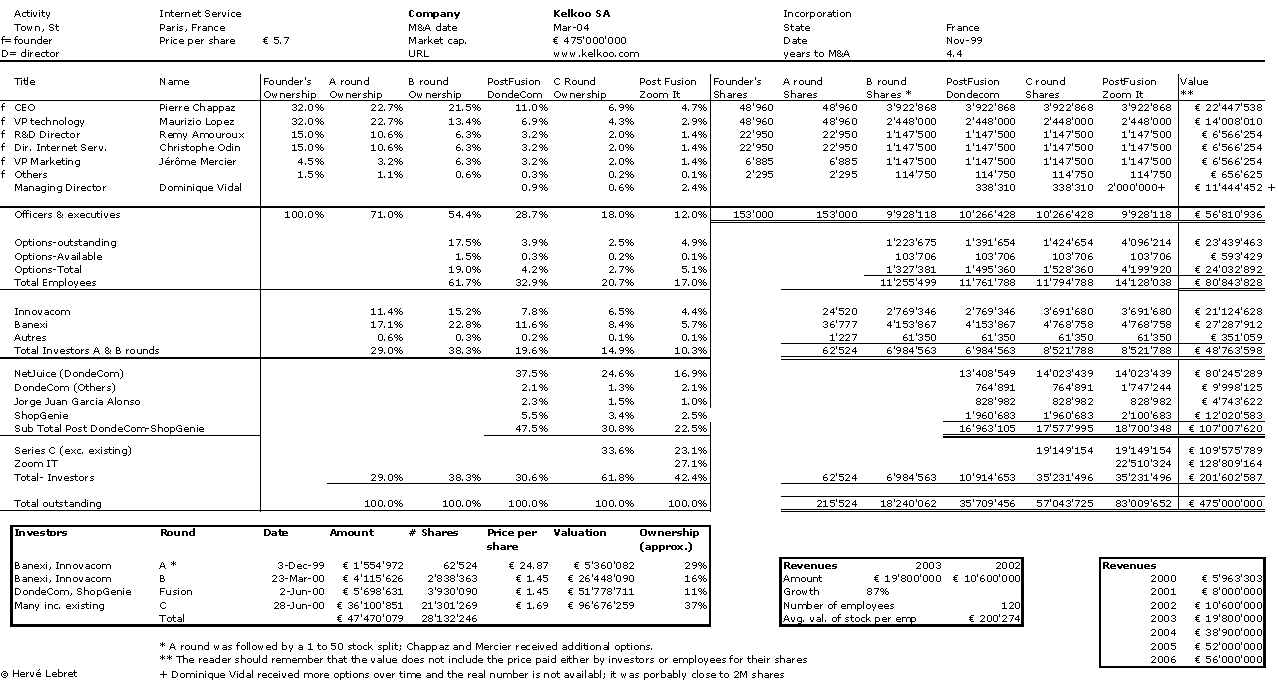
Kelkoo is a great case study. It was one, not to say the, success story of the Internet in France and even in Europe. It was acquired by Yahoo for €475M in 2004. It was extremely ambitious from its foundation and had an amazing pan-European strategy thanks to acquisitions in Spain, the UK and Scandinavia: DondeCom, Shopgenie and ZoomIT. Kelkoo raised more than €45M in less than 12 months! Therefore the founders faced a huge dilution linked to three rounds of financings and these three mergers & acquisitions (“M&As”).

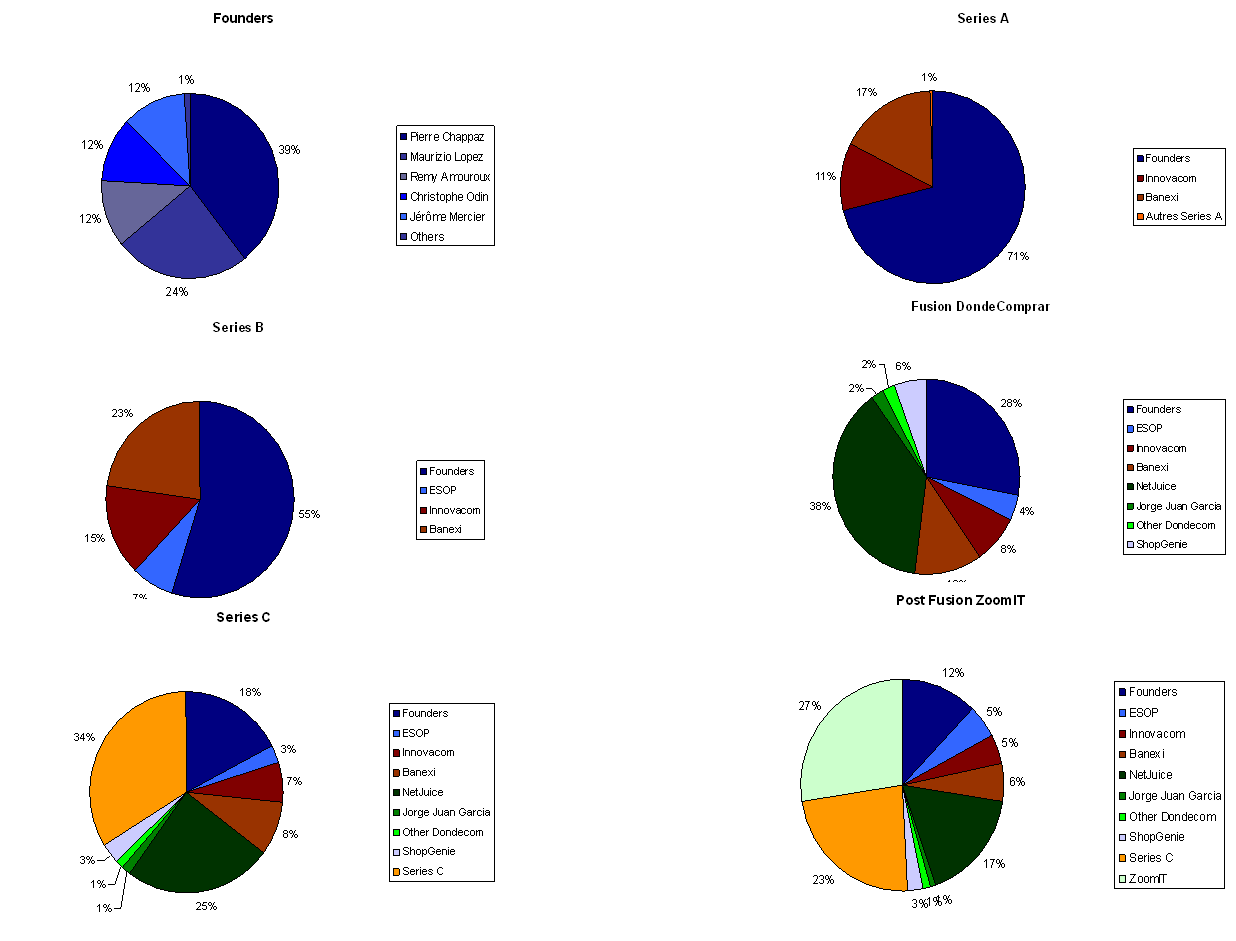
The capitalization table and the figures below show the evolution of the numbers. I am aware that these data are dry, tough to read, but if the reader accepts to follow me, he or she may find them of interest. Let us begin by the last table which describes the financing rounds. In 1999, Kelkoo was founded by five individuals (Chappaz, Lopez, Amouroux, Odin and Mercier) and immediately financed by two venture capitalists (“VCs”): Banexi and Innovacom. The two funds provided €1.5M in December 1999 (A round) and then a little more than €4M in March 2000 (B round). There is an important detail to notice: there was a 1 to 50 stock split between the two rounds; it explains the huge difference in the numbers as well as the fact that the price per share of €24.67 of the A round is equivalent to €0.50 after the split. The price per share of the B round was €1.45. The five founders had shared their stock as 1/3 to Chappaz, 1/3 to Lopez and the remaining between the three others. However options were granted to Chappaz and Mercier at B round to give a new founders’ balance. The pies below give therefore different ratios. Dominique Vidal is not a founder but was working with Banexi when Kelkoo was founded. He joined the founders to become a managing director and received initially 338’000 shares. He received more shares with time but the final number is not known (so I make an assumption in his case). Finally a stock-option plan was created to incentivize employees. Those had virtually 19% of the company at round B. We were only in March 2000 and the data are already complex. The capitalization table can be read on the right part with number of shares or on the left part as percent of the company.

(Click on pictures to enlarge or download)

kelkoo.gif

The situation is even more complex with the acquisitions. First DondeCom (Spain) and ShopGenie (UK) in June 2000. Kelkoo kept about 50% of the shares and the new entrants the other 50%. Also in June 2000, Kelkoo raised its C round of €30M. In September another €6M were raised with the same terms. Initially the price per share was €1.99. But there was a major condition: Kelkko had to provide an exit, a liquidity event to the investors in 2001 or the price per share would decrease to €1.70. There was no IPO or M&A for Kelkoo, i.e. no exit, so that the investors received free shares to reduce the price per share. This implies a valuation of €96M for the C round and the investors of that round owned 37% of Kelkoo. Then came the ZoomIT acquisition, which gave a little less then 30% to the new comers.

Yahoo bought Kelkoo for €475M meaning a price per share of €5.7 if the reader accepts that the total number of shares is correct. The last column therefore gives the value of their shares for all stockholders (but it does not indicate it much these cost; this cost would have to be deducted to know the profit before tax). I can not be too far from real numbers but as I said with my previous examples (Skype, mysql) these numbers are never sure at 100%. The capital increases are however well described in documents from the register of commerce that I bought for this study. The exact number of exercised shares is however unsure. These documents were my only source of information for this study. The history of Kelkoo is also written in the book “Ils ont réussi leur start-up” at Village Mondial (Pearson France). Pierre Chappaz is today the CEO of Wikio and is also the author of an excellent blog, Kelblog. Finally, Pierre made a great presentation of his stroy at EPFL in 2005.

Source: www.euridile.fr

(Click on pictures to enlarge or download)

kelkoo-share.gif

Stanford and Start-Up

soe1.gif

Is there anything nicer than being interviewed by your Alma Mater. The Stanford School of Engineering asked me why I wrote “Start-Up” and for whom. You will find it on the Stanford SOE web site. I tried to explain that the book is not (only) about the innovation infrastructure which failed in Europe but (mostly) about the need to encourage young individuals in taking more risks. A debate about nature and culture which I develop at length in the book.

Cap. table: Skype

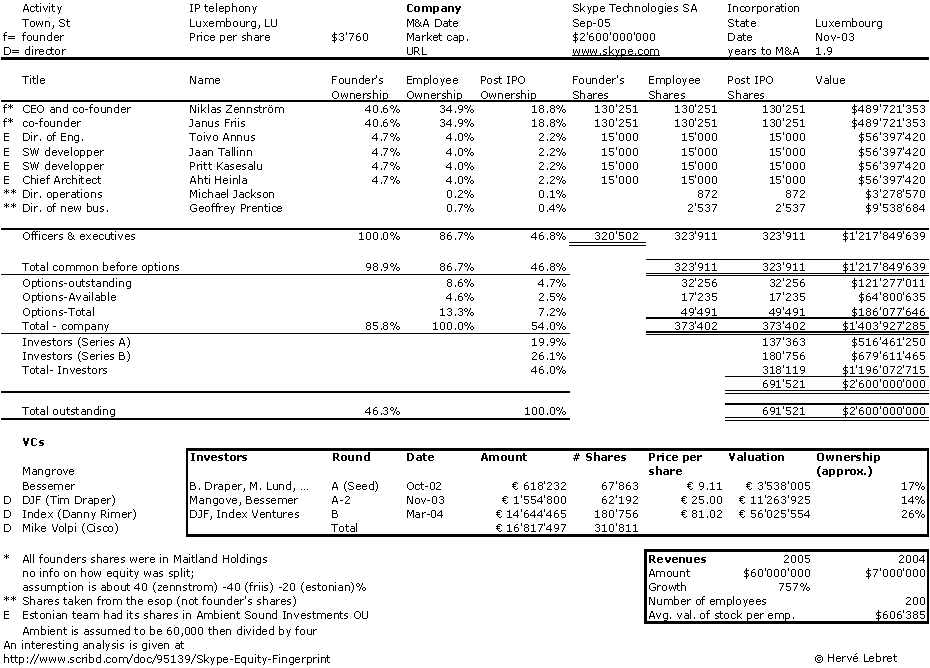
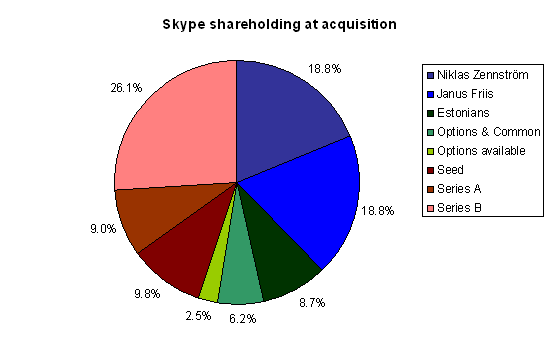
Following the mysql case, here is the Skype capitalization. Skype was founded in November 2003 and acquired by eBay in September 2005 for about $2.6B. The deal was complex as it had a cash component as well as an equity one and because there was an upside potential, up to $4B. The SEC document said “Skype shareholders were offered the choice between several consideration options for their shares. Shareholders representing approximately 40% of the Skype shares chose to receive a single payment in cash and eBay stock at the close of the transaction. Shareholders representing the remaining 60% of the Skype shares chose to receive a reduced up-front payment in cash and eBay stock at the close plus potential future earn-out payments which are based on performance-based goals for active users, gross profit and revenue.” In October 2007, eBay announced the final earn-out to be $530M. I consider here the acquisition was $2.6B.

The two founders, Janus Friis (Danish) and Niklas Zennström (Swede) were the previous founders of Kazaa and had created a holding company, Maitland Holdings, which would own their founder’s shares in Skype. It is not clear if other people had shares in Maitland and I made the assumption that the team of Estonian early developers (Toivo Annus, Jaan Tallinn, Pritt Kasesalu and Ahti Heinla) had such shares but it is possible they had options only. Because the sharing is unknown, I plainly assume that the two founders had about 40% each and the Estonians shared equally the remaining 20%. This is not fully consistent with SEC documents where the Estonians seem to have 5.6% of the eBay shares at acquisition. But I could not find hard facts. However the number of common shares, stock options and preferred A and B shares comes from Legilux, the Luxembourg register of commerce and is therefore correct (see sources below).

Skype had two main rounds and also a seed round before the creation of the company (a convertible loan). The Legilux documents help is assuming that Skype raised €600k of seed money in 2002-2003 with Bill Draper and other angels, its first round of €1.5M in Nov. 2003 (led by Mangrove and Bessemer) and a €14.5M B round in March 2004 (led by DFJ and Index Ventures). The number of shares and the amounts in each round imply in each case a specific price per share.

Skype seemed to have a strong board with its investors, Tim Draper (DFJ), Danny Rimer (Index) and Mike Volpi (Cisco). Volpi later became CEO of Joost, Friis and Zennström’s new venture. Skype had about 200 employees at acquisition; its revenues were $7M in 2004 and expected to be $60M in 2005.

Click on pictures to enlarge or download

skype.gif

skype-share.gif

Sources: SEC, Legilux, Kazaa and Skype, Eestit Ekspress

Next posts: Kelkoo, Addex.


Nurturing Science-based Ventures

Nurturing Science-based Ventures – An International Case Perspective by Seifert, Ralf W., Leleux, Benoît F., Tucci, Christopher L.

nsbv.jpg

A new book about start-ups has recently been published and it is mainly centered on Swiss (including EPFL) ventures. The authors do indeed have a strong knowledge of this environment as they are faculties from IMD or EPFL. What is unique with this book is that it does not describe success stories only, but also failures or not famous firms. Indeed failures are often better lessons than successes. You do not always know why you succeed and it may be easier to understand a failure. The authors have built their book as a process and describe in detail the development of start-ups; they begin with the opportunity recognition (chapter 1), they follow with writing a business plan (chapter2), financing a start-up (chapter 3), growing a company (chapter 4) to finally harvesting value creation (chapter 5). The final chapter is dedicated to corporate entrepreneurship (“Intra-preneurship”). I have not read it yet (it is more than 700 pages!) but the numerous case studies (more than 20) look rich and detailed. It is not the first book on the subject but it might be the first one with such a focus on European start-ups.

Cap. table: mysql

As a follow-up to my recent post on Scandinavia, I begin, with mysql, a series of posts which are close to Chapter 3 “Founders of start-ups”: it is quite interesting to analyze the capitalization table of a start-up at an exit event (IPO or M&A). Entrepreneurs and employees may learn there what to expect in terms of dilution because of investors, stock-option plan. The recent acquisition of mysql by Sun Microsystems for $1B shows that there are European success stories. Interestingly enough, mysql follows Skype, another Swedish start-up. Also of interest, let me add that founders were Swedes but not only (Danish for Skype and Finnish for mysql). Luxembourg was used as a base for the founders’ equity. The article “Focus on Sweden” recently published by the Library House in Cambridge shows the importance of Scandinavia and the Baltic countries. You, reader, may not remember, but Scandinavia had very nice success stories such as Navision, Qeyton, Altitun. The Trolltech acquisition by Nokia recently is another even if smaller example.

Let me come back to mysql. In the same way I built data about many success stories in chapter 3 and 8 of “Start-Up”, here is some data point about mysql: mysql (as a project) was formed in 1987 by three founders, two Swedes and a Finn: David Axmark, Allan Larsson and Michael “Monty” Widenius who had worked together in the 80’s. Marten Mickos, their CEO, joined the company in 2001. In 2001, mysql also raised its first round ($1M) led by ABN Amro. It then raised $19.5M in June 2003 with Benchmark and Index. In February 2006, a final round of $18.5M was led by IVP, and included Intel, Red Hat, SAP. Though an open-source company, mysql generated revenues through support, maintenance. The growth is impressive. (Disclaimer: the numbers are subject to errors as the company was private and did not communicate about its revenues. I found these numbers on the web)

Year Revenues
2002 $6’500’000
2003 $12’600’000
2004 $20’000’000
2005 $34’000’000
2006 $50’000’000
2007 $75’000’000

The board of the company included strong personalities such as Bernard Liautaud, founder of Business Objects and Tim O’Reilly. Finally, the capitalization table at the time of acquisition is probably not far from the one below. I had to use different (public) sources to build the table but just as with revenues, these numbers might be subject to errors.

Click on pictures to enlarge or download

mysql.gif

mysql-share.gif

Sources: Di.se Legilux

Next posts should be about Skype, Kelkoo, Addex.

Finland

I am not the only one complaining about the weakness of Europe in terms of start-ups. Juha Ruohonen compared in his report VICTA (www.tekes.fi/en/document/42911/victa_pdf) the situation of Finland and Israel and he reaches similar conclusions to mine: not enough growth companies, a lack of ambition, and too many lifestyle companies.

His comparison table is self-sufficient:

finland-data.jpg

And his analysis of the reasons for problems are:

finland-probs.jpg

Finally his conclusions: There is a clear need in Finland:

  • To create a viable high-growth ecosystem
  • To multiply the number of VC capable growth companies
  • To eliminate the waste of resources to lifestyle companies
  • To provide a viable platform for fast international growth
  • To increase the corporate involvement and the number of corporate spin-offs/-outs
  • To better facilitate the transformation from research project into a fast growth start-up.

This can be achieved by:

  • shifting focus from quantity into quality
  • moving from project-based development to efficient long-term structures
  • creating structures to enable success of commercial players
  • attracting much more international talent into Finnish early-stage community.

My comment: you can replace Finland by Europe and the analysis is the same. Solutions are complex no doubt but I would add that betting on youth, on risk taking is essential (the “Stay Foolish, Stay Hungry” explained by Jobs, see the July 07 post) and that international exchange must also include discovering what exists abroad.

Taking Risks

The Stanford Venture Technology Program is one of the best source of info I know about start-ups. In one of their recent newsletter, they mention a video of Vinod Khosla (a co-founder of Sun Microsystems and former venture capitalist with Kleiner Perkins). STVP summarizes his views as follows:

khosla.jpg

“Launching a start-up is not a rational act. And Vinod Khosla, a partner in Kleiner, Perkins, Caufield & Byers and former Sun Microsystems CEO, believes that success only comes from those who are foolish enough to think unreasonably. Entrepreneurs need to stretch themselves beyond convention and constraint to reach something extraordinary.”

The Art of the Start

The Art of the Start is a great book because it inspires. Guy Kawasaki, the author, does tell you how to build a convincing vision, a convincing pitch. It is not about writing a 40-page business plan. It is about the “value of making meaning” which may induce making money. The book is clear, simple and once you have read it, you will not see things the same way… go, run and buy it!

A brief quote from the book which illustrates why start-ups are important.

“Innovation often originates outside existing organizations, in part because successful organizations acquire a commitment to the status quo and a resistance to ideas that might change it” – Nathan Rosenberg.

The Man Behind the Microchip

The Man Behind the Microchip is one of the best biographies about technology and entrepreneurship. This book is a pleasure to read from beginning to end. It is full of important facts about Silicon Valley, its history and its development.

I will just quote Robert Noyce, the hero of this book, founder of Fairchild and Intel:

Look around who the heroes are. They aren’t lawyers, nor are they even so much the financiers. They’re the guys who start companies

and also author Leslie Berlin adds:

Noyce testified against an industrial policy managed by the Federal government. He referred to his own experience with Apple to strengthen his argument: “If I was not capable of identifying the future champions of technology, how could we believe that the government could do better?”

This a must-read book for anyone interested in start-ups and high tech.