Tag Archives: Tech Giants

Research and Development (R&D) in Tech Startups (vs. Sales & Marketing)

This strange post was motivated by my colleague Antoine (thanks!) who asked me what I thought of a recent article which claimed that in startups, technology is not as important as many think. The article is in French Pourquoi, dans les startups, les moins techniques gagnent souvent and was written by Manu Papadacci-Stephanopoli.
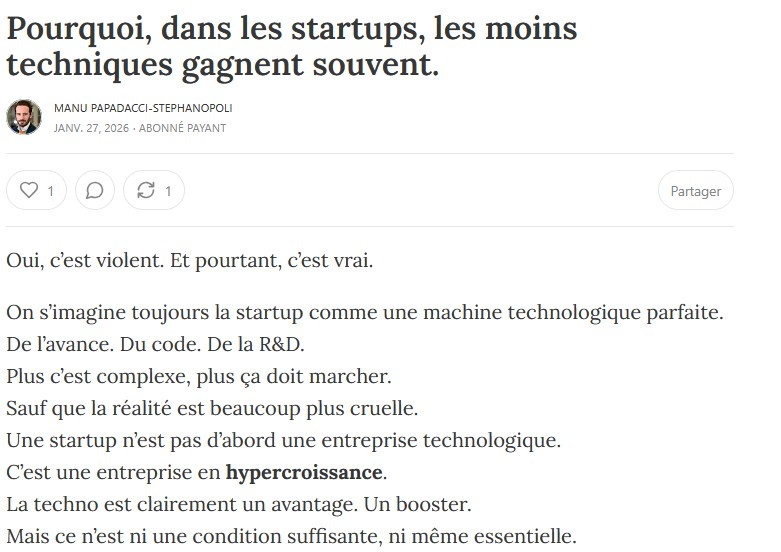
So let me translate the claim : in startups, the least technical often win. Yes, it’s harsh. And yet, it’s true. We always imagine a startup as a perfect technological machine. Ahead of the curve. Code. R&D .The more complex it is, the better it must work. Except that reality is much harsher. A startup isn’t primarily a technology company. It’s a hypergrowth company. Technology is clearly an advantage. A booster. But it’s neither a sufficient condition, nor even essential.

I never really thought deeply about it, probably because I fully agree and learnt this during my VC years. Technology is important but it is far from sufficient. And selling is tough. Google was the best example that “First mover adavantage was a myth”. So I agree again with Manu Papadacci-Stephanopoli when he adds later “In its early days, Google didn’t have the best algorithm for linguistic analysis. Its competitors were more advanced. But Google exploited something else: metadata, hyperlinks, the famous “backlinks,” the collective intelligence of the web. Less spectacular. But simply more effective.” (À ses débuts, Google n’avait pas le meilleur algorithme sur le plan linguistique. Ses concurrents étaient plus avancés. Mais Google a exploité autre chose : les méta-données, les liens hypertexte, les fameux “back-link’, l’intelligence collective du web. Moins spectaculaire. Mais juste plus efficace).

So I had to go one step further, dig deeper and here is my analysis.

20260228 Equity List Lebret

Some of you may know I am a kind of crazy data cruncher. I love data. They provide food for thought. Since 2008, when I published my book, I have been compiling data about startups such as cap. tables. I have now 978 such tables and the last time I published about them was in July 2025 and June 2024. I will celebrate with a long update when I reach 1000 but I have been slow recently with about 20 new tables per year. So we’ll see if the celebration will be in 2026 or 2027.

I studied something new here which is the R&D intensity in technology companies and startups. Let me develop. Most of the techology companies I study went public or at least filed to go public at some point in their history. Some were still startups (they might not have validated their business model), some were not anymore. But as technology companies, they often publif the level of R1D investments, but also the level of their expenses in sales & marketing (S&M). As I have data of companies since the 1960s, it would not be fair to look at absolute numbers in $M. SO i tried to llok at relative numbers, the ratio of R&D and S&M compared to total revenues. When the revenue was zero or very weak, this ration does not mean much so I also study the ratio of R&D vs. S&M.

For example, as a first illustration, let us have a look at “my giants”.
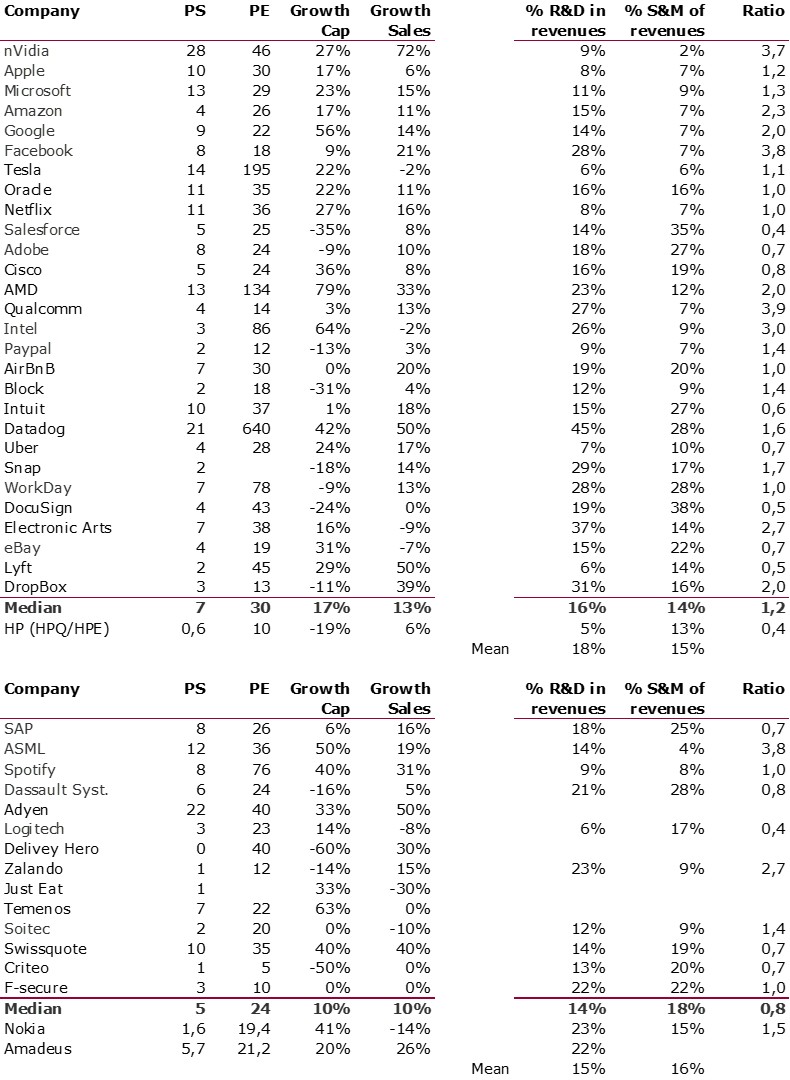
It’s no easy to draw conclusions from this first series. Except that for these “technology giants”, R&D is not as high as I would have thought. R&D is on average close to 15% and rarely at the 25% that I thought common. Still R&D is in general higher than S&M. This relatively low levels are probably linked to the fact that these companies have huge revenues, very high profitability and there is a limit to what you can spend in R&D and S&M.

Now let us have a look at the data from the 978 startups.
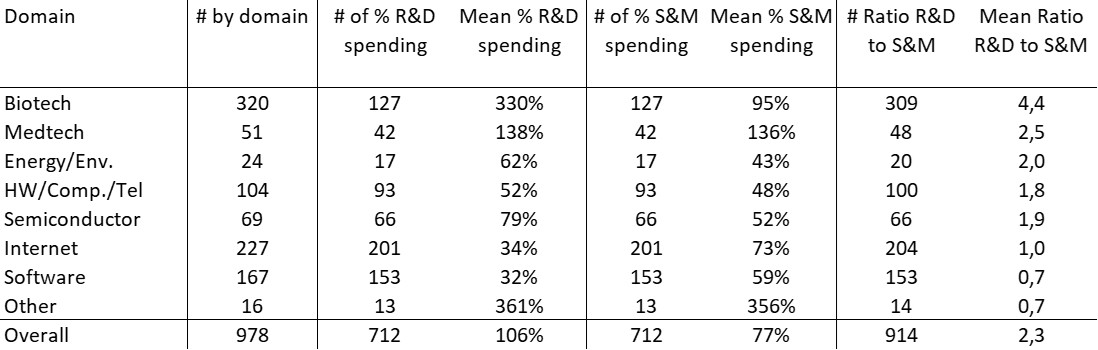
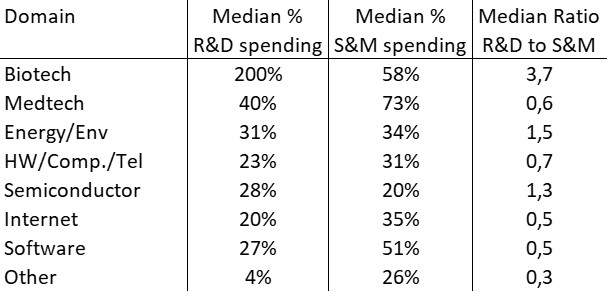
So whether I look at the mean or median, R&D is really high in tech startups. But Sales & Marketing is really high too. It is not sufficient to build things. There is a huge effort to sell them.

Second, the R&D intensity (as well as S&M) is particularly high in Biotech and Medtech. However this probably come form the fact that the revenue levels are lower in these fields at UPO.

Third, the R&D intensity is the lowest in Software and internet probably because there is less need for R&D but S&M is relatively higher and this shows to in the relative ratio which is 0,5 for the media value of both.

No conclusion but an important Post-scriptum

I will not draw any conclusion but indicate a number of caveats :

– in many cases, R&D is not strictly mentioned but sometimes replace by technology development or product development. Probably for good reasons : in startups, it is not clear there are available resources to do strictly research.

– in many cases, sales and marketing is not mentioned and replaced by selling, general and administration, or even general and administration only. This probably means the focus on sales and marketing is not high enough to be considered separately. In that case, I took what was available.

Tech giants : nothing changes but their names !

I love data and I love analyzing them at the micro (cap tables) and macro level (revenues, income, employees). But I am surprised to discover that I had not posted about this since 2021:
Tesla, Google and Facebook do not suffer from the crisis showed the growth of these giants as of February 2021,
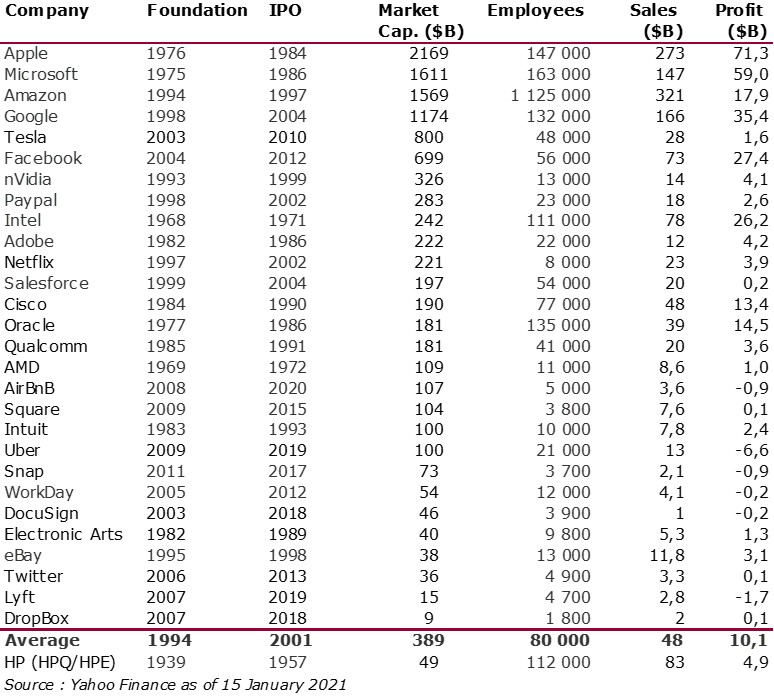
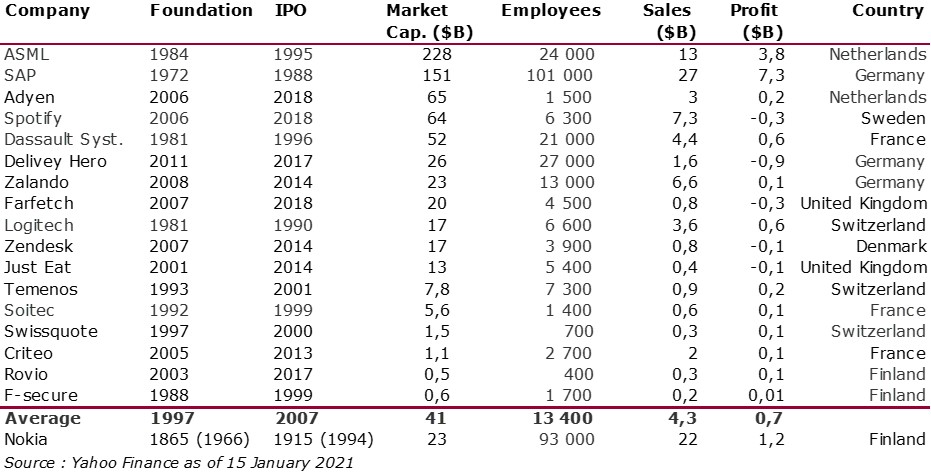
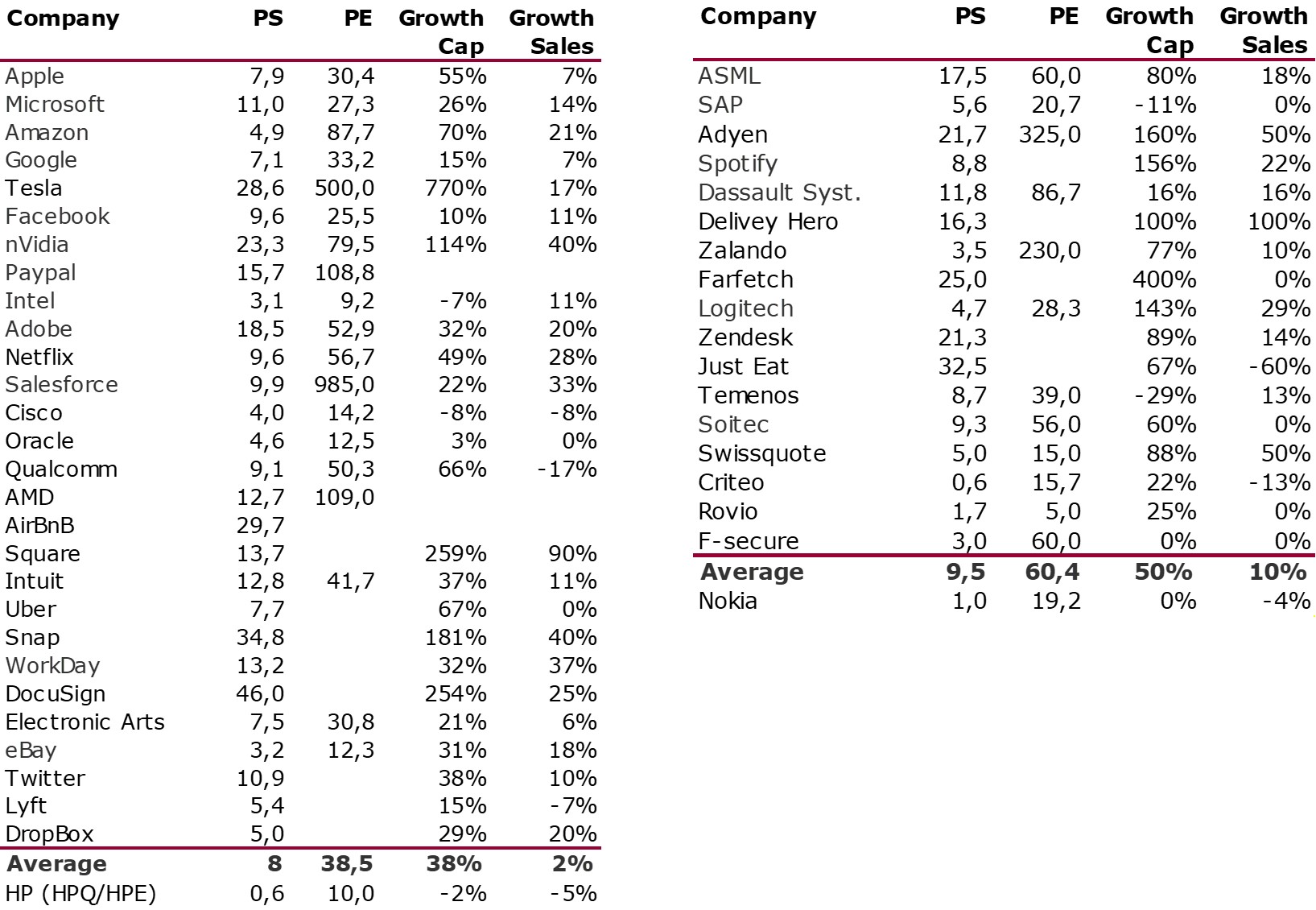
The largest technology companies in Europe and the USA in 2020 compared about 30 American and 15 European public firms as of January 2021.

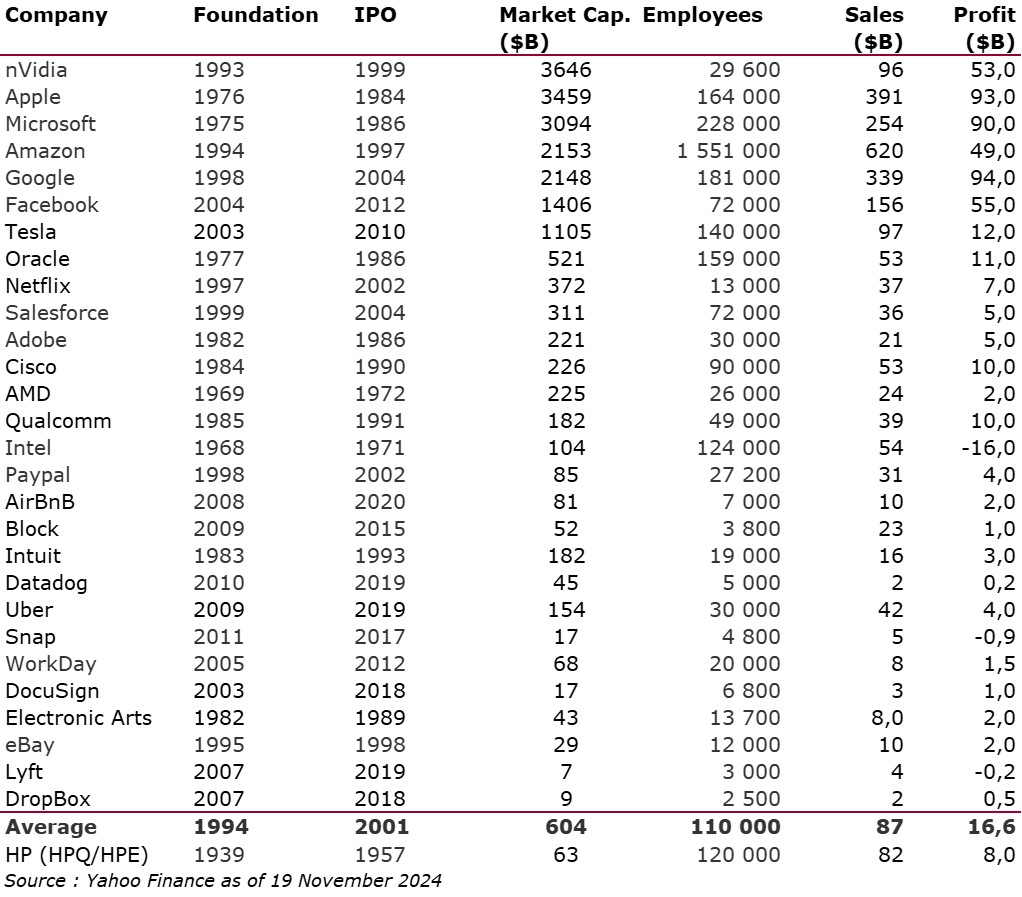
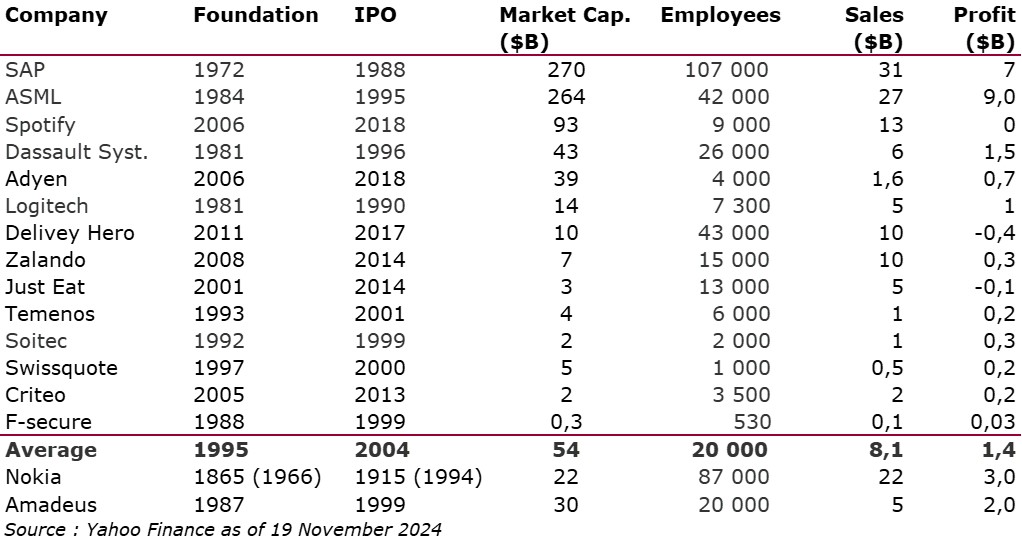
What I have updated below does not see much change, except may be Google is Alphabet and Facebook is Meta. Tesla has not changed its name but Twitter is X! So with not much comment, here are first the largest technology companies in Europe and the USA in 2024 :


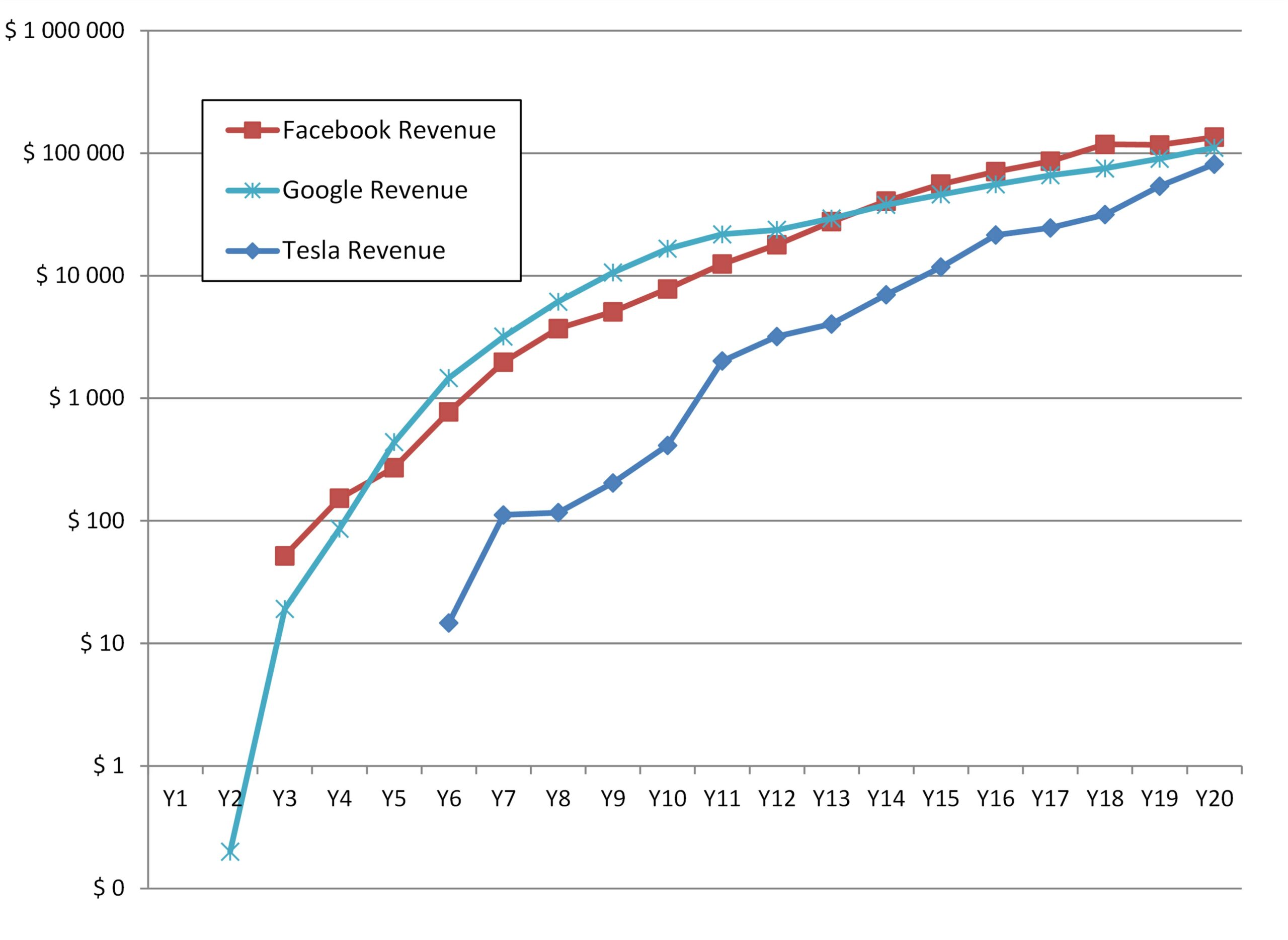
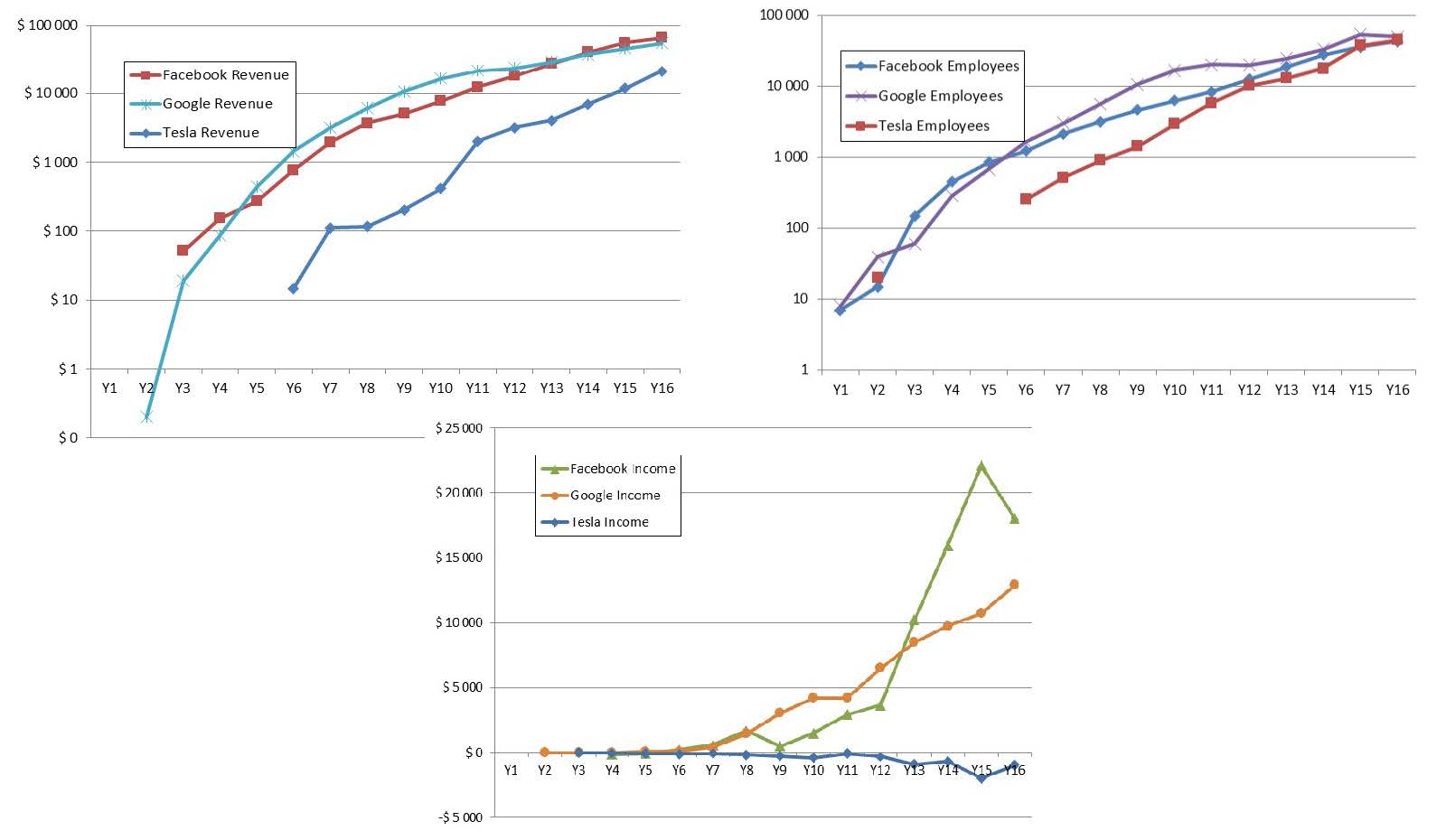
The conclusion is similar, US companies are about 10 times bigger in market cap. and sales, 5 times in employees number. I even fear the gap is bigger. I also love the following three charts which illustrate similarites in firm growth.


Maybe all this is not that good and has contributed to the planet destruction with being aware of it. Maybe innovation is not solving much and destroying a lot. These are just numbers as food for thought.

GAFAM do not suffer from the crisis (part II)

Yesterday I published data in Tesla, Google and Facebook do not suffer from the crisis. and after linking my post to the usual Twitter, LinkedIn and Facebook, one of my readers (thanks Manuel!) told me it would be fun to add Uber as a comparison. I said I would if/when I find the time and then thought why not AirBnB, Apple, Amazon, Microsoft?

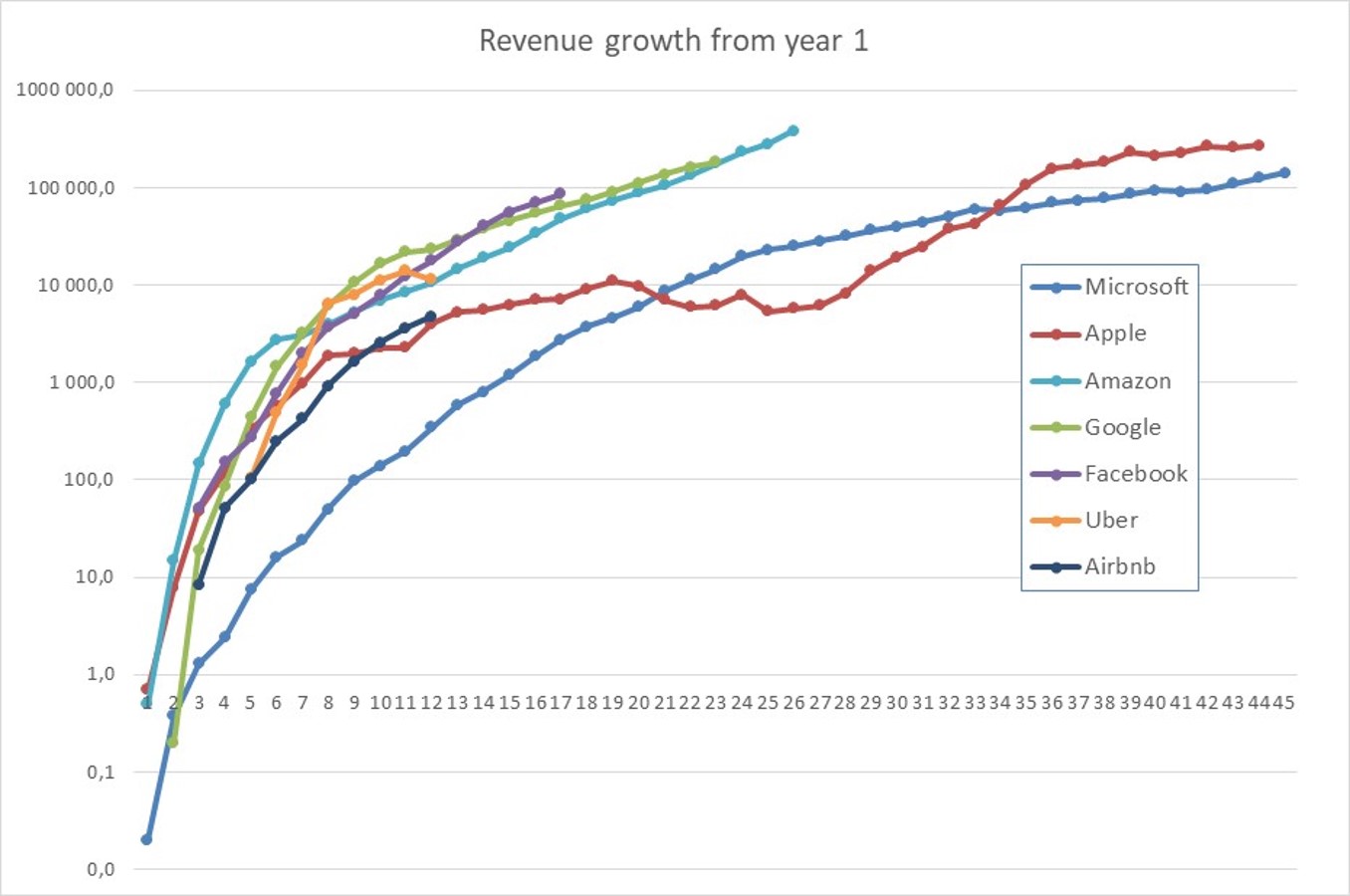
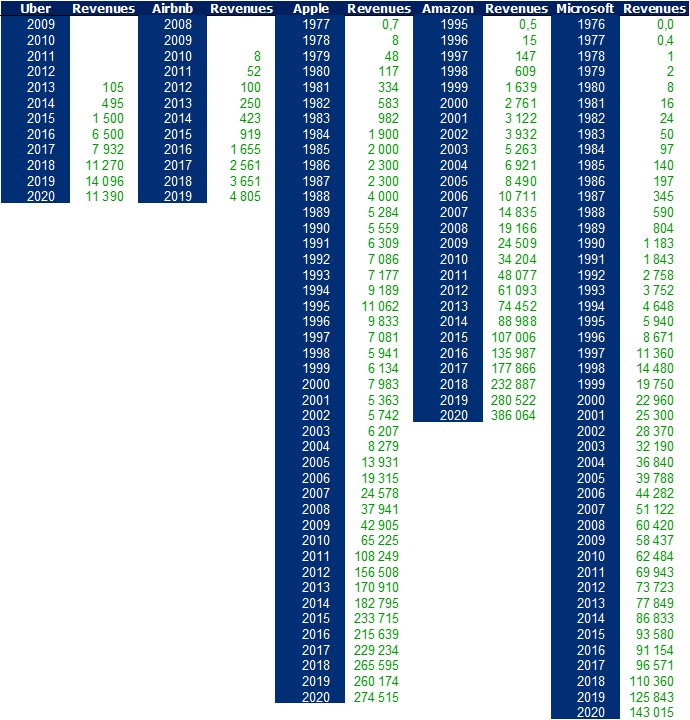
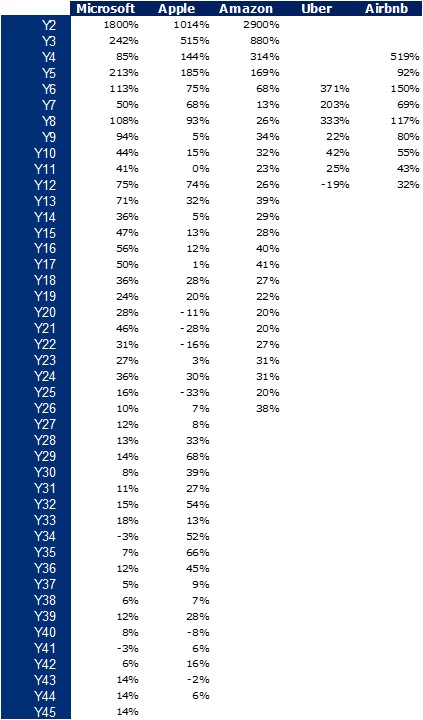
I could only compile data about revenues of these firms and I think it is striking enough:

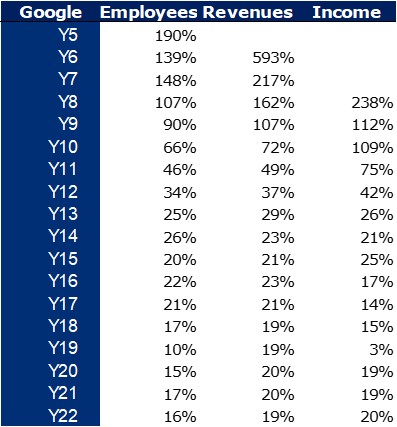
I wrote yerterday the growth rate was above 100% (doubling every year) in the early years declining to around 40% (doubling every other year) then to 15% (doubling evry five-year). Here are the growth rates of these old and new Titans. It begins again with 100+% for all of them. Too early to say about the future of Uber and AirBnB.
The three others of the GAFAM.
– Microsoft even had a 50% growth in its second decade, Amazon was closer to 30% and Apple struggled with 20%.
– In their 4th decade, Microsoft had an average grwoth of 10% and Apple 30%.

OK Manuel?

Tesla, Google and Facebook do not suffer from the crisis.

This may not be surprising and it has been said in the media. The GAFAs have generally benefited from the Covid crisis. So, as I was independantly doing in the recent years, I looked again at the growth of Google and Facebook as well as Tesla.

[As a reference here are past articles:
– Are GAFAs threatened? Their growth is still steady: www.startup-book.com/2019/12/28/are-gafas-threatened-their-growth-is-still-steady/
– Facebook Finally Files For $5B: www.startup-book.com/2012/02/02/facebook-finally-files-for-5b/
– Google vs. Facebook: www.startup-book.com/2010/11/12/google-vs-facebook/]

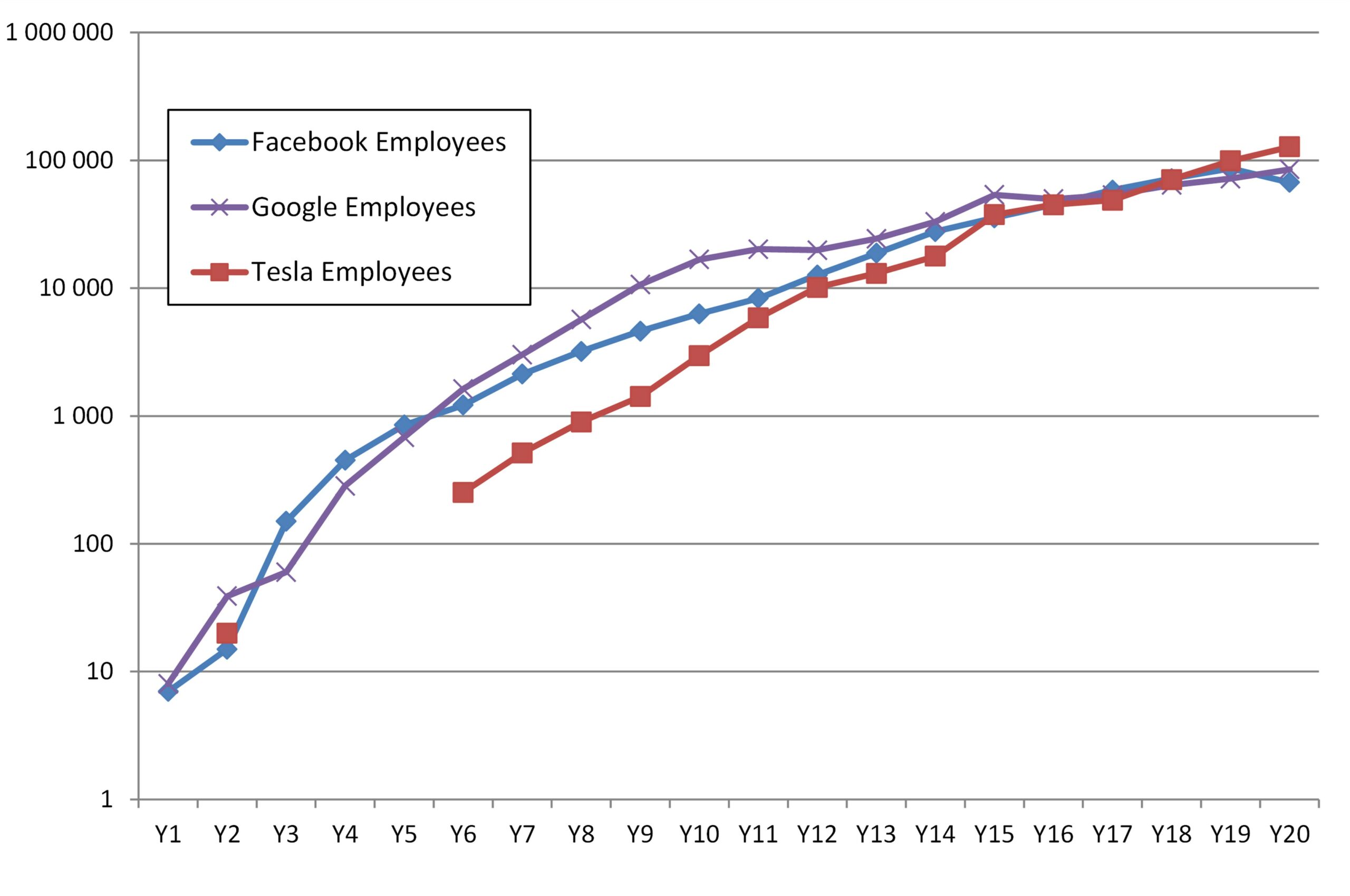
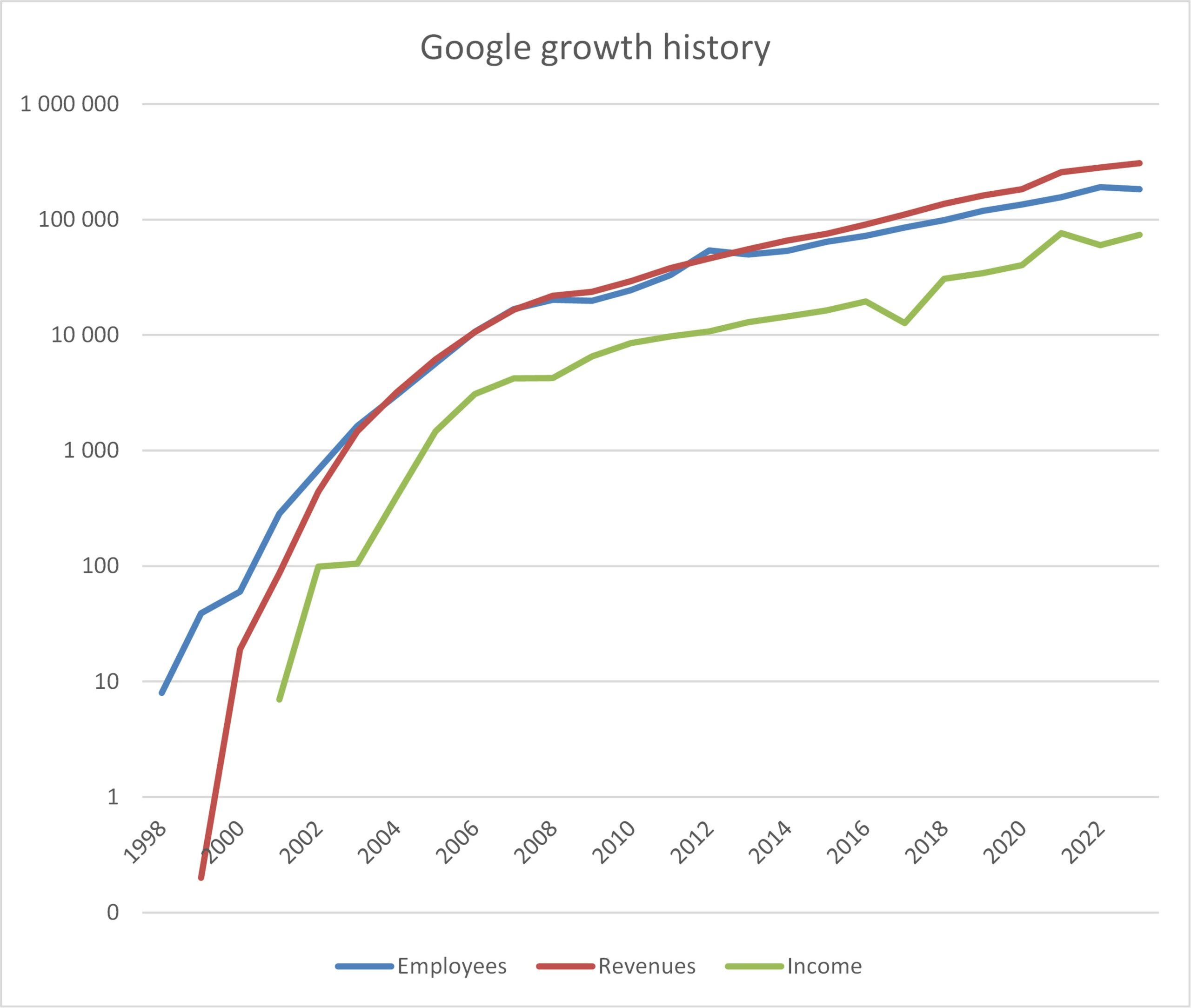
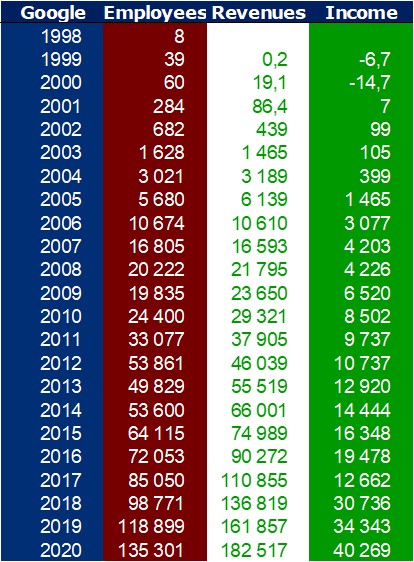
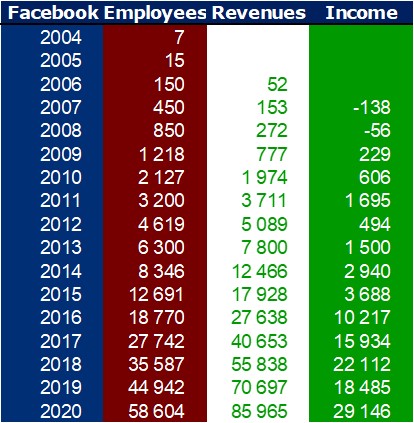
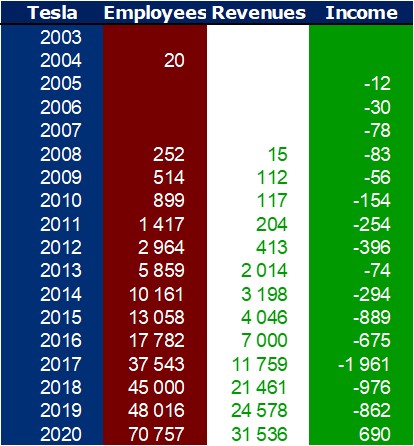
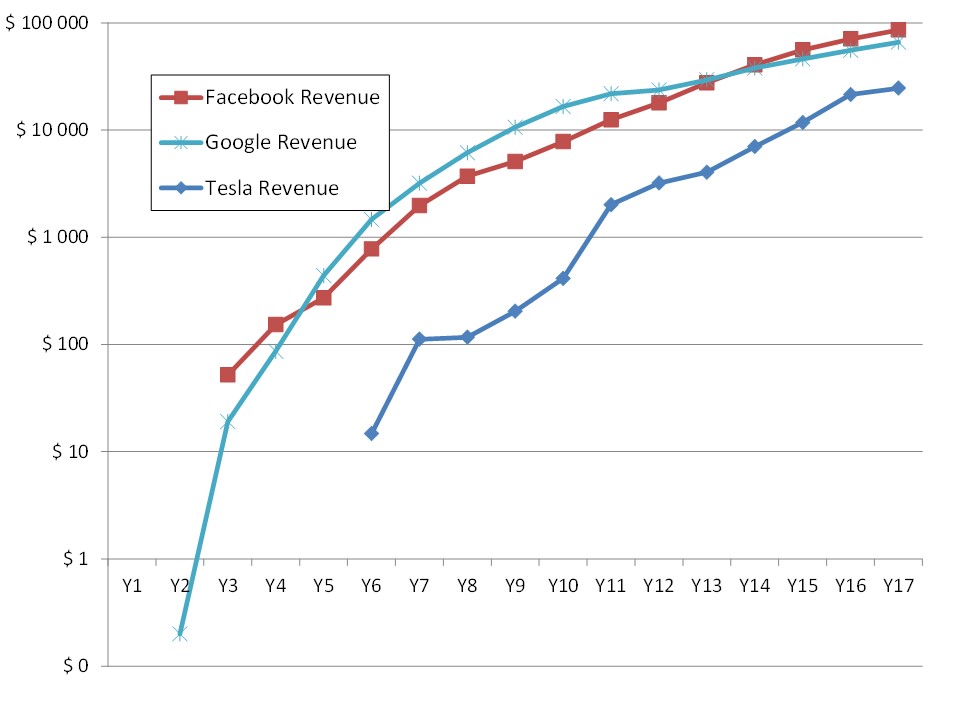
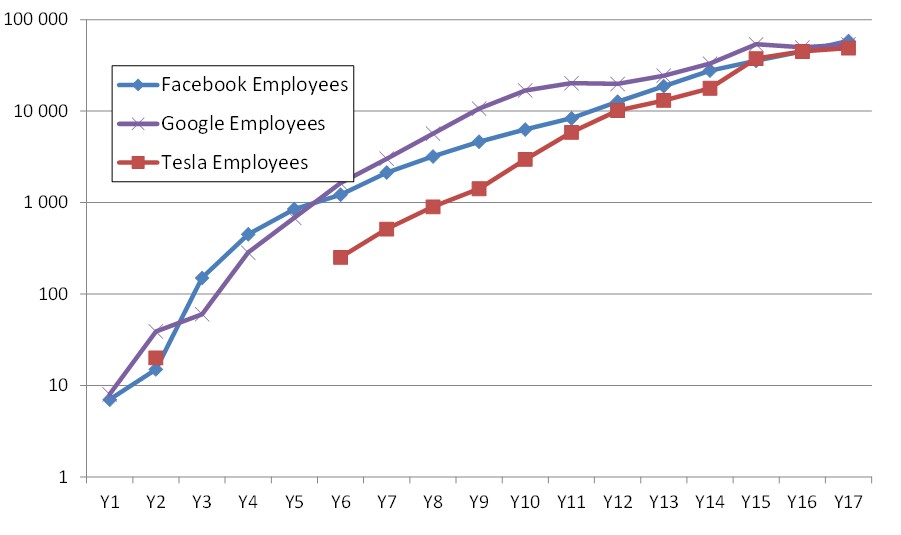
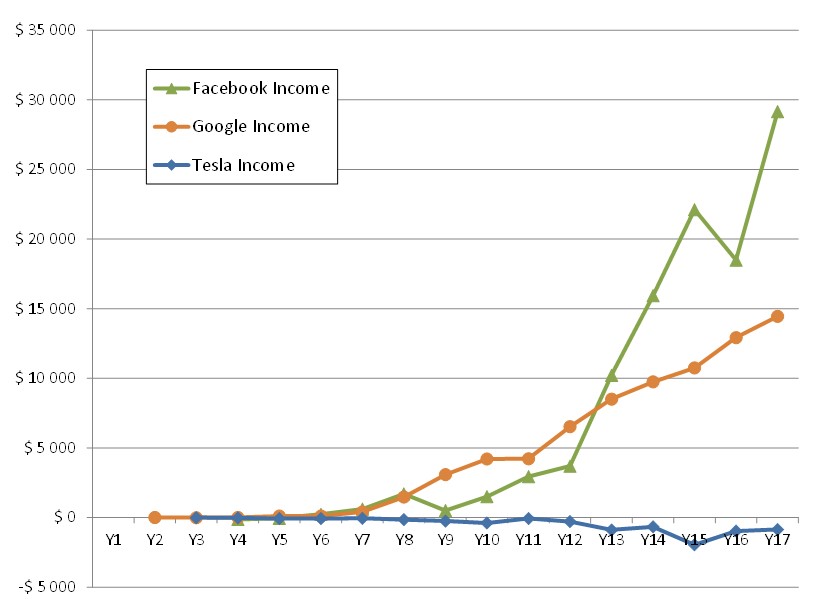
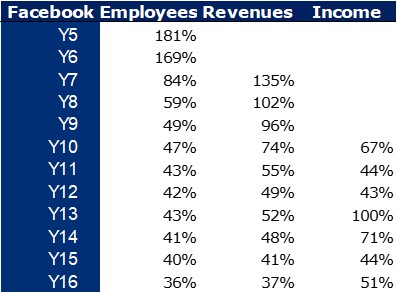
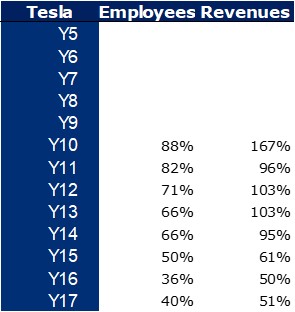
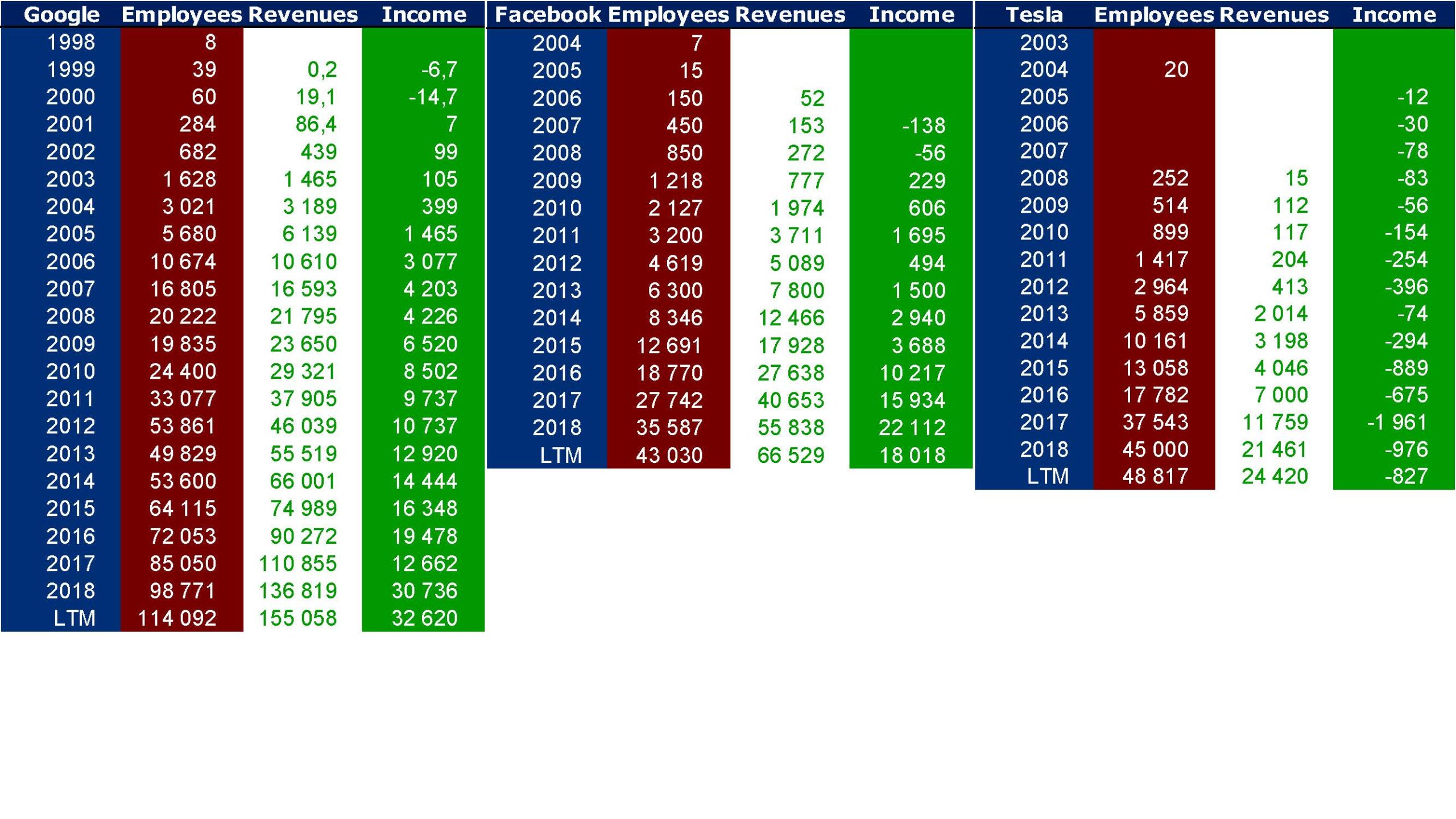
And here are my udpates abour revenue, income and employee growth of Google, Facebook and Tesla:

Revenues and profits are in millions of $. What is undoubtedly the most striking is the similarity of the growths of the three actors and of course the fact that all these numbers are considerable, not to say extraordinary.

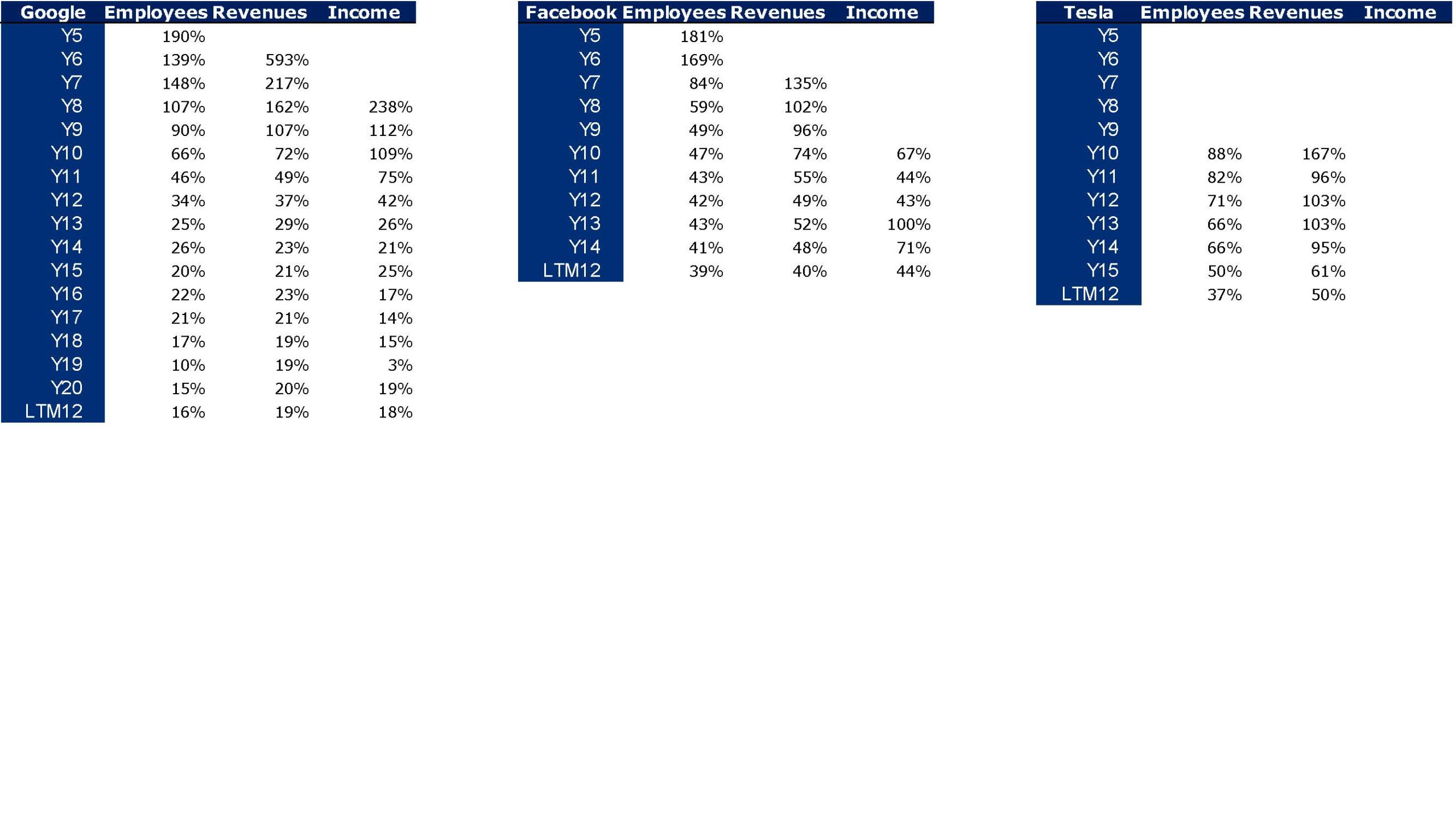
Typical of Silicon Valley startups, the growth is often above 100% in the early years decreasing to about 40% after a few years and still above 15% after 20 years. This means respectively doubling the numbers every year, every two years and every five years.

The largest technology companies in Europe and the USA in 2020

I regularly look at the largest technology companies in the USA and Europe and obviously this year, I had the impact of Covid in mind. Here are the tables I build once a year (and that you could compare to the ones published in January 2020 here or in 2017 here.

I am adding below their PS (price to sales, ratio of market cap to revenues) and PE (price to earnings, ratio of market cap to profits when positive) as well as the growth of the market cap. and revenues. There are 3 new companies I had not studied last year (Airbnb, Paypal and AMD) for which the growth is therefore not mentioned.

There would be many comments to give btu I will be fast:
– The GAFAs are the clear leaders, 4 of them are trillion dollar companies. Facebook is a little surprinsingly not as impressive and Tesla is appearing on top.
– The COVID did not have a big impact, not to say it had a positive impact on technology companies (in financial more than in economic terms)
– Again, looking at averages we see Europe is lagging in market caps, employement, sales and profits by factors close to 10…

Are GAFAs threatened? Their growth is still steady

It’s by reading Nicolas Colin’s always interesting newsletter, European Straits #149, 10 Tech Giants That Are (Almost All) in Bad Shape that I decided to revisit quickly the growth of 3 tech giants that I have been following for many years now: Google, Facebook and Tesla. And here are their numbers in terms of thousands of employees, revenue and profit in $M.

If you really love numbers, here is a little more: their average growth of 5 years is about 20% for Google, 40% for Facebook and about the same for Tesla (except that they never made a profit). Google is older so it is not a fair comparison. here is a more precise analysis.

So are the three tech giants threatened? I am not sure given this steady growth.