Monthly Archives: March 2016

Alexander Grothendieck, 1928 – 2014

What link is there between Andrew Grove (the previous article) and Alexandre Grothendieck? Beyond their common initials, a similar youth – both were born in the communist Eastern Europe they left for a career in the West) and the fact they have become icons of their world, they just represent my two professional passions: startups and mathematics. The comparison stops there, no doubt, but I’ll get back to it.

Two books (both in French) were published in January 2016 about the life of this genius: Alexander Grothendieck – in the footsteps of the last mathematical genius by Philippe Douroux and Algebra – elements of the life of Alexander Grothendieck by Yan Pradeau. If you like mathematics (I should say the mathematical science) or even if you do not like it, read these biographies.

livres_alexandre_grothendieck

I knew as many others about the atypical route of this stateless citizen who became a great figure of mathematics – he received the Fields Medal in 1966 – and then decided to live in seclusion from the world for over 25 years in a small village close to the Pyrenees until his death in 2014. I also have to confess that I knew nothing of his work. Reading these two books shows me that I was not the only one, as Grothendieck had explored lands that few mathematicians could follow. I also found the following stories:
– At age 11, he calculated the circumference of the circle and deduced that π is equal to 3.
– Later, he reconstructed the theory of Lebesgue measure. He was not 20 years old.
– A prime number has his name, 57, who nevertheless is 3 x 19.
Yes, it is worth discovering the life of this illustrious mathematician.

tableau_alexandre_grothendieck

The reason for the connection I made between Grove and Grothendieck is actually quite tenuous. It comes from this quote: “There are only two true visionaries in the history of Silicon Valley. Jobs and Noyce. Their vision was to build great companies … Steve was twenty, un-degreed, some people said unwashed, and he looked like Ho Chi Minh. But he was a bright person then, and is a brighter man now … Phenomenal achievement done by somebody in his very early twenties … Bob was one of those people who could maintain perspective because he was inordinately bright. Steve could not. He was very, very passionate, highly competitive.” Grove was close Noyce in more ways than one, and extremely rational and according to Grove, Noyce was too lax! Grothendieck would be closer to Jobs. A hippie, a passionate individual and also somehow self-taught. Success can come from so diverse personalities.

648x415_uvre-banksy-pres-jungle-calais

Last point in common or perhaps a difference. The migration. Grove became a pure American. Grothendieck was an eternal stateless, despite his French passport. But both show its importance. Silicon Valley is full of migrants. I often talk about this here. We know less that what is called “the French school of mathematics” also has its migrants. If you go to the French wikipedia page of the Fields Medal, you can read:

Ten “Fields medalists’ are former students of the Ecole Normale Superieure: Laurent Schwartz (1950), Jean-Pierre Serre (1954), René Thom (1958), Alain Connes (1982), Pierre-Louis Lions (1994) Jean-Christophe Yoccoz (1994), Laurent Lafforgue (2002), Wendelin Werner (2006), Cédric Villani (2010) and Ngo Bao Chau (2010). This would make “Ulm” the second institution after the ‘Princeton’ winners, if the ranking was the university of origin of the medal and not the place of production. Regarding the country of origin, we arrive at a total of fifteen Fields medalists from French laboratories, which could put France ahead as the formative nations of these eminent mathematicians.

But in addition to Grothendieck, the stateless, Pierre Deligne, Belgian, had his thesis with him, Wendelin Werner was naturalized at the age of 9 years, Ngo Bao Châu the year he received the Fields Medal, after doing all his graduate studies in France, and Artur Avila is Brazilian and French … One could speak of the International of Mathematics, which might not have displeased Alexander Grothendieck.

Andrew S. Grove 1936 – 2016

Andrew Grove died a few days ago. I remember reading is “Only The Paranoid Survive”. I remember that he had an amazing life, at least his first years from his native Hungary until he reached New York.

andrew-grove_2-225x300
Andrew S. Grove was chairman of the board of Intel Corporation from May 1997 to May 2005. He was the company’s chief executive officer from 1987 to 1998 and its president from 1979 to 1997. Ref: Andrew S. Grove 1936 – 2016 (Intel web site)

I also remember he wrote in 1010 an analysis about start-ups which is very profound. So I will quote him again.

It’s our own misplaced faith in the power of startups to create U.S. jobs. Americans love the idea of the guys in the garage inventing something that changes the world. New York Times columnist Thomas L. Friedman recently encapsulated this view in a piece called Start-Ups, Not Bailouts. His argument: Let tired old companies that do commodity manufacturing die if they have to. If Washington really wants to create jobs, he wrote, it should back startups.

Mythical Moment.

Friedman is wrong. Startups are a wonderful thing, but they cannot by themselves increase tech employment. Equally important is what comes after that mythical moment of creation in the garage, as technology goes from prototype to mass production. This is the phase where companies scale up. They work out design details, figure out how to make things affordably, build factories, and hire people by the thousands. Scaling is hard work but necessary to make innovation matter. The scaling process is no longer happening in the U.S. And as long as that’s the case, plowing capital into young companies that build their factories elsewhere will continue to yield a bad return in terms of American jobs. Scaling used to work well in Silicon Valley. Entrepreneurs came up with an invention. Investors gave them money to build their business. If the founders and their investors were lucky, the company grew and had an initial public offering, which brought in money that financed further growth.

Intel Startup

I am fortunate to have lived through one such example. In 1968, two well-known technologists and their investor friends anted up $3 million to start Intel Corp., making memory chips for the computer industry. From the beginning, we had to figure out how to make our chips in volume. We had to build factories; hire, train and retain employees; establish relationships with suppliers; and sort out a million other things before Intel could become a billion-dollar company. Three years later, it went public and grew to be one of the biggest technology companies in the world. By 1980, which was 10 years after our IPO, about 13,000 people worked for Intel in the U.S. Not far from Intel’s headquarters in Santa Clara, California, other companies developed. Tandem Computers Inc. went through a similar process, then Sun Microsystems Inc., Cisco Systems Inc., Netscape Communications Corp., and on and on. Some companies died along the way or were absorbed by others, but each survivor added to the complex technological ecosystem that came to be called Silicon Valley. As time passed, wages and health-care costs rose in the U.S., and China opened up. American companies discovered they could have their manufacturing and even their engineering done cheaper overseas. When they did so, margins improved. Management was happy, and so were stockholders. Growth continued, even more profitably. But the job machine began sputtering.

U.S. Versus China

Today, manufacturing employment in the U.S. computer industry is about 166,000 — lower than it was before the first personal computer, the MITS Altair 2800, was assembled in 1975. Meanwhile, a very effective computer-manufacturing industry has emerged in Asia, employing about 1.5 million workers — factory employees, engineers and managers. The largest of these companies is Hon Hai Precision Industry Co., also known as Foxconn. The company has grown at an astounding rate, first in Taiwan and later in China. Its revenue last year was $62 billion, larger than Apple Inc., Microsoft Corp., Dell Inc. or Intel. Foxconn employs more than 800,000 people, more than the combined worldwide head count of Apple, Dell, Microsoft, Hewlett-Packard Co., Intel and Sony Corp.

10-to-1 Ratio

Until a recent spate of suicides at Foxconn’s giant factory complex in Shenzhen, China, few Americans had heard of the company. But most know the products it makes: computers for Dell and HP, Nokia Oyj cell phones, Microsoft Xbox 360 consoles, Intel motherboards, and countless other familiar gadgets. Some 250,000 Foxconn employees in southern China produce Apple’s products. Apple, meanwhile, has about 25,000 employees in the U.S. — that means for every Apple worker in the U.S. there are 10 people in China working on iMacs, iPods and iPhones. The same roughly 10-to-1 relationship holds for Dell, disk-drive maker Seagate Technology, and other U.S. tech companies… (more on the Bloomberg article)

A great man has just disappeared.

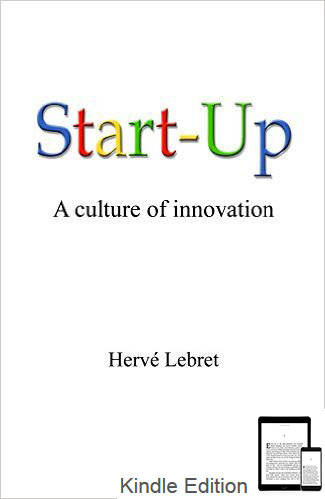
Start-Up, a culture of innovation

I just published a very short essay. A summary of my activity in the start-up world: “Almost 10 years ago, I wrote a book entitled Start-up, what we may still learn from Silicon Valley. If I had to do a second edition, I don’t think I’d change much despite all the flaws and blunders of the exercise. Yet one morning in February 2016, I had a look at ten years of supporting start-up entrepreneurs and decided to send again old and also new messages to those that the world of innovation and high-tech entrepreneurship puzzles or interests.”

It is also available in French. If you wish to obtain a pdf copy of the books, just send me an email!

Startup-A_culture_of_innovation_Amazon Startup-A_culture_of_innovation_Kindle
Startup-Une_culture_de_l_innovation_Amazon Startup-Une_culture_de_l_innovation_Kindle

Immigrants and Unicorns

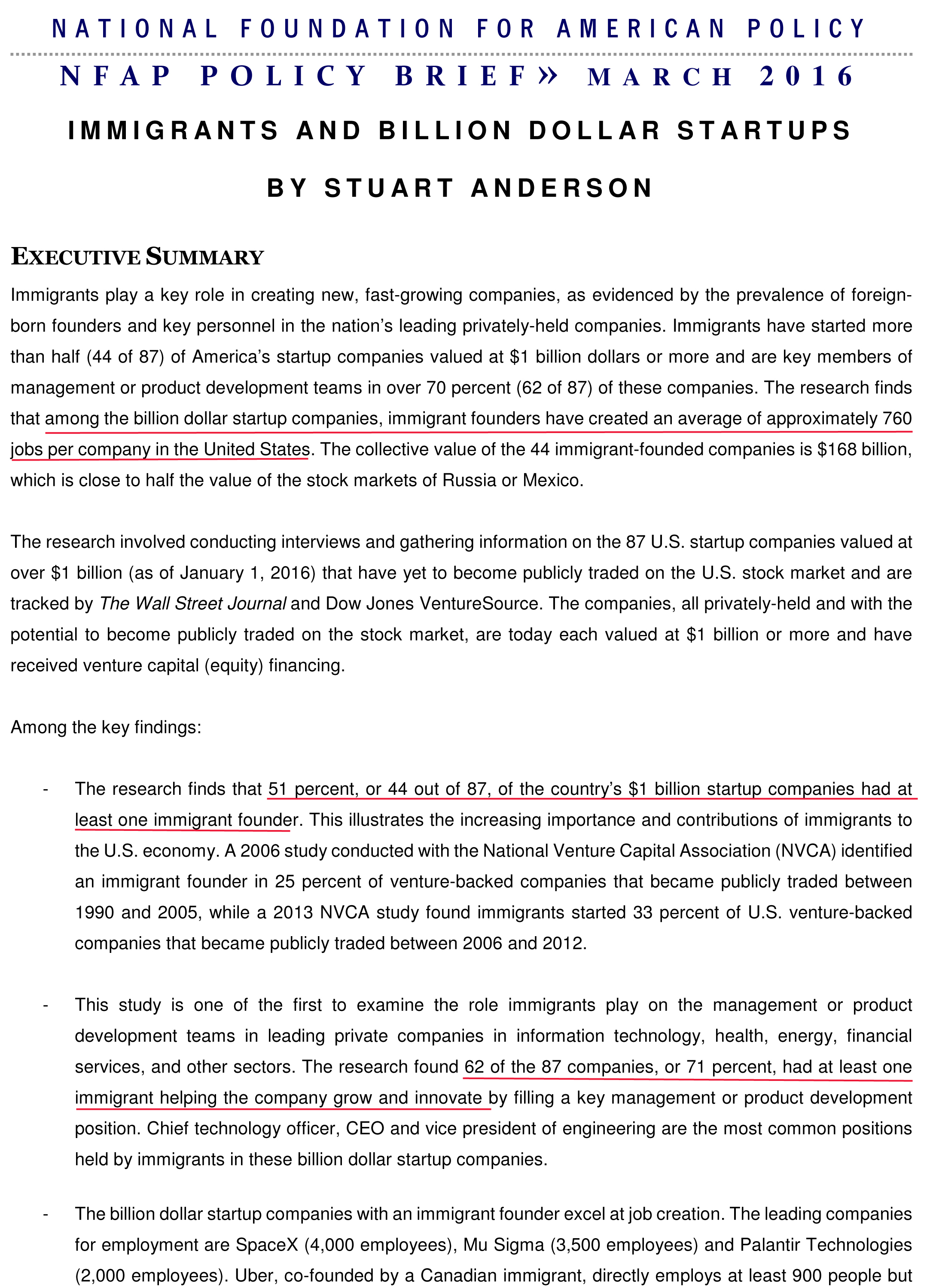
Thanks to the a16z weekly newsletter, I just discovered another interesting study about the importance of migrants in the US innovation landscape: Immigrants and the Billion Dollar Startups (in pdf). Here are some key findings:
– 51 percent, or 44 out of 87, of the country’s $1 billion startup companies had at least one immigrant founder.
– 62 of the 87 companies, or 71 percent, had at least one immigrant helping the company grow and innovate.
– immigrant founders have created an average of approximately 760 jobs per company in the United States.
Of course this is limited to the Unicorns, private companies with a rather young history, but these are impressive data.

Immigrants and Billion Dollar Startups

If you have never read anything about the importance of migrants in Silicon Valley, you might also be interested in the work of AnnaLee Saxenian. Now, I copied the data from the study, to add my own comments:

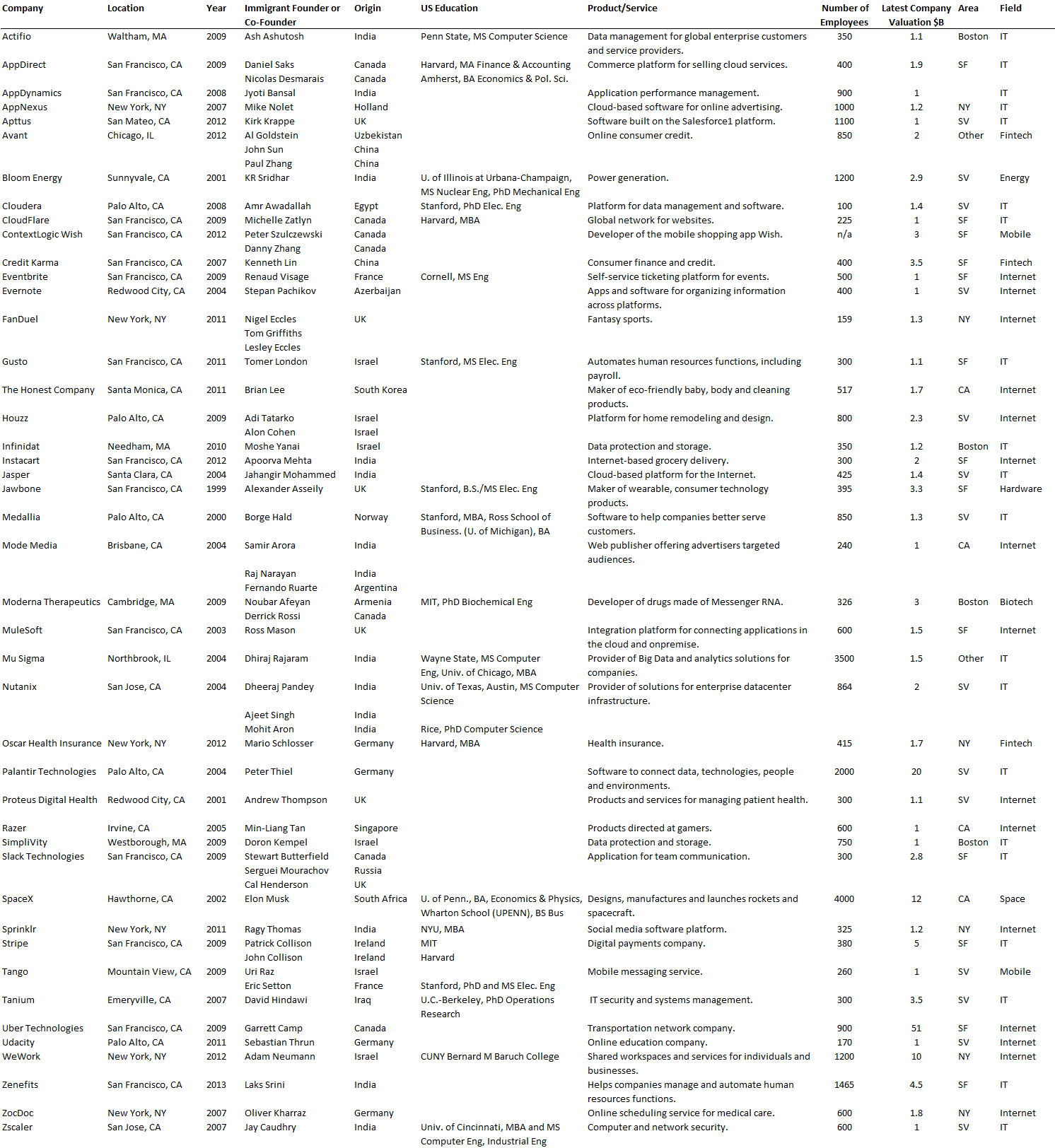
Unicorns_and_migrants

In terms of geography, out of the 44 start-ups, 14 are based in Silicon Valley and 12 in close-by San Francisco.
In terms of education, out of the 60 immigrant founders, 23 have studied in the US universities, including 5 at Stanford and 1 at Berkeley vs. 4 at Harvard and 2 at MIT.
In terms of origin, the study gives the individual countries and I was interested at Europe: 15 come from the European Union vs. 14 from India and 7 from Israel.
Interesting, right?

Two Challenges of Technology Transfer – Part 2, Get to Know Your TTO.

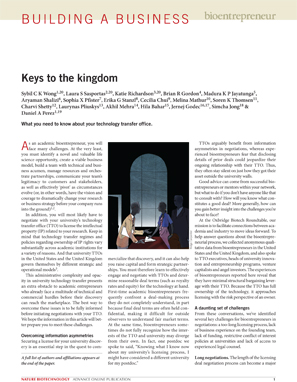
My second post about Technology Transfer (following the one about National Systems) is about the micro-economics of the activity. This is motivated by the very good Keys to the kingdom – subtitled What you need to know about your technology transfer office.

Before summarizing its content, let me remind you about the posts which already cover the topic so you will agree it’s not a new topic for me and I consider it as important:
– University licensing to start-ups in May 2010 (www.startup-book.com/2010/05/04/university-licensing-to-start-ups) followed by
– University licensing to start-ups (Part 2) in June 2010 (www.startup-book.com/2010/06/15/university-licensing-to-start-ups-part-2)
– How much Equity Universities take in Start-ups from IP Licensing? in November 2013 (www.startup-book.com/2013/11/05/how-much-equity-universities-take-in-start-ups-from-ip-licensing)
– Should universities get rich with their spin-offs? in June 205 (www.startup-book.com/2015/06/09/should-universities-get-rich-with-their-spin-offs)

bioe2015

Co-authored by 18 people from Stanford, Oxford, Harvard, the University of California in San Francisco and the University College London, the article describes what should know people interested in getting a license on intellectual property to create a start-up. The paper begins with “As an academic […]entrepreneur, you will face many challenges” and the second paragraph follows with “In addition, you will most likely have to negotiate with your university’s technology transfer office (TTO) to license the intellectual property (IP) related to your research”.

What are these challenges related to TTO? they are written in the article in bold fonts as follows: Overcoming information asymmetries – Long negotiations – Inexperience – Lack of funding – Conflict of interest rules – Experienced legal counsel. This means that as a future entrepreneur, you should be prepared and ideally be knowledgeable about these.

The challenges

The main challenge seems to be the administrative complexity and opacity (page 1), including confidentiality of contracts, which makes it difficult for outside observers to understand fair market terms (page 1 again). In the end, they nearly conclude with: “Indeed, even for the universities for whom we have data regarding equity policies, it was often hidden deep within a jumble of legalese. To that end we encourage universities and research institutes receiving public monies to be fully transparent in their equity and royalty policies, and not use these information asymmetries as a bargaining advantage against fledgling […]entrepreneurs.”

On page 2, I note:
– A negotiation may be long (6-12 months, even 18 months) and one way to make it short is to take the proposed terms.
– A way to mitigate inexperience is by “preparing an adequate business plan or strategy for your IP before approaching your TTO” or by “bringing aboard team members with prior experience in […] commercialization to improve your team’s credibility”.
Lack of funding can be partially solved by signing “license option agreements”.
Conflict of interest rules “exist to prevent academics from playing both sides of a technology licensing deal or devoting too much time to nonacademic obligations”. Furthermore, “TTOs represent the interests of the university (not the academic), yet the academic is technically an employee of the university. “Our policy is to never negotiate directly with the faculty,” says a US-based TTO representative”.
– Experienced legal counsel is advised for assessing the quality of the IP but also because “[…]entrepreneurs often fail to appreciate the opportunity cost to the TTO in outlicensing. If a technology is licensed to an ineffective team (particularly with an exclusive license), the university forgoes any success or revenue it may have received from licensing the technology to a better organized industry partner. Moreover, universities have limited resources and manpower to protect IP, and, for this reason, prefer to license technology to teams they believe are well prepared to commercialize it.”

The equity deal terms

“Perhaps the most striking difference between the United States and United Kingdom is seen with equity deal terms. In the United Kingdom, a typical licensing deal is a rarely negotiable 50:50 split between the university and the academic […]entrepreneur, whereas US interviewees often reported universities taking a 5–10% negotiable equity share.”

You now understand why I said I was not convinced in my previous post about taking the UK as a reference. The US practice shows space for debate. You may check again my article from November 2013, where you will see that a typical deal is either 10% at creation or 5% after significant funding. Very rarely more.

Again the authors mention “US founders often do not realize that some deal terms are negotiable, including upfront fees, option payments, equity, royalty payments, milestone payments, territories covered, field of use and exclusivity versus nonexclusivity” and “In the UK, licensing deal equity terms are often perceived as being non-negotiable, though this is not always the case. In fact, many institute policies explicitly state that equity terms are negotiable.” This may however make the process lengthier.

On page 4, the authors add: “It is difficult to understand the justification of UK TTOs, such as Oxford’s Isis Innovation, taking 50% of a company’s equity at formation — which after investment can leave the academic entrepreneur with an extremely low stake from the get-go, for what was likely years of work, and will require many years and millions more to develop.” and indeed “The data would suggest that TTOs taking less upfront and leaving more to the academic and investors who will actually carry the idea forward pays off in the long term. Simply put: holding a smaller piece of something is still more valuable than a large piece of nothing.”

The mystery of royalties

“It is also worth noting that while a discussion on royalties was outside the scope of this study, it was clear from our research that many university TTOs “double dip” and take significant equity and royalty.” but again “Perhaps more disquieting than the out-sized equity and royalty stakes that universities are claiming is the lack of transparency from many universities on this critical issue.”

My conclusion: any wannabe entrepreneur should read this short 5-page paper and be prepared to negotiate. I would love as much as the authors that universities and research institutes be fully transparent in their equity and royalty policies, though I am also aware of the possibly weakened position of universities which would do so.