Category Archives: Must watch or read

When Peter Thiel & Friends talk about Start-ups – part 3: company culture, founders, team, investors

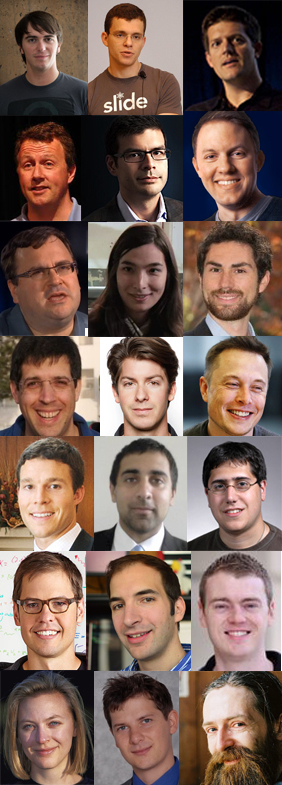
Part 3 of my series of comments about Thiel’s class notes at Stanford mainly cover his Class 5-8. But first I should add that Thiel invited a “honor class” of innovators during his 19 classes. Quite fascinating!

Thiel-Friends-CS1st row: Stephen Cohen, co-founder and Executive VP of Palantir Technologies,
Max Levchin, co-founder PayPal and Slide,
Roelof Botha, partner at Sequoia Capital and former CFO of PayPal,
2nd row: Paul Graham, partner and co-founder of Y Combinator,
Bruce Gibney, partner at Founders Fund,
Marc Andreessen, general partner Andreessen Horowitz,
3rd row: Reid Hoffman, co-founder of LinkedIn,
Danielle Fong, Co-founder and Chief Scientist of LightSail Energy,
Jon Hollander, Business Development at RoboteX,
4th row: Greg Smirin, COO of The Climate Corporation,
Scott Nolan, Principal at Founders Fund and former aerospace engineer at SpaceX,
(Elon Musk was going to come, but he was busy launching rockets),
5th row: Brian Slingerland. Co-Founder, President & COO at Stem CentRx,
Balaji S. Srinivasan, CTO of Counsyl,
Brian Frezza, Co-founder, Emerald Therapeutics,
6th row: D. Scott Brown, co-founder of Vicarious,
Eric Jonas, CEO of Prior Knowledge,
Bob McGrew, Director of Eng, Palantir,
7th row: Sonia Arrison, Associate Founder of Singularity University,
Michael Vassar, the Singularity Institute for the study of Artificial Intelligence (SIAI),
Aubrey de Grey, Chief Science Officer at the SENS Foundation.

Thiel covered how to build a company from the ideas and vision of founders, through hiring and sometimes funding from investors. But he began with a critical though fuzzy concept, the company culture: “A robust company culture is one in which people have something in common that distinguishes them quite sharply from rest of the world.”

He mentions also some important dimensions of the culture:
– Consultant-nihilism or Cultish Dogmatism: “You want to be somewhere in the middle of that spectrum. To the extent you gravitate towards an extreme, you probably want to be closer to being a cult than being an army of consultants.” which could be why Thiel said earlier,
pre-money valuation = ($1M*n_engineers) – ($500k*n_MBAs).
– To Fight or Not To Fight (i.e. Nerds or Athletes or again Zero-sum and Non zero-sum). “So you have to strike the right balance between nerds and athletes. Neither extreme is optimal. Consider a 2 x 2 matrix. On the y-axis you have zero-sum people and non zero-sum people. On the x-axis you have warring, competitive environments and then you have peaceful, monopoly/capitalist environments. The optimal spot on the matrix is monopoly capitalism with some tailored combination of zero-sum and non zero-sum oriented people. You want to pick an environment where you don’t have to fight. But you should bring along some good fighters to protect your non zero-sum people and mission, just in case.”
I was just told this is crytic… I agree… another reason to read Thiel directly!

Foundings are obviously temporal. But how long they last can be a hard question. The typical narrative contemplates a founding, first hires, and a first capital raise. But there’s an argument that the founding lasts a lot longer than that. The idea of going from 0 to 1—the idea of technology—parallels founding moments. The 1 to n of globalization, by contrast, parallels post-founding execution. It may be that the founding lasts so long as a company’s technical innovation continues. Founders should arguably stay in charge as long as the paradigm remains 0 to 1. Once the paradigm shifts to 1 to n, the founding is over. At that point, executives should execute.”

Max Levchin: The notion that diversity in an early team is important or good is completely wrong. You should try to make the early team as non-diverse as possible. There are a few reasons for this. The most salient is that, as a startup, you’re underfunded and undermanned. It’s a big disadvantage; not only are you probably getting into trouble, but you don’t even know what trouble that may be. Speed is your only weapon. All you have is speed. […] How to hire? A specific application of this is the anti-fashion bias. You shouldn’t judge people by the stylishness of their clothing; quality people often do not have quality clothing. Which leads to a general observation: Great engineers don’t wear designer jeans. So if you’re interviewing an engineer, look at his jeans. There are always exceptions, of course. But it’s a surprisingly good heuristic. […] PayPal also had a hard time hiring women. An outsider might think that the PayPal guys bought into the stereotype that women don’t do CS. But that’s not true at all. The truth is that PayPal had trouble hiring women because PayPal was just a bunch of nerds! They never talked to women. So how were they supposed to interact with and hire them?

“No CEO should be paid more than $150k per year” (in Silicon Valley)
“Another important insight is that people must either be fully in the company or not in it at all.”

Dilution and funding
Building a valuable company is a long journey. A key question to keep your eye on as a founder is dilution. The Google founders had 15.6% of the company at IPO. Steve Jobs had 13.5% of Apple when it went public in the early ‘80s. Mark Pincus had 16% of Zynga at IPO. If you have north of 10% after many rounds of financing, that’s generally a very good outcome. Dilution is relentless. The alternative is that you don’t let anyone else in. It’s worth remembering that many successful businesses are built like this. Craigslist would be worth something like $5bn if it were run more like a company than a commune. GoDaddy never took funding. Trilogy in the late 1990s had no outside investors. Microsoft very nearly joined this club; it took one small venture investment just before its IPO. When Microsoft went public, Bill Gates still owned an astounding 49.2% of the company. So the question to think about with VCs isn’t all that different than questions about co-founders and employees. Who are the best people? Who do you want—or need—on board?

The VC model in a nutshell: a power law. “To a first approximation, a VC portfolio will only make money if your best company investment ends up being worth more than your whole fund. (And the investment in the second best company is about as valuable as number three through the rest.)”

I have not yet read the following classes…

When Peter Thiel talks about Start-ups – part 2: value creation

As promised, here are additional comments from my reading Peter Thiel’s class notes on start-ups at Stanford University (after the general ones in part 1 about innovation). And today, it’s about value creation. When I teach valuation techniques at EPFL, I provide similar information: value creation is future cash flows adjusted for time value (check Wikipedia for valuation using DCF). The difficulty with DCF is that in the case of start-ups most of the value appears in the very long term and given the uncertainty of start-up projection revenues, it makes DCF nearly useless… This is why, for start-ups, it is often easier to use techniques based on multiples & comparables (again check Wikipedia for valuation using multiples.)

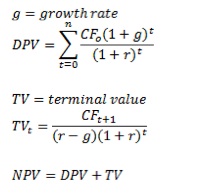
Thiel enlighted me here by providing a very interesting explanation of why DCF still makes sense for start-ups. First he defines “Great Technology Companies”: “Great companies do three things. First, they create value. Second, they are lasting or permanent in a meaningful way. Finally, they capture at least some of the value they create.” Surprisingly (for me), the second thing is the most important: they are lasting or permanent in a meaningful way. He then introduces DCF with a growth rate:
dcf-valuation
and then he adds: “Tech and other high growth companies are different. At first, most of them lose money. When the growth rate—g, in our calculations above—is higher than the discount rate r, a lot of the value in tech businesses exists pretty far in the future. Indeed, a typical model could see 2/3 of the value being created in years 10 through 15. This is counterintuitive. Most people—even people working in startups today—think in Old Economy mode where you have to create value right off the bat. The focus, particularly in companies with exploding growth, is on next months, quarters, or, less frequently, years. That is too short a timeline. Old Economy mode works in the Old Economy. It does not work for thinking about tech and high growth businesses. Yet startup culture today pointedly ignores, and even resists, 10-15 year thinking.”

I will not add much more here but just mention that Thiel has in this Class 3 & 4 very interesting arguments about why competition may not be that good and monopoly not that bad for the economy and individuals… “Whether competition is good or bad is an interesting (and usually overlooked) question. Most people just assume it’s good. The standard economic narrative, with all its focus on perfect competition, identifies competition as the source of all progress. If competition is good, then the default view on its opposite—monopoly—is that it must be very bad. But exactly why monopoly is bad is hard to tease out. It’s usually just accepted as a given. But it’s probably worth questioning in greater detail.”

He does the analysis not only for companies but also for individuals with a moving section about fierce competition at Princeton, Yale or Harvard with an interesting comparison with Stanford: “Of all the top universities, Stanford is the farthest from perfect competition. Maybe that’s by chance or maybe it’s by design. The geography probably helps, since the east coast doesn’t have to pay much attention to us, and vice versa. But there’s a sense of structured heterogeneity too; there’s a strong engineering piece, the strong humanities piece, and even the best athletics piece in the country. To the extent there’s competition, it’s often a joke. Consider the Stanford-Berkeley rivalry. That’s pretty asymmetric too. In football, Stanford usually wins. But take something that really matters, like starting tech companies. If you ask the question, “Graduates from which of the two universities started the most valuable company?” for each of the last 40 years, Stanford probably wins by something like 40 to zero. It’s monopoly capitalism, far away from a world of perfect competition.”

zerotoone

He finishes with an analysis consistent with his first class on zero to one: “If globalization had to have a tagline, it might be that “the world is flat.” Technology, by contrast, starts from the idea that the world is Mount Everest. If the world is truly flat, it’s just crazed competition. (…) And yet, the single business idea that you hear most often is: the bigger the market, the better. That is utterly, totally wrong. The restaurant business is a huge market. It is also not a very good way to make money.
(…)
Where does venture capital fit in? VCs tend not to have a very large pool of business. Rather, they rely on very discreet networks of people. That is, they have access to a unique network of entrepreneurs. So VC is anti-commoditized. That kind of dynamic arguably characterizes all great tech companies, i.e. last mover monopolies. Last movers build non-commoditized businesses. They are relationship-driven. They create value. They last. And they make money.”

More to come…

When Peter Thiel talks about Start-ups – part 1

““We wanted flying cars, instead we got 140 characters.” The Founders’ Fund

PeterThiel

Peter Thiel is probably one of my favorite characters when I think of start-ups and Silicon Valley. Here are just two posts where I mentioned him:
Technology = Salvation in October 2010
The promise of technology. Disappointing? in November 2013 (about the great article by George Packer from the New Yorker: No Death, No Taxes – The libertarian futurism of a Silicon Valley billionaire.
And I should not forget short mentions related to The Social Network and PayPal.

An EPFL acquaintance and business angel (thanks Dave :-)) just told me about the course Thiel gave at Stanford in 2012 and the comprehensive notes taken by one of his student, Notes Essays—Peter Thiel’s CS183: Startup—Stanford, Spring 2012. I copied and pasted the notes from this 19-session class, and it makes a 233-page pdf document. Indeed, Thiel will publish this together with his student as a book next summmer: Zero to One: Notes on Startups, or How to Build the Future.

zerotoone

As I did with Mazzucato, I plan to posts a few articles about this piece of work which I find really interesting. His first chapter is about the need for start-ups in innovation and technology, and it motivates the title Zero to One:

“Progress comes in two flavors: horizontal/extensive and vertical/intensive.
– Horizontal or extensive progress basically means copying things that work. In one word, it means simply “globalization.”
– Vertical or intensive progress, by contrast, means doing new things. The single word for this is “technology.”
Intensive progress involves going from 0 to 1 (not simply the 1 to n of globalization).
[…]
Maybe we focus so much on going from 1 to n because that’s easier to do. There’s little doubt that going from 0 to 1 is qualitatively different, and almost always harder, than copying something n times. And even trying to achieve vertical, 0 to 1 progress presents the challenge of exceptionalism; any founder or inventor doing something new must wonder: am I sane? Or am I crazy?
[…]
Teaching vertical progress or innovation is almost a contradiction in terms. Education is fundamentally about going from 1 to n. We observe, imitate, and repeat. Infants do not invent new languages; they learn existing ones. From early on, we learn by copying what has worked before. That is insufficient for startups. At some point you have to go from 0 to 1—you have to do something important and do it right—and that can’t be taught. So case studies about successful businesses are of limited utility.”

Then he addresses “why start-ups?” and “why do a start-up?”

“Size and internal vs. external coordination costs matter a lot. North of 100 people in a company, employees don’t all know each other. Politics become important. Startups are important because they are small; if the size and complexity of a business is something like the square of the number of people in it, then startups are in a unique position to lower interpersonal or internal costs and thus to get stuff done.
[…]
The easiest answer to “why startups?” is negative: because you can’t develop new technology in existing entities. Anyone on a mission tends to want to go from 0 to 1. You can only do that if you’re surrounded by others to want to go from 0 to 1. That happens in startups, not huge companies or government.
[…]
Doing startups for the money is not a great idea. Perhaps doing startups to be remembered or become famous is a better motive. Perhaps not. A better motive still would be a desire to change the world. The U.S. in 1776-79 was a startup of sorts. What were the Founders motivations? There is a large cultural component to the motivation question, too. In Japan, entrepreneurs are seen as reckless risk-takers. The respectable thing to do is become a lifelong employee somewhere. The literary version of this sentiment is “behind every fortune lies a great crime.” Were the Founding Fathers criminals? Are all founders criminals of one sort or another?

More to come soon. But if you like this, just read Thiel!

After Banksy and Invader, Pully’s Mirror Mosaic Man…

What is fascinating with Street Art is that you might not be aware of it but when you begin to see it, it does not stop appearing in front of your eyes. After following Banksy in New York and then discovering Space Invader’s work in Switzerland (Lausanne, Geneva and Bern), a colleague mentioned to me the poetic mirror mosaics in Pully. I spent a few hours walking around and they blossomed everywhere!

DSCF0761

The beauty of life also comes from chance as Paul Auster artistically expresses it in his novels (check The Music of Chance). While I was taking a picture of one of these mirrors, someone behind me asked “So you like my snail?”. It was “Mirror Mosaic Man”. We had a short chat. I mentioned Space Invader in Lausanne and Pully’s artist told me I should contact Pierre Corajoud who publishes very nice little books about walks around Lausanne. Pierre Corajoud had indeed published a small booklet about Invaders in Lausanne. I thank him here again for offering me a copy because unfortunately, many works have been destroyed or stolen after its publication and Corajoud took his book out of the shelves. A pity! I hope the mosaics will not disappear… Here is the map though.


Afficher Mirror Mosaic Man on a bigger map

Finally here is a pdf document with all the works I saw or found online. But the best is to go and find them directly on site!
GillesPandel-Pully-2020

also on Scribd:

Bern Space Invaders (and in the Rest of the World – including Paris, Basel, Ravenna…)

A very short post which is a complement to Space Invaders in Lausanne and in Geneva.

mapbern

Space Invaders arrived in Bern in 2000 and for those passionate by his work and close to Switzerland, he was also in Basel in 2013 and Anzère in 2014…

msoda2

Here is the map and you can also have download my pdf which includes what I have found so far… An update will come when/if I go to Bern!

PS: I went to Bern on June 15, 2014. A strange coincidence étrange is that I finished reading that day La Vie mode d’emploi by Georges Pérec. I thought then that Bartlebooth is a kind of analogy for Street Art and its fans… I just updated also the pdf above and here are the ones which survived after nearly 15 years. Another coincidence: they are 8 surviving pieces out of 29, similarly to start-ups where 50% still survive after 5 years and about 25% after 15 years…

Invaders-Bern-2014

PS2: from time to time, I add chapters to my Space Invaders discoveries. Here is a synthesis essentially based on the artist site and using other passionate data: SpaceInvaders around the World (pdf – 8Mo)

You may find in other posts data about Lausanne, Geneva, Basel, Grenoble, Brussels. In September 2014, I began to compile data about Paris. Here are pdfs files about specific arrondissements:
the 1st,
the 2nd,
the 3rd,
the 4th,
the 5th,
the 6th,
the 12th,
the 13th,
the 14th,
the 15th,
the 16th,
the 17th
and also the 1000+ Paris Invaders. Below is my Paris map.
You will find more recent Paris data here.

In October 2014, I followed in invasion of Ravenna. Here is what I found on line: Space Invaders in Ravenna.

Space Invaders were also in Geneva

It was tough not to add the Geneva invasion by the Space Invaders after the one in Lausanne (After Banksy in NYC, Space Invader in Lausanne). But this one is far from perfect, many images are missing and I did not take the time to go on site.

mapgeneve

Still, you can download my pdf compilation of what I found online as well as a Google map of the places.


Afficher Space Invader Geneva sur une carte plus grande

After Banksy in NYC, Space Invader in Lausanne

Another post which does not have much to do with my favorite topic, start-ups. But after discovering Banksy’s work in New York, I saw his movie Exit Through the Gift Shop. A very loose link is Space-Invader, another street artist, who appears in the movie. Another loose link is that Space Invader has produced some work in Lausanne where I work. So I looked for his invaders and the result is that attached pdf: Space Invader and Spaceramik in Lausanne (Note that it is a rather large 24Mb pdf document)

Which-invader-in-Lausanne
An unidentidied Lausanne Invader

I am far from the first one to do this. For example Alain Hubler blogged about it in 2007 and helped me in finding the final place I was struggling with (thanks!) And I nearly know nothing about Street Art. But it was fun to look for his work.

As a strange coincidence Xavier Delaporte on French Radio France Culture had an interesting chronicle last Friday about our new ways to walk in the street in the Internet Age, Les nouvelles façons de marcher (avec nos outils numériques) This is just another example!

Space Invader, just like Banksy and many other Street Artists, remains anonymous. He has his own web site, www.space-invaders.com. He has his fans like Monsieur Chat who follows his production in Paris and many others who put pictures of his work online. Unfortunately, most of the work has disappeared, either the buildings have been destroyed, or the art has been stolen and/or replaced by others. There is also a second artist, Spaceramik, who put his own video on YouTube. The picture I put above might not be from Space Invader neither from Spaceramik, hence the term “unidentified”.

A final point here is the Google Maps of Invaders in Lausanne.

Display Invaders in Lausanne directly on Google Maps

PS: (February, 8, 2014) Pierre Corajoud and Space Invader
Pierre Corajoud is famous in Lausanne for publishing very nice little books about walks around Lausanne. I learnt through Mirror Mosaic Man that he had published such a booklet about Space Invader in Lausanne. I thank Pierre Corrajoud here again for offering me a copy of his book because unfortunately, many works have been destroyed or stolen after its publication and Corrajoud took his book out of the shelves.

SpaceInvaders-Corajoud

PS: (December, 24, 2013) A year of Street Art

Banksy in NYC

Banksyny

An unusual post, as it has nothing to do with start-ups. Strangely enough, another one was related to New York City and Obama. I mention from time to time that entrepreneurs have similarities with artists when they want to have an impact. And innovation is an art, not a science.

I followed Banksy‘s work in NYC from time to time last month and spent the last week-end compiling what I could find. Feel free to have a look at the pdf, which contains his 31 October days with pictures, maps and links to other sites as well as my own Google map of its locations. You can also download the Powerpoint slideshow by clicking here. It automatically launches all audios and videos (but it might depend on the ppt version you have if any).

Banksyny-lebret-pdf
Click on picture to download pdf

And here is the map of Banksy’s journey.

Afficher Banksy sur une carte plus grande

PS: June 1st, 2014: a short video summarizing Banksy’s residence in NYC:

The book that launched the Lean Startup revolution

There is nothing really new with Steve Blank’s 5th edition of The Four Steps to the Epiphany. But first I lost my first copy (who has it?) and second I thought I should read again this bible for entrepreneurs. So why not a second look.

Four-Steps-to-the-Epiphany-5th-edition

Ten years after the 1st edition, Blank is as right as ever. His Customer Development model is a great lesson about the dangers of business plans and of product development without some validation form early customers and the Market. You can read my post from 2011, Steve Blank and Customer Development. You should, as I will not say again what I said then. I do not have much to change. Let me just say again a few key elements:

– “The good new is these customer and market milestones can be defined and measured. The bad news is achieving these milestones is an art. It’s an art embodied in the passion and vision of the individuals who work to make their vision a reality. That’s what makes startups exciting.” [Page 22 and see note (1) below]
– Start-ups are not early versions of established companies. they have nothing to do with them in fact. “Startups are temporary organizations designed to search for a scalable and repeatable business model.” As a consequence, people running start-ups (product, sales, marketing, management) need to understand the start-up culture and dynamics. “Traditional functional organizations [Sales, Marketing and Business Development] and the job titles and the job descriptions that work in a large company are worse than useless in a startup. They are dangerous and dysfunctional in the first phases of a startup.”[Appendix A, “The Death of the Departments”.]

Blank’s Four Steps to the Epiphany is not easy to read but it is a must have and a must read for any entrepreneur!

(1) In another interview Balnk explained: Over the last decade we assumed that once we found repeatable methodologies (Agile and Customer Development, Business Model Design) to build early stage ventures, entrepreneurship would become a “science,” and anyone could do it. I’m beginning to suspect this assumption may be wrong. It’s not that the tools are wrong. Where I think we have gone wrong is the belief that anyone can use these tools equally well.” In the same way that word processing has never replaced a writer, a thoughtful innovation process will not guarantee success. Blank added that ” until we truly understand how to teach creativity, their numbers are limited. Not everyone is an artist, after all.”

The Entrepreneurial State: the important role of government in innovation (part 1)

Mazzacuto’s Entrepreneurial State is I think an important book. The author claims we have been unfair with the role in innovation of government and the public sector in general, which has provided funds for most not to say all R&D (Pharma, IT, Space). I share the blame as I am a strong supporter of start-ups, venture capital, Silicon Valley being the ultimate model. And the idea that the State should just provide the basics (education, research, infrastructure) and let the private sector innovate may have been a big mistake (of mine included). I will not take the blame on the second argument as I always shared with the author the idea that tax breaks and tax evasion makes the judgment even more unfair. Finally, the private sector is very risk averse so that there is less innovation (not only venture capital but corporate R&D, compared to the past when corporate R&D labs at IBM, Bell or Xerox were big or when VCs really contributed to innovation in semiconductor, computers and biotech in the 60s and 70s)

9780857282521_hi-res_2

Let me now quote Mariana Mazzacuto following her book linearly. You can also listen to her when she gave a talk at TedX.

While innovation is not the State’s main role, illustrating its potential innovative and dynamic character – its historical ability, in some countries, to play an entrepreneurial role in society is perhaps the most effective way to defend its existence. (Page 1.)

Entrepreneurship is not (just) about start-ups, venture capital and “garage tinkerers”. It is about the willingness and ability of economic agents to take on risk and real Knightian* uncertainty, what is genuinely unknown. (Page 2.)
Note: *Knightian uncertainty relates to the “immeasurable“ risk, i.e. a risk that cannot be calculated.

Even during a boom most firms and banks (would) prefer to fund low-risk incremental innovations, waiting for the State to make its mark in more radical areas. (Page 7.) Examples are provided from the pharmaceutical industry – where the most revolutionary new drugs are produced mainly with public, not private funds. (Page 10.)

Apple must pay tax not only because it is the right thing to do, but because it is the epicenter of a company that requires the public purse to be large and risk-taking enough to continue making the investments that entrepreneurs like Jobs will later capitalize on. (Page 11) Precisely because State investments are uncertain, there is a high risk that they will fail. But when they are successful, it is naive and dangerous to allow all the rewards to be privatized. (Page 12)

Chapter 1 – (The Innovation Crisis)

The emphasis on the State as an entrepreneurial agent is not of course meant to deny the existence of private sector entrepreneurship activity, from the role of young new companies in providing the dynamism behind new sectors (e.g. Google) to the importance source of funding from private sources like venture capital. The key problem is that this is the only story that is usually told. (Page 20)

It is naive to expect venture capital to lead in the early and most risky stage of any new economic sector today** (such as clean technology). In biotechnology, nanotechnology and the Internet, venture capital arrived 15-20 years after the most important investments were made by public sector funds. (Page 23) The State has been behind most technological revolutions and periods of long-term growth. This is why an “entrepreneurial” state is needed to engage in risk taking and the creation of a new vision.
Note: ** Well maybe not in the 50s to the 70s, certainly in the last 10 years.

Big R&D labs have been closing and the R of the R&D spend has also been falling. A recent MIT study (1) claims that the current absence in the US of corporate labs like Xerox PARC (which produced the graphical user interface technology that led to both Apple’s and Windows’ operating systems) and Bell Labs – both highly co-financed by government agency budgets – is one of the reasons why the US innovation machine is under threat. (Page 24) Rodrik (2004) states that the problem is not in which types of tools (R&D, tax credits vs. subsidies) or which types of sectors to choose (steel vs. software), but how policy can foster self-discovery processes, which foster creativity and innovation – the need to foster exploration trial and error (and this is the core tenet of the “evolutionary theory of economic change” in chapter 2)
References
[1] MIT 2013. Innovation Economic Report, web.mit.edu/press/images/documents/pie-report.pdf‎
[2] Rodrik, 2004. Industrial Policy for the 21st century. CEPR Discussion Paper 4767

Chapter 2 – Technology, Innovation and Growth.

Progressive redistribution policies are fundamental, but they do not cause growth. Bringing together the lessons of Keynes and Schumpeter can make this happen. (Page 31) Solow discovered that 90 per cent of variation in economic output was not explained by capital and labor, he called the residual “technical change”. (Page 33)

An “evolutionary theory” explains this as a constant process of differentiation among firms, based on their ability to innovate. Selection does not always lead to “survival of the fittest” both due to the effects of increasing returns and also to the effects of policies. Selection dynamics in products markets and financial markets may be at odds.

Innovation is firm specific and highly uncertain. It is not the quantity of R&D, but how it is distributed throughout an economy. The old view that R&D can be modeled as a lottery where a certain amount will create a certain probability of successful innovation is criticized because in fact innovation would be an example of a true Knightian uncertainty, which cannot be modeled with a normal (or nay other) probability distribution. (Page 35 – the Black Swan again)

Systems of innovation are defined as the “network of institutions in the public and private sector whose activities and interactions initiate, import, modify and diffuse new technology”. (Equilibrium theory cannot work; rather than using incremental calculus from Newtonian physics, mathematics from biology are used, which can explicitly take into account heterogeneity, and the possibility of path dependency and multiple equilibria.) (Page 36) The perspective is neither micro nor macro, but meso. The causation between basic science, to large scale R&D, to applications to diffusing innovation is not linear, but full of feedback loops. One must be able to recognize serendipity and uncertainty that characterizes the innovation process. […] Using Japan as an example, “the contributions of the development state in Japan cannot be understood in abstraction from the growth of companies such as Toyota, Sony or Hitachi aside from the Japanese State’s public support for industry”. (Page 38)

Regional systems of innovation focus on the cultural geographical, and institutional proximity that creates and facilitate transactions between different socioeconomic actors, including local administrations, unions and family-owned companies… The State does this by rallying existing innovation networks or by facilitating the development of new ones that bring together a diverse group of stakeholders. But a rich system of innovation is not sufficient. The State must develop strategies for technological advance.

Mazzacuto finishes Chapter 2 with 6 myths about innovation I totally agree with!

Myth 1: Innovation is about R&D. “It is fundamental to identify the company-specific conditions that must be present to allow spending on R&D to positively affect growth.”

Myth 2: Small is Beautiful. “There is confusion between size and growth.” What is important is the “role of young high-growth firms. Many small firms are not high-growth. […] Most of the impact is from age.” “Targeting assistance to SMES through grants, soft loans and tax breaks will necessarily involve a high degree of waste. While this waste is a necessary gamble in the innovation process,” it should be targeted on high growth and not SMEs, i.e. support “young companies that have already demonstrated ambition”.

Myth 3: Venture Capital is Risk-Loving. “Risk capital is scarce in the seed stage; it is concentrated in areas of high-growth potential, low technological complexity and low capital intensity.” […] “The short-term bias is damaging to the scientific exploration process which requires longer-term horizon and tolerance to failure.” “Rewards to VC have been disproportional to risks taken”, but Mazzacuto also recognizes that “Venture capital has succeeded more in the US when it provided not only committed finance, but managerial expertise.” Finally “The progressive commercialization of science seems to be unproductive”.

Myth 4: Patents. “The rise in patents does not reflect a rise in innovation”. [I will not come back here on the topic, read again Against Intellectual Monopoly]

Myth 5: Europe’s problem is all about Commercialization. “If the US is better at innovation, it isn’t because university-industry links are better (they aren’t) or because US universities produce more spinouts (they don’t). It simply reflects more research being done in more institutions, which generate better technical skills in the workforce. US funding is split between research in universities and early stage technology development in firms. Europe has a weaker system of scientific research and weaker and less innovative companies.”

Myth 6: Business Requires Less Tax. “The R&D tax credit system does not hold firms accountable as whether they have conducted new innovation that would not otherwise have taken place, or simply pursued routine forms of product development.” “As Keynes emphasized, business investment is a function of the gut instinct of investors about future growth prospects.” This is impacted not by tax break, but by the quality of the science base, education, credit system and human capital. “It is important for innovation policy to resist the appeal of tax measures of different kinds”.

More will follow when I have read chapters 3 and followings. Now I need to share some of my concerns, first by quoting again:

“Entrepreneurship by the State can take on many forms. Four examples: DARPA, SBIR, the Orphan Drug Act, Nanotechnology. (…) Apple is far from the “market” example it is often used to depict. It is a company that not only received early stage finance from the government (through the SBIC program) but also “ingeniously” made use of publicly funded technology*** to create “smart” products.” (Pages 10-11)
Note: *** Internet, GPS, Touch screen, Siri.

“Many of the most innovative young companies in the US were funded not by private venture capital but by public venture capital, such as that provided by the Small Business Innovation Research (SBIR) program.” (Page 20)

My concerns are that
– research is not innovation & the transfer is where entrepreneurship occurs so that investing in research is not innovating or even being entrepreneurial. This is at least my experience in the field.
– SBIR real impact unclear
– Green and nano-tech impact also unclear
But I have not finished reading yet…