Category Archives: Must watch or read

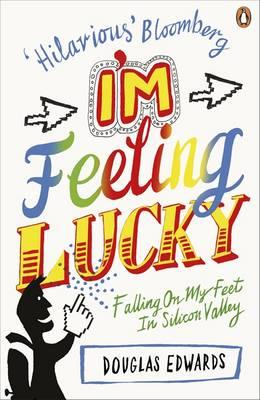
I’M Feeling Lucky, not just another book about Google

As a follow-up of my post Safe choices aren’t always good choices, here is my full account of I’M Feeling Lucky – Falling On My Feet in Silicon Valley by Douglas Edwards. As I said then, I thought it might be just another book about Google. It is not. The lessons are amazing. And here are examples.

A first illustration comes from a conversation between Douglas and Larry Page: “I realize that more often than not you’ve been right about things. I feel like I’m learning a lot and I appreciate your patience as I go through that process.” […] “More often than not?” [Larry] asked me. “When were we ever wrong?” he didn’t smile as he asked his question or arch an eyebrow to signify annoyance. He simply wanted to know when he had been wrong so he could feed that information into the algorithm that ran his model of the universe. [Pages ix-x]

Douglas was employee number 59 [Page xv]. He left in 2005, so his account of the Google story is extremely rich and shows how exceptional it was. “Other signs pointed to something out of the ordinary. Sequoia Capital and Kleiner Perkins were the Montagues and Capulets of Silicon Valley venture capital firms. An intense rivalry usually kept them from investing in the same startup”. [Page 7] [This is not so true as you may see from When Kleiner Perkins and Sequoia co-invest(ed).]

As a marketing person, he also has an interesting vision of engineers. “Neither Larry nor Sergey had been to business school or run a large corporation, but Larry had studied more than two hundred business books to prepare for his role running Google as a competitive entity”. [Page 141]

“Impulsive and opinionated, Ray [employee #6] will always personify for me Google engineering id, a lone cowboy patrolling the electronic frontier in shocking-pink shorts, facing down the black hats and making them blink, then riding off into a sunset that was only as colorful as he was”. [Page 152]

“The ideal success rate was seventy percent, which showed we were stretching ourselves. Missing targets would not factor in performance reviews, because if they did we would take too few risks”. [Page 55] … “Starting with something that’s more ambitious will get you something that’s reasonable. But if you don’t put the goal post way out there, people are already taking fewer risks and are less ambitious about how big the idea should be. It was another reason Google valued intelligence over experience.” [Page 105] “Think big. Stay flexible. Embrace data. Be efficient and economical in the extreme. [Page 113]”

There is a funny account of MentalPlex, an April Fool that upset some people but which was apparently quite creative, an “Ante-temporal search that anticipated user requests”. [Page 97-103] At the end of the post, you can have a look at how it looked like.

Part II is about growth and it is a change from the chaotic experimental company Google was. Not a dramatic change, but a change. The main lesson I keep from part I is that Google did many things in the opposite way that business books or experienced managers would tell you. Always doubtful, always skeptical with obvious truths. In particular anything which is not engineering or which cannot be backed by data.

“Larry’s decision to let user-created ads go live on our site without review convinced me he occupied some alternative and severely distorted reality”. [Page 185]

“There were people my age at Google when I joined and people older than me within a few months. Hardware engineer Will Whitted had been fifty-four when he started, and he saw no gap between his thought process and that of his younger colleagues. “I think that I think younger, which probably means more irresponsibly than most people do” he confessed. “There were people at Google who had the opposite problem – who were a little younger than me, but perceived by people who mattered as old-thinking. To be slow and overly-conservative, and it got them in trouble.” Those who succeeded, as I was trying to do, needed to be open to new ideas regardless of their source or seeming defiance of logic.” [Page 187]

“Would Google never tire of succeeding with big ideas that I found patently ludicrous? It was starting to make me feel like a crotchety geezer yelling at kids to get off his lawn.” [Page 190]

“What matters is whether we are doing the right thing, and if people don’t understand it now, they will eventually come to understand it.” It was a lesson that would shape Google’s attitude towards the public from that point on. Sure we had upset people with MentalPlex, but at least some us conceded their kvetching might have had cause. With Deja, we were clearly on the side of the angels. The public just did not get it. Even when we worked our asses off, spent our own cash, and tried to do something good for them, they bellowed and ranted, bitched and moaned. Since users were being so unreasonable, we could safely ignore their complaints. That suited our founders just fine – they always get with their guts anyway.
I’ve been asked if Larry and Sergey were truly brilliant. I can’t speak to their IQs but I saw with my own eyes that their vision burned so brightly it scorched anything that stands in their way. The truth was so obvious that they felt no need for the niceties of polite society when bringing their ideas to life. Why slow down to explain when the value of what they were doing was so self-evident that people would eventually see it for themselves?
That attitude was both Google strength and Achilles’ heel. From launching a better search engine in an overcrowded field to running unscreened text in Adwords, the success of controversial ideas gave momentum to the conviction that initial public opinion was often irrelevant. [Page 212]

You might remember how shocking Sept 11 was for Americans. But Google’s reaction to Sept 11 was moderate with Alon Cohen’s looped ribbon. Doug is showing how Google has been at the same time extreme with experimentation and much cautious about users than paranoid people might think…
Google-Ribbon

You can skip this section if you have already read “Safe choices are not always good choices“.
[Pages 256-258] “When Google finally recognized its failure in implementing a CRM software to manage customer emails, “composing a list of CRM vendors didn’t take long. Fewer than half a dozen major players offered stable, well-tested systems. […] Larry has a college friend, David, who would advise us on desirable features and then added, by the way, he and a buddy were building a CRM product called Trakken. […] Interested? Interested in an untested CRM product still in development with one tiny client? Sure that’s just what I was looking for – another risky technology with no support and no track record behind it. I thanked David for his help and, because he was a friend of Larry, assured him we’d be happy to send him our request for proposal. [Meanwhile they analyzed established players.] I felt confident I could convince Larry and Sergey to loosen the purse strings and do it right this time: spend money for a high-quality, stable system from a respected vendor. I hoped Larry’s friend had taken the hint and forgotten about us. [He had not] I didn’t want him to complain to Larry when his hopes were dashed. I decided to head him off at the pass by talking to Larry myself. “Actually,” Larry recommended “you should hire these guys. They’re really smart. They’ll work hard to build the product and we can invest in their company. […] They’ll be very responsive.” I could say I was stunned, outraged, incredulous, but that would be an understatement. I couldn’t believe Larry was going cheap again instead of buying reliability. When I informed the other vendors, they thought I was either corrupt or an idiot. […] “If you can believe you can build an email tool like resembling ours in thirty days, you are mistaken. It has taken us four years and twelve hundred customers.” […] I’d still be cursing Larry’s decision today if not for one small thing: Larry was absolutely right. […] Within a couple of months we had the CRM system we wanted built to our specs, fully stable and intuitive to use. […] So what did I learn from all this? I learned that obvious solutions are not the only ones and “safe” choices aren’t always good choices. I had thought that due diligence meant finding the product most people relied on, then putting pressure on the vendor to cut the price. It never occurred to me to talk to Larry not to do that. We had different tolerances for risk and different ideas about what two smart people working alone could accomplish in a complex technical area – and that is why I spent seven years working in mainstream media while Larry found a partner and founded his own company. Two smart guys working on complex technical problems, it turns out, can accomplish a hell of a lot”.

“Yet, once again, risk reaped rewards. The willingness to suffer a few quickly eradicated indignities opened up enormous gates to international audience growth. The world tolerated awkward translations and the occasional insult in order to access Google’s search technology. It was a reminder that perfecting the polish was not as important as giving people access to the product behind it. The results we returned and the speed with which we returned them were ultimately all that mattered. They were the essence of Google’s brand”. [Page 263]

[Pages 290-92] “The hour I spent with (Larry) and Sergey probing their vision for Google gave me my best look at their motivations and aspirations for the company. Larry wanted Google to be a force for good, which meant we would never conduct marketing stunts like sweepstakes, coupons and contests, which only worked because people were stupid. Preying on people’s stupidity, Larry declared, was evil.
We need to do good. We need to do things that matter on a large scale. When I asked for examples, he mentioned microcredit in Bangladesh (…) and talked about changing business systems to make them environmentally friendly while saving money. He also talked about distributed computing, drug discovery and making the Internet faster. And that wasn’t all.
We should be known for making stuff that people can use, he said, not just for providing information. Information is too restrictive. In fact, we shouldn’t be defined by a category but by the fact that our products work – the way you know an Apple product will look nice and a Sony product will work better but cost more. We’re a technology company. A Google product will work better.
(Then they talk about personal information, sensors, storage, cameras, and user-generated data.)
Not once did the subject of making money come up. I was probably a naïve-middle-aged dreamer, because looking back at it now, I see there was nothing truly extraordinary about what Larry described. But when I walked out of his office I believed that for the first time in my life, I had been in the presence of a true visionary. It wasn’t just the specifics of what he saw, but the passion and conviction he conveyed that made you believe Larry would actually achieve what he described. … My respect for our two capricious, obstinate, provocative and occasionally juvenile founders increased tenfold that day”.

[Page 324] “The experience confirmed the power of prototyping to give definitive answers far more quickly than theoretical discussions. Google learnt a lesson: the prototype had been put together not for a specific project but just because it was found interesting. The real value is that people will do things that everyone thinks are a waste of time. That’s where the big opportunities are. It’s an opportunity because other people don’t see it. Google itself was a canonical example. No other company had thought search was important. If they had, Microsoft or Yahoo would have invested more heavily in technology and Google would never gained such a big head start”.

[Pages 387-389. Finally…] “There was no longer a role at Google for what I did. I would wind things down. I picked March 4, 2005 as my last day: “Three, Four, Five.” I liked the architectural purity of it. […] I had started at a small company as a big-company guy. Now I was leaving a big company as a small-startup guy. And I like to think that, in some small way, I helped advance the human condition. Or at least that I did more good than harm.”

************ GOOGLE MENTALPLEX – APRIL FOOL 2000 ************

Title_HomPg2

Enter your search terms…


…or browse web pages by category.
New!  Search smarter and faster with Google’s MentalPlexTM
foolanim Instructions:

  • Remove hat and glasses.
  • Peer into MentalPlex circle. DO NOT MOVE YOUR HEAD.
  • Project mental image of what you want to find.
  • Click or visualize clicking within the MentalPlex circle.

See our FAQ and illustrations for correct usage.

Note: This page posted for April Fool’s Day – 2000.

© Google Inc.

7 x 7 = (7-1) x (7+1) + 1

Well yesterday I noticed this strange formula. Would it be that 7 is a magic number and I would go from rational to irrational – though start-ups are often irrational aventures too? No: 7 is not alone, the formula applies to 5 [25=24+1], 3 [9=8+1], and so on: 11, 17. So prime numbers? Not even, true for any integer… I felt a little stupid when I found it is just a particular application of a^2 – b^2 = (a-b) x (a +b)!!

I love maths, but maths is not just magical numbers, it’s much broader. And I love to read books on the topic. There is poetry and beauty in math, for sure. To conclude this unusual post, here is a list of books I enjoyed reading in the past. In no particular order, but thematic.

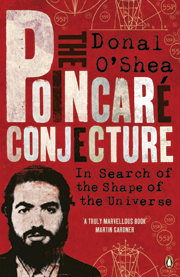
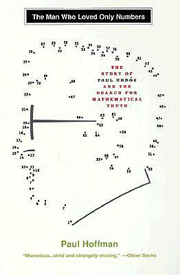
There are still “many” unsolved problems in mathematics. The most famous one is probably proving the Riemann hypothesis. Here are 2 books developing the story:

(Please click on image for a link to the book)

Indeed there is a million-dollar prize offered to 7 such problems by the Clay Institute. And the first solved one is the Poincare Conjecture by Grigori Perelman. Perelman declined the prize but this is another story!

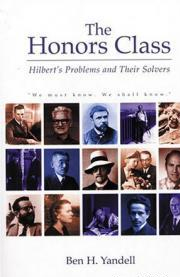
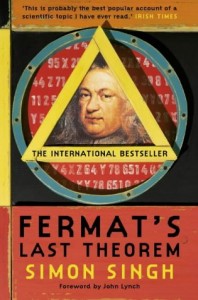
Before the Millenium problems, there were the Hilbert Problems. At the time, the Fermat theorem was probably the most famous challenge!

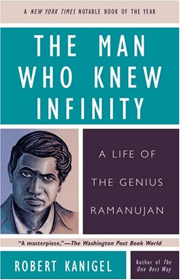
And as 2 last examples, but I could mention so many more, here are two biographies of extremely strange geniuses, Srinivasa Ramanujan and Paul Erdös

Maybe one day, I’ll be back with more on the topic of math and more broadly about popular science books! Don’t hesitate to give me examples and advice 🙂

NB: if you want to check the French versions, go to the article: https://www.startup-book.com/fr/2012/11/19/7-x-7-7-1-x-71-1/

A beautiful thriller in the world of start-ups

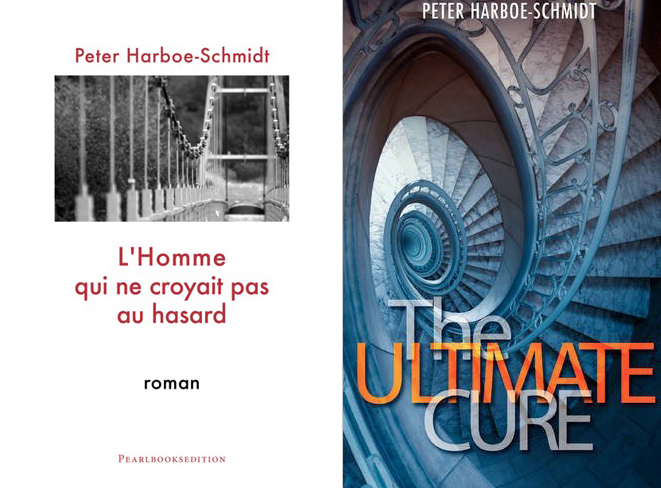
Today, Peter Harboe-Schmidt presents L’HOMME QUI NE CROYAIT PAS AU HASARD the French translation of his thriller The Ultimate Cure. I had at the time said how much I liked this novel. Do not hesitate to join him on the EPFL campus this afternoon.

Here is a short piece again:

“Take your start-up as an example. Why did you do it? If you analyzed the pros and cons for doing a start-up, you’d probably never do it. But your gut feeling pushed you on, knowing that you would get something very valuable out of it. Am I right?”
Martin speculated on why he was so drawn to a world that at times could appear to be no more than sheer madness. Like a world parallel to real life with many of the same attributes, just much more intense and fast-moving. People trying to realize a dream in a world of unpredictability and unknowns, working crazy hours, sacrificing their personal lives, rushing along with all those other technology based start-ups. Medical devices, Internet search engines, telecommunications, nanotechnologies and all the rest competing for the same thing: Money. To make the realization clock tick a little faster.
“Funny you should say that,” Martin finally said. “I’ve always thought of this start-up as a no-brainer.I never tried to justify it in any way.”

When Apple was still Apple Computer

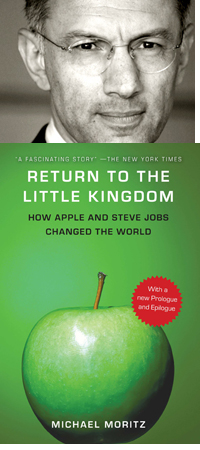
After reading The Apple Revolution, I discovered Return to the Little Kingdom, subtitled How Apple and Steve Jobs Changed the World. It’s not just another book about Apple for 2 reasons: it was written in 1984 so when Apple, Inc was still Apple Computer, Inc and it was written by Michael Moritz, then a journalist at Time Magazine, but today one of the most famous venture capitalists, with investments in Yahoo and Google, just to mention two, although I must add that he has “a rare medical condition which can be managed but is incurable” and a result, he stepped back as managing director of Sequoia Capital.

It’s not that it adds a lot to the Apple Revolution, so no need to read both. Now, there are (very) interesting lessons, the best for me was probably in the Epilogue: “In 1984, faced with the challenge of managing a fast growing company in an increasingly competitive business, the board of directors were faced with the most important task that confronts any board: selecting a person to run the company. […] Only in retrospect have I come to understand the immense risk associated with hiring an outsider. […] It is not an accident that most of the great companies of yesterday and today have, during their heydays, been run or controlled by the people who gave them life. […] The founder, acting with an owner’s instincts, will have the confidence, authority and skills to lead. […] Experience is of little use in a young, fast-growing company in a new business that has a different pulse and unfamiliar rhythm. Experience is the safe choice, but often the wrong one.”

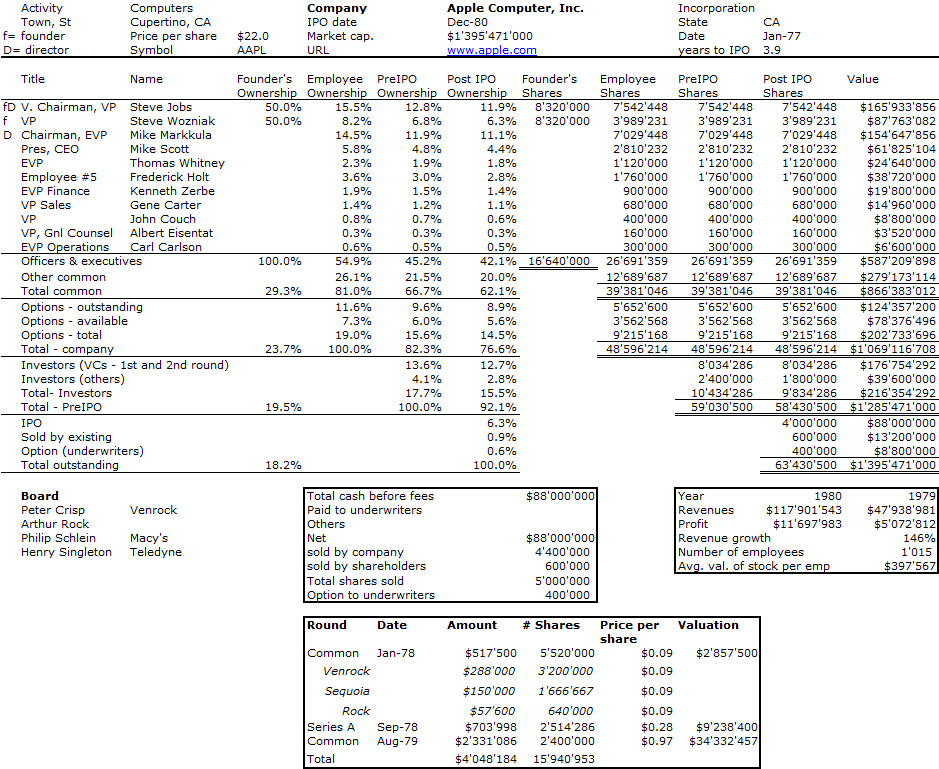
Now I could also refine my Apple cap. table as Moritz gave some nice details about employee shares. I also went back to the Apple S-1 document and slightly changed the content.

Here are the things I learnt: Both Jobs and Wozniak initally had 8’320’000 shares which they paid $2’654.48 so a price per share of $0.00032 in March 1977. Then Markkula bought the same 8’320’000 shares but for an amount of $91’000 so a price per share of $0.01094 in November 1977. The three of them were called the Promoters of the company. Then shares were sold to employees 1’280’000 to Michael Scott at a price per share of $0.01 in November 1977 and again 1’920’000 at $0.09 in August 1978. 800’000 to Frederick Holt at $0.01 in November 1977 and again 960’000 at $0.09 in August 1978. Same with Gene Carter, 160’000 to Gene Carter at $0.09 in June 1978 and 160’000 to at $0.09 in January 1979.

It should be noticed that employees were ranked as

#1 Stephen Wozniak
#2 Steven Jobs
#3 Mike Markkula
#4 Bill Fernandez had no share
#5 Frederick Holt
#6 Randy Wiggington (no info on his shares)
#7 Mike Scott – CEO
#8 Chris Espinosa had no share
#9 Sherry Livingston, first assistant, had shares
#10 Gary Martin – Accounting
#11 Don Bruener had no share
#12 Dan Kottke had no share
#13 John Draper
#14 Mike Wagner
#15 Donna Whitner
#16 Wendell Sander
Unknown Gene Carter had 320’000 shares
Unknown Jim Martindale
#34 Elmer Baum had no share

Jobs was so competitive, he did not like to be #2, so he asked to be #0! Buit Scott refused. Scott gave himself his number as a reference to 007!

Wozniak sold some stock to Fayez Sorfim, Richard Kramlich and Ann Bowers (Noyce’s wife). In the summer of 1979, Apple sold a total of $7M if existing shares are counted. Markkula and Jobs sold about $1M each. The “Wozplan” enabled some people including employees who had no shares so buy some of his.

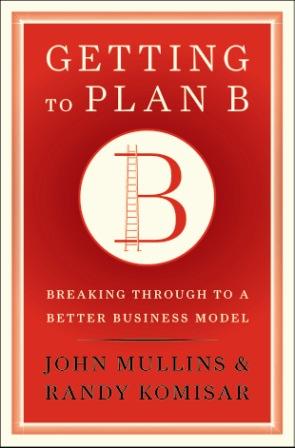
Getting to plan B (or to a Better Business Model)

It’s the second book I read from Randy Komisar (after the Monk and the Riddle) and I have to admit I preferred his first book even if Getting to Plan B is quite good too. I might have been slightly misled by the title even though the subtitle was quite clear, Breaking Through to a Better Business Model. But it might be I never read seriously subtitles. I thought the book was about what you do when you were wrong first. But it is more subtle. It is not so much about what happens if your idea was not good vs. what about finding a better or valid business model. If it says better, you plan A might have been good enough! The other reason I was not totally convinced comes from my feeling the case studies were chosen to illustrate a theory, a process, a framework, but did not prove it. I had the feeling the same case studies might have been used to illustrate opposite views, but again, who am I to say such things!

Mullins and Komisar’s book remains a very good book thanks to a rich variety of cases and lessons. In their preface, the authors say important things. “Entrepreneurship is not easy. [..] they are countless tales of companies that quickly went down in flames. Ultimately [many of them] failed because the economics of their business model didn’t work” [Page viii]. I was a little puzzled because I am not so sure; many companies failed because customers did not buy. But it might be the same! The authors claim “they developed a process and a framework to discover the best business model” [page ix]. Again I am puzzled, I am not sure this exists. But still, they certainly provide interesting tools.

One of the most interesting one is the use of analog and antilogs, that I had already mentioned when reviewing Ries’ Lean Start-up. Again For the iPod, the Sony Walkman was an Analog (“people listen to music in a public place using earphones”) and Napster was an Antilog (“although people were willing to download music, they were not willing to pay for it”). Analogs are successful predecessors worth mimicking in some way whereas antilogs are predecessors (whether successful or not) in light of which one explicitely decides to do things differently [Page 14]. But when they claim Apple’s plan B was to transform itself from a struggling PC maker to a consumer electronics powerhouse [page 21] , I find the broadness of the plan B concept really too broad!

Then their methodical dashboard is about validating leaps of faith by testing hypotheses. And what is new compared to other important references such as Steve Blank’s customer development is the focus on the business model through 5 elements: revenue, gross margin, operating expenses, working capital and investments.

Business model element Relevant analogs and the numbers they give you Relevant antilogs Leaps of faith around which you will build your current dashboard Hypotheses that will prove or refute your leaps of faith
Revenue model
Gross margin model
Operating model
Working capital model
Investment model

Why plan A won’t work? The authors answer, page 3, by quoting Albert Page: “it takes 58 new product ideas to deliver a single successful new product”. And a few lines below, “figuring out what the customer wants is not easy.” PayPal worked on its plan G! Google’s plan C works. Plan A had no revenue model, plan B was licensing, plan C was advertising. (But remember Google was always a search engine. In terms of product, it was still plan A! That is why I said before I was misled by the title Getting to Plan B)

They begin chapter 1 with the following: “Mediocre success – finding a passable business but missing the real potential – is equally problematic. Arguably, it’s worse than missing the target completely because it will tie down your considerable talent in a venture with no real future. You and other entrepreneurs and innovators like you are the lifeblood of today’s economy. And to waste your talent on something mediocre would be a real shame.”

Now the book shows that success does not have only one way. The Silverglide case [pages 74-78] shows that an entrepreneur can succeed with $80k for friends and family money whereas I am not even sure how many hundreds of millions Jeff Bezos needed before reaching profitability for Amazon.com [pages 186-192]. Many case studies illustrate how to optimize each of the 5 business models elements [chapters 3-7], whereas chapter 8 shows that you will need to find a balanced solution trying to get the best of these 5 key financial objectives. Amazon.com needed to reach a very large size to make its automated process worthwhile but “great lessons are born from leaps of faith” [page 192].

I fully agree with their final chapter’s early sentence: “As you know by now, this is not a book about business planning. It’s about, in a sense, business discovering. Quoting Eisenhower, “plans are useless, but planning is indispensable” or McArthur: “No plan ever survives its first encounter with the enemy”. So again, the building blocks of the process are:
– an identified customer pain and a solution or an opportunity to offer delight,
– some relevant analogs and antilogs,
– which lead to some as-yet-untested leaps of faith,
– which lead to a set of hypotheses to test them,
– a dashboard to focus your attention on what’s most important right now and to provide some mid-course corrections,
– all comprehensively organized, in just the right sequence, to inform and create the five elements of your business model.

[page 208]

Does this mean you need a plan B right from the start? The answer [page 212] is nice: “There’s a temptation to think that, since plan A probably won’t work, you should have plan B in your hip pocket. Don’t do it. A contingency plan would probably be just as flawed.”

There is clearly in the eraly 21st century a new trend in that business plans may not be a sufficient tool, not to say even necessary. From Randy Komisar, through Eric Ries, to Steve Blank (including my recent account of Cohen’s Winning opportunities), the important element is the discovering process of your business, of your customers in an iterative and flexible manner. This is clearly an important lesson to remember.

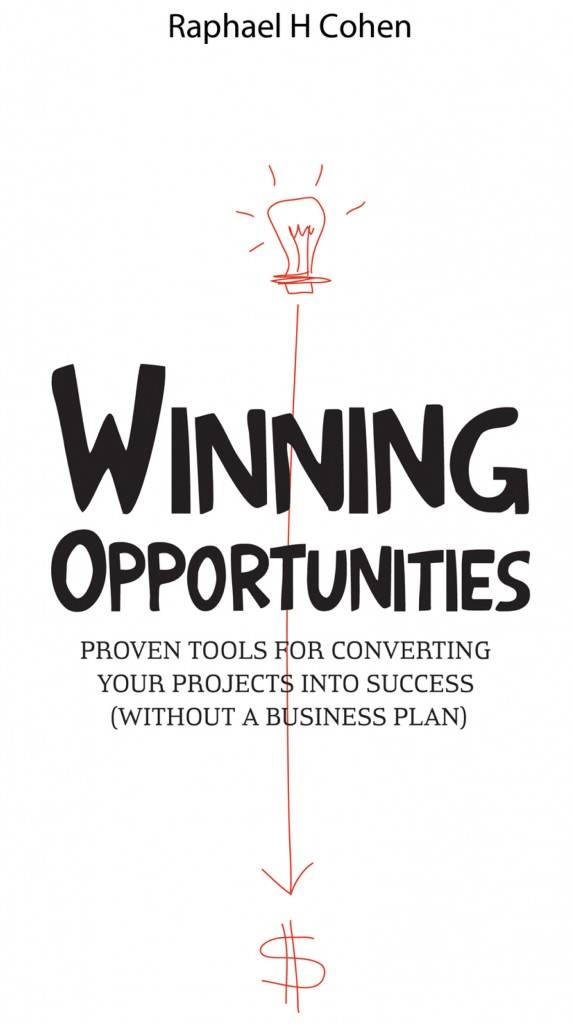
Proven Tools for Converting Your Projects into Success (without a Business Plan)

Winning Opportunities is not just another book about business planning. Indeed Raphael Cohen’s new book is subtitled Proven Tools for Converting Your Projects into Success (without a Business Plan).

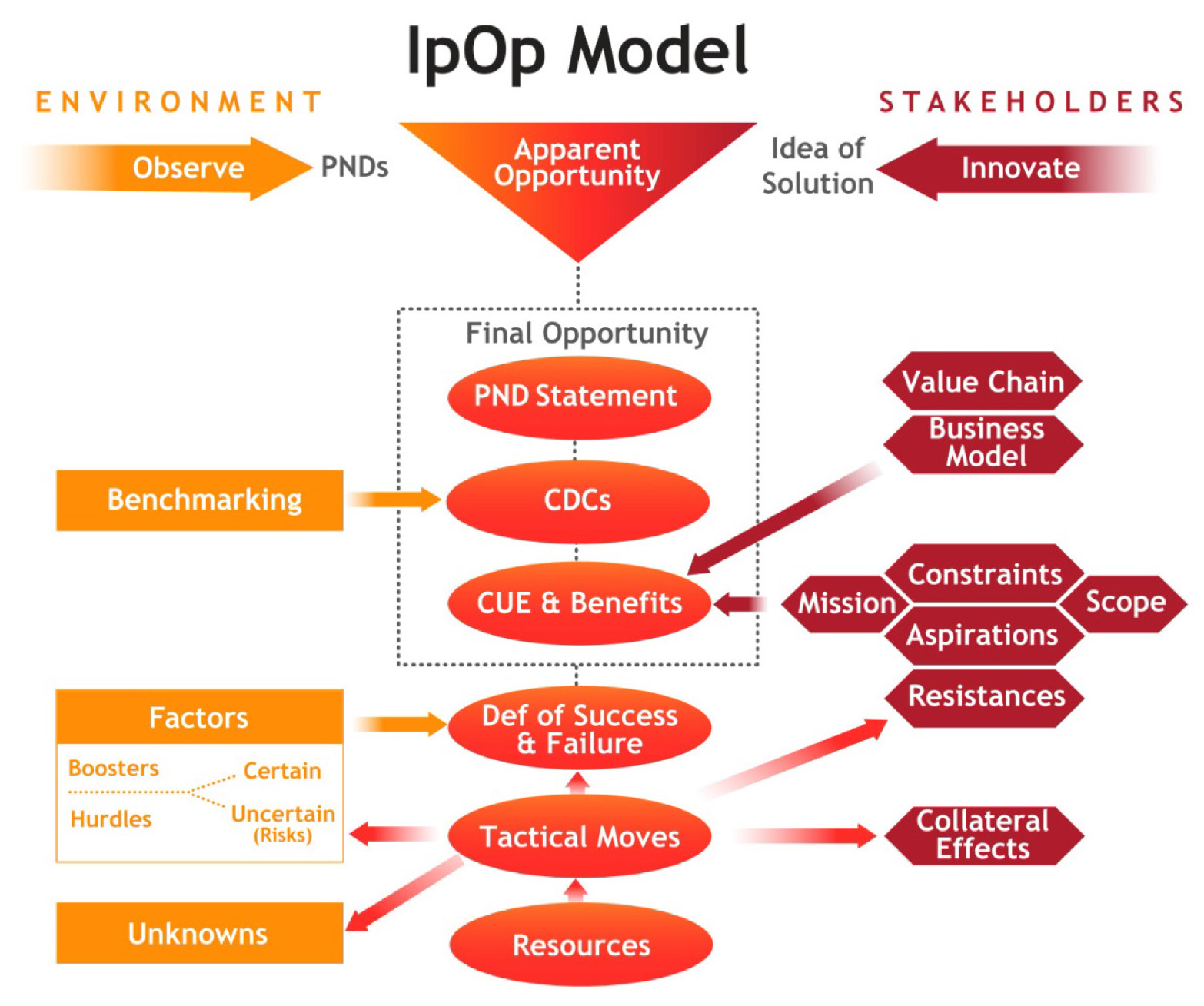
This 200-page, 18-(short)-chapter book is a very interesting way to analyze your project opportunity (maybe more in a corporate than in a start-up set-up). “Designed for doers, it provides a structured model of the entrepreneurial/intrapreneurial process. […], it is about discipline and process. […]. In other words, creativity is not enough. Framework and discipline are essential companions.” [Page 3] Cohen is therefore a disciple of Peter Drucker who believes entrepreneurs can be tought. But he adds on page 15, that “Observation is a state of mind. To understand your customers, you need to spend time observing them in their own environment. […]. There is no way engineers ensconced in their cubicle offices could observe (and so identify) such a “Pain”. Many real opportunities can only be identified outside of your office.” He is also close to Steve Blank and his customer development framework and here I should remind the reader with Blank’s comment on creativity.” But it’s more likely that until we truly understand how to teach creativity, [entrepreneurs] numbers are limited. Not everyone is an artist, after all.” And we should be all aware that though tools and states of mind are critical, success can not be guaranteed, its odds can increased however.

Cohen has a great framework that is summarized in the next figure but you should read his book and see how he builds the full IpOp (Innovation by Opportunity) model, step by step.

Again he is close to Blank when he explains that assumptions will be checked via practice, not via theory: “Selecting a Business Model usually requires making a number of assumptions. In many cases, it is impossible to verify these assumptions before implementing the Business Model in real time or at least in a pilot study. You should test a Business Model whenever possible, and must always be prepared to revise it or explore alternatives.” [Page 73]

One critical factor that may not be enough emphasized in business planning is the energy required to sell. “To be successful, it is not enough to have written up the perfect Business Model, you still need to persuade customers to buy. And for this, you must convince them that what you offer has an outstanding superior perceived value”. [Page 80]. You need to desire and be able to sell!

Cohen mentions metrics as a way to measure success. His KISS are Key Indicators of Success and these may be subjective. He is right. But once you decide about how you define success, measure it. “The Definition of Success determines a project’s sex appeal. […] While other factors such as preventing the competition from entering the market, testing new markets or distracting stakeholders from other issues may play a role in the decision process, it is the Definition of Success that is the bottom line. Whatever is measurable will always be very much at the heart of the decision process, because it is an output that can be monitored.” [Page 91] “Defining failure will provide stop/no stop criteria” [Page 92]. My personal experience is that it is one of the toughest decisions to admit one’s own failure. “If the opportunity is worth it, you will find the necessary resources when the time comes.” [Page 99].

Cohen introduces the concept of Unknowns as a separate chapter, showing again that entrepreneurship is not easy. They should be catalogued, characterized, prioritized. “Be humble enough to recognize what you do not know” [page 109] and “testing assumptions is often the key to reducing the level of uncertainty” [page 110]. One of the best examples of reducing unknowns is Arnaud Bertrand’s amazing testing with Housetrip.

Again entrepreneurship is about selling, making money, it is about action. “The fun part is in the action. This is why people excel at thinking of Tactical Moves. In fact, most people jump straight from identification of the Opportunity into planning Tactical Moves. Some even jump into the action without any planning at all. Because most creative people are action-oriented, their natural inclination is to skip the strategic analysis presented in the previous chapters. […] And these people like action” [Page 113] and again: “Finding Tactical Moves is a highly creative process” [Page 115].

At the same time, action can be scary, because of the possible collateral effects: “damaging the company’s reputation; altering the essence or image of an existing brand; upsetting distributors or other partners; reducing the market share of other company products (this is known as cannibalization); irritating management; disclosing critical information; making colleagues jealous” [Page 118]. I remember an entrepreneur from my Index days telling me, “each day, you take 10 decisions, 5 might be good, 5 might be bad; just hope the bad ones will not be deadly”. Action, Action!

“Contrary to common belief, entrepreneurs do not like to take risks” [Page 126] “What they like is success and they are willing to take risks to achieve it.” {…] “Managing risks means not only identifying them and anticipating their impact but also preparing contingency plans.” (cf Plan B by Mullins and Komisar, next blog paper or the famous Pivot by Blank / Ries). “The contingency plan sometimes turns out to be the main plan”. And it may mean rethink the Definition of Success and revisit the stop / no stop criteria. Once again uncertainty is highly present and decisions never black and white.

Lack of money is often presented as the main obstacle to start-ups and intraprises. While this may sometimes be the case, the truth generally is that really attractive projects get the necessary funding. Of course, some people are more skilled than others in obtaining the Resources they need. Necessary qualities of an attractive entrepreneurial or intrapreneurial project are:
• The ability to deliver a convincing Definition of Success (plus possible additional Benefits) as against the Resources required (Return on Investment)
• A reasonable chance of success, given the team behind the project and other critical success Factors and Unknowns.
Many entrepreneurs are not lucid enough to make a realistic assessment of the attractiveness of their project, having a tendency to believe that what is attractive to them is automatically attractive to others. It is important that entrepreneurs seek resources from the right people. To do so, they will need a sufficiently large network to turn to.” [Pages 135-136]
“Fund-raising exacts an enormous collateral cost. The whole time spent on looking for money and convincing fund providers is unavailable to promoting delivery of the Definition of Success. The milestone-based is much healthier than putting a lot of energy into multiple rounds of financing, but is only possible with a very well-thought-out pre-project.” [Page 138]

Business plans are in fact more trouble than they are worth [page 151], because:
• They do not increase the probability of success of a new venture, […]
• Less than 10% of business plans actually get read. […]
• Production of the plan delays presentation of the project to Decision-makers
• Apart from people who make a living producing, teaching or selling business plans, almost everybody else in the business community agrees that they are useless for start-ups and new initiatives. The business plan does however remain relevant as the output of a strategic analysis for coordinating the functions of an existing organization (marketing, production, HR, finance, etc.)
• So … writing them is a waste of time and energy

Cohen finishes his book by explaining how important is an ecosystem friendly to entrepreneurs. “The simple Five P’s formula for emPowerment is a recipe that works wonders to promote innovation within organizations:
+ A Passionate leader
+ Permission (to do)
+ Protection (in the event of failure)
+ a Process
= Powerful Performance (by emPowered People)” [Page 185]

The book is extremely well-written and this is not so common in the business litterature. Another original feature is that Cohen does not use quotes (mea culpa!) at the beginning of each chapter but jokes. And because he authorizes the use of them, here is one I liked:

Making a compelling proposition pays
A guy with a severe stutter applied for a job selling Bibles. The interviewer believed he’d never make it as a salesman, and was about to tell the guy to look elsewhere for work. The stutterer begged for the job, “P-p-p-p-p-le-ease g-gg-g-ive m-m-m-mee a ch-ch-cha-a-ance. I-i-ic-c-can d-d-d-o i-i-tt.”
The manager said, “Okay”, and gave him a few Bibles and the rest of the day to see if he could sell one or two. By lunchtime, the stutterer was back, having sold all the Bibles. The manager was impressed, and asked if he could accompany the stutterer after lunch. “S-s-sure,” said the guy, and later they went out to the streets.
They approached a house, and the stutterer went up and knocked on the door. When the homeowner answered, he said, “G-g-g-g-good a-a-a-ftern-n-n-noon, M-m-ma’am. I-i-i’m s-s-s-selling B-b-b-bibles. W-w-w-w-would y-y-y-you l-l-l-l-l-like to b-b-b-buy a B-b-b-b-bible, or sh-sh-sh-ould I j-j-j-j-ust r-r-read it t-t-t-to you?”

A non-negligeable advantage of Cohen’s book is that it is freely downloadable and the author is just aksing you to pay what you think is fair once you’ve read it. I have not paid anything yet but my contribution has been to write this blog article and I would certainly recommend interested people to read and pay! Is this enough Raphael? 🙂

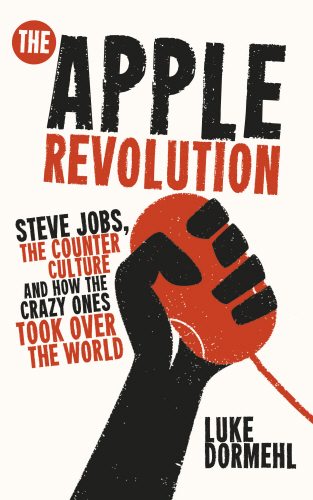
The Apple Revolution

I have not read (yet) Isaacson’ authorized biography of Steve Jobs but found (by pure accident) another recent, funny an really great book, The Apple Revolution. Interesting too and somewhat related to a previous blog I published on Robert Noyce and the culture of Silicon Valley. As important is the subtitle: Steve Jobs, the Counterculture and How the Crazy Ones Took Over the World.

Dormehl, the author, is convincing when he explains that Silicon Valley is the result of the counter-culture as much as the Midwest engineers coming to SV. Noyce might have agreed! “This ideological divide is not uncommon. Silicon Valley has long been defined by the innate tension between the technologist’s urge to share information and the industrialist’s incentive to profit. […] There were aspects of the counterculture that were staunchly anti-capitalists in their views. […] One of them was definitely Marxist and the other was largely apolitical.[..] “Do you own thing” easily translated into “Start your own business”. [Pages 61-63] “Only in Silicon Valley could starting a business be read as an act of rebellion.” [Page 169]

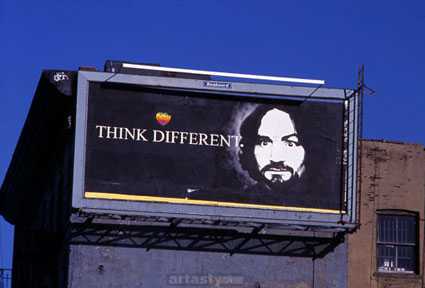
There are so many (unknown-to-me) anecdotes that I will only mention a few. For example, I did not know about Ron English, the guerrilla street artist who circumvented Apple’s billboards using murderer Charles Manson.

“The people who built Silicon Valley were engineers.” Jobs told wired in 1996. “They learned business, they learned a lot of different things, but they had a real belief that humans – if they worked hard with other creative, smart people,- could solve most of the humankind’s problems. I believe that very much.” [Pages 7-8]

At the same time, the counter-culture, the hacker culture has been critical [page 17]:
– Access to computers – and anything which might teach you something about the way the world works – should be unlimited and total;
– All information should be free;
– Mistrust authority – promote decentralization;
– Hackers should be judged by their hacking, not bogus criteria such as degrees, age, race, or position;
– You can create art and beauty on a computer;
– Computers can change your life for the better.

A funny anecdote is a woman going to the Homebrew Computer Club because nearly all the attendees were male. Her verdict: “the odds were good, but the goods were odd”. (Page 25)

You will learn about the history of the Apple logo [pages 85-90] and the first killer apps (word processing and spreadsheets). I did not know Paul Lutus and John Draper. And what about Apple first ad campaigns!


(Go to youtube at http://www.youtube.com/embed/J0Rs7d16jhU if you do not see the embedded frame!)

You will obviously read about the mouse, about interactions with Xeroc PARC and also learn about the early days of the MacIntosh concept and its father, Jef Raskin who yanked sharply in the arm of a young developer when he saw his face and guessed his thinking, labeling as “wet-behind-the-ears marketing puke, dressed in a ridiculous chalk-pinstripe, complete with banker’s vest, shoes off, stinky feet up […] an abrasive punk in need of a slap” a Steve Jobs he had not recognized! [Page 189]

“The Macintosh project represented the first time – outside the Garage in which the Apple II had been built – that Apple would put together the kind of small, dedicated team that would produce some of the company’s greatest products in later years. Jobs referred to this company-within-a-company approach as returning to the “metaphorical garage”. The Macintosh team still had all the piss and vinegar of a start-up. “Innovation has nothing to do with how many R&D dollars you have” Jobs said. “When Apple came up with the Mac, IBM was spending at least one hundred times more on R&D. It’s not about money. It’s about the people you have, how you’re led, and how much you get it.” [Page 202]

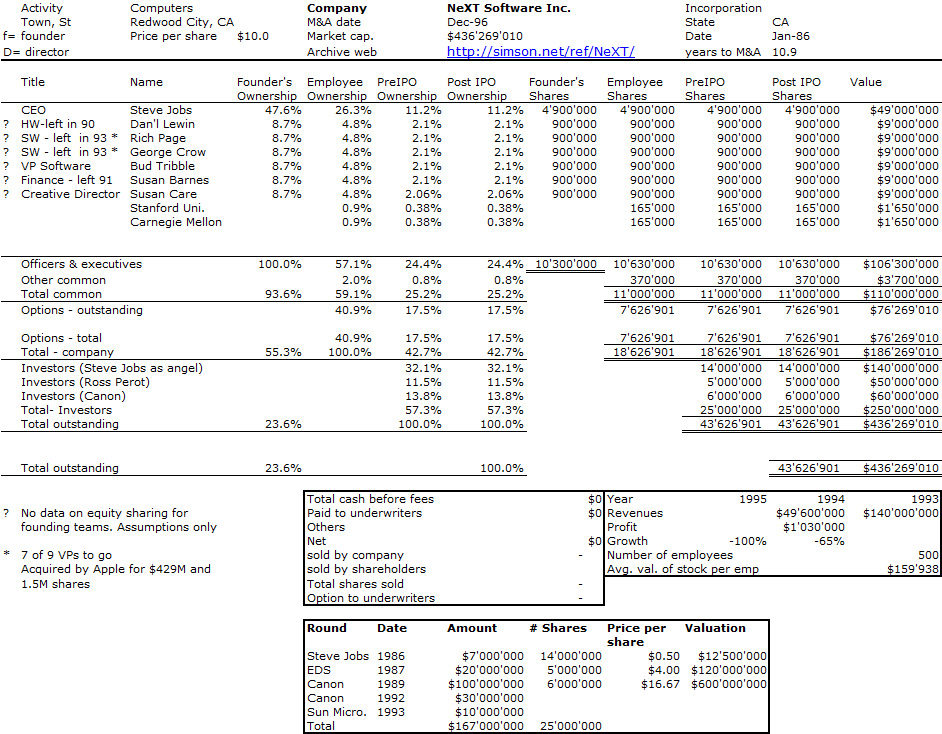
You will also read about the legal issued Apple faced in the music field and the funny origin of the Sosumi. It’s not only about Apple, you will read about Next early team, Dan’l Lewin, Rich Page, George Crow, Bud Tribble Susan Barnes an Susan Care as well as Pixar’s founding team, Alvy Ray Smith, Edwin Earl Catmull and John Lasseter ; “Pundits even came up with a tongue-in-cheek name for the unlikely convergence of Silicon Valley technology and Hollywood moviemaking. They called it Sillywood.“ [Page 303] So you can comment my tentative cap. table of NeXT (see below) when acquired by Apple.

Another piece of video is Pixar first work, The adventures of Andre and Wally B. If Jobs did OK with Next, what about with Pixar. He got 70% for $10M then Smith and Catmull each had 4%. But jobs got 100% after putting $50M. [Pages 335-336] There is also the funny anecdote that the iMac could have been called the MacMan, sounding “like a cross between the video game Pac-Man and Sony’s handheld music player, the Walkman.” [Page 413]. There is also an analysis of intellectual property [Pages 430-431] “Whether or not a breakdown i traditional copyright laws odes, in fact, lead to a similar decline in creativity and innovation remains a hotly contested debate” adding that “Gates, typically referred as imaginative”, and having “never invented anything” is wrong. “Gates had invented the notion that Software (be it entire operating systems or simple files) could be sold. Jobs merely reframed the idea as a necessary protective measure for creativity.” Apparently Dormehl advises to read Lawrence Lessig’s  The Future of Ideas.

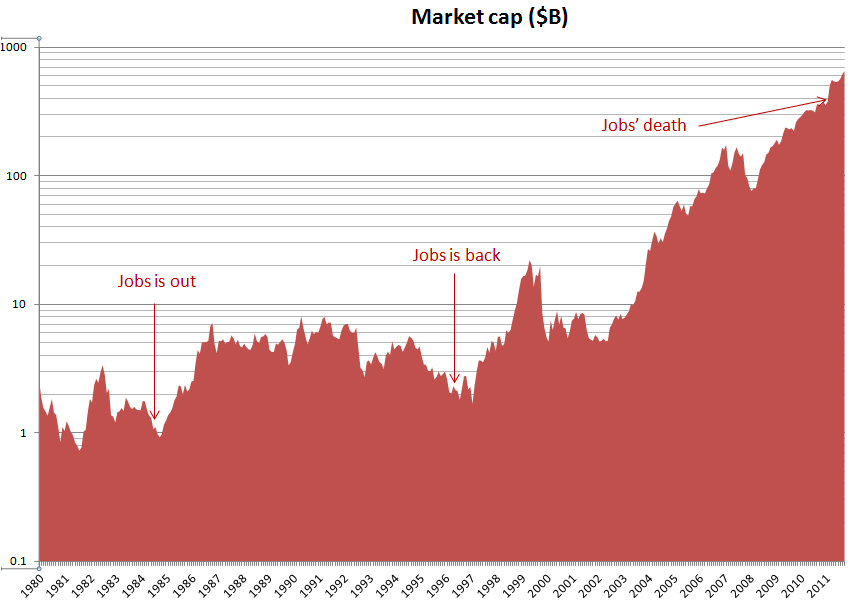
In the final chapters, Dormehl addresses the Apple paradox of the counterculture becoming mainstream. He quotes Norman Mailer [Page  384] “One is Hip or one is Square” and he adds [Page 408] that “no one better summarized the new ruling creative class of boomer bobos (that’s bourgeois bohemians) than Steve Jobs. […] They are prosperous without seeming greedy; they pleased their elders without seeming conformist; they have risen towards the top without too obviously looking down on those below; thy have achieved success without committing certain socially sanctioned affronts to the ideal of social equality; they have constructed a prosperous lifestyle while avoiding the old clichés of conspicuous consumption.”  Then [Page  456] Paul Lutus describes the App Store as a “classic marketer’s dream, with too many programmers with too many programs chasing too few buyer dollars, and the marketer in the middle the only really cashing in.” (Perfect capitalism, long if ever lost counterculture…) “Apple turning its back on its founding libertarian ideals.” […] “With the suggestion made that high-tech libertarianism apparently leans heavily towards the puritanical.” Still Jobs did not forget some elements of the start-up culture. “Jobs wanted the department to have only one hundred people, since that was the number of names he could remember.” “Apple was able to avoid unnecessary levels of bureaucracy. We’re the biggest start-up ion the planet Jobs proudly noted in 2010.” [Pages  462-463.] About innovation, “Gladwell’s suggestion (via economists Ralf Meisenzahl and Joel Mokyr) is that it is history’s tweakers – more so even than its inventors – who truly define the age:  The visionary starts with a clean sheet of paper, and re-imagines the world. The tweaker inherits things as they are, and has to push and pull them toward some more nearly perfect solution. that is not a lesser task. [Page  474] And as a near final quote from Norman Mailer again “One is a rebel or one conforms, one is a frontiersman in the Wild West  of American night life, or else a Square cell, trapped in the totalitarian tissues of American society, doomed willy-nilly to conform if one is to succeed.”  “It is for this reason that musicians like Jim Morrison and Jimi Hendrix who passed away at the age of twenty-seven, will forever be seen as young, idealistic rebels.” “The sheer scale of the current Apple makes it difficult to consider it any kind of rebel.”  [Page  502]  “Despite being declared moribund 59 times since 1995” [Page  495] , Apple is a formidable capitalist story as the next graph shows.

As a conclusion, let me quote Jobs again, and I discovered this on the Wikipedia page for Think Different:
“When you grow up you tend to get told the world is the way it is and your life is just to live your life inside the world. Try not to bash into the walls too much. Try to have a nice family life, have fun, save a little money.
That’s a very limited life. Life can be much broader once you discover one simple fact, and that is – everything around you that you call life, was made up by people that were no smarter than you. And you can change it, you can influence it, you can build your own things that other people can use.
The minute that you understand that you can poke life and actually something will, you know if you push in, something will pop out the other side, that you can change it, you can mold it. That’s maybe the most important thing. It’s to shake off this erroneous notion that life is there and you’re just gonna live in it, versus embrace it, change it, improve it, make your mark upon it.
I think that’s very important and however you learn that, once you learn it, you’ll want to change life and make it better, cause it’s kind of messed up, in a lot of ways. Once you learn that, you’ll never be the same again.”


(Go to youtube at http://www.youtube.com/embed/4oAB83Z1ydE if you do not see the embedded frame!)

Supporting creators: what VCs really are.

If you have the opportunity to visit VC firm Index Ventures in Geneva, you may see the following:

I had a closer look, was allowed to take the picture and learnt that the Index partners have four such “pictures”, one for each meeting room which has the following names: Frederick Terman, Ahmet Ertegün, Ernest Rutherford and Leo Castelli. What do have these very different people in common? In their own activity, they were the best supporters of “creators”, of “talent” and contributed to the success of people they supported. What ever critics may say, great venture capitalists help entrepreneurs in their success.

It was striking for me to discover this the week I published my post on the Black Swan. In particular, I quoted Taleb when he talks about creation: “Intellectual, scientific, and artistic activities belong to the province of Extremistan. I am still looking for a single counter-example, a non-dull activity that belongs to Mediocristan.” and later “You not only see that venture capitalists do better than entrepreneurs, but publishers do better than authors, dealers do better than artists, and science does better than scientists.” (I can add that gold seekers made less money than the people who sold them picks and shovels.) This is not fully true, one should probably add “on average”.

It’s not the first time I see connections made between scientists, entrepreneurs/innovators and artists. I am convinced of the similarities. It was the second time only that I saw a connection made between academic mentors, publishers, art dealers and venture capitalists. Interesting… I think.

PS: if you click and enlarge the picture you my recognize the pictures, read the names of famous start-ups, Adobe, Apple, Cisco, Google, Hewlett-Packard, Intel, Oracle, Yahoo and probably lesser known Stanford University motto “Die Luft der Freiheit weht” I had used as an introduction to Chapter 2 of my book about Stanford start-ups.

The Black Swan and the danger of statistics

“Thought is only a flash in the middle of a long night. But this flash means everything.”
Henri Poincaré*

When I talked to friends and colleagues about The Black Swan (“BS”), they were surprised about my interest in the movie with Natalie Portman. I cannot say, I have not watched it. I was talking about Nassem Nicholas Taleb’s book and theory. Some other friends classified at it as American b… s…, these superficial books that give advice on anything and that seem to always become bestsellers; my colleagues would classify it as airport literature, not to be read in academic circles.
I read it and enjoyed it, but I have to admit Taleb is sometimes painful. Is it because he was so much frustrated by I do not know whom or what or is it because he is so proud of his certainties? I am not sure. But his ideas are certainly worth thinking about more than a minute. (Whereas you forget about airport American b… s… after 30 seconds). So back to the BS.

You’ll find great accounts of his book or of his theory, e.g.
– Nassim Taleb’s “The Black Swan” by Andrew Gelman,
– The Wikipedia page on the Black Swan theory
– or even another essay by Taleb, the Fourth Quadrant,
so I will not try to do the same.

However defining the Black Swan might be useful! In the Fourth Quadrant, Taleb writes the following:

There are two classes of probability domains—very distinct qualitatively and quantitatively. The first, thin-tailed: Mediocristan”, the second, thick tailed Extremistan. Before I get into the details, take the literary distinction as follows: In Mediocristan, exceptions occur but don’t carry large consequences. Add the heaviest person on the planet to a sample of 1000. The total weight would barely change. In Extremistan, exceptions can be everything (they will eventually, in time, represent everything). Add Bill Gates to your sample: the wealth will jump by a factor of >100,000. So, in Mediocristan, large deviations occur but they are not consequential—unlike Extremistan. Mediocristan corresponds to “random walk” style randomness that you tend to find in regular textbooks (and in popular books on randomness). Extremistan corresponds to a “random jump” one. The first kind I can call “Gaussian-Poisson”, the second “fractal” or Mandelbrotian (after the works of the great Benoit Mandelbrot linking it to the geometry of nature). But note here an epistemological question: there is a category of “I don’t know” that I also bundle in Extremistan for the sake of decision making—simply because I don’t know much about the probabilistic structure or the role of large events. Black Swans are the unknown deviations in Extremistan.

Here are more notes taken while reading.

[Page xxii] The black swan is characterized by “rarity, extreme impact and retrospective (though not prospective) predictability” (with additional footnote: the occurrence of a highly improbably event is the equivalent of the nonoccurrence of a highly probably one.

[Page 8] The human mind suffers from 3 aliments:
-The illusions of understanding, or how everyone thinks he knows what is going on in a world that is more complicated (or random) than they realize;
-the retrospective distortion, or how we can assess matters only after the fact, as if they were in a rearview mirror; and
-the overvaluation of factual information and the handicap of authoritative and learned people – when they platonify.

[Page 15] While in the past a distinction had been between drawn Mediterranean and non- Mediterranean (i.e., between the olive oil and the butter), in the 1970s, the distinction suddenly became between Europe and non-Europe.

[Page 54] There is a major difference and often-made mistake between no evidence of something and the evidence of its non-occurence (mental bias.)

[Page 77] The answer is that there are two varieties of rare events: a) the narrated Black Swans, those that are present in the current discourse and that you are likely to hear about on television, and b) those nobody talks about, since they escape models – those that you would feel ashamed discussing in public because they do not seem plausible. I can safely say that it is entirely compatible with human nature that the incidences of Black Swans would be overestimated in the first case, but severely underestimated in the second one.

[Page 80] One death is a tragedy; a million is a statistic. […] We have two systems of thinking. System 1 is experiential, effortless, automatic, fast, and opaque. System 2 is thinking, reasoned, local, slow, serial, progressive. Most mistakes come from using system 1 when we think we use system 2.

[Page 140] We overestimate what we know and underestimate uncertainty. Another bias, ”think about how many people divorce. Almost all of them are acquainted with the statistic that between one-third and one-half of all marriages fail, something the parties involved did not forecast while tying the know. Of course, “not us” because “we get along so well” (as if others tying the know got along poorly.)”

[Page 174-179] Poincaré is a central personality of Taleb’s theory, in particular through the 3-body problem. According to Taleb, “Poincaré angrily disparages the use of the bell curve.” Now the next figure simply illustrates the concept of sensitivity to initial conditions.
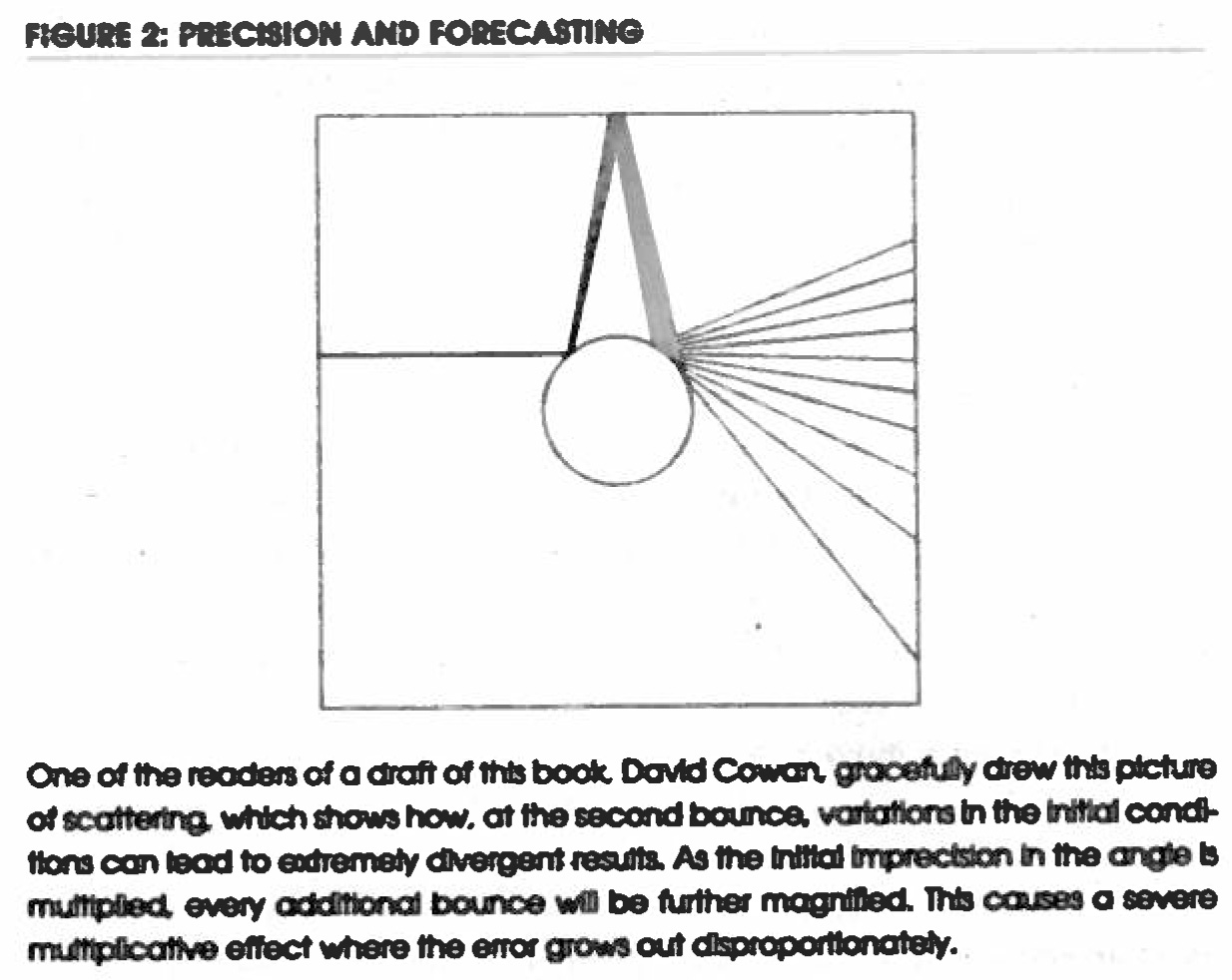
Predicting

Operation 1: imagine an ice cube and consider how it may melt.
Operation 2: consider a puddle of water. Try to reconstruct the shape of the ice-cube.
The forward process is generally used in physics and engineering, the backward process in nonrepeatable, nonexperimental historical approaches. And the backward is much more complex to analyze.

[Page 198] While in theory it is an intrinsic property. In practice, randomness is incomplete information. Nonpractitioners do not understand the subtlety. A true random process does not have predictable properties. A chaotic system has entirely predictable properties, but they are hard to know.
a) There are no functional differences in practice between the two since we will never get to make the distinction.
b) The mere fact that a person is talking about the difference implies he has never made a meaningful decision under uncertainty – which is why he does not realize that they are indistinguishable in practice.
Randomness in practice, in the end, is just unknowledge. The world is opaque and appearances fool us.

[Page 204] Trial and error means trying a lot. In the Blind Watchmaker, Richard Dawkins brilliantly illustrates this notion of the world without grand design, moving by small incremental random changes. Note a slight disagreement on my part that does not change the story by much: the world, rather moves by large incremental random changes. Indeed, we have psychological and intellectual difficulties with trial and error and with accepting that series of small failures are necessary in life. “You need to love to lose”. In fact the reason I felt immediately at home in America is precisely because American culture encourages the process of failure, unlike the cultures of Europe and Asia where failure is met with stigma and embarrassment.
[It’s really Taleb writing and not the blog’s author, but I fully agree !]

[Page 207] When you have a very limited loss, you need to be as aggressive as speculative and sometimes as unreasonable as you can be. Middlebrow thinkers sometimes make the analogy with lottery tickets. It is plain wrong. First lottery tickets do not have a scalable payoff. Second, lottery tickets have known rules.

The economics of superstars

[Page 24] Who is this book written for? You need to understand who your audience is and amateurs write for themselves, professionals write for others. [This irony of the author’s is stimulating. I experienced it, I’m an amateur. But are the masterpieces not then written by amateurs? The Black Swans (The Lord of the Rings, Harry Potter) look often like a work of amateurs. The Yevgenia Krasnova example provided by Taleb is also stimulating]

[Page 214] Someone who is marginally better can easily win the entire pot. The problem is the notion of “better.” People take from the poor to give to the rich. An initial advantage follows someone through life and keep getting cumulative advantages. Failure is also cumulative. The advent of modern media has accelerated these cumulative advantages. The sociologist Pierre Bourdieu noted a link between the increased concentration of success and the globalization of culture and economic life.

[Page 221] Taleb claims new comers mitigate the cumulative advantages. “of the five hundred largest US companies in 1957, only seventy-four were still part of that select group, the S&P 500, forty year later. Only a few hundred had disappeared in mergers; the rest either shrank or went bust.

Actors who win an Oscar tend to live on average five years longer than their peers who don’t. People live longer in societies that have flatter social gradients.

[Page 277] What is poorly understood is the absence of a role for the average in intellectual production. The disproportionate share of the very few in intellectual influence is even more unsettling than the unequal distribution of wealth- unsettling because, unlike the income gap, no social policy can eliminate it. Communism could conceal or compress income discrepancies, but it could not eliminate the superstar system in intellectual life. [I am not sure]

Skepticism

Taleb defines himself as a skeptic and his mentor are Hayek and Popper. He links it with humility in the following: [Page 190] Someone with a low degree of epistemic arrogance is not too visible, like a shy person at a cocktail party. We are not predisposed to respect humble people, those who try to suspend judgment. Now contemplate epistemic humility. Think of someone heavily introspective, tortured by the awareness of his own ignorance. He lacks the courage of the idiot, yet has the rare gust to say “I don’t know”. He does not mind looking like a fool or, worse, an ignoramus. He hesitates, he will not commit, and he agonizes over the consequences of being wrong. He introspects, introspects, and introspects until he reaches physical and nervous exhaustion.

Experts

[Page 146] We know the difference between know-how and know-what. The Greeks made a distinction between techne and episteme, craft and knowledge. We have experts who tend to be experts: astronomers, pilots, physicists, mathematicians, accountants and experts who tend to be… note experts: stockbrokers, psychologists, councilors… Simply things that move and therefore require knowledge do not usually have experts and are often Black-Swan-prone. The negative effect of prediction is that those who have a big reputation are worse predictors than those who had none.

[Page 166] The classical model of discovery is as follows: you search for what you know (say, a new way to reach India) and find something you didn’t know was there (America). It’s called serendipity. A term coined in a letter by the writer Hugh Walpole who derived it form a fairy tale, “The Three Princes of Serendip” who “were always making discoveries by accident or sagacity, of things they were not in quest of.“ […] Sir Francis Bacon commented that the most important advances are the least predictable ones.

[Page 169] Engineers tend to develop tools for the pleasure of developing tools. Tools lead to unexpected discoveries. So I disagree with Taleb’s definition: A nerd is simply someone who thinks exceedingly inside the box. It may not be contradictory but I prefer the engineer-like one: “I think a nerd is a person who uses the telephone to talk to other people about telephones. And a computer nerd therefore is somebody who uses a computer in order to use a computer. [https://www.startup-book.com/2012/02/03/triumph-of-the-nerds/]
And [Page 170] Pasteur claims “Luck favors the prepared”

[Page 170] On the difficulty of predicting, just look at the failure of the Segway which “it was prophesized, would change the morphology of cities.”

[Page 184] Another example of Taleb’s target: optimization… Optimization consists in finding the mathematically optimal policy that an economic agent could pursue. Optimization is a case of sterile modeling [discussed also in Chpater 17].

Politics

[Page 16] Categorization always produces a reduction in true complexity. Try to explain why those who favor allowing the elimination of a fetus in the mother’s womb also oppose capital punishment. [Which reminds me of André Frossard : “The unfortunate thing is that the left does not believe much in original sin and that the right has not much faith in redemption.”]

[Page 52] “I never meant that the Conservatives are generally stupid. I meant to say that stupid people are generally conservative” John Stuart Mill once complained. The problem is chronic: if you tell people that the key to success is not always skills, they think that you are telling them that it is never skills always luck.”

[Page 227] Which may explain “we live in a society of one person, one vote, where progressive taxes have been enacted precisely to weaken the winners”. I am not sure if Taleb does not prefer the aristocratic world. At least he seems to favor his friends from that world.

[Page 255] True, intellectually sophisticated characters were exactly what I looked for in life. My erudite and polymathic father – who, were he still alive, would have only been two weeks older than Benoît Mandelbrot [his mentor on non-linear fractals] – liked the company of extremely cultured Jesuit priests. I remember these Jesuit visitors […] I recall that one has a medical degree and a PhD in physics, yet taught Aramaic to locals in Beirut’s Institute of Eastern Languages. […] This kind of erudition impressed my father far more than scientific assembly-line work. I may have something in my genes dirving me away from bildungsphilisters.

Globalization/Scalability

[Page 28] a scalable profession is good only if you are successful; they are more competitive, produce monstrous inequalities and are far more random. Consider the example of the first music recording, of the alphabet, of the printing press. Today a few take almost everything; the rest, next to nothing [page 30].

[Page 32] In Mediocristan,” when your sample is large, no single instance will significantly change the aggregate or the total”. In Extremistan, Bill Gates in wealth or J. K. Rowling in book selling totally change the average of a crowd. “Almost all social matters are from Extremistan.” [When giving a talk on high-tech serial entrepreneurs at BCERC last month, I was slightly criticized with a “but you are only looking at 2% of the entrepreneurs! And I replied, yes but look at the impact…”]
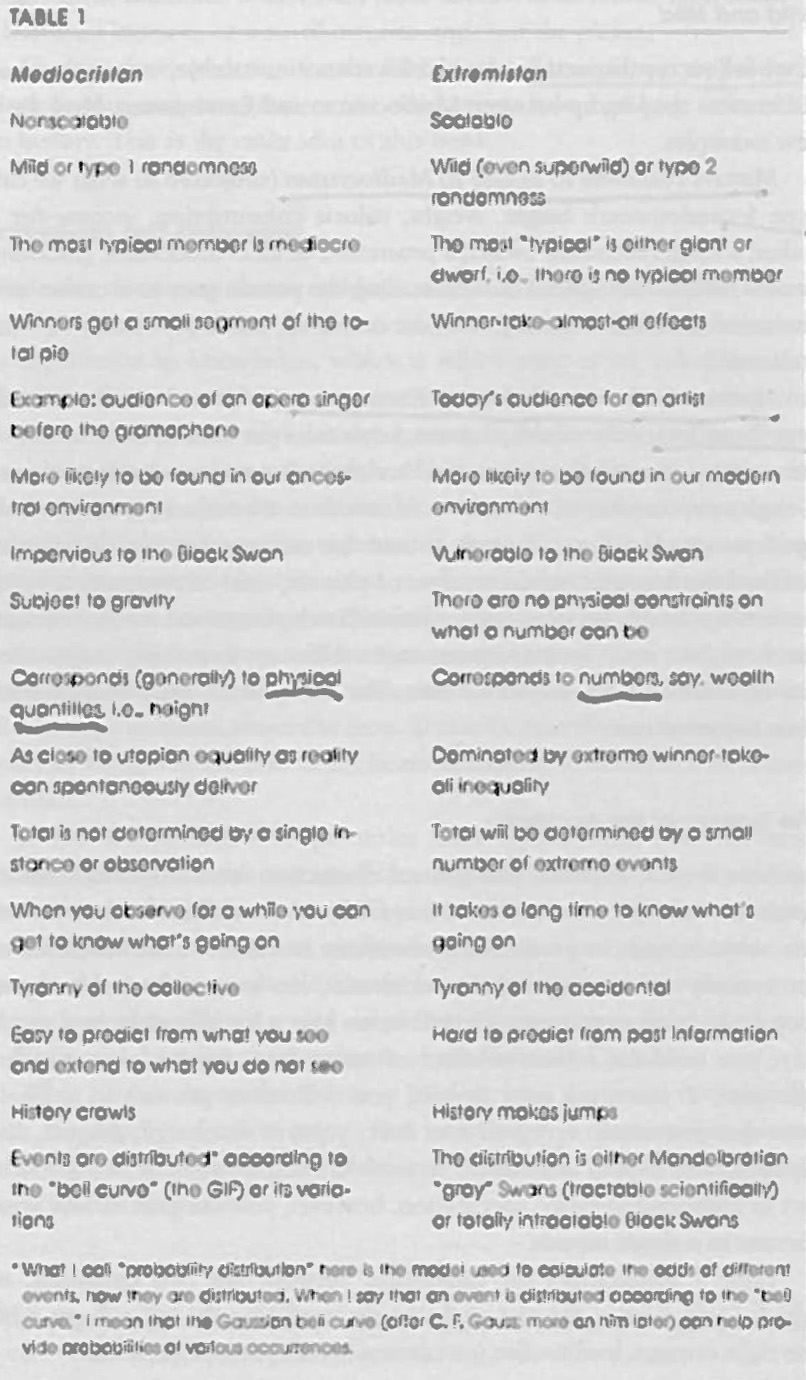
[Page 85] Intellectual, scientific, and artistic activities belong to the province of Extremistan. I am still looking for a single counter-example, a non-dull activity that belongs to Mediocristan.

[Page 90] You not only see that venture capitalists do better than entrepreneurs, but publishers do better than authors, dealers do better than artists, and science does better than scientists.” (I can add that gold seekers made less money than the people who sold them picks and shovels.)

[Page 102] The consequence of the superstar dynamic is that what we call “literary heritage” or “literary treasures” is a minute proportion of what has been produced cumulatively. Balzac was just the beneficiary of disproportionate luck compared to his peers.

[Page 118] The problem here with the universe and the human race is that we are the surviving Casanovas (who should not have survived and had his life without luck – no destiny].

Statistics

Taleb is not against statistics, but against Gaussian law, averages, etc. [Page 37] “The near-Black Swan are somewhat tractable. These are phenomena commonly known by terms such as scalable, scale-invariant, power laws, Pareto-Zipf laws, Yule’s law, Paretian-stable processes, Levy-stable and fractal laws.”

One thousand and one days or the story of the turkey confirms to me that an individual may not owe to the society that fed them initially!

[Page 239] Standard deviations do not exist outside the Gaussian, or if they do exist, they do not matter and do not explain much. But it gets worse. The Gaussian family (which includes various friends and relatives, such as the Poisson law) are the only class of distributions that the standard deviation (and the average) is sufficient to describe. You need nothing else. The bell curve satisfies the reductionism of the deluded. There are other notions that have little or no significance outside of the Gaussian: correlation and worse, regression. Yet they are deeply ingrained in our methods: it is hard to have a business conversation without hearing the word correlation.

[Page 240] Taleb has nothing against mathematicians, but he refers to Hardy’s views: The “real” mathematics of the “real” mathematicians, the mathematics of Fermat end Euler and Gauss and Abel and Riemann, is almost wholly “useless” (and this is as true of “applied” as of “pure” mathematics).

[Page 252] A critical feature of Gaussian statistics is the inclusion of two assumptions: First central assumption: the flips are independent of one another. The coin has no memory. The fact that you got heads or tails on the previous flip does not change the odds of your getting heads or tails on the next one. You do not become a “better” coin flipper over time. If you introduce memory, or skills in flipping, the entire Gaussian business becomes shaky. (Whereas there is preferential attachment and cumulative advantage in non-Gaussian events.) Second central assumption: no “wild” jump. The step size in the building block of the basic random walk is always known, namely one step. There is no uncertainty as to the size of the step.
[…] I have not for the life of me been able to find anyone around me in the business and statistical world who was intellectually consistent in that he both accepted the Black Swan and rejected the Gaussian and Gaussian tools. Many people accepted my Black Swan idea but could not take its logical conclusion, which is that you cannot use one single measure for randomness called standard deviation (and call it “risk”), you cannot expect a simple answer to characterize uncertainty.

But Taleb goes one step further. [Page 272] “But fractal randomness does not yield precise answer. […] Mandelbrot’s fractals allow us to account for a few Black Swans but not all. […] A gray swan concerns modelable extreme events, a black swan is about unknown unknowns. […] I repeat: Mandelbrot deals with gray swans; I deal with the Black Swan. So Mandelbrot domesticated many of my Black Swans, but not all of them, not completely.

Finance

Taleb shows that the stock crashes are sometimes linked to bad modeling and is particularly critical of the Black-Scholes options. He is very much critical of the stock portfolio theories and related Nobel prizes (Markowitz, Samuelson, Hicks or Debreu, “wrecking the ideas of Keynes”. The story of the LTCM hedge fund is an illustration of Taleb’s points.

Business and technology

[Page xxv] Almost no discovery, no technologies of note came from design and planning – they were just Black swans. […] So I disagree with the followers of Marx and those of Adam Smith: the reason free markets work is because they allow people to be lucky thanks to aggressive trial and error, not by giving rewards or “incentives” for skill.

[Page 17] The business world – inelegant, dull, pompous, greedy, unintellectual, selfish and boring.
[…] What I saw was that in some of the most prestigious business schools in the world, the executives of the most powerful corporations were coming to describe what they did for a living and it was possible that they too did not know what was going on.

[Page 135] When I ask people to name three recently implemented technologies that most impact our world today, they usually propose the computer, the Internet and the laser. All three were unplanned, unpredicted and unappreciated upon their discovery, and remained unappreciated well after their initial use. They were consequential. They were Black Swans.

Against averages

[Page 295] Half of the time I am a hyperskeptic; the other half I hold certainties. […] Half of the time I hate Black Swans, the other half I love them. […] Half of the time I am hyperconservative; the other half I am hyperaggressive”. I could delete the quotes!

I am not fully finished with the Black Swan, I am now reading the 70-page postcript essay which Taleb added to the latest paperback edition. There might be more to say (and read if you followed me until now…)

* Poincaré is quoted in Le Monde on July 7, 2012, by Cedric Villani, who by the way also mentions Black Swans in Dans les entrailles des cygnes noirs


The power and control of the Internet by the few tech giants in Silicon Valley

I was contacted out of the blue by Tony Shin who designed the following. I am not sure I fully agree, but his thoughts are worth thinking about them. You will need to click on it to see the full picture/story. Tony is also a designer looking for customers….


Click on picture to see full image and story. Created by: OnlineMastersDegree.com