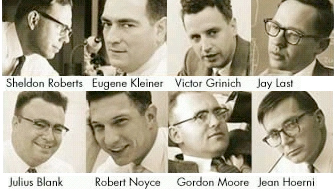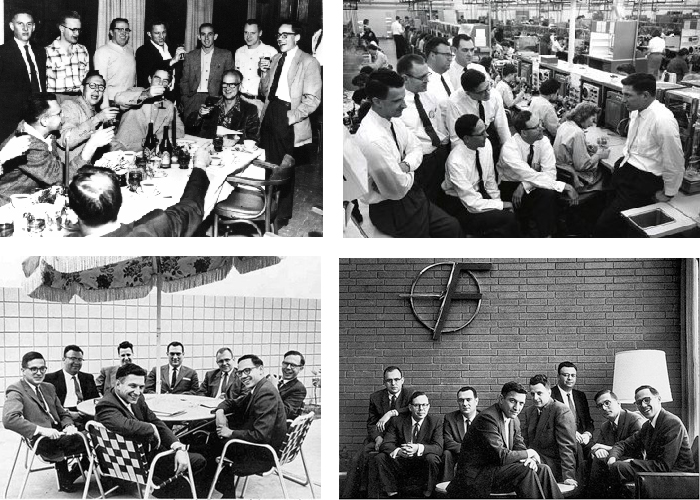
The fathers of Silicon Valley: the Traitorous Eight.

Thanks to a conversation with an EPFL colleague, I was recently reminded the early history of Silicon Valley. I knew about Shockley, Fairchild and the Traitorous Eight. I did not know Shockley had been funded by Beckman (thanks Andrea :-)), that was the point of the recent conversation.

What is interesting is to have a look at the Traitorous 8 also. Their history (cf Wikipédia) is well-known, what may be less known is their background.

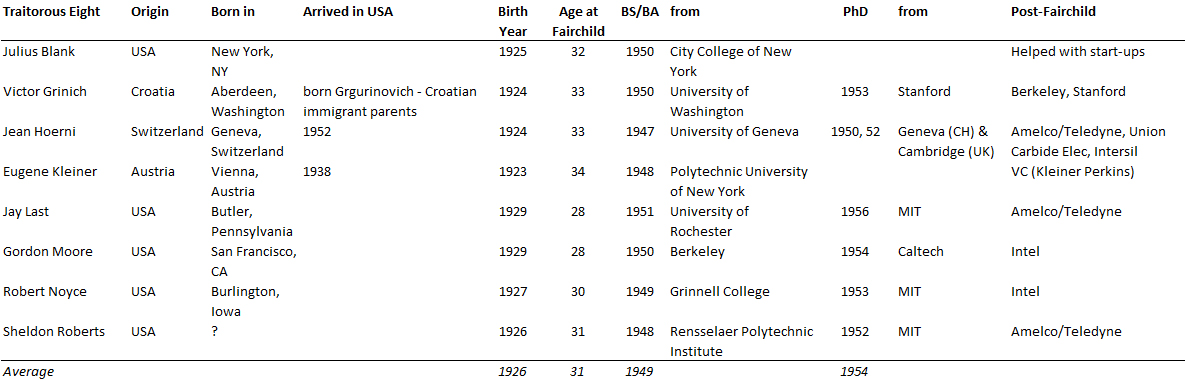
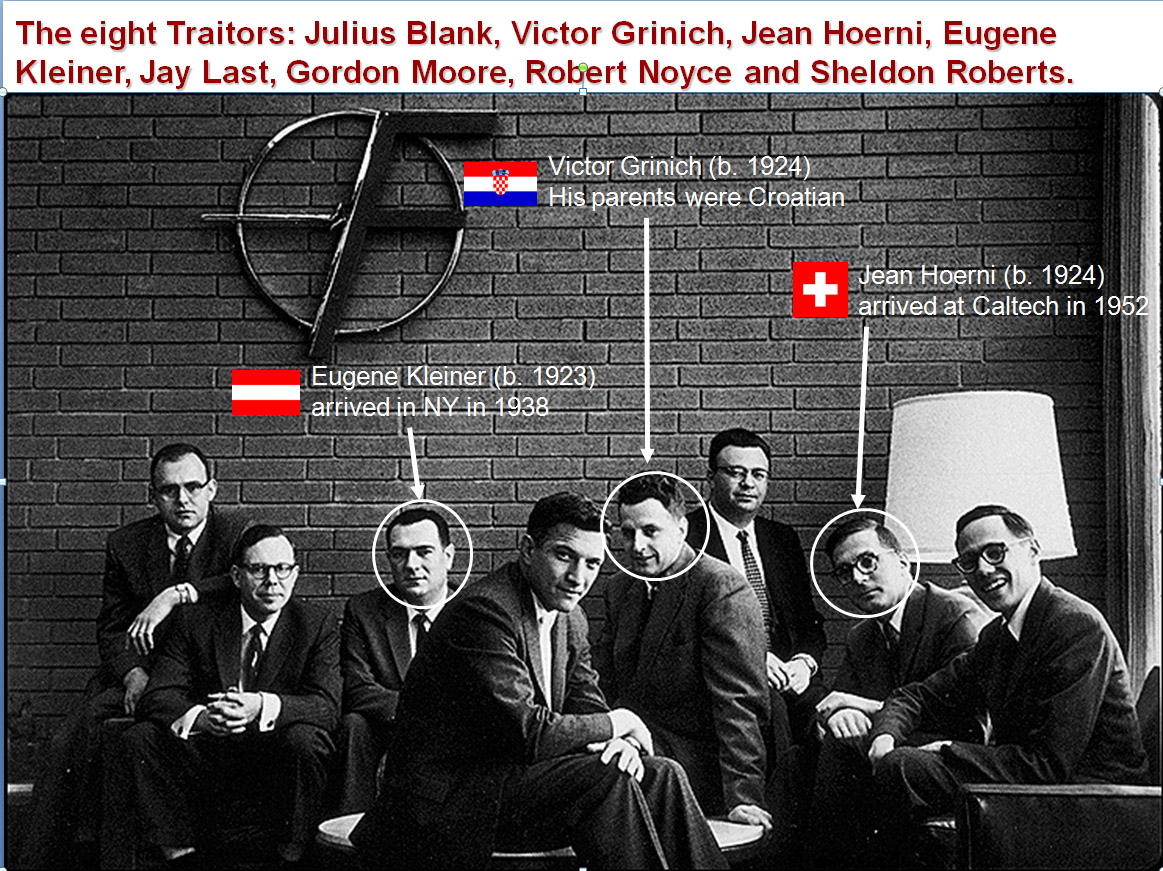
The next table gives the origin, education and age of the 8 traitors, the 8 engineers who left Shockley labs to found Fairchild Semiconductor in 1957 (click on it to enlarge).

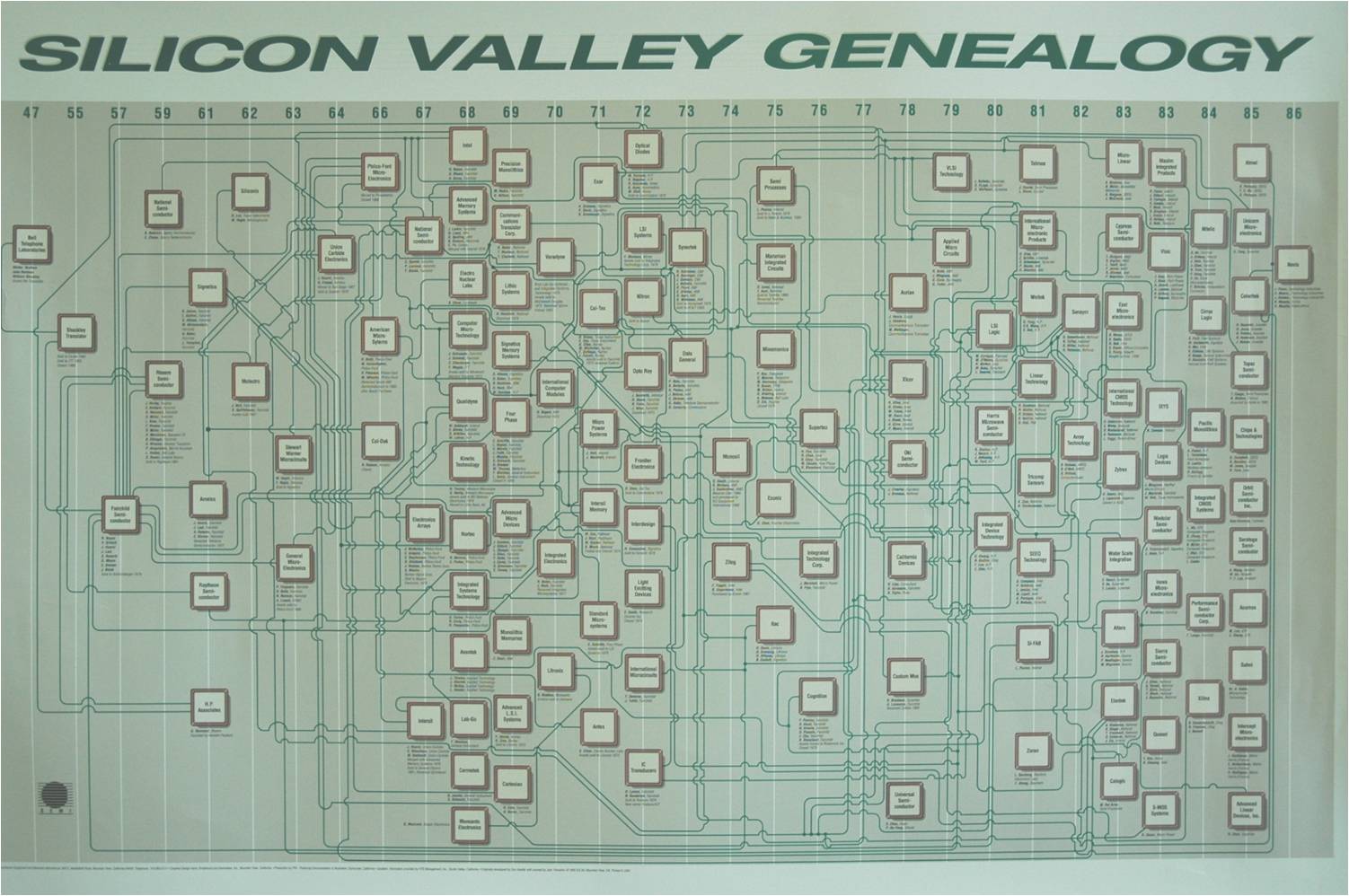
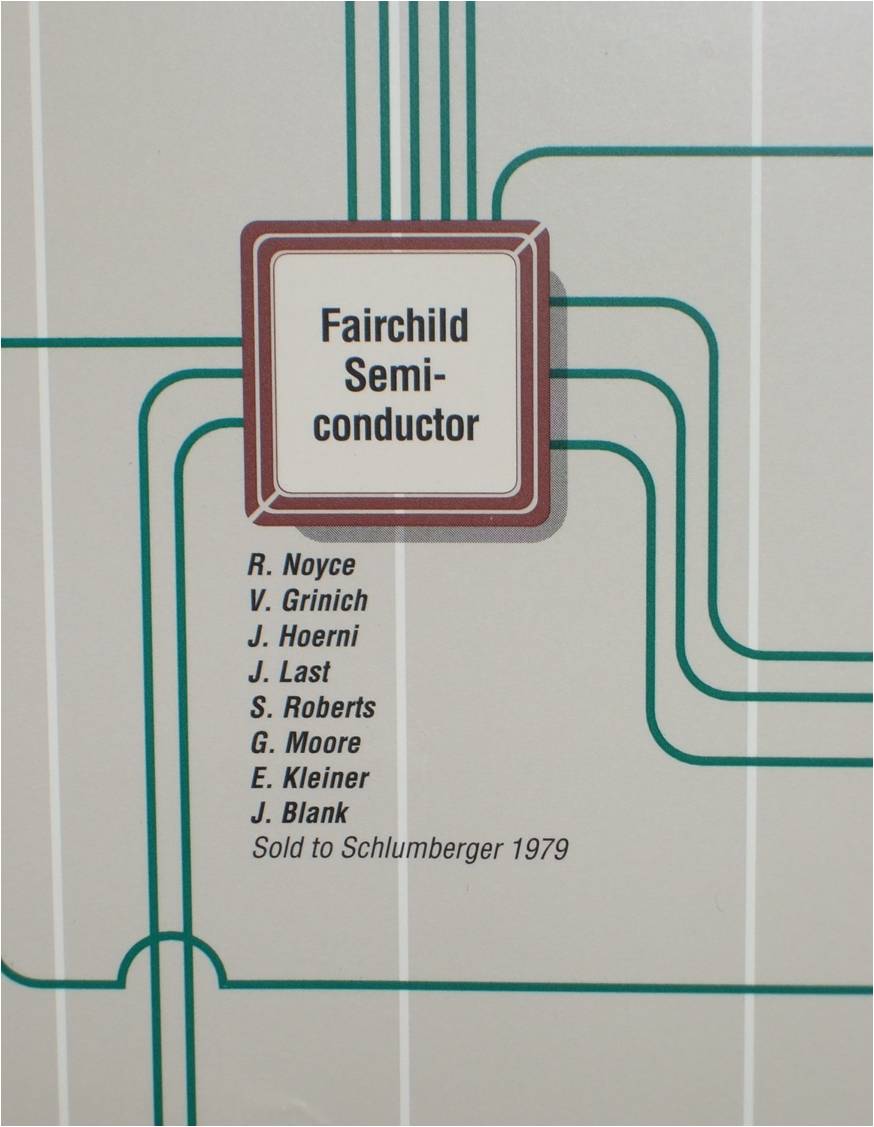
They can be considered as the real fathers of Silicon Valley. The famous poster entitled Silicon Valley Genealogy is certainly a convincing illustration of it as well as their Post-Fairchild activities.

The next image is extracted from the one above (left, mid-height level, corresponding to 1957).

A few comments:
– 5 were educated on the East Coast, 2 on the West Coast and 1 in Europe.
– Indeed, three were from Europe.
– 6 had a PhD (3 from MIT), all had a bachelor.
– They were between 28 and 34-year old in 1957.

If Twitter was going public, some far-fetched assumptions

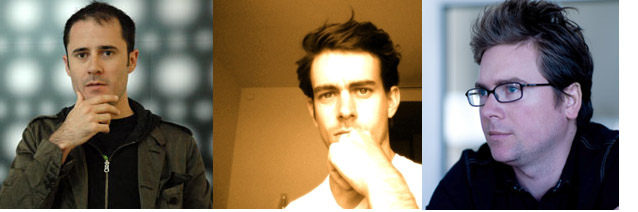
Twitter is with Facebook, Groupon and LinkedIn, one of the divas if the web 2.0. This morning, I read about a new rumor that the start-up received a new investment valuing Twitter at $4.5B. Twitter has already raised more than $250M and the latest valuation was $3.7B for only $45M in revenues in 2010 with 300 employees. If this is true, Evan Williams, Jack Dorsey et Biz Stone, the 3 founders, are already wealthy, all the more that it seems that some of the investors did not buy new shares from the company, but existing shares from management and employees.

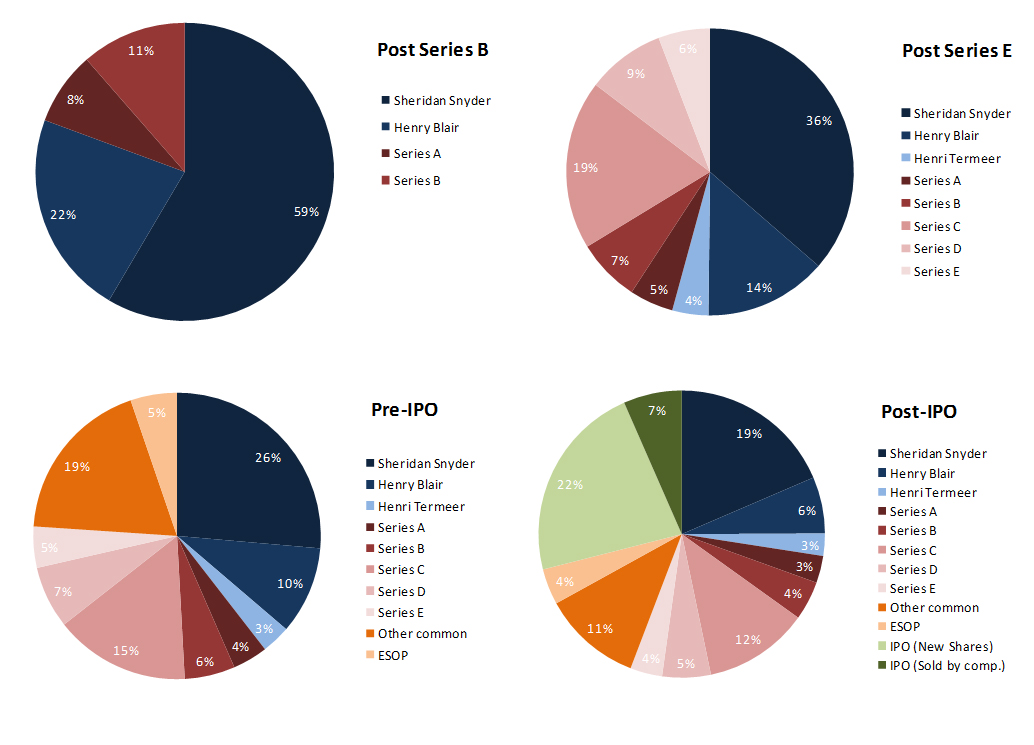
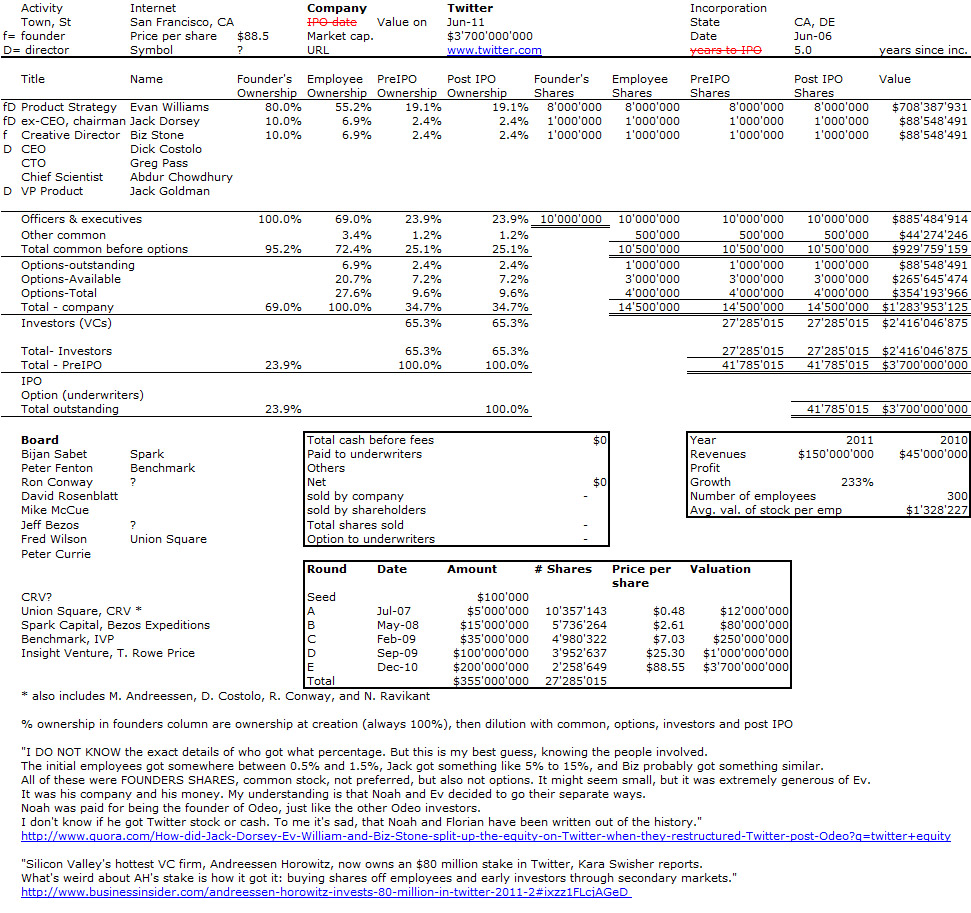
I tried to read the crystal ball and guess how the shareholding is structured. Given the number of unknown parameters, I am probably quite far from the current status, but, thanks to a simple analysis of the financing rounds, a standard stock option plan and a quora article on the founders, here is the result:

Google, Silicon Valley and the spin-off virtuous cycle

It’s one of Silicon Valley strongest assets: entrepreneurs do not stay for long in established companies and create new ones. And it is accepted as a fact. Let us just me quote again Richard Newton: “The Bay Area is the Corporation. […When people change jobs here in the Bay Area], they’re actually just moving among the various divisions of the Bay Area Corporation.”

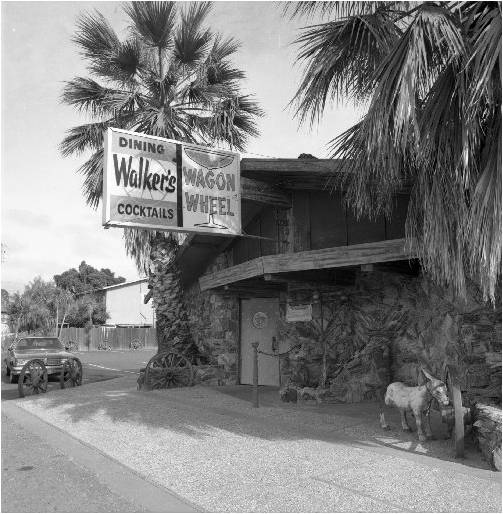
And what about the famous Wagon Wheel bar: “During the 1970s and 1980s, many of the top engineers from Fairchild, National and other companies would meet there to drink and talk about the problems they faced in manufacturing and selling semiconductors. It was an important meeting place where even the fiercest competitors gathered and exchanged ideas.”

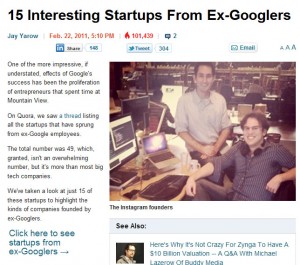
The story goes on. I read today (thanks to Burton Lee) 15 Interesting Startups From Ex-Googlers from Jay Yarow. He found that since 2004, 49 spin-offs were created by former “Googlers”. Because it was a work in progress, apparently the number has increased to more than 70. See slide 2 of the pdf.

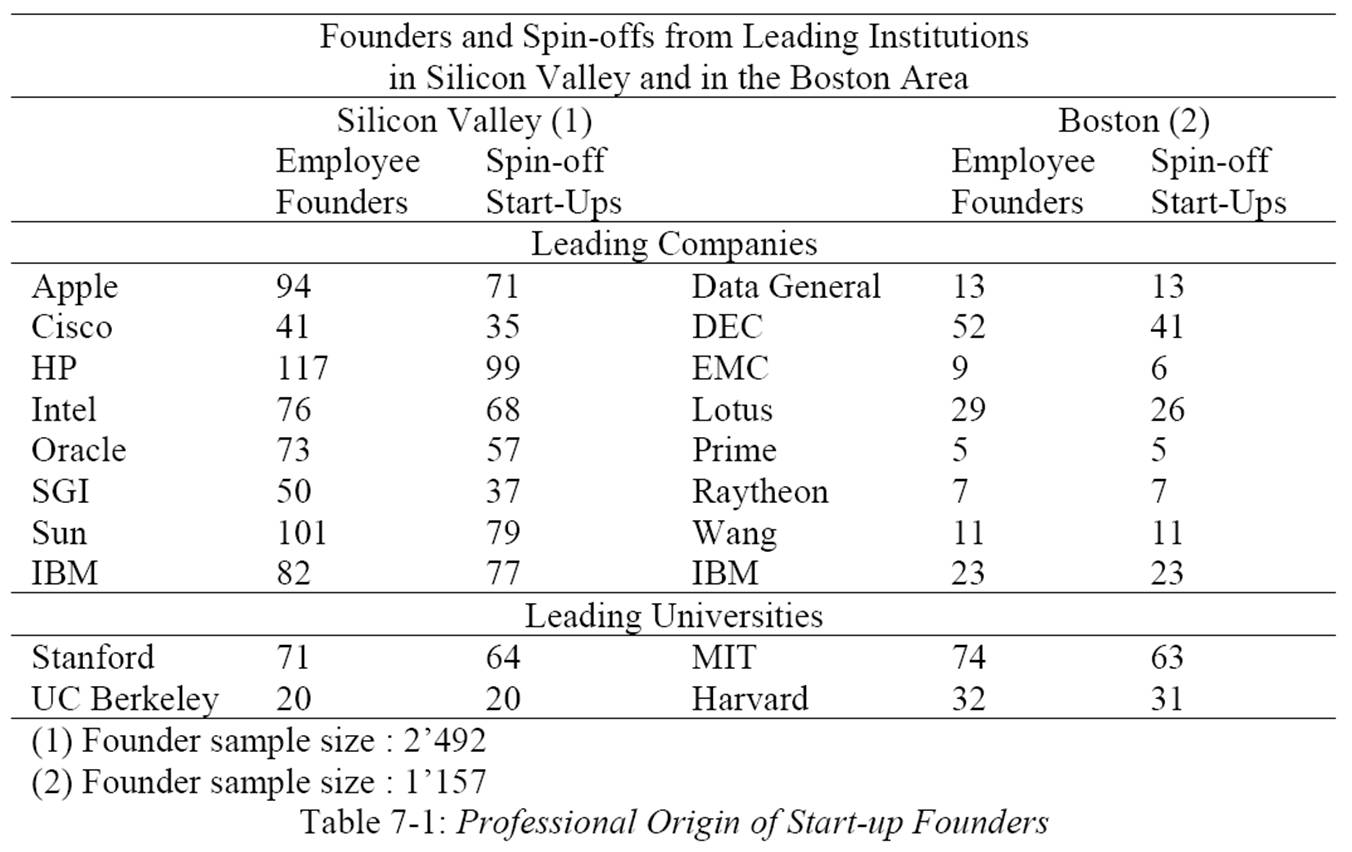
As a conclusion, let me add a study by Junfu Zhang who compared Silicon Valley to the Boston Cluster, in terms of how many entrepreneurs left their big company. He showed the big difference there was between the two regions that both Newton and the Wagon Wheel bar explain in terms of culture.


Source: High-Tech Start-Ups and Industry Dynamics in Silicon Valley – Junfu Zhang – Public Policy Institute of California – 2003

Check Point, the Israel success story

After my recent posts about Israel and high-tech innovation, I discovered I did know not very well the Check Point story. Start-up Nation did not provide much info and though you can find a lot on Wikipedia or on the Facts@Glance of the company. for example, I became a little frustrated when I discovered I could not find much about the company early days and IPO. I even had to buy the IPO filing through the SEC as the document is not public on the web and Check Point could not help me with such info.

There are a couple of very interesting points:
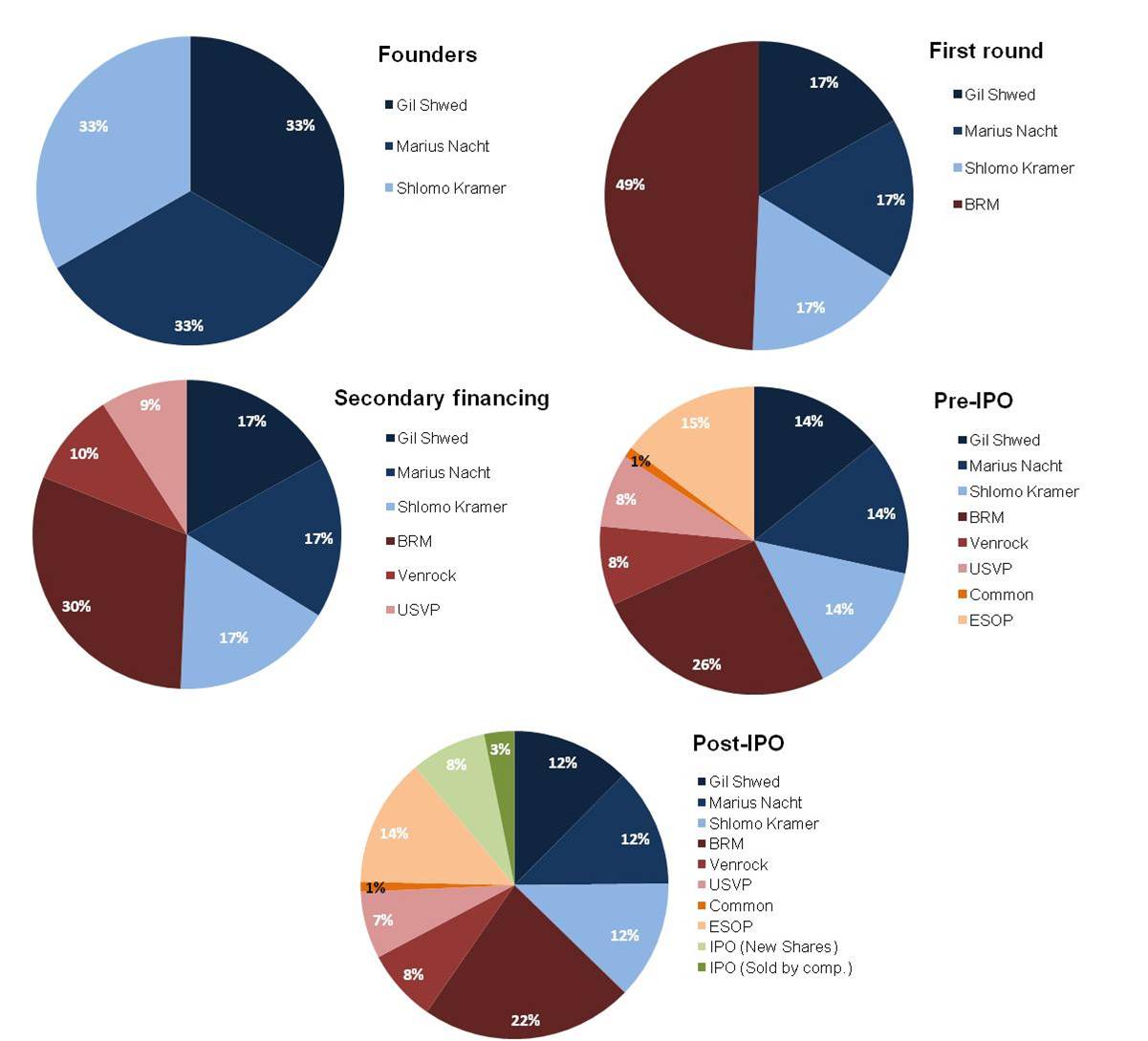
– the three founders had equal shareholding at foundation (and afer Check Point went public).
– Gil Shwed, one of the co-founders, is still the chairman and CEO. Another unexperienced and young entrepreneur who grew his baby through adulthood.
– Many women in the management of the company, Deborah Triant at the time of IPO, but even today Dorit Dor, Tal Payne and Juliette Sultan as the executive team page shows. (This may have to be linked to Israel culture again).


Gil Schwed, Shlomo Kramer ,Marius Nacht, the 3 co-founders and
Deborah Triant (from the early web sites of Check Point)

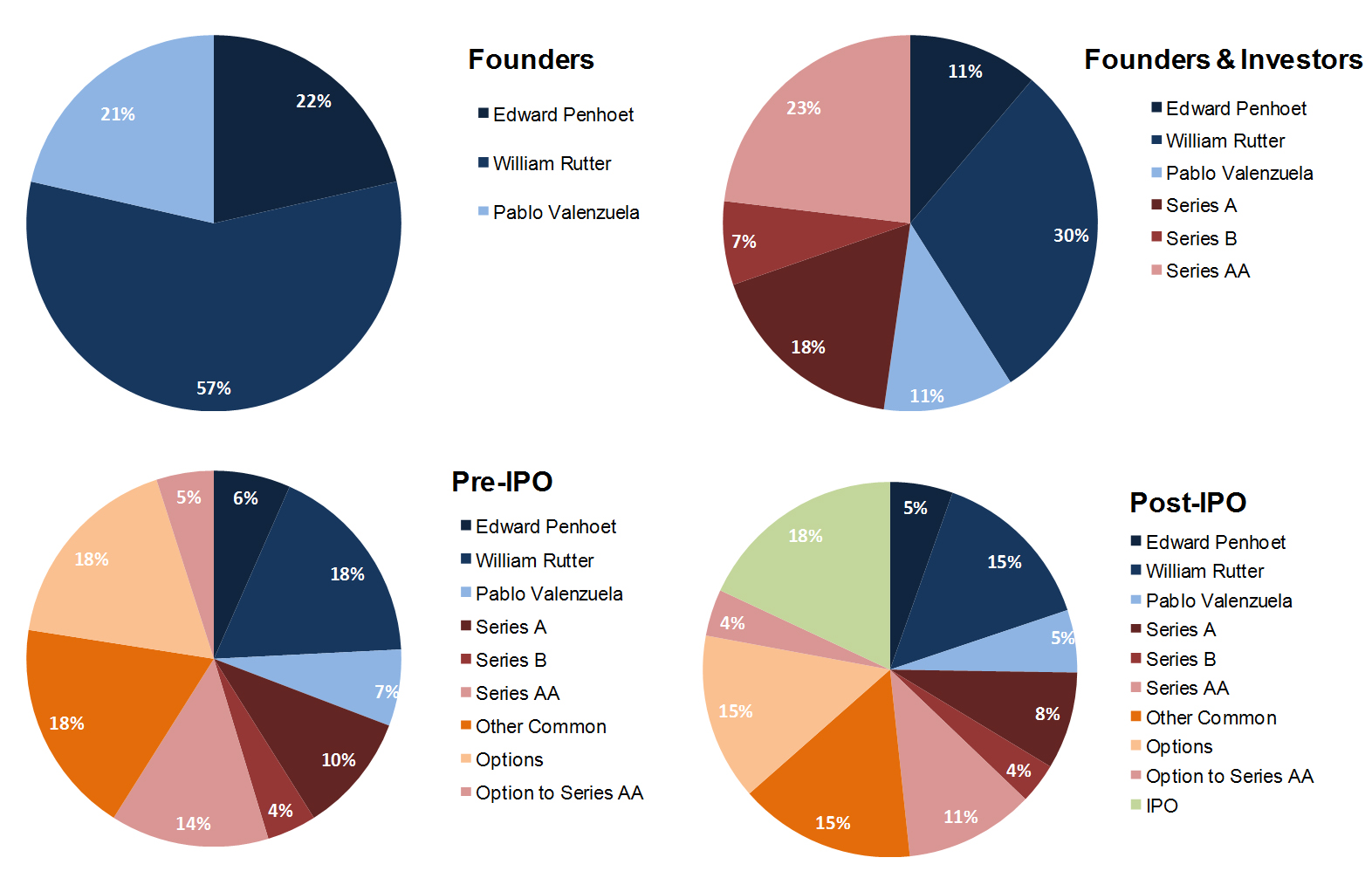
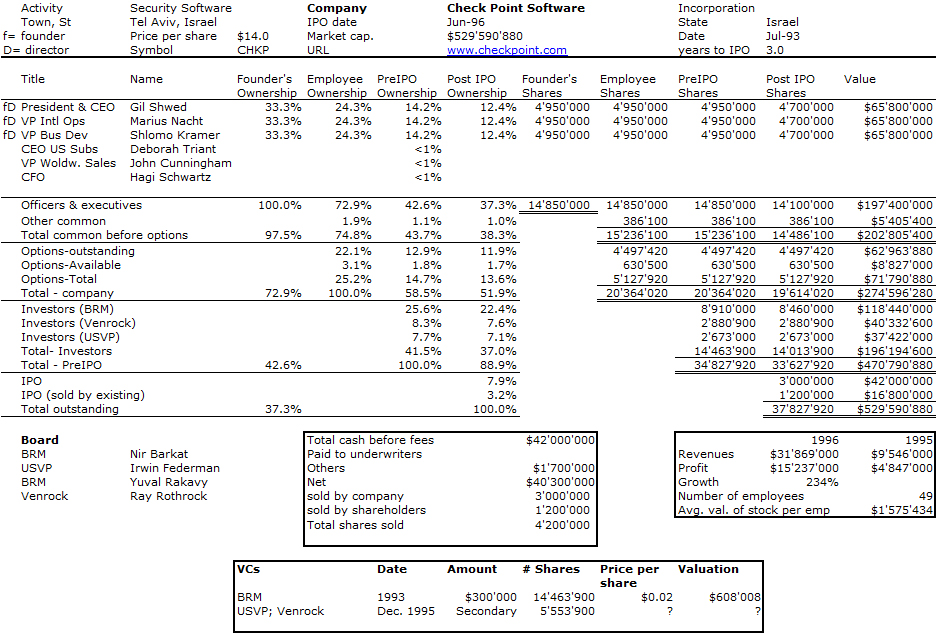
Now the usual cap. table that I could build from the IPO filing and the shareholding pies at the end of the post.

– What is interesting is that Check Point did not raise a lot of money, mostly $600k from BRM in 1993. There were also some loans ($400k) and R&D ($160k) from BRM also which do not appear in the shareholding.
– The American VCs (Venrock and USVP) bought shares from BRM in a secondary financing, so there was no new money for Check Point.
– Check Point issued 3M new shares at IPO and existing shareholders (BRM and the 3 co-founders) sold 1.2M shares.
– Not the least impressive, it took the company 3 years only to go public and its 1995 and 1996 numbers are already impressive.

As usual, I hope this does not include too many inaccuracies or mistakes…

What’s wrong with European venture capital?

It’s the title of a contribution in the Telegraph by Richard Titus. You can read the full article in Start-Up 100: What’s wrong with European venture capital?

I do not agree with 100% of the arguments, but probably 90%, which is good enough. Feel free to react by commenting! (And by the way, there is a French translation in the other side of the blog).

60 Great Books to Spur Your Entrepreneurial Spirit

Julia Watson works with Oedb.org, where was just published the article “60 Great Books to Spur Your Entrepreneurial Spirit

I love to read books as you all know and I read some of the 60s (like Founders at Work or Startup Nation). they probably forgot a few (mine!, just kidding) but this looks very good. Thanks Julia 🙂

When a cap. table is a nightmare!

As I wrote recently, IPO filing is accelerating (just check my recent post on LinkedIn and Pandora). Maybe, it should not be so much. Too much may mean a speculative bubble A recent one is Active Network. I tried to build the cap. table. Piece of cake, usually, even if I am sure, they have some mistakes. And I was lucky, Active had filed but failed in 2004 (a sign?), so I also have the 2004 cap. table. But it was a nightmare. I could not find anything about the founders, not much about how much the company really raised, even if I have full disclosure on liquidation preference.

So here is first the 2004 cap. table (once again I must mention that information given is subject to possibly many inaccuracies)

And here is the 2011 new table.

Not very sexy, not to say awful! I do not talk only about the pictures themselves that you can download and enlarge, but also about the messiness of the structure! But still interesting…

Pandora wants to go public

Something is going on. LinkedIn has filed to go public, many lesser known companies have succesfully done it and it is now Pandora. You can read a lot about Pandora’s filing so my contribution is limited to the following points:

– you can read below the cap. table of Pandora (and enlarge it by clicking or even download the picture, ask me for the excel file if interested)
– there were 3 founders: Tim Westergren, Will Glaser, Jon Kraft but only the first one is mentioned in the filing and the equity of the two other ones is unknown. I made the assumption that the remaining common shares belong to them, but it canot be true. It is just an assumption.
– Pandora has raised nearly $100M with its investors.
Revenues are nice: $50M in 2010 and $19M in 2009, but the company never had a profitable year even if its recent quarters have been (about $1M for the July and october quarters).
– The company was founded in 2000, so it would have taken him 11 years to go public.

Will this be sufficient to concince investors? To be seen….

Women, Europe and High-Tech

Pemo Theodore is doing great interviews of people in high-tech, and she has a specific focus on women & entrepreneurship, on venture capital too, her blog is ezebis. She was interested in my views on the topic, I am not sure why as I am neither an entrepreneur, nor a VC anymore. If you are not afraid of French accents… here it is and the text is on Hervé Lebret, EPFL Swiss Tech Institute, Difference in European & US Venture Capitalists. Thanks, Pemo!

Start-Up Guides

I have recurrent questions about how to practically setup your start-up in Switzerland. Here is a guide recently published by the Swiss Innovation Agency (CTI/KTI): Gründen 2.0 – start-up guide – From an idea to an enterprise: information and tips for setting up a company in Switzerland (pdf file).

I’d like to add also the very good guide Olivier Ezratty manages for the French start-ups: l’accompagnement des startups high-tech en France (pdf file).