Monthly Archives: September 2021

Why you should never look for a cofounder

This recurring question of looking for a cofounder has been bothering me for years. Similarly I do not like the idea of giving titles in the early days of a startup (project) as you may read here : Titles in Start-ups.

My argument is that you don’t look for cofounders. You have them already, you found them by talking about your project to friends or colleagues. It’s a bit like falling in love, you do not look to marry, you meet people. Point.

Of course, this does not help much, because there remains the loneliness of the entrepreneur. But do we get married just to fill the loneliness? As it turned out, thinking about it, I came across an excellent article in which I totally recognized myself: Everything You Need to Know About Startup Founders and Co-Founders.

Here are some key points:
– A founder is a person who comes up with an idea and then transforms it into a business or startup. If a founder sets up a company with other people, they are both a founder and a co-founder.
– “Founder” and “CEO” are two […] startup titles that people can carry simultaneously. One is a permanent title, while the other is not. “You will always be a Founder or Co-Founder.” Be sure to be careful however how you dole out the Founder/Co-Founder titles. That should be a lifetime title so be sure it goes to the right people who played a major role in the starting of the company and who will continue to play a role in the years to come.
– A founding member can often feel similar to a founder or co-founder because they come on so early in the process that they’re also putting in crazy hours and maybe even taking a pay cut in order to be a part of something important. But a founding team member is an early employee, not a founder. One important difference? The types of stock the two groups receive. Founder’s equity is different from Employee Stock Grants.
– “I’m totally unconvinced that two people can find a person they haven’t known previously, and become effective co-founder,” […] “I think you’re better off finding the money to hire someone than actually find a co-founder.
– If someone has come along a little later in the game, but still early — as in, pre-first employee — then you treat the same any other co-founder! If you’re choosing to add a “co-founder” after you already have employees, though, things can get a little tricky.

One thing is forgotten in the article, it is the investor (friends & family, BA, VC) or institution entering at the creation and from my point of view they are not founders because they do not (generally) contribute to the business…

Finally, the term founder does not seem to me to have a legal existence. It is only awarded by the group of people who recognize themselves as such. There is, however, an interesting example, namely how one of the founders of Tesla filed a complaint against Elon Musk, in particular because he considered that he was not a founder. The complaint is readable here (see page 28).

If you wish to dig a little more, here are two older posts:
The Founder’s Dilemmas – The Answer is “It depends!”
Founder without experience, lonely founder.
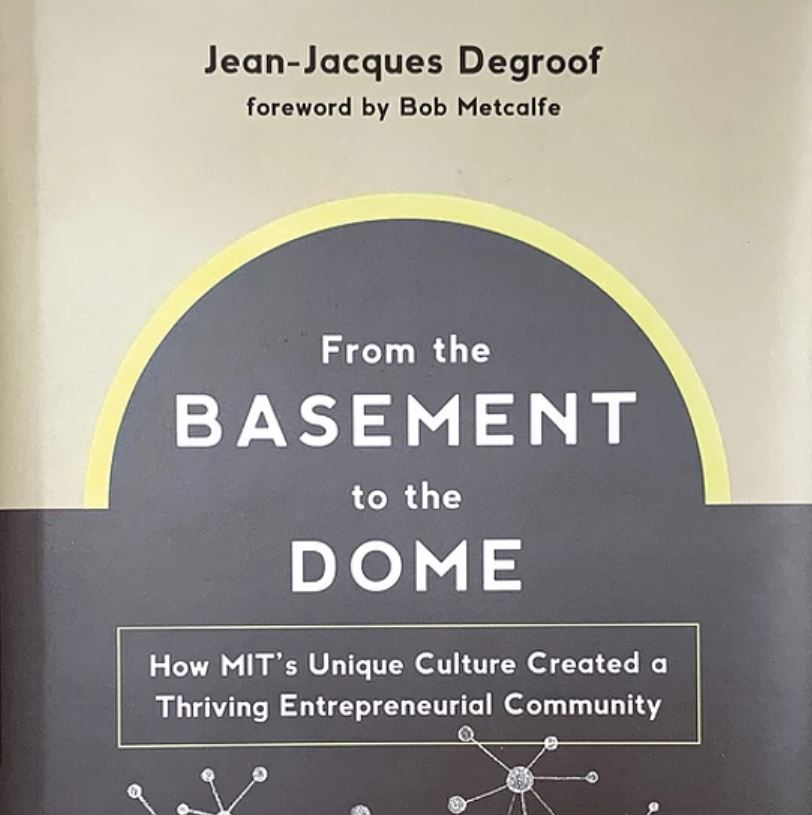
A MIT entrepreneurial history by Jean-Jacques Degroof

With an impressive foreword by Bob Metcalfe (the inventor of Ethernet et cofounder of 3Com) who rightly renames MIT a “Innoversity”, Degroof explains in From the Basement to the Dome that entrepreneurship is engrained in the MIT history and culture, not so much from a political decision but from serendipitous events.

Its motto (Mens et Manus, “Mind and Hand” in Latin), its logo, the right given to professors to spend 20% of their time in consulting since the 20s and the creation of the patent committee in 1932 are all indications that practice is as important as theory in engineering science. The importance of military funding through the creation of OSRD was also critical to the richness of MIT’s inventions.

The culture is exemplified by Ray Stata, a cofounder of Analog Devices : “It’s like ‘monkey see, monkey do.’ If you see others start companies and become successful, you say, ‘If they can do it, so can I.’ Whereas if you don’t see that up close and personal, there’s a fear and a mystery about how to do it. The entrepreneurial spirit at MIT gives you confidence.” [Page 17] And what about his experience in business: “I don’t have a clue about how to be a president, but I’m going to take the next twelve months to learn. And if at the end of that twelve months you guys collectively decide, or if the board decides, that I’m not the person who can provide leadership, I’ll step down. But in the meantime, while I’m learning, you’ve got to help me.” Fortunately, Stata’s direct approach worked. “Everybody dug in, and there was then no way I could fail. Over the next twelve months I learned how to be a president, and that process has continued for four decades.” [Page 18]

If you didn’t know Ray Stata, you might have known the building on MIT’s campus with his name.

I wondereed before beginning the reading if Degroof would mention the debate about why Boston did not end being as successful as Silicon Valley. And he does! Early in his book, on pages 24-25. This is a must-read and I am not finished yet. Degroof quotes famous Regional Advantage by AnnaLee Saxenian. I will let you discover.

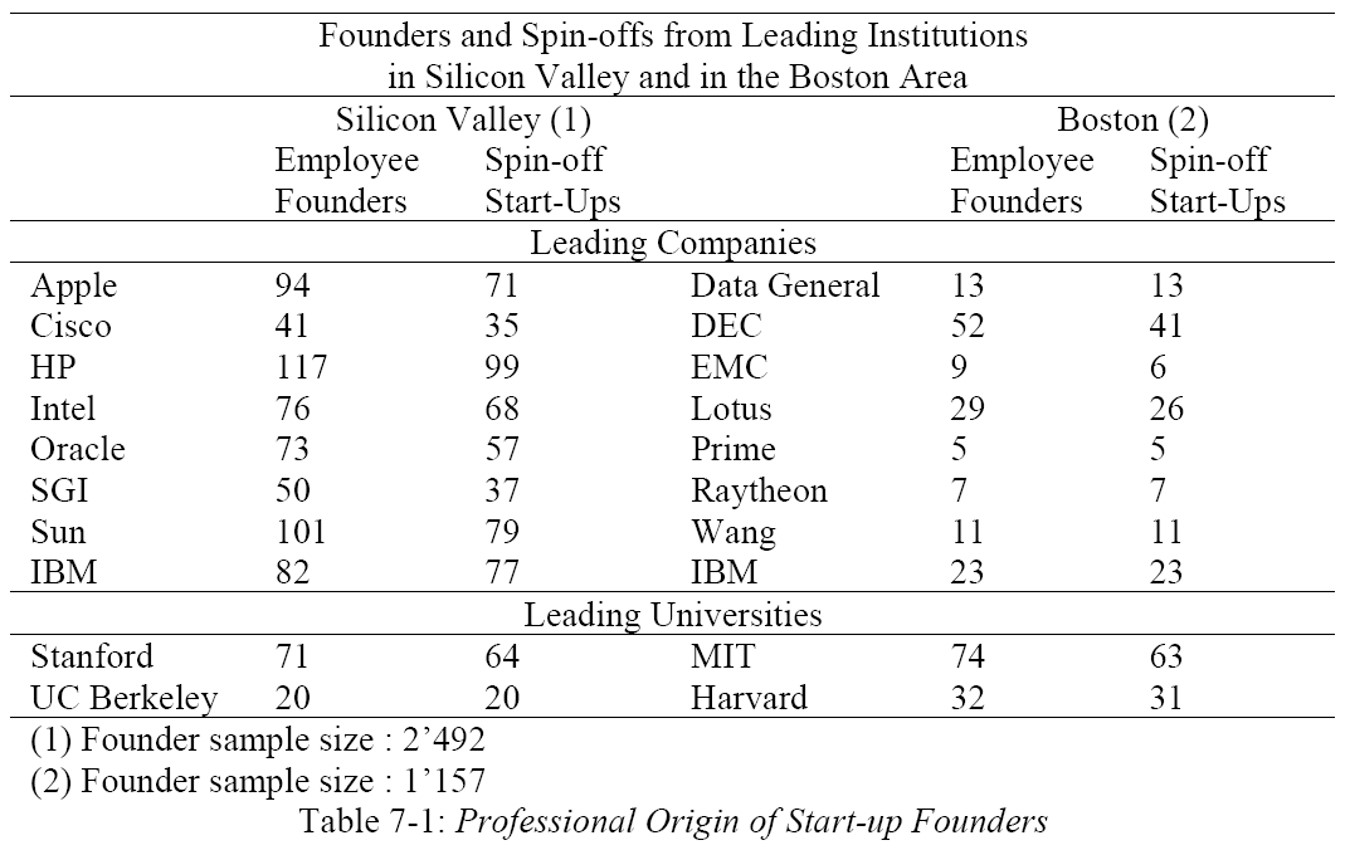
This table that I had copied a long time ago is another illustration of the differences, not so much between Stanford/Berkeley and MIT/Harvard but about the number of firms spun-off from established firms. Just compare what happened at IBM on the west and east coasts. (PS: I had not initially mention the source of the table, it is part of High-Tech Startups and Industry Dynamics in Silicon Valley, Public Policy Institute of California, Junfu Zhang (2003) San Francisco, California.)

Let me finish this 1st part with another quote by Lita Nelsen, former head to MIT’s Technology Licensing Office: “People say to me, ‘Does MIT have an incubator?’ And my classic answer has been, ‘Yes, it’s called the city of Cambridge.’” [Page 26] This reminds me a quote of Richard Newton, a former professor at Berkeley. He had written stating a colleague of his: “The Bay Area is the Corporation. […When people change jobs here in the Bay Area], they’re actually just moving among the various divisions of the Bay Area Corporation.” This is a critical explanation of ecosystems, they are not so much about institutions but about the fluidity of exchanges between individuals.

Doris Lessing again – about great men

I wrote in Testament or Testimony ? Lessing, Reich, Grothendieck, Jobs, Arles how much I loved reading The golden notebook.

I just read another strange page which stroke me. And even more strangely, I discovered that the French translation (that I first discovered) was quite different from the original version. Have a look here at the French post if you read French or at my translation below. Here is the original text (but please read until the end of this post for some surprise):

You and I, Ella, we are the failures. We spend our lives fighting to get people very slightly more stupid than ourselves to accept truths that the great men have always known. They have known for thousands of years that to lock a sick person into solitary confinement makes him worse. They have known for thousands of years that a poor man who is frightened of his landlord and of the police is a slave. They have known it. We know it. But do the great enlightened mass of the British people know it? No. It is our task, Ella, yours and mine, to tell them. Because the great men are too great to be bothered. They are already discovering how to colonise Venus and to irrigate the moon. That is what is important for our time. You and I are the boulder-pushers. All our lives, you and I, we’ll put all our energies, all our talents, into pushing a great boulder up a mountain. The boulder is the truth that the great men know by instinct, and the mountain is the stupidity of mankind. We push the boulder. I sometimes wish I had died before I got this job I wanted so much – I thought of it as something creative.

Now here is my translation of the French translation, and it is quite different from the original version!

But, my dear Anna, we are not the failures we think we are. We spend our lives struggling to get people hardly less stupid than ourselves to accept the truths that great men have always known. They have always known, for ten thousand years, that by locking a human being in total isolation we can make him or her an animal or a beast. They have always known that a man who is poor or terrorized by the police or by his owner is a slave. They have always known that a terrorized man is cruel. They have always known that violence leads to violence. And we know it. But do the great masses in the world know this? No. Our job is to tell them. Because great men cannot waste their time on it. Their imaginations are already busy inventing ways to colonize Venus; they are already creating in their minds a vision of a society made up of free and noble human beings. Meanwhile, human beings are ten thousand years behind them, and are locked in fear. Great men cannot waste their time on it. And they are right. Because they know we are here, the rock pushers. They know that we will continue to push rocks on the first foothills of a huge mountain, while they are already free at the top. They are counting on us, and they are right. And that’s why we are ultimately not useless.

I am not sure which version I prefer, but I was quite amazed by what Doris Lessing had written more than 50 years ago, all the more it reminds me again the quote by Wilhelm Reich in the post I mentioned above.

Now shame on me! I had second thoughts and could not believe the translator was so creative so I looked again, and I found this new piece:

‘But my dear Anna, we are not the failures we think we are. We spend our lives fighting to get people very slightly less stupid than we are to accept truths that the great men have always known. They have always known, they have known for ten thousand years, that to lock a human being into solitary confinement can make a madman of him or an animal. They have always known that a poor man frightened of the police and his landlord is a slave. They have always known that frightened people are cruel. They have always known that violence breeds violence. And we know it. But do the great masses of the world know it? No. It is our job to tell them. Because the great men can’t be bothered. Their imaginations are already occupied with how to colonise Venus; they are already creating in their minds visions of a society full of free and noble human beings. Meanwhile, human beings are ten thousand years behind them, imprisoned in fear. The great men can’t be bothered. And they are right. Because they know we are here, the boulder-pushers. They know we will go on pushing the boulder up the lower slopes of an immensely high mountain, while they stand on the top of the mountain, already free. All our lives, you and I, we will use all our energies, all our talents, into pushing that boulder another inch up the mountain. And they rely on us and they are right; and that is why we are not useless after all.’

Why was there Anna and Ella, I should have thought about it immediately. The Ella piece is on page 107 and the Anna one on page 311 of my version. My mistake at least is an indication of the strange richness of Lessing’s novel.

Silicon Valley will soon be 65. Should it be Retired ? – The Darwinian Dynamics of the Region

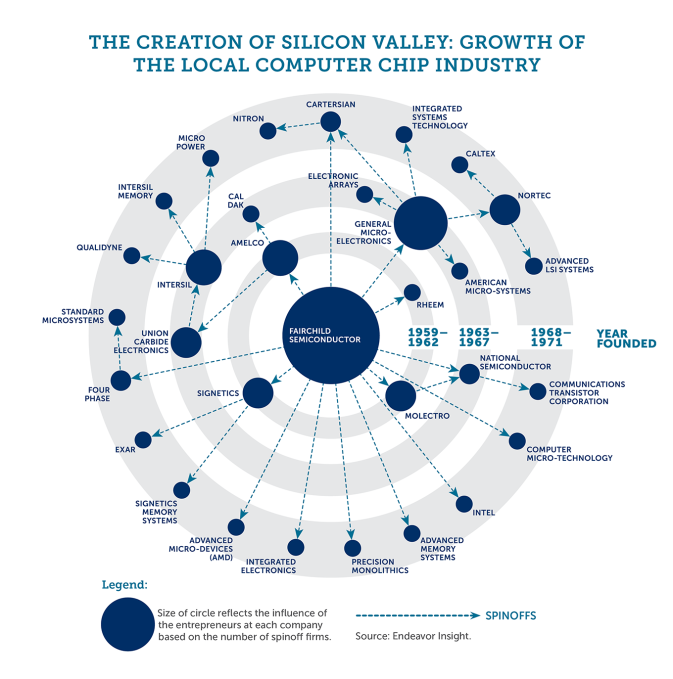
Silicon Valley will soon be 65. 65? Yes, I usually say that the region began its growth with the foundation of Fairchild Semiconductor in 1957 (even if the name itself was created in 1971).

endeavor-insight-sv-2-retina

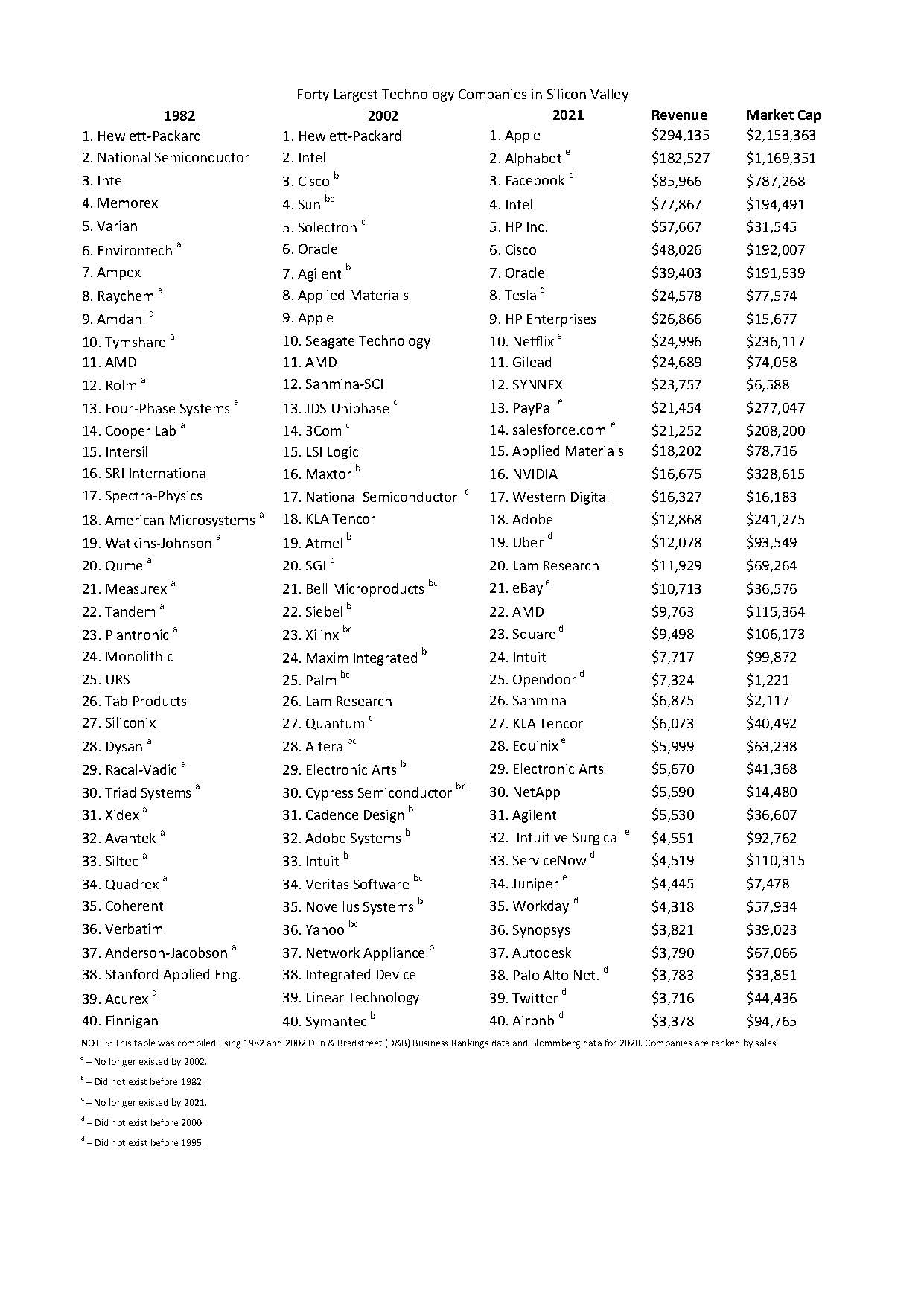
The region is increasingly criticized for both good and bad reasons (see for example here and there) and perhaps it is a little out of breath. Too old ? Ten years ago I had looked at its “Darwinian dynamics” in Darwinian and Lamarckian innovation – by Pascal Picq. I had noted there the remarkable dynamics of creation (and destruction) of businesses. “Twenty of the top 40 SV companies in 1982 did not exist anymore in 2002 and twenty one of the 2002 top 40 companies had not been created in 1982.” So I just did the exercise again.

The table below gives the data for 1982 and 2002 again, then those for 2020. I should have waited for 2022 and the 65th birthday of Silicon Valley, but I didn’t have the patience! Ten of the 40 largest companies did not exist in 2000 and seven more did not exist in 1995. Sixteen of the top 40 of 2002 no longer exist in 2021. The region is therefore a little less dynamic but it remains quite remarkable… The retirement seems to me far away in reality !

As a final comment, five years ago, I had mentioned the evolution of the American capitalism in The top US and European (former) start-ups and in particular The Largest Companies by Market Cap Over 15 Years. You could compare it with the dynamics of French CAC40.

Forty Largest Technology Companies in Silicon Valley
(the same data are provided in jpg format at the end of the post)

1982 2002 2021 Revenue Market Cap
1. Hewlett-Packard 1. Hewlett-Packard 1. Apple $294,135 $2,153,363
2. National Semiconductor 2. Intel 2. Alphabet e $182,527 $1,169,351
3. Intel 3. Cisco b 3. Facebook d $85,966 $787,268
4. Memorex 4. Sun bc 4. Intel $77,867 $194,491
5. Varian 5. Solectron c 5. HP Inc. $57,667 $31,545
6. Environtech a 6. Oracle 6. Cisco $48,026 $192,007
7. Ampex 7. Agilent b 7. Oracle $39,403 $191,539
8. Raychem a 8. Applied Materials 8. Tesla d $24,578 $77,574
9. Amdahl a 9. Apple 9. HP Enterprises $26,866 $15,677
10. Tymshare a 10. Seagate Technology 10. Netflix e $24,996 $236,117
11. AMD 11. AMD 11. Gilead $24,689 $74,058
12. Rolm a 12. Sanmina-SCI 12. SYNNEX $23,757 $6,588
13. Four-Phase Systems a 13. JDS Uniphase c 13. PayPal e $21,454 $277,047
14. Cooper Lab a 14. 3Com c 14. salesforce.com e $21,252 $208,200
15. Intersil 15. LSI Logic 15. Applied Materials $18,202 $78,716
16. SRI International 16. Maxtor b 16. NVIDIA $16,675 $328,615
17. Spectra-Physics 17. National Semiconductor c 17. Western Digital $16,327 $16,183
18. American Microsystems a 18. KLA Tencor 18. Adobe $12,868 $241,275
19. Watkins-Johnson a 19. Atmel b 19. Uber d $12,078 $93,549
20. Qume a 20. SGI c 20. Lam Research $11,929 $69,264
21. Measurex a 21. Bell Microproducts bc 21. eBay e $10,713 $36,576
22. Tandem a 22. Siebel bc 22. AMD $9,763 $115,364
23. Plantronic a 23. Xilinx bc 23. Square d $9,498 $106,173
24. Monolithic 24. Maxim Integrated b 24. Intuit $7,717 $99,872
25. URS 25. Palm bc 25. Opendoor d $7,324 $1,221
26. Tab Products 26. Lam Research 26. Sanmina $6,875 $2,117
27. Siliconix 27. Quantum c 27. KLA Tencor $6,073 $40,492
28. Dysan a 28. Altera bc 28. Equinix e $5,999 $63,238
29. Racal-Vadic a 29. Electronic Arts b 29. Electronic Arts $5,670 $41,368
30. Triad Systems a 30. Cypress Semiconductor bc 30. NetApp $5,590 $14,480
31. Xidex a 31. Cadence Design b 31. Agilent $5,530 $36,607
32. Avantek a 32. Adobe Systems b 32. Intuitive Surgical e $4,551 $92,762
33. Siltec a 33. Intuit b 33. ServiceNow d $4,519 $110,315
34. Quadrex a 34. Veritas Software bc 34. Juniper e $4,445 $7,478
35. Coherent 35. Novellus Systems b 35. Workday d $4,318 $57,934
36. Verbatim 36. Yahoo bc 36. Synopsys $3,821 $39,023
37. Anderson-Jacobson a 37. Network Appliance b 37. Autodesk $3,790 $67,066
38. Stanford Applied Eng. 38. Integrated Device 38. Palo Alto Net. d $3,783 $33,851
39. Acurex a 39. Linear Technology 39. Twitter d $3,716 $44,436
40. Finnigan 40. Symantec b 40. Airbnb d $3,378 $94,765


NOTES: This table was compiled using 1982 and 2002 Dun & Bradstreet (D&B) Business Rankings data and Blommberg data for 2020. Companies are ranked by sales.
a – No longer existed by 2002.
b – Did not exist before 1982.
c – No longer existed by 2021.
d – Did not exist before 2000.
e – Did not exist before 1995.

Same table in jpg format

Female founders – an analysis from 800 (former) startups

I just decided to add a new analysis to my recent study of 800 (former) startups. Although the topic is an important one in high-tech entrepreneurship, I had never looked at it except anectoticaly in the posts with the tag #women-and-high-tech.


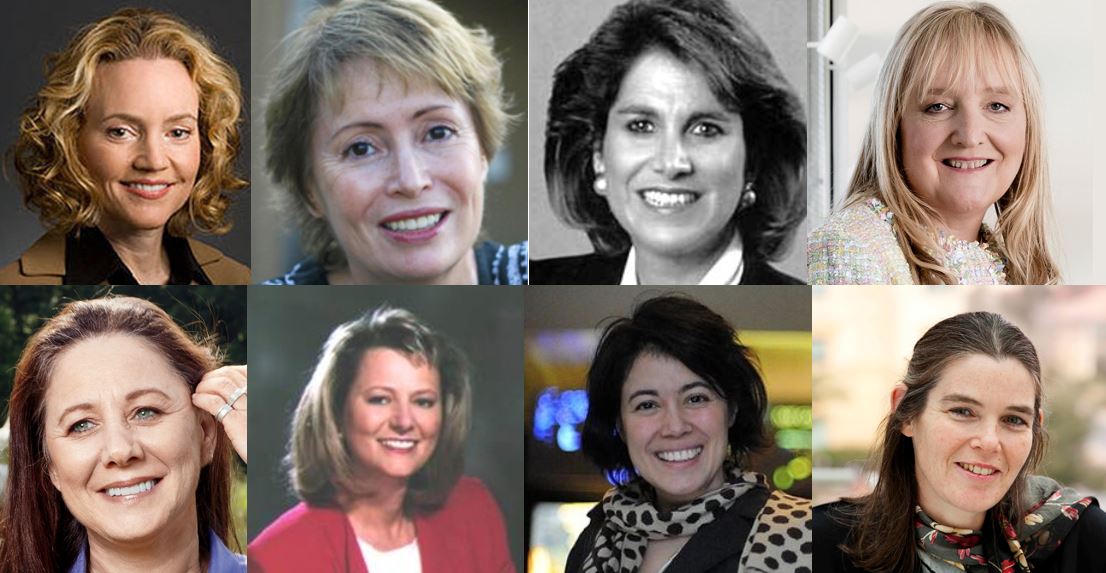
Eight female founders or entrepreneurs. I am not sure how many I would have automatically recognized. And you?

And here are the results I found. My apologies in advance as this work is far from perfect: I tried to identify female founders from their name and this is not always easy. I believe however I cannot be too far from the exact results.

So what does this say?

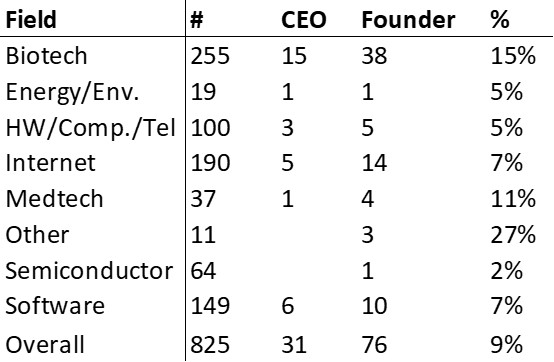
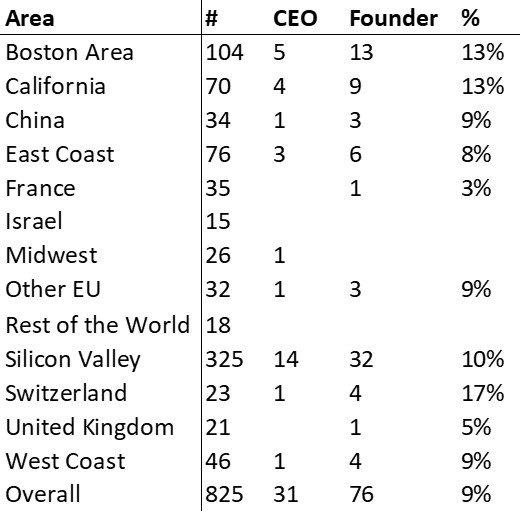
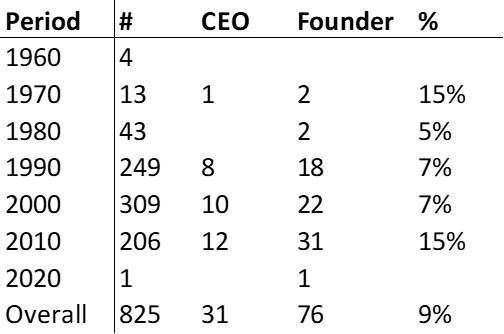
– There are 76 female founders in 825 companies, which says 9% of these former startups had a female founder. Now to make it worse, the total number of founders identified is 1644.
– It is in the biotech field, that they are most represented (hence Boston, Switzerland, California outside Silicon Valley)
– The good news is that the number is up to 15% for the last decade. Still…
– Now there are only 31 female CEOs, this is only 4% (remember that founding CEOs are a little more than 60% so this is even worse as some of these female CEOS are not even founders – see here if you don’t know what I am talking about). In fact, 20 of these women were founders and 11 were not…