Author Archives: Hervé Lebret

About Kleiner Perkins first fund (episode 2)

Was the information provided in episode 1 correct? I decided to try and contact Tom Perkins, the famous VC and he answered!

“I looked at the data you sent but, honestly, I don’t know where they came from.  We have never given this sort of thing out,  and we would have a lot of trouble even to find it today. I don’t think we had so many investments in that first fund—seventeen seems far to many.  The ones which I recall I put into my book. Having said that, I do believe that the fund would have achieved a modest return without Tandem and Genentech.  Those two were most important in changing our way for V.C. in the future.”

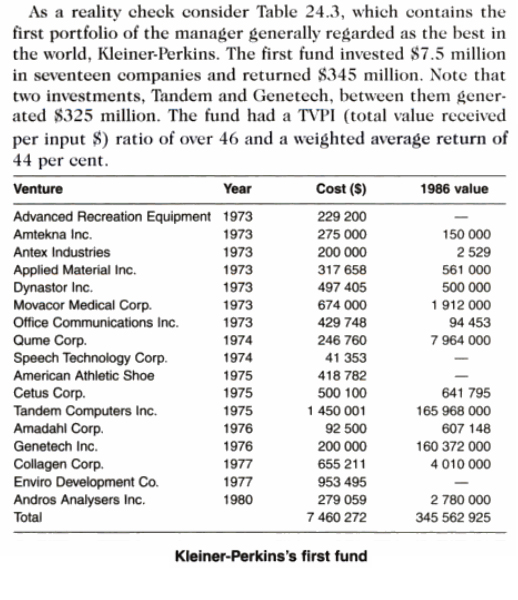
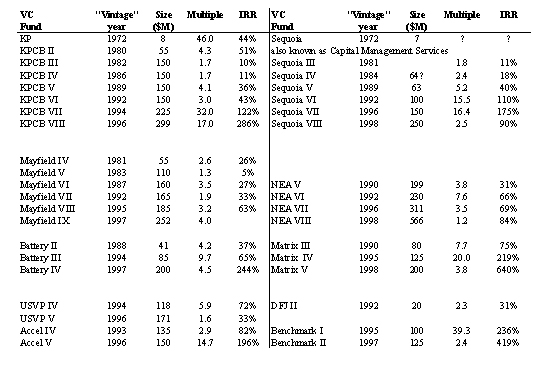
What does Perkins mean? In each case, KP co-founded the companies and did not simply invest in them. So where were these numbers coming from? After some research via the web, I found on Google Books the next table, from the book Enterprise and Venture Capital by Christopher Golis.

If correct, they would be however different from the ones I had before even if they are quite similar.

I checked Perkins’ book and Perkins obviously mentions Tandem and Genentech. He also mentions Advanced Recreation Equipment (aka Snow-Job, a company which converted motorbikes into snowmobiles) and American Athletic Shoe (re-soled tennis shoes). He adds: “Unsurprisingly, both failed”. He also mentions Qume as a nice return. Not much more.

So I asked Golis where all this came from…  “I cannot remember where I got it as I actually wrote the 4th edition some 8 years ago.  However I only put the table in the 4th edition.   Comparing the bibiographies of the third and fourth editions I would say the source was Gompers.  However Nesheim, Lewis, or Kaplan are potentially other sources. Hope this is of some help.”

Well, well… To know more, you will have to wait for episode 3!

About Kleiner Perkins first fund (episode 1)

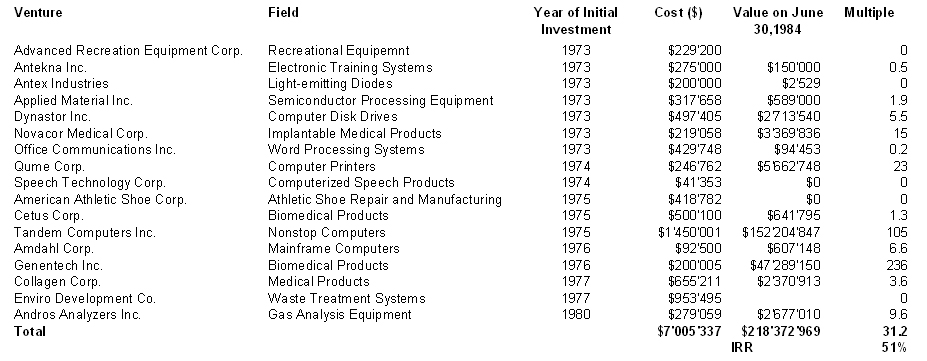
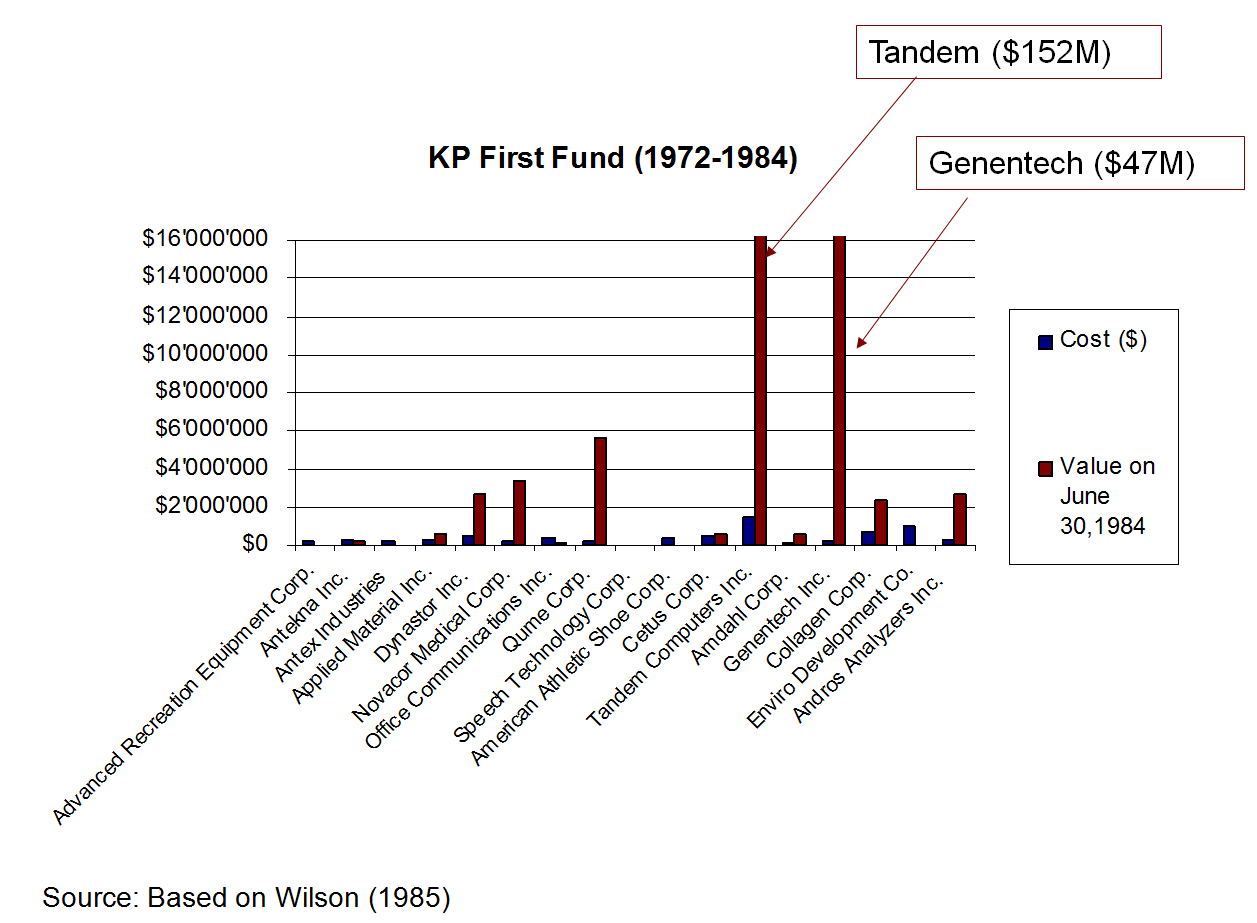
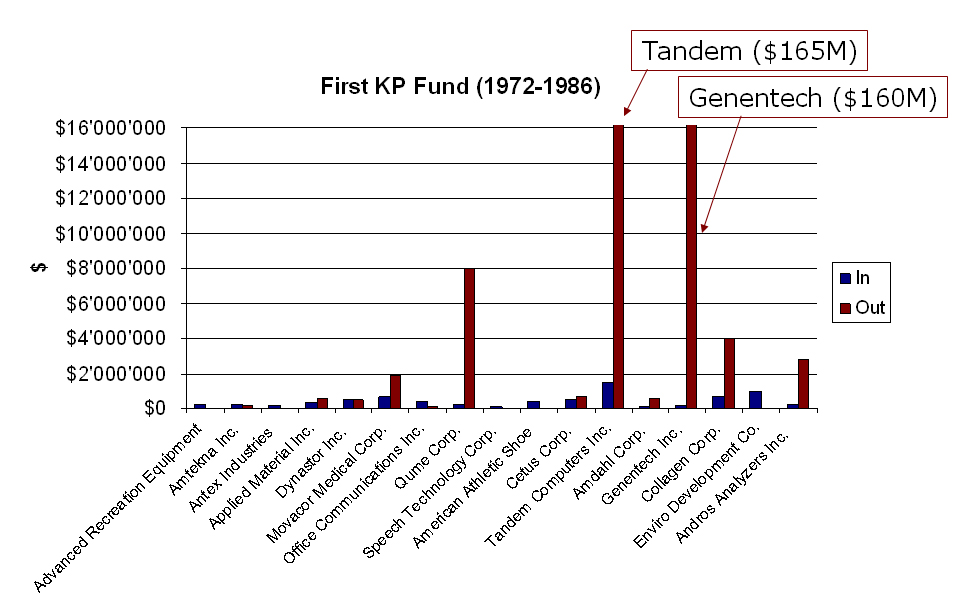
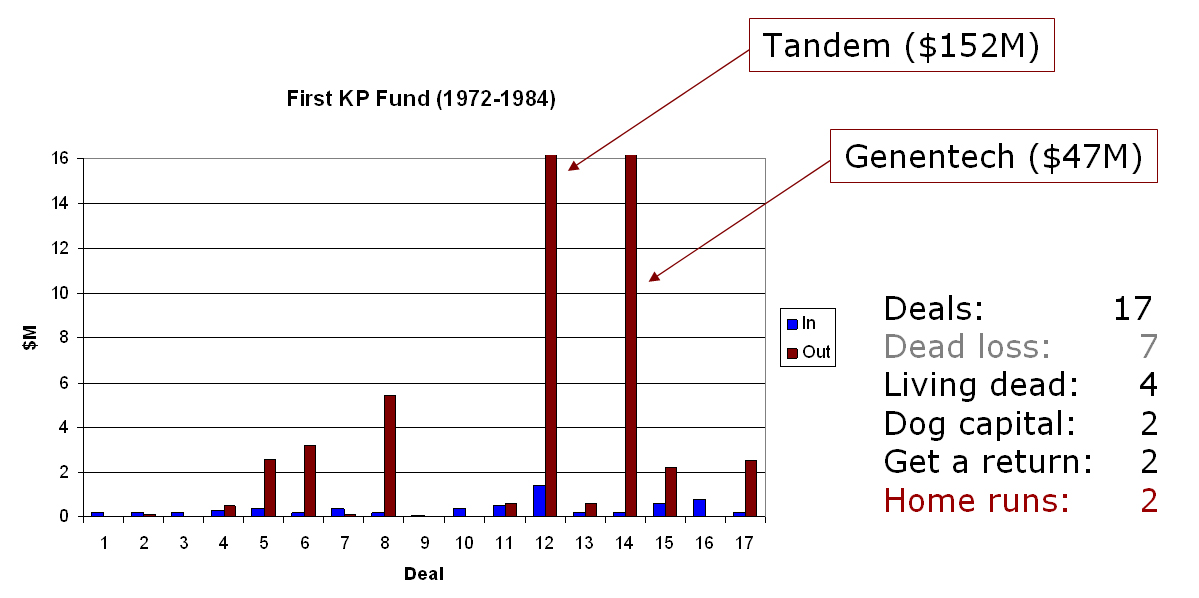
As I mentioned in my previous post about returns of venture capital, I was lucky enough to see the performances of Kleiner Perkins first fund (launched in 1972). Here is the slide I discovered in mid-December.

I was extremely surprised to find such data. They are usually difficult, not to say impossible to get. I asked the author where he got them. He thought he had read them from a book by a Kleiner Perkins partner. I contacted him and he replied: “Not possible that it came from me. I don’t have such information. Not sure I have ever seen the returns for KPCB 1. I don’t know where the information could have come from.” Too bad.

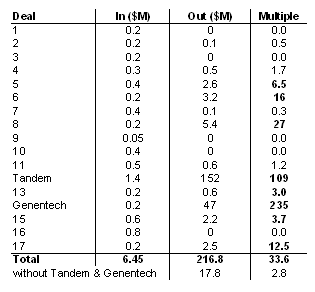
I also try to “measure the bars” and rebuild what it could have meant in terms of numbers. Here are my measures.

A couple of comments (if we admit all this is true):
– Genentech and Tandem were two home runs (out of 17 deals).
– Even if these two had not worked, the fund value would be $17.8M, i.e. a 2.8x multiple. This would have been a decent return compared to even the best VC funds…

But is this true? You will have to wait for episode 2!

Returns of Venture Capital

Venture Capital returns remain very difficult to analyze mostly because access to data is tough. There are some web sites such as venturereturns but more interesting are the official reports of endowment funds such as the University of California, Washington State or Castle in Europe. Most venture capital firms do not publish any data.

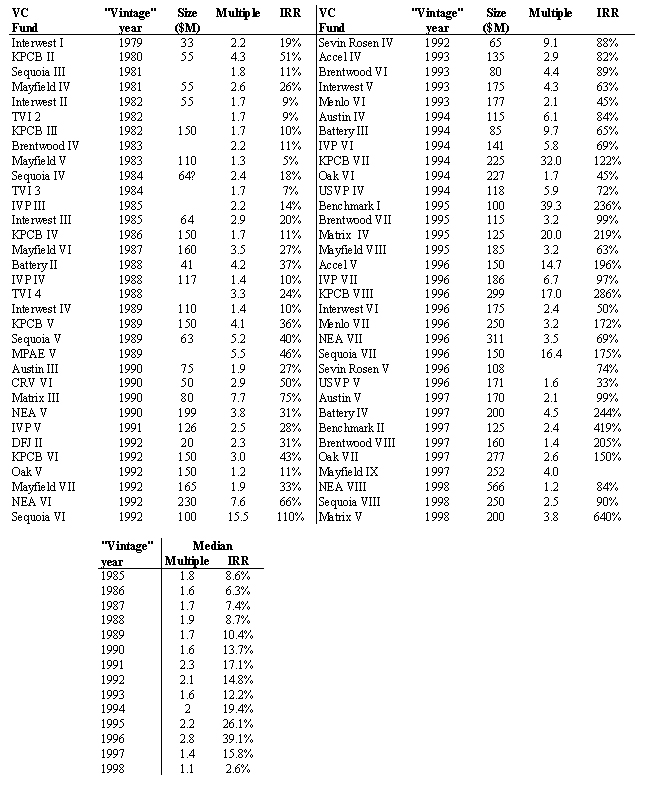
In chapter 5 of “Start-Up”, I have published the following table:

Now let me publish them for some specific funds:

I had not mentioned before KP and Sequoia first funds which is something I plan to work on in the next weeks. Anyone with data would interest me! Late last year I was lucky enough to “see” KP first fund’s portfolio performance in more details which I will describe in my next post…

So you want to be an entrepreneur

So you want to be an entrepreneur, but you’re just not sure. And you wonder: Should I quit my well-paid job in the middle of a recession, raise money on 37 credit cards, build a lab bench in my garage next to my rusty old bike and start a […] company? Hell yes! Leaping into the void leads to freedom and growth, which always lands you on a higher plane. Afraid of failure? You’d be amazed at how many investors prefer to back someone who has tasted the bitter fruits of failure. In failing you learn what not to do. Get your skin in the game and there is no failure—you have opened your mind to growth and yourself to reinvention.

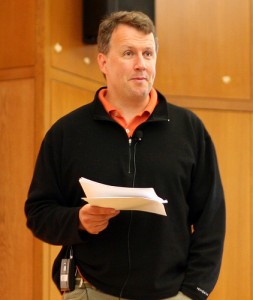
This is how Larry Marshall, a serial entrepreneur, begins an article he wrote in 2001! Maybe not as sexy as Guy Kawasaki or Paul Graham, but certainly as interesting. I just discovered this and his blog yesterday and I thought it is worth reading it entirely. So here is the full paper taken from Laser Focus World.
So you want to be an entrepreneur, but you’re just not sure. And you wonder: Should I quit my well-paid job in the middle of a recession, raise money on 37 credit cards, build a lab bench in my garage next to my rusty old bike and start a photonics company? Hell yes! Leaping into the void leads to freedom and growth, which always lands you on a higher plane. Afraid of failure? You’d be amazed at how many investors prefer to back someone who has tasted the bitter fruits of failure. In failing you learn what not to do. Get your skin in the game and there is no failure—you have opened your mind to growth and yourself to reinvention.

As engineers and scientists, we have natural obstacles to overcome if we are to become entrepreneurs. We look at things from the technology perspective and forget the mantra of the marketplace. Open your mind to a market, understand your customer’s problem, then create a solution that puts more cash in his pocket. While technology can enable a new business, it is not necessary. However, knowing your market and the needs of your customers is mission-critical in starting your business.

Too early to market and you run out of money before you generate revenue to sustain your business. Too late and you’re just another “me too” scrambling for the crumbs of the pie dropped by the market leader. But if you read the market right, then you ride the crest of the market wave all the way to success.

Focus, focus, focus
As a photonics person you should understand focus. In a startup your focus must be diffraction limited—do one thing and do it better than everyone else. With limited resources, the only way to produce enough force to penetrate the market is to focus all your weight on a single point. Don’t wear blinders. You must be aware of and respond to changes in the market. But focus is the key. Pick the one product you think will sell. Talk with your customers to define your product. Make sure that your customers want to buy it. Then, when you have defined it, engineer it, produce it, and sell it fast. Pick the wrong product and you will fail quickly. But try to spread the risk and you will linger in purgatory indefinitely.

Only two things create value in a company—product development and selling (marketing is selling to groups). Research may be the key to your company’s future, but there are bills to pay between now and then. Don’t get into business to do research—find a university and give them some money to do it for you; they’ll do a better job for less money. Your mission is to satisfy a market need and make money in the process. Unfortunately, it is possible to raise money today on the promise of tomorrow’s great technology, but this is a train wreck waiting to happen.

There is another aspect to focus—the customer. Everyone in the company from the janitor to the CEO must focus on the customer. Successful hi-tech companies maximize interactions between their engineers and customers and promote peer-to-peer selling. Customers are not only the source of your revenue, they are also the wellspring of your ideas.

One more thing, answer this question: Do I want to change the world (even a little), or do I just want to get rich quick? Those who start businesses because they want to create something new and better don’t always succeed, but those who are just in it for the buck almost never do. The fire inside your belly sustains you through the ordeal, but greed alone will not.

Did I mention focus?

Raising money
After funding startups in several ways, including using credit cards (37 of them, and in a recession too), friends and family, corporate backing, and venture capitalists (VCs), I have these observations. Bootstrapping and incubation work extremely well if you are smart enough to see far ahead of the market—then you can afford to trade time for money. You can raise an “angel” round to finance your prototype development and line up some real customers before you give away half the company raising venture financing. Although a VC will want 40% to 50% of the equity in the first round of financing (regardless of how much money you raise), if you can’t see more than two years into the future, get VC money (see “Making the pitch,” this page).

Venture capitalists add value beyond mere money. Their portfolio of companies can contain your future customers, their name should greatly leverage your cash, and their networks will open doors through which you could not otherwise pass. If you are a diamond in the rough, they will polish you until you shine, but if you don’t shine they’ll find another rock that will. And whoever gives you money, be it your brother, your barber, an angel, or a VC, make sure you like each other—you’ll go through a lot together in the years to come. Remember: you always need much more money than you think.

How do VCs decide which businesses to fund? Ask yourself how you decide to lend money to a friend. Trust. A VC trusts character, experience, team, and the quality of the idea. The idea will attract them, but the team will hook them. Venture capitalists invest in people first and ideas second. The market will change after you are funded and unless the team responds with better ideas, the business will fail. Startups have a wonderful ability to respond rapidly to change, and this, I believe, makes them the new-product development engines of industry.

Building the team
So what makes a great company? A great team. Clearly, a great CEO surrounds himself with people whose skills complement his own. Technical excellence alone is insufficient justification to hire any individual. It is better to have a well-coordinated team of good players than an ungainly group of outstanding individuals. As a founder you must set the tone for your company and recruit people who share your vision, goals, and ideals. Hire the best people you can find wherever you can find them. And always be on the lookout for your own replacement—after all, don’t you want the best people running your company?

When you start hiring skilled people, many of them will want to “make the move to management.” Few of them are capable. A great manager gathers information first, and then takes decisive action. A great inventor makes leaps of faith based on intuition, and is usually a frustrating manager. A great entrepreneur is a mix of the two. Understand that many people want to be managers but few should be—management is not about ego. It is about serving your subordinates in any way that better enables them to do their job, and then getting the hell out of the way so they can do it.

Even the best team players are working for a paycheck. So, share the wealth. Pay people what they are worth, not what you can get them for. Generally, compensate those who contribute to future value—scientists and engineers—in stock, and those who generate immediate value (sales) in cash. If everyone is an owner of your business they will take pride in it, nurture it, and ensure its success.

And remember, you are the lynchpin of your team. Surround yourself with quality advisors on technology, marketing, and business. These are peers, colleagues, and friends. But most important, find an experienced startup CEO who has built companies like yours before and who is still actively doing it, and make him your mentor.

Build more than a better mousetrap
As technologists we often are fooled into thinking that if we simply create a better technology, the market will be ours. A business creates solutions for which customers pay. So if better technology creates a better solution, then the world will beat a path to your door, right? Wrong! Technologically, visible diodes were a quantum leap from HeNe lasers, yet it has taken 10 years for them to replace the HeNe. It’s much harder than you think to displace an entrenched technology. You need substantial improvements, better cost structure, or both. Cash in the pocket is the customer’s bottom line—if you keep more in theirs, they will put some in yours. There is a fixed amount of cash being spent in any given industry. If you want a portion of that cash, either you can take market share from competitors, or capture cash that is paid to others (lifecycle costs, for example), or (ideally) grow the market by adding functionality. This is the crux of any new business.

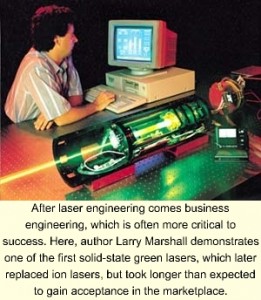
In my second business, we created a revolutionary solid-state laser technology to replace the ion laser. We could produce several watts of green laser output from an all-solid-state box the size of a cigar case. This was a big improvement over ion lasers, but only to people who worried about 3-phase power, water-cooling, portability, and lifetime. It turned out that, for many people, other benefits of ion lasers that we had never considered outweighed these problems. We persevered, though, and ultimately found a niche in the medical market creating the world’s first miniature portable photocoagulator. Customers loved it. We also replaced copper vapor lasers in dermatology. Again the customers loved it. But we forgot to grow the market. We had made a box that didn’t need a new tube every few years. It worked so well, that once we sold a unit we never saw that customer again. Your new product should not only offer greater functionality at a lower price—it also needs to grow the market.

Running your business
The marketplace is a crucible that burns away all irrelevancies and leaves one pure product—profit. If you don’t make money, your business will fail, and no amount of excuses can save you. No excuses is a core principle of business. Keep your commitments! If you tell Wall Street you will make $1/share earnings—do it. If you fail, have a recovery plan and be sure to eliminate the source of the failure. The market hates failures, but it hates excuses more.

The market rewards results, not effort. As R&D people we learn there is no such thing as failure; even a null result is valuable. Not in business. If you spend a year working on a contract that then goes south, you just wasted a year. You failed to generate revenue and you took food out of the mouths of your team. You should be shot! I hope you had a backup plan.

As your company grows, it will change. Businesses tend to excel at only one thing, but that thing evolves over the life of a business. A typical cycle would be technology, then execution, then manufacturing. JDS Uniphase (JDSU; San Jose, CA) is a great example—it penetrated the market with a great technology, gaining knowledge and experience that enabled the company to execute better than everyone else, and ultimately developed a world-class automated manufacturing system that produce long-lived quality products at a lower price. Now JDSU has fine-tuned a process that allows it to buy new technologies and quickly integrate them into that finely tuned manufacturing machine—that’s an ability that’s hard to beat.

Are you the CEO?
I’ve been lucky enough to report directly to several different types of CEOs whose backgrounds were technical, sales, marketing, and engineering. The two best were technical and marketing. The latter person had a natural advantage over the others in that he valued technology for its ability to reach the customer, not as something of intrinsic worth. He was customer-focused and hired great technology people (I like to think I was one of them) to create his vision.

The technology person was a truly visionary CEO. He immersed himself in his customers’ market. He spent a lot of time working alongside his customers to understand their needs, and thereby won both their trust and their business. He understood their problems and solved them. If you can do this too, you will win! So what are you waiting for?

ACKNOWLEDGMENTS
I have been fortunate enough to learn from some outstanding people and I thank them here: Josh Mackower, Milton Chang, Ted Boutacoff, Don Hammond, Bill Lanfri, Walter Koechener, Paul Davis, Bob Anderson, Robert Haddad, Bob Byer, and Dan Hogan.

ABOUT THE AUTHOR
Larry Marshall is the CEO of Lightbit Corp, a next-generation telecommunications components startup. He has angel-invested in three startups, and personally done three others, including Light Solutions Corporation, which merged with Iris medical, and went public as Iridex, in February 1996 (Nasdaq:IRIX; Mountain View, CA). Marshall is an active inventor, holds nine patents protecting 16 commercial products, and has over 100 publications and presentations. He is chairman of the OSA Conference on Advanced Solid State Lasers, is an editorial advisory board member to Laser Focus World, and is on the board of directors of two telecommunications startups. Larry Marshall is founder and CEO of Lightbit Corp. P.O. Box 20453, Stanford, CA 94309; e-mail: larry@lightbit.com.

_______________________________

Making the pitch
When you write your business plan and pitch to a venture capitalist, you only need to answer seven basic questions:

  1. What problem or need will you solve or serve?
  2. Who are your customers?
  3. How much will they pay?
  4. What is your product?
  5. How much will it cost to build and sell?
  6. Who are your competitors and how will you beat them (barriers to entry or exit)?
  7. How big is the payoff and when will it happen?

Your single-page executive summary should answer these questions and is likely to be the only part of your plan an investor actually reads. Write concisely and honestly.

When you write your business plan remember that a little bit of “hype” goes a very long way—the wrong way. And don’t believe your own hype. If you claim, for example, that “there are no competitors” or that “they are inferior,” you are actually telling investors that you are either a genius or a fool (and they will assume the latter). It’s actually pretty easy to sell a story and there have been some great cons. But if you do sell a story you’ll spend the next several years building a business doomed to fail—and who wants to do that?

It is hard to be honest with your own ideas, so take them for a test drive with friends. Surround yourself with quality business advisors who are not afraid to tell you the truth and you can quickly separate the lemons from the gems.

Born to Grow

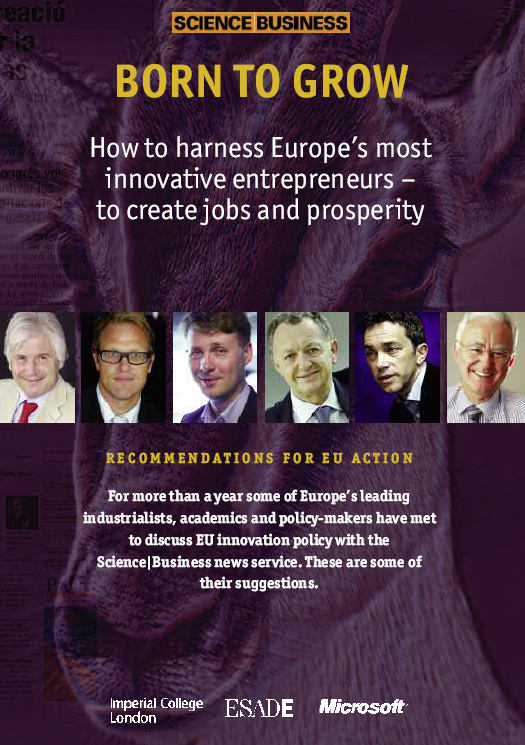
I just finished reading an interesting report entitled “Born to Grow – How to Harness Europe’s most innovative entrepreneurs

Nothing really new but a very good synthesis of recommendations and I emphasize in bold the ones I consider really critical:

  • Teach the values of innovation and entrepreneurship in our schools
  • Celebrate successful entrepreneurs – in prizes and the media
  • Break the barrier between business and technical universities
  • Organise researchers to work across scientific disciplines
  • Train young researchers and managers for global growth – and flexibility
  • Adopt policies to encourage innovation clusters around universities
  • Create “free innovation zones” to speed growth in selected clusters
  • Support the role of large companies in cluster-development
  • Give priority to creating “lead markets” for innovation
  • Free information flows – with online portals, benchmarking and patents
  • Target tax incentives and other financing aids to growth companies
  • Even better are the features of a high-growth entrepreneur (page 11):

    Originality. The greatest entrepreneurs have a better idea: a novel product, service or process that fills a need.

    Adventurousness. In the generally risk-averse culture of Europe, it’s rare to find an entrepreneur with the will to quit a cushy job and gamble the future on an idea.

    Dedication. Rigor and determination are hotwired into the best entrepreneurs – and that comes naturally to many scientists and engineers.

    Ambition. International business success comes easier if the entrepreneur’s plan is global from the
    start.

    Humility. Perhaps the rarest, but most important, trait in a high-growth entrepreneur is the ability to recognise one’s personal limitations – and seek help from others, rather than try to
    run the whole show.

    In the nurture of a high-growth entrepreneur:

    A thriving ecosystem. Businesses don’t grow in vacuums; they need networks of suppliers, researchers and customers.

    Financial backing. It takes money for a start-up to grow from minnow to whale; and deeppocketed, deeply engaged investors are critically important.

    A big, open market. A company needs plenty of room for manoeuvre – and some of the brightest entrepreneurial stars have profited when old, regulated markets started to open up.

    Big brothers. For many start-ups, it helps to grow in the shelter of big corporations that create their
    own ecosystems. Examples: Risto Siilasmaa, whose F-Secure antivirus company thrived in the 3,500-company world created around mobilephone giant Nokia; and Peter Bang and Jesper Balser, whose Danish business-process software firm Navision grew up in Microsoft’s programming environment – and was later bought by it.

    In the company of Giants

    I had read In the Company of Giants in 1997 just before becoming a venture capitalist. Then when I began to read again about entrepreneurs, I just could not find it anymore and had to buy it through the reseller network of Amazon. It is as interesting as my previous posts (Once You’re Lucky, Betting it All, Founders at Work).

    I will let you link the names and quotes with the pictures if you have time!

    Steve Jobs: “In the early days, we were just trying to hire people that knew more than we did about anything and that wasn’t hard because we didn’t know a lot. Then your perspectives are changing monthly as you learn more. People have to be able to change.”

    T. J. Rodgers (Cypress Semiconductor): “the standard entrepreneurial answer is frustration. You see a company running poorly, you see that it could be a whole better. Intel and AMD were arrogant. If you think about it, any billion dollar company, that has so much money to spend on R&D should be unassailable. But the large companies routinely cannot crunch little companies so something’s got to be wrong.”

    Gordon Eubanks (Symantec): “What makes a company successful is people, process, product, and passion. You must have great people and product and passion balanced by process.”

    Steve Case (AOL): “Do something you really love, you are passionate about. Take a long-term view, be really patient. There are going to be bumps on the road.”

    Scott Cook (Intuit): “People [customers] won’t tell you what they want. Often they can’t verbalize it because they don’t understand things they’ve not seen. You must understand fundamental motivations and attitudes.”

    Sandy Kurtzig (ASK): “I did not see it as incredible risk. Many entrepreneurs would tell you why it was obvious to do what they did. When you have nothing, you have nothing to lose. That’s why so few entrepreneurs can do it a second time. Even Jim Clark did not really start Netscape or Jobs did not really start Pixar. They funded it. You need other people to be hungry… Believe in yourself, surround yourself with good people, be willing to make mistakes, don’t get wrapped up in your success. You are still the same person you were when you started.”

    John Warnock and Charles Geschke (Adobe): “Actually there was the very first business plan, then there was the second business plan, and then the third business plan; we never actually wrote the third business plan.”

    Michael Dell: “It did not seem risky to leave school because I was already earning obscene amounts. The worst thing that could happen is I would return to school. The greater risk was to stay at school.”

    Charles Wang (Computer Associates): “Managing is not just telling people what to do, but it is leading by doing. Know your strengths and weaknesses and complement yourself. Be realistic and objective. Surround yourself with great people.”

    Bill Gates: “It’s mostly about hiring great people. We are [in 1997] 18,000 people and still the key constraint is bringing in great people. We naively thought there were guys who could tell us we weren’t doing things the best way.”

    Andy Grove: “I can’t look at a startup as an end result. A startup to me is a means to achieve an end.”

    Trip Hawkins (Electronic Arts): “You don’t have an objective, rational process. You need a certain amount of confidence. There are many things that you don’t know will go wrong. If you knew in advance all the things that could go wrong, as a rational person, you wouldn’t go into business in the first place.”

    Ed McCracken (Silicon Graphics): “My venture capital friends tell me that many of the ideas they’re seeing for new businesses are coming from people under 26 years old.”

    Ken Olsen: “Business school’s goal today is to teach people to become entrepreneurs. I think it’s a serious mistake. You learn first how to be a team member, then a leader.”

    Bill Hewlett: “It was 1939 and it was no time to start a company. It was probably the supreme optimism of youth.” and “It’s not all due to luck, but certainly a large percentage of success is. We were in the right place at the right time. We were lucky and we had wonderful teachers and mentors. HP didn’t start in a vacuum.”

    The thoughts of a Swiss entrepreneur based in Silicon Valley

    Following a long phone conversation with a Swiss entrepreneur based in Silicon Valley, I received from him an email where he put his thoughts. They are indeed quite interesting and he authorized me to publish them:

    “It’s a bit depressing to see that things change slowly (I had that intuition already)…

    On a philosophical standpoint, I was thinking while driving my car that one of the issues is self-confidence.In the USA, everyone is raised with the idea that “anything is possible”, the “American dream”, to the point that it is sometimes stupid and annoying… On the contrary, in Switzerland, anyone wants to do things well and the culture is more about “this is not possible” or “I do not know how to do this”. But to be an entrepreneur, you must not be afraid of trying, of being far from perfect, of doing things in fields you do not master and sometimes even “quick and dirty”. It is the opposite culture of the Swiss craftsman who is a perfectionnist, the “travail bien fait”)… In summary, it is important to learn by doing things such as:

    – Who to raise money, where to begin?
    – How to negotiate a shareholder and investor agreement?
    – How to deal with partners?
    – Learn how to negotiate
    – How to work with Head Hunters, Lawyers, Customers…?
    – How to build and manage a team? – How to hire a sales team (a tough thing for an engineer). By the way, what are marketing, sales, operations?!!

    – What about productization, schedule, specs, qualification?
    – Where to find distributors?
    – etc…

    All this can not be taught in schools, I am not sure it is covered in an MBA. I am not conviced it can be taught anywhere. According to my experience, an entrepreneur does not stop doing new things, quite badly the first time and hopefully better and better with time. One should not have the negative attitude of never trying difficult and risky ventures, which does not mean one should launch or fund unrealist projects… There is a fuzzy line between arrogance (one should know its own limits) and dynamism of a good entrepreneur.

    It is certainly a bad thing that engineering schools do not provide enough about marketing, accounting, legal elemts in the curriculum. But this is also true in teh USA, by the way!”

    I was yesterday in Grenoble for a round table on the Nouveaux Conquérants:

    The topics that were discussed were very similar to the comments above: self confidence, uncertainty, risk taking, passion, and success & failure.

    Obama

    The first and maybe last time my post has nothing to do with start-ups. But this is just TOO BIG for America and for the Rest of the World.

    It just shows everything is possible even if often risky, uncertain. Passion, ambition shall prevail!

    Finally here is a picture taken in-mid october in a street of Soho in New York.

    obama-in-ny.jpg

    Once you’re lucky, Twice you’re good.

    This is the third book I report on this blog about entrepreneurs. In fact it is the fourth if I include Inside Steve’s Brain (but this one is about a single entrepreneur). The two previous ones were interviews of many, i.e. Betting it all and Founders at Work. The beauty (and at same time weakness) of Once you’re lucky, Twice you’re good is that is is about web2.0. Is this new step in the Internet development a speculative bubble or a speculative revolution. It is probably too early to say even if author Tracy Lacy (appearing in another post) is quite convinced it is a revolution.

    lacy_book_web.jpg

    It is a beautiful book because it shows once again the richness of individual connections. I have done below my illustration of it. Paypal and its founders appear to be at the center of this network. Fairchild had such a similar situation at the beginning of Silicon Valley in the sixties, Apple, Sun, Cisco thereafter.

    webnetwork.gif

    Another interesting element is about investors. There has been a popular idea that web2.0 was not funded by venture capitalists anymore because the web2.0 business angels who were web1.0 entrepreneurs had learnt their lesson. The situation is more complex as the web2.0 financing shows. Greylock, CRV, Accel but also Benchmark and Sequoia are vey active. Finally, it shows again and again what entrepreneurs are: passionate, driven individuals and I can only advise reading the epilogue about Levchin’s childhood. Quite fascinating…

    web20funding.gif
    Source: Crunchbase and companies’ web sites.

    Equity split in start-ups

    Following a few case studies I posted earlier this year (Kelkoo, Skype, mysql), here is a more generic analysis about the process of equity splitting. The document is a pdf file I have used a number of times with students, entrepreneurs and I think it is helpful even if not new. At the end, there are also cap tables of other famous and less famous start-ups.

    equity.gif

    From the inception where a few founders share the initial equity between them to the exit (IPO or M&A) through a possible number of financing events, shares of a start-ups will be shared, distributed among founders, employees and investors. It is one of the most important decisions in a company’s life and should be handled with care.