The Apple Revolution

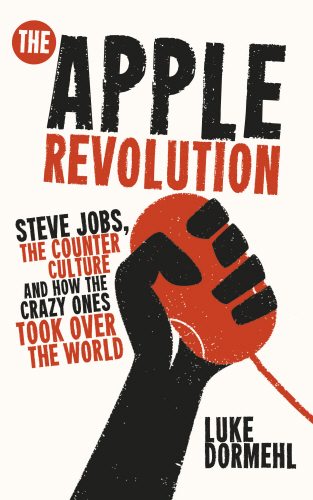
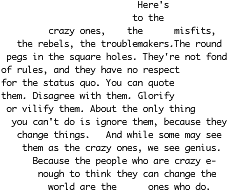
I have not read (yet) Isaacson’ authorized biography of Steve Jobs but found (by pure accident) another recent, funny an really great book, The Apple Revolution. Interesting too and somewhat related to a previous blog I published on Robert Noyce and the culture of Silicon Valley. As important is the subtitle: Steve Jobs, the Counterculture and How the Crazy Ones Took Over the World.

Dormehl, the author, is convincing when he explains that Silicon Valley is the result of the counter-culture as much as the Midwest engineers coming to SV. Noyce might have agreed! “This ideological divide is not uncommon. Silicon Valley has long been defined by the innate tension between the technologist’s urge to share information and the industrialist’s incentive to profit. […] There were aspects of the counterculture that were staunchly anti-capitalists in their views. […] One of them was definitely Marxist and the other was largely apolitical.[..] “Do you own thing” easily translated into “Start your own business”. [Pages 61-63] “Only in Silicon Valley could starting a business be read as an act of rebellion.” [Page 169]

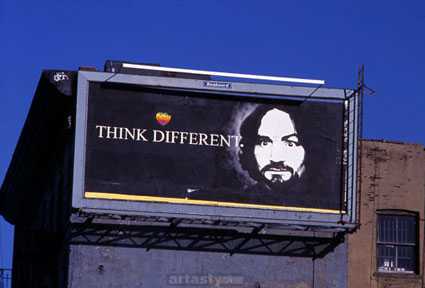
There are so many (unknown-to-me) anecdotes that I will only mention a few. For example, I did not know about Ron English, the guerrilla street artist who circumvented Apple’s billboards using murderer Charles Manson.

“The people who built Silicon Valley were engineers.” Jobs told wired in 1996. “They learned business, they learned a lot of different things, but they had a real belief that humans – if they worked hard with other creative, smart people,- could solve most of the humankind’s problems. I believe that very much.” [Pages 7-8]

At the same time, the counter-culture, the hacker culture has been critical [page 17]:
– Access to computers – and anything which might teach you something about the way the world works – should be unlimited and total;
– All information should be free;
– Mistrust authority – promote decentralization;
– Hackers should be judged by their hacking, not bogus criteria such as degrees, age, race, or position;
– You can create art and beauty on a computer;
– Computers can change your life for the better.

A funny anecdote is a woman going to the Homebrew Computer Club because nearly all the attendees were male. Her verdict: “the odds were good, but the goods were odd”. (Page 25)

You will learn about the history of the Apple logo [pages 85-90] and the first killer apps (word processing and spreadsheets). I did not know Paul Lutus and John Draper. And what about Apple first ad campaigns!


(Go to youtube at http://www.youtube.com/embed/J0Rs7d16jhU if you do not see the embedded frame!)

You will obviously read about the mouse, about interactions with Xeroc PARC and also learn about the early days of the MacIntosh concept and its father, Jef Raskin who yanked sharply in the arm of a young developer when he saw his face and guessed his thinking, labeling as “wet-behind-the-ears marketing puke, dressed in a ridiculous chalk-pinstripe, complete with banker’s vest, shoes off, stinky feet up […] an abrasive punk in need of a slap” a Steve Jobs he had not recognized! [Page 189]

“The Macintosh project represented the first time – outside the Garage in which the Apple II had been built – that Apple would put together the kind of small, dedicated team that would produce some of the company’s greatest products in later years. Jobs referred to this company-within-a-company approach as returning to the “metaphorical garage”. The Macintosh team still had all the piss and vinegar of a start-up. “Innovation has nothing to do with how many R&D dollars you have” Jobs said. “When Apple came up with the Mac, IBM was spending at least one hundred times more on R&D. It’s not about money. It’s about the people you have, how you’re led, and how much you get it.” [Page 202]

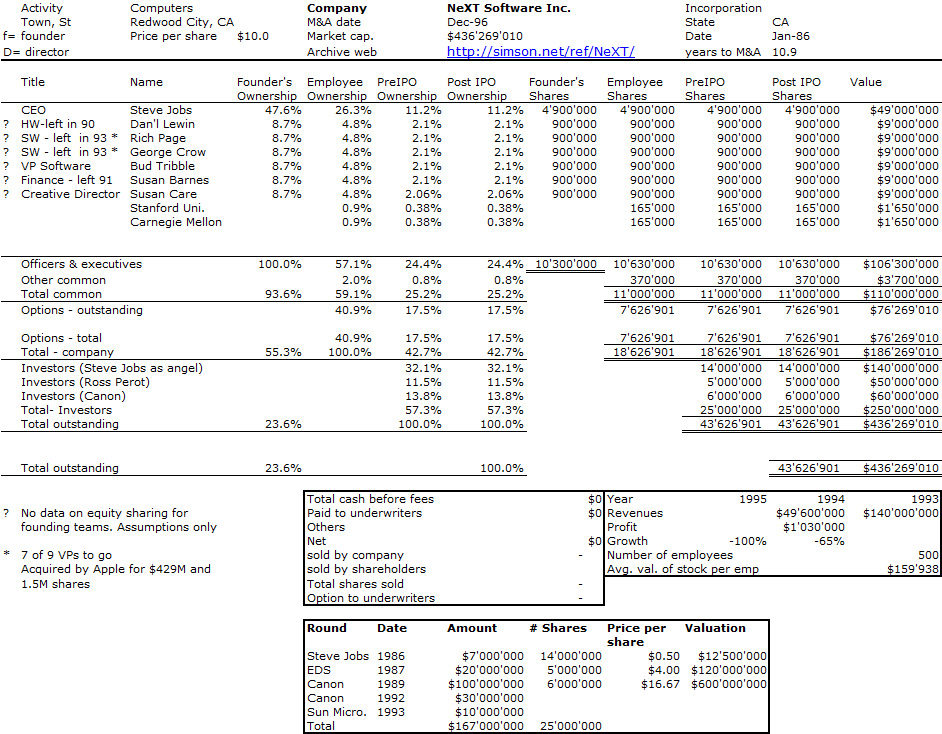
You will also read about the legal issued Apple faced in the music field and the funny origin of the Sosumi. It’s not only about Apple, you will read about Next early team, Dan’l Lewin, Rich Page, George Crow, Bud Tribble Susan Barnes an Susan Care as well as Pixar’s founding team, Alvy Ray Smith, Edwin Earl Catmull and John Lasseter ; “Pundits even came up with a tongue-in-cheek name for the unlikely convergence of Silicon Valley technology and Hollywood moviemaking. They called it Sillywood.“ [Page 303] So you can comment my tentative cap. table of NeXT (see below) when acquired by Apple.

Another piece of video is Pixar first work, The adventures of Andre and Wally B. If Jobs did OK with Next, what about with Pixar. He got 70% for $10M then Smith and Catmull each had 4%. But jobs got 100% after putting $50M. [Pages 335-336] There is also the funny anecdote that the iMac could have been called the MacMan, sounding “like a cross between the video game Pac-Man and Sony’s handheld music player, the Walkman.” [Page 413]. There is also an analysis of intellectual property [Pages 430-431] “Whether or not a breakdown i traditional copyright laws odes, in fact, lead to a similar decline in creativity and innovation remains a hotly contested debate” adding that “Gates, typically referred as imaginative”, and having “never invented anything” is wrong. “Gates had invented the notion that Software (be it entire operating systems or simple files) could be sold. Jobs merely reframed the idea as a necessary protective measure for creativity.” Apparently Dormehl advises to read Lawrence Lessig’s  The Future of Ideas.

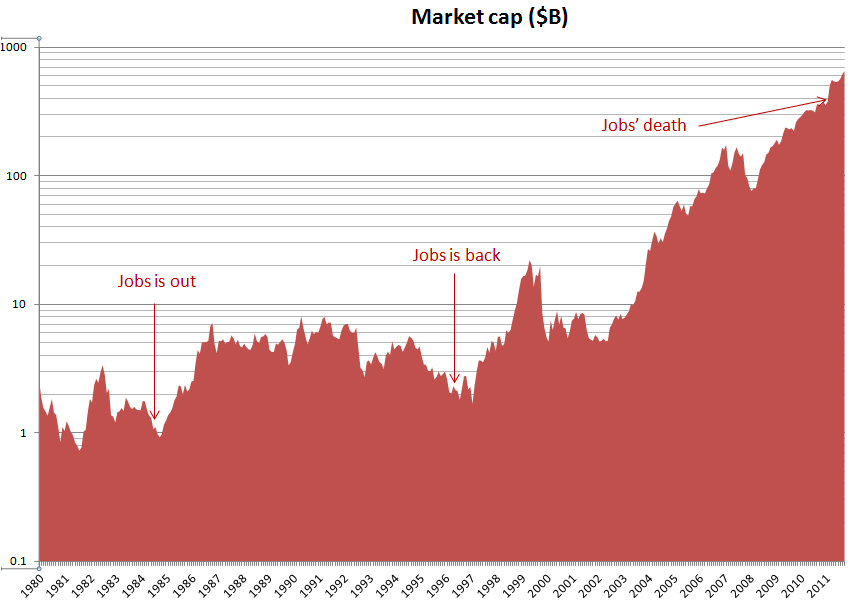
In the final chapters, Dormehl addresses the Apple paradox of the counterculture becoming mainstream. He quotes Norman Mailer [Page  384] “One is Hip or one is Square” and he adds [Page 408] that “no one better summarized the new ruling creative class of boomer bobos (that’s bourgeois bohemians) than Steve Jobs. […] They are prosperous without seeming greedy; they pleased their elders without seeming conformist; they have risen towards the top without too obviously looking down on those below; thy have achieved success without committing certain socially sanctioned affronts to the ideal of social equality; they have constructed a prosperous lifestyle while avoiding the old clichés of conspicuous consumption.”  Then [Page  456] Paul Lutus describes the App Store as a “classic marketer’s dream, with too many programmers with too many programs chasing too few buyer dollars, and the marketer in the middle the only really cashing in.” (Perfect capitalism, long if ever lost counterculture…) “Apple turning its back on its founding libertarian ideals.” […] “With the suggestion made that high-tech libertarianism apparently leans heavily towards the puritanical.” Still Jobs did not forget some elements of the start-up culture. “Jobs wanted the department to have only one hundred people, since that was the number of names he could remember.” “Apple was able to avoid unnecessary levels of bureaucracy. We’re the biggest start-up ion the planet Jobs proudly noted in 2010.” [Pages  462-463.] About innovation, “Gladwell’s suggestion (via economists Ralf Meisenzahl and Joel Mokyr) is that it is history’s tweakers – more so even than its inventors – who truly define the age:  The visionary starts with a clean sheet of paper, and re-imagines the world. The tweaker inherits things as they are, and has to push and pull them toward some more nearly perfect solution. that is not a lesser task. [Page  474] And as a near final quote from Norman Mailer again “One is a rebel or one conforms, one is a frontiersman in the Wild West  of American night life, or else a Square cell, trapped in the totalitarian tissues of American society, doomed willy-nilly to conform if one is to succeed.”  “It is for this reason that musicians like Jim Morrison and Jimi Hendrix who passed away at the age of twenty-seven, will forever be seen as young, idealistic rebels.” “The sheer scale of the current Apple makes it difficult to consider it any kind of rebel.”  [Page  502]  “Despite being declared moribund 59 times since 1995” [Page  495] , Apple is a formidable capitalist story as the next graph shows.

As a conclusion, let me quote Jobs again, and I discovered this on the Wikipedia page for Think Different:
“When you grow up you tend to get told the world is the way it is and your life is just to live your life inside the world. Try not to bash into the walls too much. Try to have a nice family life, have fun, save a little money.
That’s a very limited life. Life can be much broader once you discover one simple fact, and that is – everything around you that you call life, was made up by people that were no smarter than you. And you can change it, you can influence it, you can build your own things that other people can use.
The minute that you understand that you can poke life and actually something will, you know if you push in, something will pop out the other side, that you can change it, you can mold it. That’s maybe the most important thing. It’s to shake off this erroneous notion that life is there and you’re just gonna live in it, versus embrace it, change it, improve it, make your mark upon it.
I think that’s very important and however you learn that, once you learn it, you’ll want to change life and make it better, cause it’s kind of messed up, in a lot of ways. Once you learn that, you’ll never be the same again.”


(Go to youtube at http://www.youtube.com/embed/4oAB83Z1ydE if you do not see the embedded frame!)

“Entrepreneurship should be cherished,” the Nokia chairman says.

I did not check how many times I blogged about Finland, but it is certainly one of the most interesting and entrepreneurial countries in Europe. However, when I attended the REE conference at Aalto University last week, I have been shocked by the talk of Risto Siilasmaa. He is not only the chairman of the struggling mobile giant, but also the founder and chairman of F-secure, a successful software start-up. If you have time, watch his talk and listen carefully. Here are may notes, hopefully correct: “Entrepreneurship should be cherished, because it will be critical of the future of the world. It is not a profession, it is a state of mind.”


(Go to youtube at http://youtu.be/nFyKRCo4QkM if you do not see the embedded frame!)

“In 1924, Finland got 37 medals and 14 gold medals in the Olympics, much less in 2012. Finland was poor but at that time Europe was 25% of the world population and 33% of the GDP. In 2050, it will be 7% of population and 15% of GDP. And we will not be able to give to everyone all the wealth Europeans enjoy today. Not even talking about climate change and aging. Today, out of 100 people, 46 work in Europe including 8 in health care. In 2050, 38 will work and 18 in health care. Less than 20 will create wealth for the others. The equation does not work. European subsidies are 1/3 to coal mining and agriculture and 6% to R&D and technology. This is also meaningless. Europeans citizens need to elect leaders who have vision and courage… Entrepreneurship is making an impact and there is no point in doing small innovations when you are going to fail.”

Risto founded f-secure when he was 24 years old, but began making pocket money when he was 12. He studied at Aalto but found more negative elements than positive ones. Entrepreneurship was not valued, teachers did not value their teaching or if they taught well. “It was very disappointing”. He did not have classmates with an interest in entrepreneurship BUT he has to thank Aalto for pushing him to create a company with a friend when he began doing business. It was a consulting/project firm and he hired many Aalto alumni. He also remembers “the aversion to transfer practical skills” and an attraction for theory [something we should think about – why is that?]. “Management science was disappointing, the more complicated you were, the better (do you know what are “diseconomies of time compression?” [see next line]). CEOs never read management research, researchers want they fellow researchers only to read them, or why would not they use “lead-time” instead of the complex concept before? Whereas there might be hidden gems in research but how can CEOs know.” “Again entrepreneurship is a state of mind, which implies pragmatism, ambition, dreams, perseverance, optimism and give-up-&-start-again. It is also about a desire for results. We need to wake up, try, kill what fails and start again.” Siilasmaa quoted George Bernard Shaw: “Some men see things as they are and ask why. Others dream things that never were and ask why not.”

Then there were Q&As about:
– The Taboo of Money. Yes, the new French president said he hates rich people. Money is a by-product, but success should be celebrated. Once you have enough, you do not need money, but it is an outcome.
– Stock options. Q: Is it accepted in Finland like in SV? A: yes but down rounds and lack of exits make stock-options less successful not less accepted.
– Values: they should come from parents not from school. Now it is true some leaders succeed with strange values, such as “cult leader”. Not easy to blame them when they are successful but then how do we align this with values… not easy.
– Research on entrepreneurship again: if a paper is not complex, it is not accepted, too bad! CEOs read 300-page books with 1 idea, unfortunately. So you need to select teachers with the right values & ambition. Why not entrepreneurs? There is a book about picking the right people. Google it…

The REE conference was rich in quality speakers but nothing close to Siilasmaa. I noticed some good things such as “being an entrepreneurs is making an impact. Just like scientists or artists, it is about do you want to be remembered. Therefore we should “expose as many people as possible to entrepreneurship and hope that diversity will induce wealth. Again it is about a Darwinian process. And we should also be aware that entrepreneurship is not just about satisfying needs, but also answering to frustrations and desires.

I was less convinced about the fact that creativity can be taught (but I am not creative so maybe I should follow such courses!), about the idea that customers may be better to fund your start-up than investors (it is not my experience but I might be biased) or even that teaching can replace the state of mind. But there was a funny analysis that I restate my way: “If 100 students follow a course, 10 may launch a company, 5 will fail because they did not listen / learn, 4 will survive because they learnt the tools to avoid fatal mistakes, and 1 will succeed because he did not fully listen and did it his way on top of surviving.”

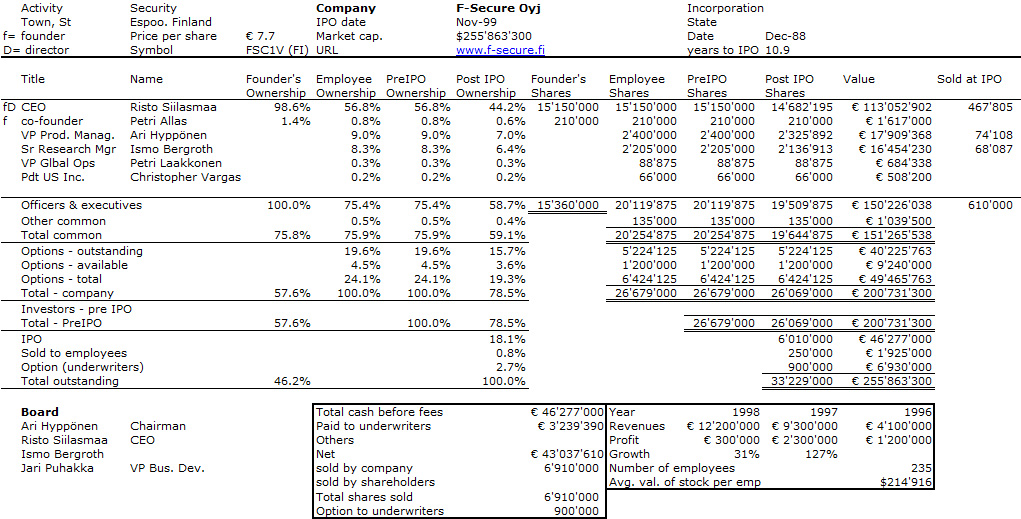
Let me finish with something loosely related. As you may know if you a regular visitor here, I love to put cap. tables of start-ups when available (at time of an exit), and here is F-secure.

A Quiz to New 2012 EPFL Students

Each year, I have a small tradition of giving a start-up-related quiz to new EPFL students. Here it was:

I was in Helsinki last week and there, the chairman of Nokia gave a talk. “The world is in crisis and the only way we will solve our challenges is with creative people and entrepreneurs. […] Therefore entrepreneurship should be cherished, it is not a profession, it is a state of mind. […] Again it is a state of mind.”

EPFL 1st mission is teaching, its 2nd mission is research. Its maybe-lesser-known 3rd mission is innovation and technology transfer, which includes entrepreneurship. If you have creative ideas, we are here to support you. More on http://vpiv.epfl.ch/innogrants

To show you that that has been understood at the top of the best universities, both the President of Stanford University and the President of EPFL have been entrepreneurs, they have been the founders of 3 start-ups each. I will offer a bottle of champagne to the first student who sends me via email the names of these 6 companies. I am Herve Lebret and I support entrepreneurs at EPFL.

The answer may be found here, and more importantly, I will come back on Risto Siilasmaa’s talk – the chairman of Nokia.

The Black Swan again

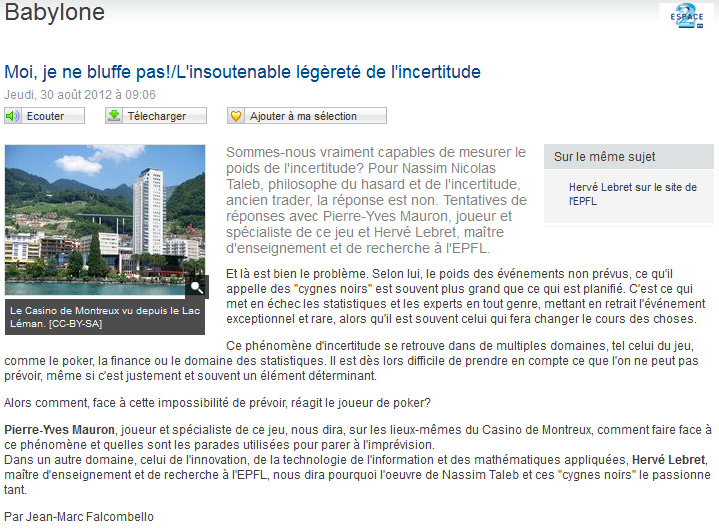
If you understand French, you might be interested in how I explained the Black Swan on French-speaking radio broadcast Babylon on Espace 2. You just have to click on the picture. Many thanks to Jean-Marc Falcombello for the time he gave me to describe Taleb’s ideas. It is 19 minutes long – between 23:15 and 42:00.

I am less sure this works: http://www.rts.ch/espace-2/programmes/babylone/4203353-moi-je-ne-bluffe-pas-l-insoutenable-legerete-de-l-incertitude-30-08-2012.html?f=player/popup

Is Intellectual Property out of Breath?

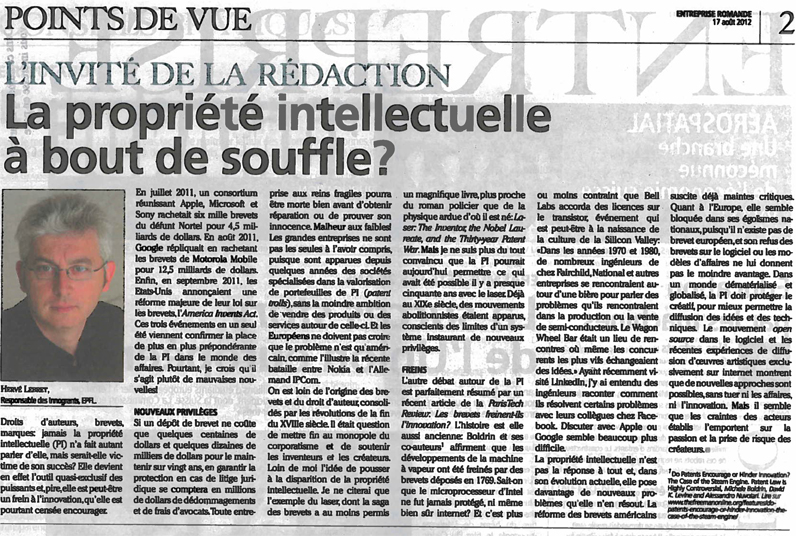
Here is my second paper published by Entreprise Romande after the one on the Challenges of Innovation.

Copyrights, patents, trademarks. Never intellectual property (“IP”) has seemed so visible, but would it be a victim of its success? It is indeed becoming an almost exclusive tool of the rich and powerful and even worse, it may be hindering innovation whereas it was supposed to encourage it.

In July 2011, a consortium including Apple, Microsoft, Sony bought 6,000 patents from now deceased Nortel for $ 4.5 billion. In August 2011, Google replied by acquiring patents from Motorola Mobile for $ 12.5 billion. Finally in September 2011, the United States announced a major reform of patent law, the America Invents Act. These three events in a single summer confirm the increasingly dominant position of IP in the business world. Yet I think it is bad news!

New privileges

If a patent application only requires a few hundred dollars and tens of thousands to maintain over 20 years, should a company enter in legal dispute over it, it might cost millions in damages and attorney fees. Any fragile business might be dead long before winning a case or proving its innocence. Woe to the weak! Large companies are not the only ones to have understood: companies specialized in the valuation of IP portfolios (“patent trolls”) have emerged in recent years and these companies have no ambition to sell products or services around their IP. And Europeans should not think that the problem is American only as illustrated by the recent battle between Nokia and Germany’s IPCom.

IP is now a far cry from the original patent and copyright statements made by the revolutions of the late eighteenth century. It was then about ending the monopoly of corporatism and about supporting inventors and creators. Far be it from me to push the disappearance of intellectual property. I only here mention the example of the laser patents whose saga has at least allowed a wonderful book, closer to a thriller than the complex physics from which ir was born, Laser: The Inventor, the Nobel Laureate, and the Thirty Patent-year War. But I’m not at all convinced that IP could now enable what was possible almost 50 years ago with the laser. And already in the nineteenth century an abolitionist movement had appeared, aware of the limitations of a system that set new privileges.

Hindering innovation

The other debate about IP is best summed up in a recent article in the ParisTech Review: “Are patents hindering back innovation?” The story is old: Boldrin and his coauthors [1] argue that the developments of the steam engine were hindered by patents filed in 1769. Do we know that the microprocessor from Intel was never protected, nor of course the Internet, and it is more or less constrained that Bell Labs granted licenses on the transistor, an event that is perhaps at the origin of Silicon Valley culture: “In the 70s and 80s, many engineers from Fairchild, National and others met over a beer to talk about problems they encountered in the production or sale of semiconductors. The Wagon Wheel Bar was a meeting place where even the fiercest competitors exchanged ideas.” Having recently visited LinkedIn, I’ve heard engineers explain how they solve problems with competitors from Facebook. Discussing with Apple or Google seems much more difficult today.

Intellectual property is not the answer to everything and in its current development, it poses more new problems than it solves. The U.S. patent reform has already attracted much criticism. As for Europe, it seems stuck in its national self-interest as there is no European patent and the lack of patents on software or business models does not give it any advantage. In a globalized and dematerialized world, the IP must protect the creative people, to better enable the dissemination of ideas and techniques. The “open source” software movement as well as recent experiments in the diffusion of artistic works exclusively on the Internet show that new approaches are possible without killing business or innovation. But it seems that the fears of the established players outweigh the passion and creative risk-taking culture.

-[1] Do Patents Encourage or Hinder Innovation? The Case of the Steam Engine. Patent Law Is Highly Controversial. Michele Boldrin, David K. Levine, and Alessandro Nuvolari.
Laser: The Inventor, the Nobel Laureate, and the Thirty-year Patent War. Taylor, Nick (2000). New York: Simon & Schuster
Are patents hindering innovation? Paristech Review, September 2011

PS: When writing this paper, I had not measured yet the impact of the Apple-Samsung litigation

The Tinkerings of Robert Noyce

I am reading a new book on Steve Jobs and Silicon Valley entitled The Apple Revolution. I will come back on what I think when I am finished reading it. I discovered in the first pages of this book that famous author Tom Wolfe had written in 1983 another article about Silicon Valley centered around Bob Noyce, The Tinkerings of Robert Noyce.

You probably do not remember my previous posts mentioning Noyce, and if not you may want to read them:
What is the mentor role? in August 2010.
The Man Behind the Microchip in February 2008.
It is not very surprising that Noyce, the founder of Intel, is mentioned in a book about Apple computer. Noyce was a mentor to Jobs as you may see below or by reading my post above. Don Valentine add further that Noyce and Jobs may have been the two most important personalities of Silicon Valley: “There were only two true visionaries in the history of Silicon Valley. Steve Jobs and Bob Noyce. Their vision was to build great companies…”

Wolfe’s article is great and if you do not have time to read The Man behind the Microchip, you might want to read this shorter version. let me just extract a few things:

About the culture of Silicon Valley, work, openness and …
“The new breed of the Silicon Valley lived for work. They were disciplined to the point of back spasms. They worked long hours and kept working on weekends. They became absorbed in their companies the way men once had in the palmy days of the automobile industry. In the Silicon Valley a young engineer would go to work at eight in the morning, work right through lunch, leave the plant at six-thirty or seven, drive home, play with the baby for half an hour, have dinner with his wife, get in bed with her, give her a quick toss, then get up and leave her there in the dark and work at his desk for two or three hours on “a couple things I had to bring home with me.
Or else he would leave the plant and decide, well, maybe he would drop in at the Wagon Wheel for a drink before he went home. Every year there was some place, the Wagon Wheel, Chez Yvonne, Rickey’s, the Roundhouse, where members of this esoteric fraternity, the young men and women of the semiconductor industry, would head after work to have a drink and gossip and brag and trade war stories about phase jitters, phantom circuits, bubble memories, pulse trains, bounceless contacts, burst modes, leapfrog tests, p-n junctions, sleeping-sickness modes, slow-death episodes, RAMs, NAKs, MOSes, PCMs, PROMs, PROM blowers, PROM burners, PROM blasters, and teramagnitudes, meaning multiples of a million millions. So then he wouldn’t get home until nine, and the baby was asleep, and dinner was cold, and the wife was frosted off, and he would stand there and cup his hands as if making an imaginary snowball and try to explain to her… while his mind trailed off to other matters, LSIs, VLSIs, alpha flux, de-rezzing, forward biases, parasitic signals, and that terasexy little cookie from Signetics he had met at the Wagon Wheel, who understood such things.
It was not a great way of life for marriages.”

About youth and innovation:
“The rest of the hotshots were younger. It was a business dominated by people in their twenties and thirties. In the Silicon Valley there was a phenomenon known as burnout. After five or ten years of obsessive racing for the semiconductor high stakes, five or ten years of lab work, work lunches, workaholic drinks at the Wagon Wheel, and work-battering of the wife and children, an engineer would reach his middle thirties and wake up one day; and he was finished. The game was over. It was called burnout, suggesting mental and physical exhaustion brought about by overwork. But Noyce was convinced it was something else entirely. It was…age, or age and status. In the semiconductor business, research engineering was like pitching in baseball; it was 60 percent of the game. Semiconductor research was one of those highly mathematical sciences, such as microbiology, in which, for reasons one could only guess at, the great flashes, the critical moments of inspiration, came mainly to those who were young, often to men in their twenties. The thirty-five year-old burnouts weren’t suffering from exhaustion, as Noyce saw it. They were being overwhelmed, outperformed, by the younger talent coming up behind them. It wasn’t the central nervous system that was collapsing, it was the ego.”

About status, hierarchy and success:
“And if he was extremely bright, if he seemed to have the quality known as genius, he was infinitely more likely to go into engineering in Iowa, or Illinois or Wisconsin, then anywhere in the East. Back east engineering was an unfashionable field. The east looked to Europe in matters of intellectual fashion, and in Europe the ancient aristocratic bias against manual labor lived on. Engineering was looked upon as nothing more than manual labor raised to the level of a science. There was “pure” science and there was engineering, which was merely practical. Back east engineers ranked, socially, below lawyers; doctors; army colonels; Navy captains; English, history, biology, chemistry, and physics professors; and business executives. This piece of European snobbery that said a scientist was lowering himself by going into commerce. Dissenting Protestants looked upon themselves as secular saints, men and women of God who did God’s work not as penurious monks and nuns but as successful workers in the everyday world.”

Although he was an atheist, Wolfe sees in the values of “Dissenting Protestantism” roots of the Silicon Valley culture. “Just why was it that small-town boys from the Middle West dominated the engineering frontiers? Noyce concluded it was because in a small town you became a technician, a tinker, an engineer, and an and inventor, by necessity. “In a small town,” Noyce liked to say, “when something breaks down, you don’t wait around for a new part, because it’s not coming. You make it yourself.”

Interestingly enough the Apple Revolution also mentions all these points, but in the context of the hippie counter-culture… wait for next post!

Parrot and Henri Seydoux, a French success story

It is in discovering the Parrot investment in two EPFL start-ups, senseFly and Pix4D, that I was reminded a start-up which recent success I did not know. I am sometimes very much disconnected! I had indeed met its founder, Henri Seydoux, in one of these start-up conferences that were popular in the late 90s. The start-up had already received support from Sofinnova, but it was less than 5 years old and was far from its € 250 million turnover achieved in 2011 and its 700 employees it has hired since!

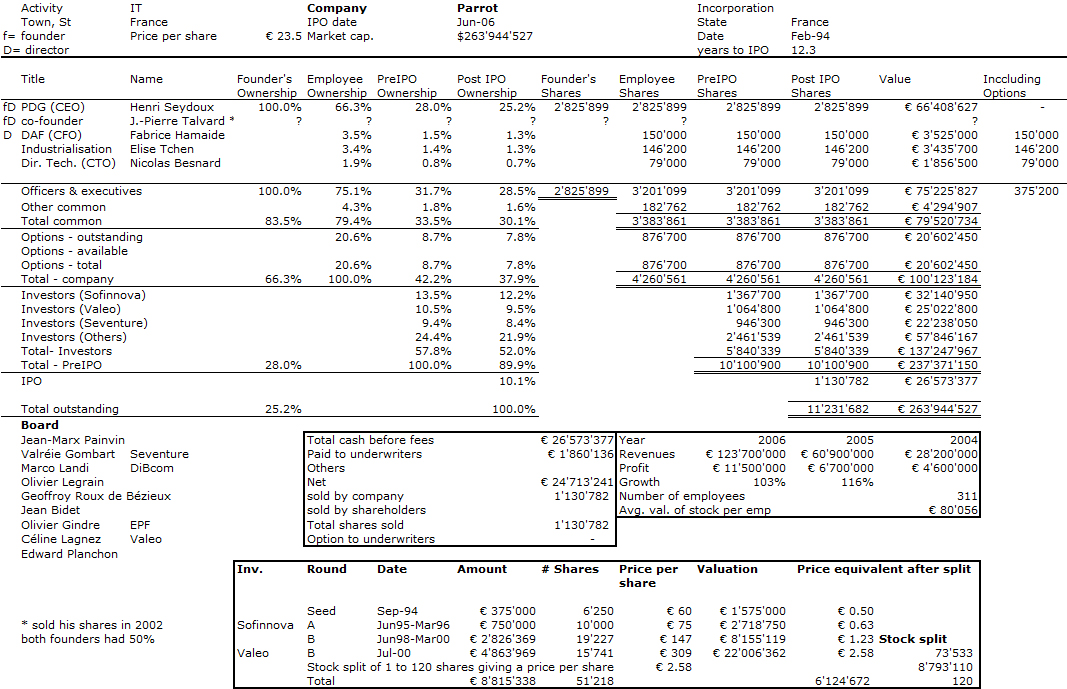
As usual, I could not help but get its IPO filing document, and also some older material on the French register of commerce, which allowed me to build the following capitalization table.


(Click on image to enlarge)

To learn more about Parrot, the following video is quite refreshing …

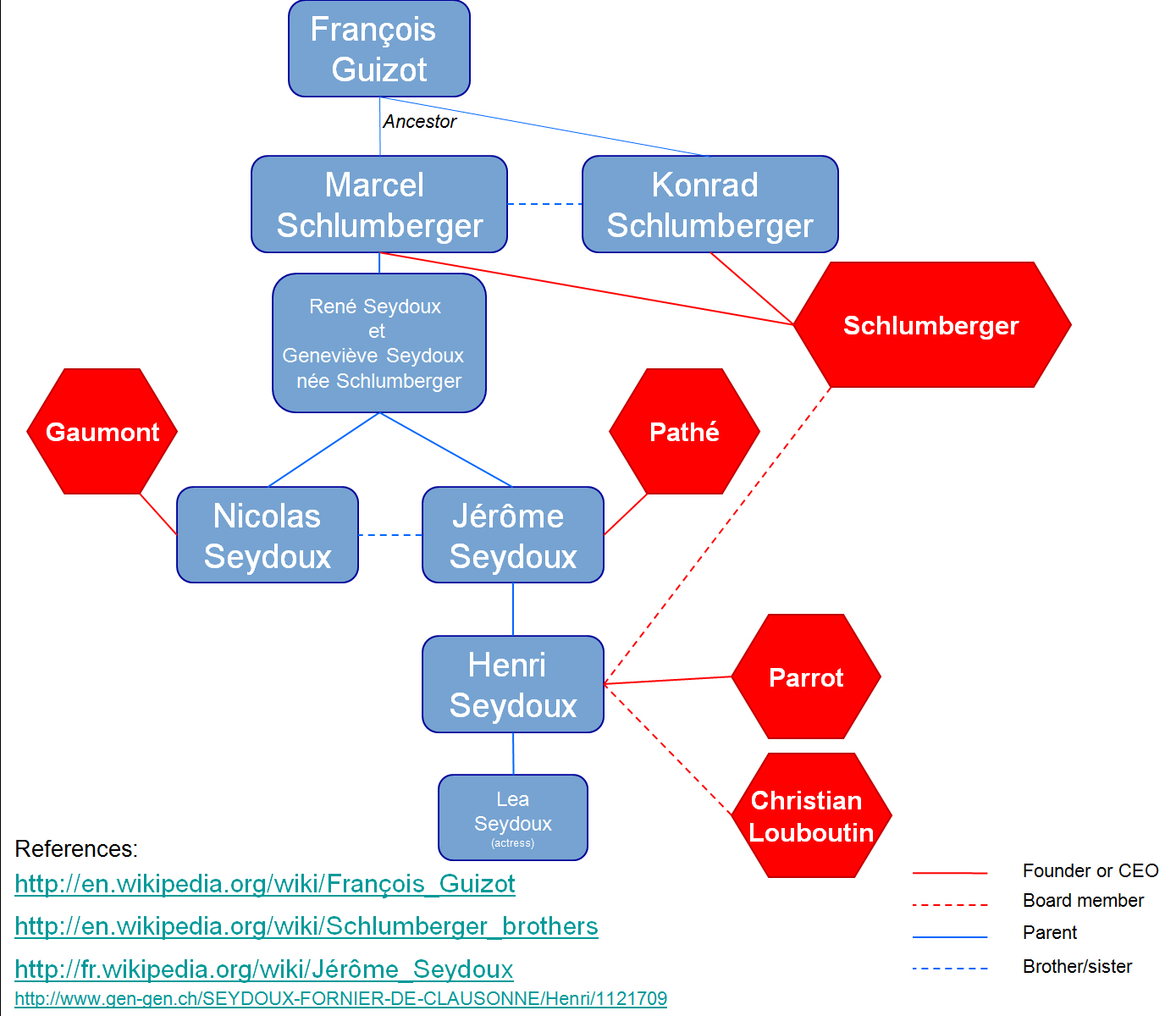
Finally, I also wanted to try to learn more about Henri Seydoux, intrigued by a fairly famous family name in France … this work is probably closer to the tabloids than this blog but hey, I find the genealogy interesting!

(Click on image to enlarge)

The State of Innovation

After my summer break, I received mails from friends and colleagues, all related somewhat to new (in fact old) trends in innovation. Thanks to Jean-Jacques, Andrea, Will and Martin :-). The four articles I read are:
Les Misérables – Europe not only has a Euro crisis, it also has a growth crisis. That is because of its chronic failure to encourage ambitious entrepreneurs from the Economist (July 2012).
Small is not beautiful from the Economist again (March 2012).
In bid for start-ups, venture capitalists elbow their way into the spotlight from the International Herald tribune, (not freely available online).
In Silicon Valley, Chieftains Hold Sway With Few Checks and Balances from the New York Times (July 2012)

The second one is probably the easiest to summarize and it is such an important message, that it needs to be hammered again: Innovation is not about large or small companies (SMEs), it is about fast growth (gazelles, start-ups). And let me add, it is also about a culture of trying and risk taking. “Rather than focusing on size, policymakers should look at growth.” […] “In a healthy economy, entrepreneurs with ideas can easily start companies, the best of which grow fast and the worst of which are quickly swept aside. Size doesn’t matter. Growth does.”

The first article is more complex to describe and I really liked only the first half. The second half explains that Europe struggles because of bad laws on bankruptcy, bad access to finance and bad labor laws. I am not sure these are the causes of our innovation crisis. I preferred the first part such as: “Europe’s culture is deeply inhospitable to entrepreneurs; wanting to grow a start-up into a behemoth is quite as countercultural as piercings and performance art.” […] “They will struggle to hire professional managers to help their firms grow, because European executives are extremely risk-averse. Their young firms will quickly find that established European companies tend not to like dealing with tiny ones.” And as a consequence, “the giants are all ageing”.

“Europe gave birth to just 12 new big companies between 1950 and 2007. America produced 52 in the same period (see chart above).” […] “Many aspiring entrepreneurs simply leave. There are about 50,000 Germans in Silicon Valley, and an estimated 500 start-ups in the San Francisco Bay area with French founders. One of the things they find there is a freedom to fail.” The answer is not simple, but there is hope: “There are schemes […] to get academics to hate business less, to expose schoolchildren to entrepreneurial notions.”

The last two articles are probably less important but give interesting new trends in Silicon Valley. One shows that the venture capitalists are becoming more visible (in order to court entrepreneurs) and mostly thanks to or because of new fund Andreessen Horowitz. But there is also debate (and I agree with the following comment): ‘‘I don’t quite understand the venture capital celebrity. We should be supporting actors. The entrepreneurs do the work and deserve the credit.’’ But Andreessen adds an interesting comment about the dynamics of venture capital: “Each year 15 deals account for 97 percent of all venture capital profits. To be successful, they would have to pursue those 15 companies. And they would do it by aggressively marketing their expertise to the reporters and bloggers who follow start-ups.” The final paper complains about the dangers of too much control to founders and managers vs. board or shareholders: “Since Google went public in 2004 in a way that maintained control for its founders, the leaders of Silicon Valley have been chary about shareholder voting rights.” […] “Directors are meant to act as a check on executives or at least add their expertise and advice to big decisions. In the Valley, however, the idea of the visionary chief executive dominates, and there may be little room for input from directors.” […] “So the new thing in Silicon Valley appears to be for public companies to be run as private ones without significant input from boards and shareholders. This leaves the wunderkinder of the Internet free to run their companies without interference. The question is whether this is merely a bubble in corporate governance or a trend that will spread to the rest of corporate America.”

What’s a start-up worth, or reflections on Facebook’s IPO fiasco

Here’s my 5th contribution to EPFL‘s “start-up of the month

When its IPO was announced last February, everyone agreed that Facebook was worth somewhere in the ballpark of $100 billion. Today, Facebook has lost 40% of its value – how is this possible?


Facebook a perdu plus de 40% de sa valeur

Facebook, unfortunately, isn’t an EPFL start-up, but the controversy surrounding its overvalued stock market debut (Initial Public Offering, or IPO) nonetheless provides a good opportunity to discuss the value of a start-up, in particular, spin-offs from EPFL laboratories.

A company’s value cannot truly be measured scientifically, even though there are techniques that try to do this via revenues and profits – Logitech and Swissquote, who have historical connections with EPFL, are measured like this. The law of supply and demand rules here: the value of a company is the product of the number of shares and the price per share. Companies listed on the stock exchange are thus hostages of the market and its moods.

When companies are not listed on the stock exchange, as is the case in the majority of start-ups, they can still be valued. Interested readers can learn more in the article “Equity Split in Start-ups.” When EPFL start-ups like Eelcee, Abionic, Aleva and Kandou (see previous articles) recently announced they were looking for financing, they were valued by their investors, even though there was no market in which to buy shares. Switzerland, however, provides some information via the registre du commerce (commerce registry) in which each start-up registers the change in its number of shares. From there, if you know the amount of money that has been raised, you can deduce the price per share and thus the value of the company. But I personally wouldn’t make the calculation, out of respect for the discretion desired by the entrepreneurs and the investors.

Again, value is just a subjective thing that depends on the good will of the investors. Facebook, like Google ten years ago, didn’t completely abide by Wall Street’s rules, by which a company agrees to be under-valued at its IPO so that the ensuing trading result in an upward curve. So far, it’s just simple speculation, and we’ll have to wait several years before we know whether or not Facebook’s IPO was a failure or not.

Our start-ups have a similar problem. I’ve known many entrepreneurs who prefer that their companies have the best possible value when they were looking for funding. They forget that the only real value is that which is created over the long term by their products or services, and that the value of a company is a very volatile thing, as Facebook just illustrated so well. Entrepreneurs tend to retain the lion’s share of their companies, even though by doing this they also seem to be ignoring Logitech founder Daniel Borel’s advice: “We prefer a little pie that we control completely to a big pie that we only control 10%, and this can be a limiting factor.”

I’m convinced (even though I’m often wrong) that Zuckerberg’s impact will be similar to Brin and Page’s. Here in Switzerland, I hope that local companies are created whose value is on a par with those of Daniel Borel, Mark Bürki and Paolo Buzzi.

References

Facebook Finally Files For $5B

Facebook data today

Logitech

Swissquote

Equity split in start-ups

Eelcee and composites


Two million Swiss francs for an allergy-detecting device

Swiss register of corporations

Supporting creators: what VCs really are.

If you have the opportunity to visit VC firm Index Ventures in Geneva, you may see the following:

I had a closer look, was allowed to take the picture and learnt that the Index partners have four such “pictures”, one for each meeting room which has the following names: Frederick Terman, Ahmet Ertegün, Ernest Rutherford and Leo Castelli. What do have these very different people in common? In their own activity, they were the best supporters of “creators”, of “talent” and contributed to the success of people they supported. What ever critics may say, great venture capitalists help entrepreneurs in their success.

It was striking for me to discover this the week I published my post on the Black Swan. In particular, I quoted Taleb when he talks about creation: “Intellectual, scientific, and artistic activities belong to the province of Extremistan. I am still looking for a single counter-example, a non-dull activity that belongs to Mediocristan.” and later “You not only see that venture capitalists do better than entrepreneurs, but publishers do better than authors, dealers do better than artists, and science does better than scientists.” (I can add that gold seekers made less money than the people who sold them picks and shovels.) This is not fully true, one should probably add “on average”.

It’s not the first time I see connections made between scientists, entrepreneurs/innovators and artists. I am convinced of the similarities. It was the second time only that I saw a connection made between academic mentors, publishers, art dealers and venture capitalists. Interesting… I think.

PS: if you click and enlarge the picture you my recognize the pictures, read the names of famous start-ups, Adobe, Apple, Cisco, Google, Hewlett-Packard, Intel, Oracle, Yahoo and probably lesser known Stanford University motto “Die Luft der Freiheit weht” I had used as an introduction to Chapter 2 of my book about Stanford start-ups.