Before talking about Sylvia Serfaty’s book, Équations Personnelles, I would like to mention two other scientists, Yves Meyer and Celia Pelluet.
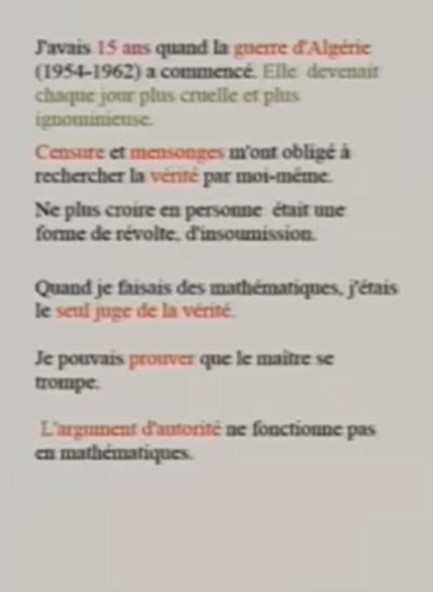
In this long video, Yves Meyer addresses the question of his vocation for the beauty and truth of mathematics from the moment 9 minutes 41 seconds.
I’m going back to my childhood. My childhood was completely ruined, shattered by the Algerian War. I was 15 years old. Especially since I was in Tunisia, which was entirely within a Muslim world. This war seemed absolutely horrific to me. So, I was 15 when it started. In fact, it lasted seven years, and it was truly terrible. And, uh, at that time, we, as children and teenagers, were completely confronted with the fact that the press was entirely censored because you couldn’t say that the war existed, you certainly couldn’t talk about the existence of torture, and so on. And it was either censored or lying. Hence the idea — a rebellious teenager has always existed; even people who wear a tie today, like me, were rebellious teenagers — and it led me to seek the truth for myself, and no longer believing in anyone was, for me, a form of rebellion, a defiance of will. And the charm of mathematics for me was that I was the sole judge of truth. I could prove the teacher wrong. In fact, my teachers were very rarely wrong because they gave excellent lessons. I did occasionally make mistakes while teaching. But you can stop the teacher by telling them they’re wrong, simply that there’s a sign error, or that the argument from authority doesn’t work in mathematics since you can’t say, “You’re going to believe this result, I’m going to prove it to you, and therefore you are the judge of truth.” It’s very strange when you think about it deeply. When I was a child, when physicists told me — my physics teacher — that Michelson and Morley had done such and such an experiment, it was actually, despite the respect I have for physics today, an argument from authority. I was forced to believe that this experiment had been done. I couldn’t possibly verify for myself, through my own intellectual resources, that the result was truly true. Because of my mindset, which was one of rebellion and insubordination, mathematics seemed to me the only discipline where I could control everything myself, and that seemed absolutely essential. So, in my adult life, as an adult mathematician, I first sought truth and beauty. Truth was something I held dear in my childhood because of the political experience of the Algerian War. And beauty, because I was very sensitive to beauty as a resident of Tunis. Beauty was everywhere. The almond trees in bloom in February were breathtakingly beautiful.
I discovered Célia Pelluet at a conference in Angers last week and she made me laugh a lot. She does something unusual: stand-up comedy, through popular science and the position of women in the field, which is as male-dominated as, or even more so than, others. Here’s a great example: “Politics Isn’t Quantum”:
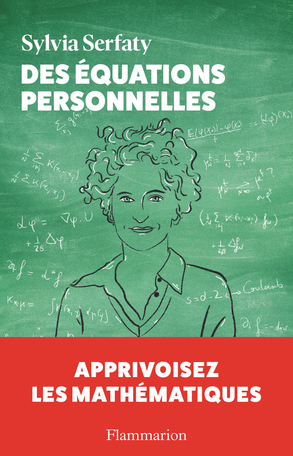
Back to Sylvia Serfaty’s beautiful book. It’s a simple yet subtle book about a vocation for mathematics. “It all started for me at fifteen. […] I proved a more general inequality.” [Page 11] “That day, it suddenly dawned on me that being a mathematician was also a classy, meaningful profession that could make me dream, just as much as being an artist or a writer.” [Page 16] But it’s also about rivalry: One of them had singled me out — I learned it indirectly — as “the girl to beat.” [La fille à abattre][Page 19]
These are shared memories and feelings, often encountered during our studies. Her high school teacher, L. Koechlin, who decided against entering her in the national mathematics competition, said, “Perhaps what he made us give up was the possibility of dreaming a little longer.” [Page 21] She went back to see him during her preparatory school years. “It was a good year, when he passed the agrégation, and I was admitted to the advanced mathematics program M’.” [Page 33]
These are also mixed feelings about those years in preparatory classes. Stéphane Hoguet, looking so much like Dave Gahan, the singer of Depeche Mode [Page 22], was undoubtedly her mentor. “Stéphane Hoguet taught at the Lycée Louis-le-Grand for a grand total of two and a half years (we were his first year). […] I learned of his death. He was 35 years old. […] I have always wondered how many vocations he would have inspired, how many mathematicians he would have launched into the stratosphere, if he had lived longer and taught for another thirty years.” [Pages 36-7]
She is less enthusiastic about her M’ professor. “It was rumored that until a certain time, perhaps ten years earlier, he had refused to have girls in his class. I don’t know if it was true, but there were some telling signs.” [Page 33] or about her physics professor: “An ENS? Well, try ENS Lyon then.” […] When he saw her again, her M’ professor shook her hand courteously and congratulated her. Our physics professor called out to her as a parting gift, “Go ahead and help women advance!” Had she applied this injunction to herself? It was a little late for encouragement. [Page 35] (You may check as a comparison the experience of Malcolm X here.)
But the “crude jokes and dubious traditions” seem to have had a motivating rather than discouraging effect. Sylvia Serfaty entered Ulm among the top students in a class that had never before included so many girls: six out of 42. Of the four who went on to study mathematics, three were daughters of mathematicians. Social mobility and class defectors exist at all levels.
I don’t know if the book will speak to everyone in the same way — obviously not, that’s a rather silly remark! And on the specific subject of mathematics, it resonates even more when you recognize yourself in the journey. I remember a few teachers’ names: Gérard Falézan, Brigitte Doisneau, Mr. François, Michel Poupaud (Melvil’s father), who also died prematurely, and of course Stephen Boyd. Like Sylvia Serfaty, the non-science teachers were just as important. I only need to think of my French teacher, Yvonne Rollet. And there are even more faces and names that brought so much imagination and inspiration. Not forgetting the friends, sometimes rivals, never enemies! Corinne, Claire, Isabelle, Frédéric, Patrice, Roger, Philippe, Vincent, Peter, Lieven, Laurent… Girls and boys.
Sylvia Serfaty describes the world of research, its grandeur and sometimes its pettiness (as I have also tried to illustrate it here at times). She also mentions the famous Fields medal with a caution I had rarely encountered: “A more accurate comparison would be to say that the Fields Medal is the equivalent of the Oscars, the Palme d’Or at the Cannes Film Festival, or a literary prize. It is awarded by the committee, which chooses based on its own assessment and relying on letters of recommendation solicited from expert and recognized mathematicians, thus striving to also reflect the opinion of the community, where certain groups promote their protégés. […] In other words, it is a scientific choice, but also a political one in the broadest sense, and necessarily subjective. It is therefore clear that the four selected, the only ones who will be remembered, are not necessarily better than the six or eight who are left out. […] Highlighting only them and their work is like only going to see films that have won an Oscar or a Palme d’Or.” [Pages 132-33] One may check about this the article about Perelman (whom you can discover at pages 136-38).
The ending takes a more philosophical turn, mentioning foxes, hedgehogs, birds, and frogs as analogies for the way mathematics is done. You will also meet before the mysterious Ramanujan.
Sylvia Serfaty also discusses the revolution that artificial intelligence seems to be bringing to mathematics. When the book was published, I’m not sure that the openAI proof of a mathematical conjecture was known. She mentions the recent article “Mathematical Beauty, Truth and Proof in the Age of AI”.
Without a doubt, Sylvia Serfaty has written a very beautiful book on the beauty and truth of mathematics. A rare, simple and subtle book.
PS: Of course, the book immediately brought back some wonderful memories. The beautiful movie La Voie royale
and as beautiful Le Théorème de Marguerite
While reading a second time and correcting the errors in the first iteration of this article, I found another one in French: Girls, women, the female gender in technology, science, mathematics (Les filles, les femmes, le genre féminin et la technologie, la science, les mathématiques).
Final comeback to Sylvia Serfaty through the France Culture morning program of June 2, 2026:
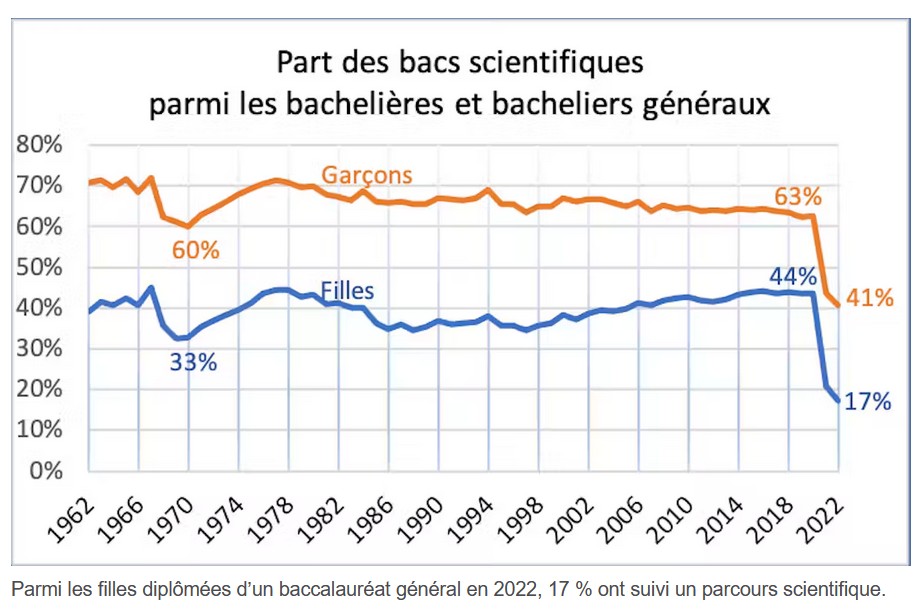
PS2 : What to say about this terrible curve?