Category Archives: Must watch or read

HBO’s Silicon Valley – episode 9: The Term Sheet

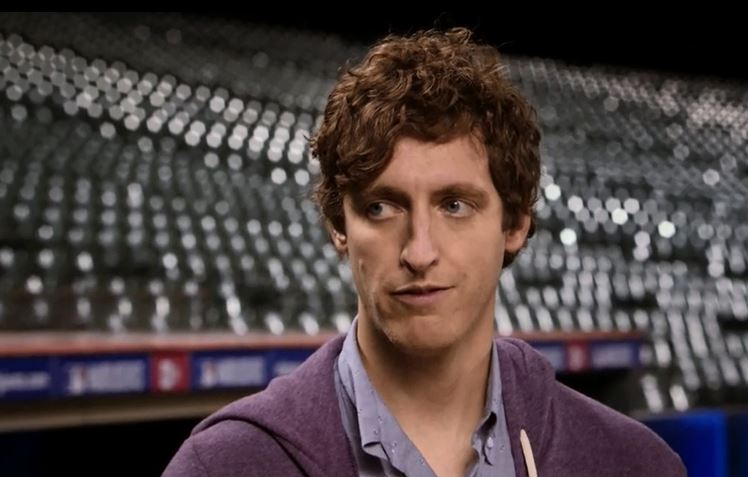
Time to see our old friends

SV02-01 Chief

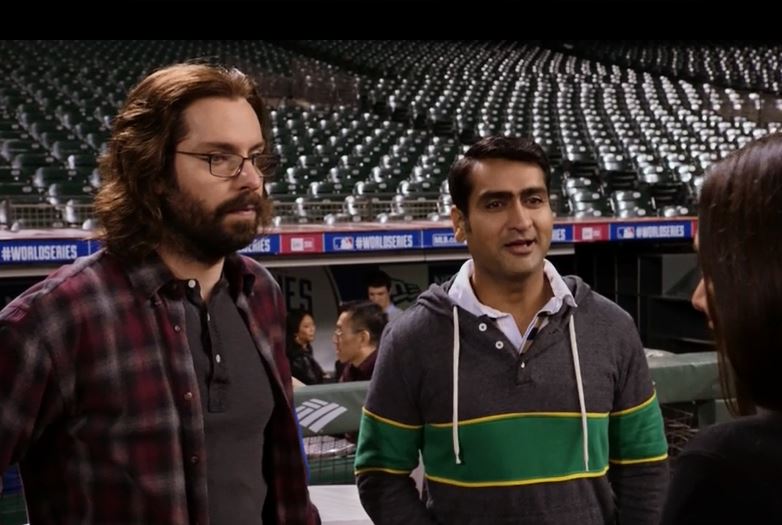
and the team fighting to be “Chiefs”

SV02-01 Chiefs and Chiefs

Of course Silicon Valley is what it is… just have a look

SV02-01 SV

or read this: “I don’t want to live in a world where someone else makes the world a better place better than we do.“

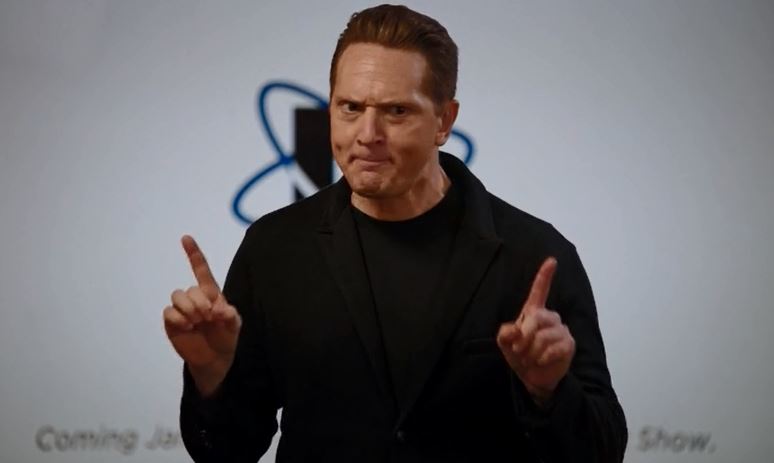
SV02-01 Nucleus

But reality is taking money can be dangerous: “You take money from the wrong dudes, you’ll get smoked as bad as I did.” But also never think you have the money until you have it in your bank account…

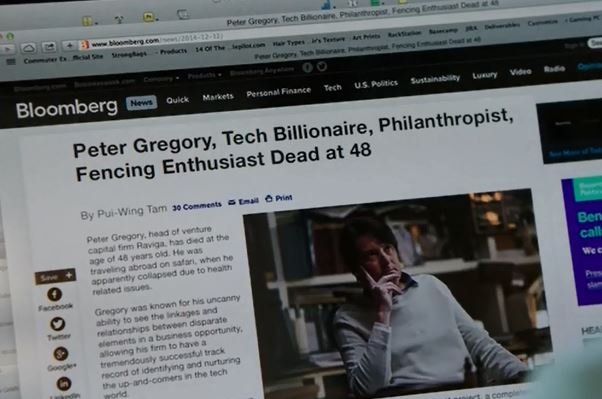
SV02-01 Gregory

America’s movie industry have always adapted the story when an actor disappears… then the fun begins. Negotiating with VCs can be hard. “There is a linear correlation between how intolerable I was and a higher valuation…”

SV02-01 VC

But then listen to Monica’s advice… A high valuation can be a very bad deal. Believe her…

SV02-01 Monica

And the final minute is great…

A brilliant conversation about science between Gérard Berry and Etienne Klein

Indeed a brilliant and “crazy” conversation between Etienne Klein, the physicist, and Gerard Berry, Gold Medal of the CNRS for his work in computer science on France Culture’s Conversation Scientifique. They speak about so many beautiful “provocative” things.

Berry

On the serious side Berry talks about the difficulty of predicting and the danger of impossible promises, also about the courage in science. Physics talks about energy, computer science about information and so do the new generations, Berry claims. Berry also speaks of the machine and the human. The digital machine, the computer goes very fast, but not with much more intelligence than a steam engine. Except the computer is everywhere. But we, humans, are intuitive, there is no insight in a computer. We are very complementary. Again, I do not agree with transhumanists who believe that the machine will overtake us – in the short term at least. Berry is very annoyed by the notion of intelligence in computers. The performance is not intelligence, but there are many interesting things in AI such as learning, find people in a photo database fascinates Berry.

On the politics of science, Berry expresses great caution and wisdom. “Claiming that a research topic will happen right away is the best way to kill it.” He was answering a question about the quantum computer. “This was the case of artificial intelligence”. There are people willing to promise the moon and more people willing to believe them. They promise sensational things in interesting topics. One must look into these areas, but one should make no promise. Among the possible benefits, but unpredictable, there will be some interesting things.

He also talks about neuroscience. He is fascinated by the way children learn, which is difficult to understand; why the brain freezes after a while. His fascination is that the brain processes information, but we do not understand creativity, the brain is a huge machine which we do not understand. But again, it will be difficult, no doubt very difficult to understand how the brain works. Berry believes “no more than that” in our ability to build artificial neurons to simulate the brain mechanisms. We also discover that pleasure and boredom, motivation are essential to learning. Finally Berry started a short analysis on the current state of research. “Do not do anything new when you want to be successful. Or rather you have to fight.” (just as in any art).

I let you discover the last quarter of an hour which talks about the college of Pataphysique… but you need to understand French…

My top 10 (must-read) (business) books

After reading a couple of top 10 and must-read list of books, here is an exercise I had never done. I went through my past readings and quickly built my own top 10 / must-read – business books. If you want an exhaustive list you could have a look at all the Must Watch or Read articles on this blog. here is my ranking:

#1: The Four Steps to the Epiphany by Steve Blank,
(subtitled Successful Strategies for Products that Win)

Four-Steps-to-the-Epiphany-5th-edition

Although it is rather painful to read because of the density of advice and check-list, it is the must read book for any entrepreneur who must understand the complex relations between building a product and service and selling to customers. Here is my post, dated November 2013.

#2: The Hard Thing about Hard Things by Ben Horowitz.
(Building a Business When There Are No Easy Answers)

thehardthing

A honest and toughest account about what entrepreneurship means. As the great Bill DAvidow was saying, “Being an entrepreneur is not for the faint of heart”. More about my account dated May 2014.

#3: Regional Advantage by AnnaLee Saxenian.
(Culture and Competition in Silicon Valley and Route 128)

Not a book about entrepreneurship but about high-tech clusters. Saxenian explained (already) in 1994 why Silicon Valley had won. It is the book to read to understand what start-ups really are and why they are important. A short indirect account dated October 2011.

#4: The Black Swan by Nassem Nicholas Taleb.
(The Impact of the Highly Improbable)

It is not directly related to innovation and entrepreneurship, but successful start-ups are highly improbable events with huge impact. A fascinating book I first talked about in July 2012 but I mention the concept and author so many times you could also check the tags Black Swan and Taleb.

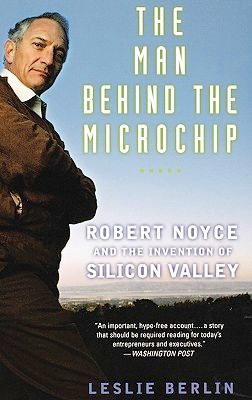
#5: The Man Behind the Microchip by Leslie Berlin.
(Robert Noyce and the Invention of Silicon Valley)

The Man Behind the Microchip

The best (in fact nearly the only!) biography of an entrepreneur I read so far. It’s great, moving and full of information. You can read my short account dated February 2008 but you could also read more in The Tinkerings of Robert Noyce dated August 2012.

#6: Founders at Work by Jessica Livingston
(Stories of Startups’ Early Days)

FoundersAtWork-2015

Great interviews of start-up founders with an account dated June 2008. I had read before and I read since many other books built with such interviews. No doubt this is the best one.

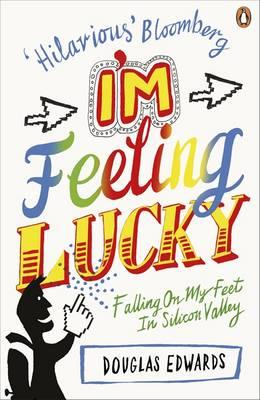
#7: I’M Feeling Lucky by Douglas Edwards
(Falling On My Feet in Silicon Valley)

I could not have a top 10 list without a book about Google! This is my favorite one (but close to #8). When a marketing expert is hired by two crazy founders and learns he does not kwow so much about marketing and many other things. And in addition, it is the funniest business book I have ever read. My account is dated December 2012.

#8: How Google Works by Eric Schmidt & Jonathan Rosenberg, with Alan Eagle.
(The rules for success in the Internet Century)

HowGoogleWorks-cover

I initially thought a book written by the chairman and former CEO of Google would not be very enlightening. I was totally wrong. great lessons. great advice. A recent account dated November 2014.

#9: The Art of Start by Guy Kawasaki.
(The Time-Tested, Battle-Hardened Guide for Anyone Starting Anything)

artofstart.jpg

The best book about what you need to say with a powerpoint pitch or write in a business plan. A simple, direct to the point about launching any venture. One of my oldest (and shortest) posts, dated March 2008

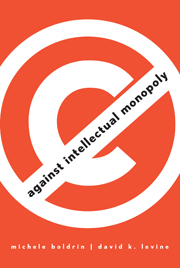
#10: Against Intellectual Monopoly by Michele Boldrin and David K. Levine.

9780521879286

An important analysis of the crisis of intellectual property: “It is common to argue that intellectual property in the form of copyright and patent is necessary for the innovation and creation of ideas and inventions such as machines, drugs, computer software, books, music, literature and movies. In fact intellectual property is a government grant of a costly and dangerous private monopoly over ideas. We show through theory and example that intellectual monopoly is not necessary for innovation and as a practical matter is damaging to growth, prosperity and liberty.” I wrote many posts about it, the latest being dated May 2013.

#11: Something Ventured

It is so difficult to build such lists, I cheat twice! First with the greatest ever video document about Silicon Valley. You must watch and listen to Sandy Lerner, the co-founder of Cisco. And it is freely available on youtube, so no excuse not to watch this fascinating movie. My account is dated February 2012.

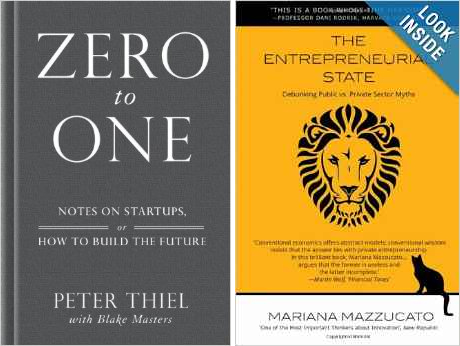
#12: The Unfinished Debate about the Individual and the State between Peter Thiel and Mariano Mazzucato

Thiel-Mazzucato

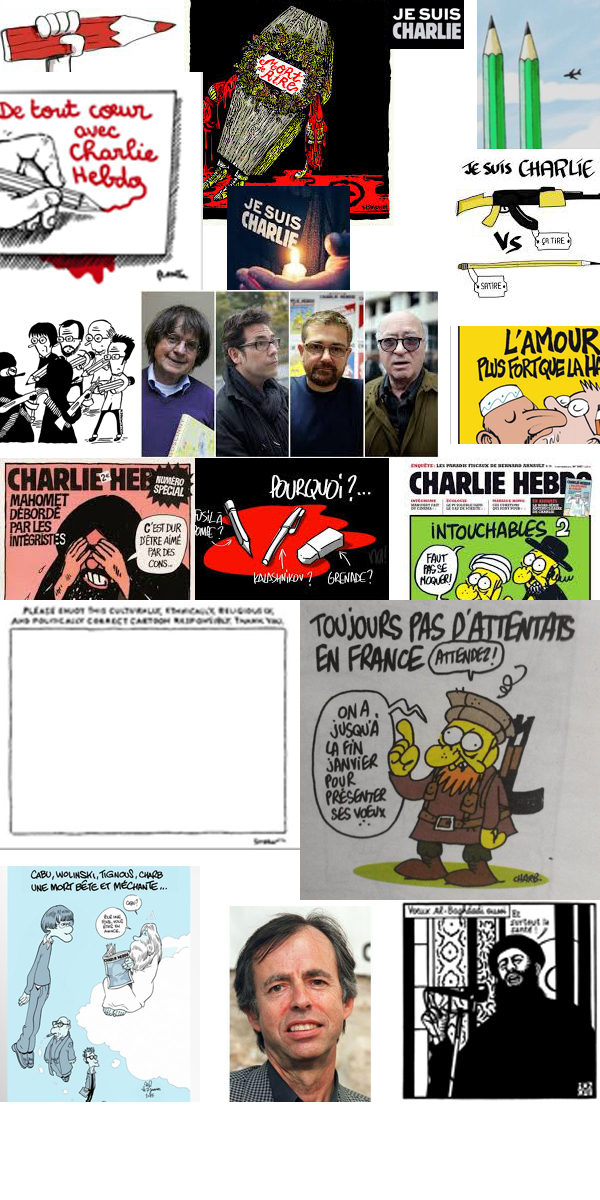
My second extension to the top 10 is made of two books! Peter Thiel is the author of Zero to One (notes on start-ups or how to to build the future). Mariana Mazzucato wrote The Entrepreneurial State (debunking public vs. private sector myths). But again, I produced so many posts on the topics they address you can also check the tags Mazzucato and Thiel. After the terrible events “Je Suis Charlie” which happened in Paris in early January 2015, these two books remind us about the complexity of analyzing how individuals and groups (societies, institutions, states) interact (with some tension) to create and innovate.

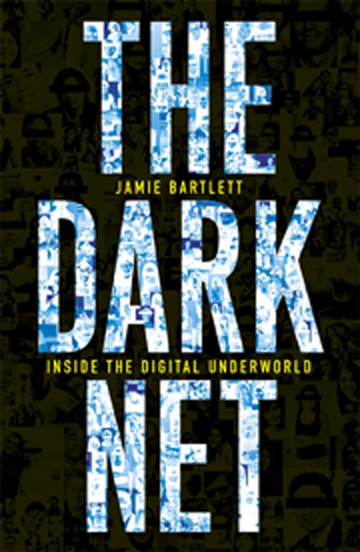
The Dark Net by Jamie Bartlett

I did not think when I bought this intriguing book about the hidden faces of the Internet that I would relate it to my three previous posts. The world is dangerous, the physical world is dangerous as we all know and as it was confirmed in Paris last week (A tribute on Jan. 8, We are all sad on Jan. 7). It is also known that the online world may be dangerous as illustrated by Jamie Bartlett in The Dark Net. I am not sure that the authors of How The Web Was Born (Dec. 2) had envisioned such possibilities.

the-dark-net-bartlett

Bartlett is not really pessimistic about the web. In his conclusion, he states: Technology is often described as “neutral”. But it could be more accurately described as power and freedom. […] The dark net is a world of power and freedom: of expression, of creativity, of information, of ideas. Power and freedom endow our creative and our destructive faculties. The dark net magnifies both, making it easier to explore every desire, to act on every dark impulse, to indulge every neurosis.[…] Each individual responds differently to the power and freedom that technology creates. It might make it easier to do bad things but it’s still a choice.

In his book Bartlett talks about the trolls (you may also want to read the recent MIT Tech Review article – The Troll Hunters), the lone wolves (such as Berwick), about Tor Hidden Services, about Bitcoin, about illegal sites selling drugs such as Silk Road, about online pornography and paedophilia, about self-harm and finally about transhumanists against anarcho-primitivists. Written this way, I am not sure I am doing a good marketing for the book, but the truth is that with the exception of terrorism, the author addresses many dark sides of the internet. It is a fair and good description of what the Internet hides (“close to its surface” [Page 238]).

These are important topics about freedom, about the evolution of our world, and I can only quote a famous French thinker: on France Culture, earlier this week, coming back about the Paris terrorist attacks, Regis Debray explained that the Western world is the primacy of the individual over the group. The Eastern world it is the reverse.” And I am not sure I understood if there was a value judgment or not, he added: “And the West today represents modernity.” I strongly believe in these values and I understand the risks linked to them, but I do not think we have much choice. You may want to read The Dark Net if these topics are of interest for you…

Patrick Modiano, Nobel Prize in Literature

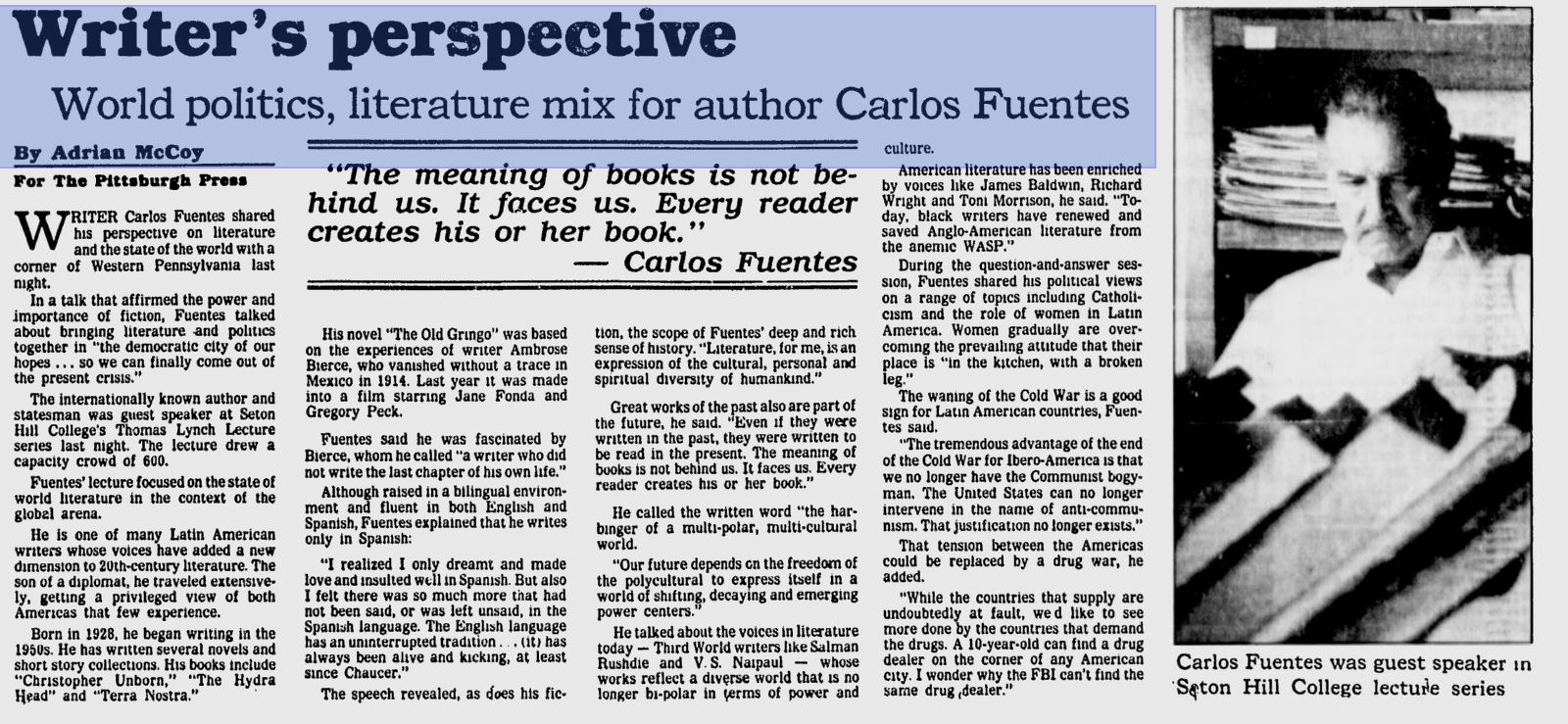
I remember a conference by Carlos Fuentes at Stanford University in 1989 or 1990. The Mexican writer said there that literature had become mixed. I did not find any trace of this conference, but some traces of a similar conference.
carlosfuentes
“Our future depends on the freedom of the polycultural to express itself in a world of shifting, decaying and emerging power centers.” He talked about the voices in literature today – Third World writers such as Salman Rushdie and V. S. Naipul – whose works reflect a diverse world that is no longer bipolar in terms of power and culture.

I took my courage in both hands and lined up to talk to him for a short moment. I asked him when my turn came what he thought of French literature. He told me that in this trend of global mixing, it was less visible except some authors such as Michel Tournier and J.M.G. Le Clézio. He did not mention Patrick Modiano but he should have! Nothing is more mixed as the writing of Modiano from La place de l’étoile until aptly titled Un pedigree. And nothing beats the most surprising opinion on this great author than François Mitterrand and Frédéric Mitterrand.

Frédéric Mitterand: “He received the Nobel Prize because, in my opinion, he permanently searches the Western guilt about the behavior of each other in times of totalitarianism, cruelty, and maltreatment from the state. […] he does not know why good people have become collaborators and bastards, resistant and what is perhaps the key to the deep melancholy and poetry that emerges from his books is that he does not know exactly.” (Minute 0:56 of the video below)

As for François Mitterrand, the archive dates back to 1978 when Bernard Pivot asked the man who was not yet President of the French Republic to invite four authors. He invited among others Patrick Modiano and Michel Tournier also! From minute 56:10, we could hear an amazing exchange … “There is a great clearness of style, which can deceive. Rue des boutiques obscures, it is an interesting story of someone who, in search of himself – he has amnesia, he does not know who he is – falls on Russian picturesque, families… But this is just a simple story. And then we get to the end […] and suddenly you realize that it’s not a simple story, it’s not a clear story. […] We realize that we are projected into another story; this man who is looking for himself does not just have amnesia – or so we all amnesic: who are we? […] This is a great classic French style and then we realize that there is some Russian under this. These are people who talk like Dostoevsky would do, but in the style of Stendhal or of a detective novel. »

When you know the relationship also ambiguous and far from simple between François Mitterrand and the Second World War, the exchange is amazing. I do not know if Modiano was surprised by the invitation. He was to receive the Prix Goncourt a few months later and the Nobel Prize some 25 years later…

NB: Fuentes and Tournier did not recieve the Nobel prize, but Le Clézio and Modiano did. If I had to bet, the next French writer on the list might be Michel Houellebecq.

NB2: when available, I will add here Modiano’s speech in Stockholm for his Nobel Prize.

The Importance and Difficulty of Culture in Start-ups: Google again…

I confirm I do not like the “how to” books or the ones helping you with recipes, methods. There are exceptions but I always struggle with them. (Same with audio or videos by the way). And same thing about culture. What is it? How do you build it? Here is an element of why it’s tough for me and others: “There are three things they never tell you about culture. First thing is they never tell you anything about culture. No one talks about culture and no one ever tells the need to have strong culture. So there’s tons of articles about building a great product, there’s tons of articles on growth and adaption, and a few things about culture. It’s a mystical thing that’s soft and fuzzy. That’s the first problem. The second problem is it is hard to measure. Things that are hard to measure often get discounted. These are two very hard things. The third thing, the biggest problem, it doesn’t pay off in the short term. If you wanted to start up a company and sell it in one year, the one thing I would tell you to do is fuck up the culture. Just hire people quickly. Culture makes you hire really slowly, makes you deliberate about your decisions that in the near term can slow progress.” This is taken from How to startup a start-up. It’s from Brian Chesky, Founder, Airbnb in class 10.

This being said, there’s a great book about company culture. It’s How Google Works, which I mentioned already in a recent post, Entrepreneurship from First Principles. So let me extract a couple of notes from my reading.
HowGoogleWorks-cover

No real businesss plan
“One of the biggest reasons for our success, though, is that the plan we delivered to the board that day in 2003 wasn’t much of a plan at all. There were no financial projections or discussions of revenue streams. There was no market research on what users, advertisers, or partners wanted or how they fit into nicely defined market segments. There was no concept of market research or discussion of which advertisers we would target first. There was no channel strategy or discussion of how we would sell our ad products. There was no concept of an org chart, with sales doing this, product doing that and engineering doing some other that. There was no product roadmap detailing what we would build and when. There was no budget. There were no targets or milestones that the board and company leaders could use to monitor our progress. […] We left that out for the simple reason we didn’t know how we were going to do it. When it came to management tactics, the only thing we could say for sure back then was that much of what [we] had learned in the twentieth century was wrong, and that it was time to start over.” [Page 10]

Smart creative
“The main reason for the lack of business plan is Google population made of Smart Creative. When we contrast the traditional knowledge worker with the engineers and other talented people who have surrounded us at Google over the past decade-plus, we see that our Google peers represent a quite different type of employee. They are no confined to specific tasks. They are not limited in their access to the company’s information and computing power. They are not averse to risk taking, nor are they punished or held back in any way when those risky initiatives fail. They are not hemmed in by role definitions or organizational structures; in fact, they are encouraged to exercise they own ideas. They don’t keep quite when they disagree with something. They get bored easily and shift jobs a lot. They are multidimensional, usually combining technical depth with business savvy and creative flair. In other words, they are not knowledge workers, at least not in the traditional sense. They are a new kind of animal, a type we call a “smart creative,” and they are the key to achieving success in the Internet Century.” [Page 17]

Key attributes of smart creative: expert in doing, comfortable with data, sees a direct line from technical expertise to product excellence to business success, hard-working, understands the user or consumer’s perspective, always questioning, not afraid to fail, self-directed, open, thorough. Communicative, eager and able.

Mentor
“When they learnt all this, they decided to write this book as if they were mentors. Lew Platt, HP’s CEO explained why he was investing so much time to help out a young executive at another company: “This is the way Silicon valley works. We’re here to help you.” Steve Jobs explained that Noyce helped him discover the tricks. Schmidt agrees that “it’s what you learn after you know it all that counts” and he believes “we had a front-row seat and used it to relearn everything we thought we knew about management, i.e. how to grow a business, attract and motivate smart creative, which start with a culture, then strategy. Business plans aren’t as important as the pillars upon which they are built” [Pages 21-23]. Culture stems from founders, but it is best reflected in the trusted team the founders form to launch their venture. [Page 30]

Slogans (believe in them)
– Keep them crowded
– Work, eat and live together
– Messiness is a virtue
– Don’t listen to the HiPPOs (*)
(later there is “your title makes you a manager, your people make you a leader”)
– The rules of seven (hierarchy is not good but flatness neither)
– Do all reorgs in a day
– The Bezos two-pizza rule
– Exile knaves but fight for divas
– Overworked in a good way
– Establish a culture of Yes
– fun, not Fun
– You must wear something
– Ah’cha’rye
– Don’t be evil
(*): Highest Paid Person’s Opinion

Strategy
Bet on technical insights, not market research
Don’t look for faster horses
Optimize for growth
Specialize
Default to open, not closed
Default to open, except when…
Don’t follow competition

The CEO needs to be the CIO (Chief Innovation Officer).

One of the best chapters is the one entitled Innovation. “To us, innovation entails both the production and implementation of novel and useful ideas. Since “novel” is often just a fancy synonym for “new”, we should also clarify that for something to be innovative, it needs to offer new functionality, but it also has to be surprising. If your customers are asking for it, you aren’t being innovative when you give them what they want; you are just being responsive. That’s a good thing, but it’s not innovative. Finally “useful” is a rather underwhelming adjective to describe that innovation hottie, so let’s add an adverb and make it radically useful, Voilà: For something to be innovative, it needs to be new, surprising, and radically useful.” [Page 206]

[NB. These are the 3 criteria for real patentability: novel, non-obvious and applicable]

“But Google also releases over five hundred improvements to its search every year. Is that innovative? Or incremental? They are new and surprising, for sure, but while each one of them, by itself is useful, it may be a stretch to call it radically useful. Put them all together, though, and they are. […] This more inclusive definition – innovation isn’t just about the really new, really big things – matters because it affords everyone the opportunity to innovate, rather than keeping it to the exclusive realm of these few people in that off-campus building [Google[x]] whose job is to innovate.” [Page 206]

And innovation is critical: “A few years ago, a major consulting firm published a report advising all companies to appoint a Chief Innovation Officer. Why? Allegedly to establish a “uniformity of command” over all the innovation programs. We’re not sure what that means, but we’re pretty sure that “uniformity of command“ and “innovation” don’t belong in the same sentence (unless it’s the one you’re reading now). […] Innovation stubbornly resists traditional, MBA-style management tactics. Unlike most other things in business, it cannot be owned, mandated, or scheduled. Innovative people do not need to be told to do it, they need to be allowed to do it“. [Page 209]

InnovationAtGoogle

If you really do not want to read this very good book, here is an alternative:

PS: a small detail. The last section is about acknowledgements. It is usually boring, here it’s not. Just because it is more than 7 pages with more than 100 names mentioned…


What has Silicon Valley to do with Capitalism?

(this is a quick and dirty translation of a French post as it is linked to a French radio broadcast – sorry for the bad english if any)

I was a guest yesterday of French radio Culturesmonde France Culture in a series about capitalsim entitled Des capitalismes (1/4) – Silicon valley: l’émancipation par l’argent. I had to give my views abotu SV and capitalism. Is it unique or extreme? Does the area care, does it have an ideology or is it indifferent to capitalism?

FranceCultureMondes-SiliconValley

The topic is rich and complex because with 7 million people, opinions in SV are also diverse and were built over 50 years. Each decade brough a new generation of entrepreneurs and investors. You can listen to the broadcast (in French) who also involved Yann Moulier-Boutang, who talked about « cognitive capitalism » and Sébastien Caré, a spécialist of libertarian thinking.

A big thank you to Clémence Allezard who prepared the series, pushing me to think about the region in a manner I was not used to. 🙂 So I thought about it as follows. Is SV an extreme form or a unique form of capitalism? or as I have a tendency to think a region quite indifferent to capitalism? On the one hand you have large powerful firms who do not really pay taxes, you have a fast Schumpterian creative destruction, the government is not active as it is in Europe (health, schools, transportation) so that firms (at the anecdote level or not?) do the work (Google buses, Apple And FB recent initiative about freezing women eggs, Peter Thile encouraging school dropouts) and even induce the SF authorities in changing housing laws. One the other hand, it is not just extreme, it is unique, SV created venture capital, systematized stock options, and has active co-opetition. Richard Newton was saying SV is the firm and all the companies are its divisions. People move from one to the other easily with market dynamics.

Finally, it is the “revenge of the nerds”. They are problem solvers, and do not care about society (hence the libertarians) and even about capitalism (making money is a by-product and if an objective, far from being the only one). I read a great New Yorker article where George Packer explains that these nerds hate the friction created by negotiation and compromises politics and society necessarily induce. So they avoid it as long as they can. And do more when they feel limited by the government but are quite neutral about it. They are selfish. But i doubt “changing the world to make it a better place” is totally convincing at the same time. It is more selfish than generous. These people are mild versions of Asperger and are obsessed by solving their problems. If it solves others’, good, not critical. (Of course SV is 7 million people and is a diverse region, I am focusing on what is visible). I was saying to the journalist when we prepared the talk, that I see more indifference than real strategy, I see some lobbying in SF or Washington, but rather limited compared to general lobbying in the USA.

Another way to summarize is: is there a particular ideology of capitalism in Silicon Valley? I would say that rather than a strategy, there has been a practice that was put in place over decades, by iteration, by trial and error. Ultimately, Silicon Valley is the meeting of ideas (entrepreneurs, and academics sometimes) and money (investors). But unlike the rest of the world where investors are bankers who lend money, in SV they are often former entrepreneurs who “give” money (in the sense that they take the risk of not finding it back), in fact they take shares in the company (often around 50%). They literally invented venture capital, which has found its final form in the 80’s. In addition, the “stock options” decried in Europe are recognized in the SV as a motivation. Secretaries at Apple or Microsoft did sometimes become millionaires, something unthinkable at home in Europe. I have also said, there is an optimism that encourages risk-taking. Moreover, there is no real risk because the skill allows you to find a new job quickly. The risk lies in the possible error in the choice of the project and nobody is ever ruined normally, except one’s health. And as the model works, it is enriched in new areas beyond which the electronics is the root, through the electric car (Tesla Motors), aeronautics (SpaceX) and even the food 2.0 movement (for synthetic food). And the last frontier, aging, death, trans-humanism … which seems to me personally crazy, but …

As a post-scriptum, some comments I got… very interesting! i think SV is more diverse these days. there are the really old school types, like intel, cisco, even apple. then there are places like google and Facebook, that actually do something valuable. and then there are the startups with a hand full of 20 year olds that do not much, but have valuations measured in billions. i think the question should be answered differently for the different groups. and it’s important to not lump cisco in with, say, whatsapp or snapchat.

i’d say for many of them, it’s indifferent to mildly positive feeling abotu politics, as you say. for some (many of the VCs) it’s definitely capitalism on steroids. (or at least, they like to think of themselves that way; they blabber all the time about “wealth creation”, making sure that much of that new wealth goes to them.) more than capitalism, i think what’s concentrated in SV is talent, especially, technical talent. creative destruction resonates *very strongly* with people here; the whole idea of SV is that a handful of kids can change an entire industry, or even create a new one. they usually fail, and sometimes they succeed. imagine how steve jobs or the google guys would have done in europe. the google guys would have gone to the librarians and asked, how can we help you find information? steve jobs would have run long, extensive marketing tests to determine what people want. or maybe he’d go to siemens to try to convince some high level manager that a smart phone was a good idea. of course what happened is way cooler. steve jobs had better taste than everyone else, so he made stuff he liked, period. and the google guys just forged a new path, without seeking the endorsement or buy in of the librarians. in europe, a startup would try to get some giant company to use their product/technology, a long, boring, and tedious process.

typically, a handful of EPFL students would not imagine/believe that they can change the world. stanford students (who are not more talented) do. so, i think it’s mostly a cultural difference, and not something that has to do with capitalism.