Category Archives: Must watch or read

So what’s good: monopoly or competition?

Two minor events drive me to write a minor post about monopoly or competition. What’s best? On the one hand, I just read an article about the poor status of the patent landscape and how to improve it. On the other hand, I listened yesterday Peter Thiel – yes, the same Peter Thiel I have so often mentioned already here – in a class he gave at How to Start a Startup? So what’s the link?

Well a patent is a monopoly given by the authorities as an incentive to innovate (just check http://en.wikipedia.org/wiki/Patent). But some authors, in particular Boldrin and Levine, claim this is an “unnecessary evil”. I just read again my notes about their Against Intellectual Monopoly and their arguments are strong. In fact, capitalism in general considers competition is good and monopoly is bad.

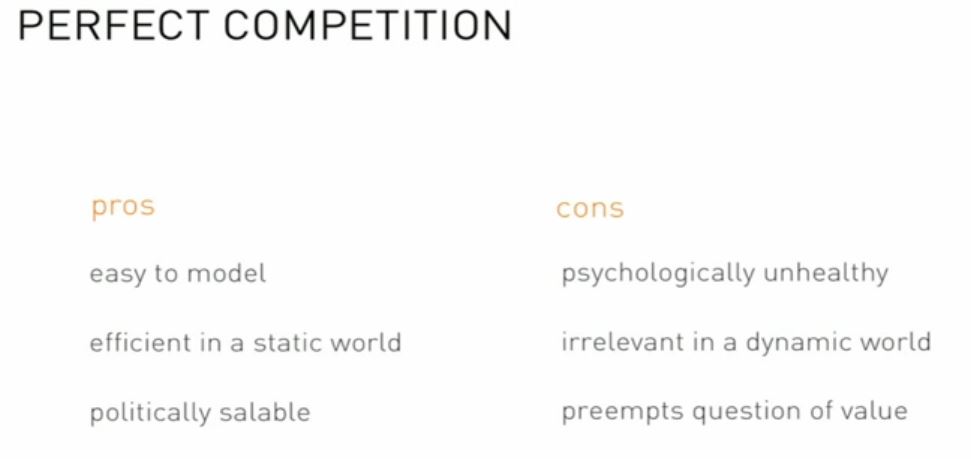
But Peter Thiel has different views. Just check two slides from his talk below. Peter Thiel, a famous libertarian, claims that start-ups should look for monopolistic positions! What a strange paradox… I honestly do not know who is right! probably, as Boldrin and Levine wrote, “in media stat virtus, et sanitas”.

Thiel-perfectcompetition

Thiel-monopoly

As I did not find his views about patents in his class, I tried to find something in his recent book, Zero to One. Here is what he says (pages 32-34): “So, a monopoly is good for everyone in the inside, but what about everyone in the outside? Do outsized profits come at the expense of the rest of society? Actually, yes […] and monopolies deserve their bad reputation – but only in a world where nothing changes. […] But the world we live in is dynamic: it’s possible to invent new and better things. Creative monopolies give customers more choices by adding entirely new categories of abundance to the world. Even the government knows this: that’s why one of its departments works hard to create monopolies – by grating patents to new inventions = even though another part hunts them down (by prosecuting antitrust cases). It’s possible to question whether anyone should really be awarded a legally enforceable monopoly simply for having been the first to think of something like a mobile software design, but… […] Monopolies drive progress because the promise of years or even decades of monopoly profits provides a powerful incentive to innovate. […] So why are economists obsessed with competition as an ideal state? It’s a relic of history.”

Maybe all this is BS, and unfortunately, I never read Jean Tirole. “He was awarded the Nobel Memorial Prize in Economic Sciences in 2014 for his analysis of market power and regulation of natural monopolies and oligopoly.” He would have much to say about this… maybe you can react and in the mean time, you can listen to Thiel’s full talk (see at the end).

In this talk, Peter Thiel has another interesting description about capturing value creation. “If you have a valuable company two things are true. Number one, that it creates “X” dollars of value for the world. Number two, that you capture “Y” percent of “X.” And the critical thing that I think people always miss in this sort of analysis is that “X” and “Y” are completely independent variables, and so “X” can be very big and “Y” can be very small. “X” can be an intermediate size and if “Y” is reasonably big, you can still have a very big business.” [HL comment: The “you” here may be the inventor or the entrepreneur, or the university at the origin of the idea…]

And then: “The thing that I think people always miss when they think about these things, is that because “X” and “Y” are independent variables, some of these things can be extremely valuable innovations, but the people who invent them, who come up with them, do not get rewarded for this. Certainly if you go back to you need to create X dollars in value and you capture Y percent of X, I would suggest that the history of science has generally been one where Y is zero percent across the board, the scientists never make any money. They’re always deluded into thinking that they live in a just universe that will reward them for their work and for their inventions. This is probably the fundamental delusion that scientists tend to suffer from in our society. Even in technology there are sort of many different areas of technology where there were great innovations that created tremendous value for society, but people did not actually capture much of the value. So I think there is a whole history of science and technology that can be told from the perspective of how much value was actually captured. Certainly there are entire sectors where people didn’t capture anything. You’re the smartest physicist of the twentieth century, you come up with special relativity, you come up with general relativity, you don’t get to be a billionaire, you don’t even get to be a millionaire. It just somehow doesn’t work that way. The railroads were incredibly valuable, they mostly just went bankrupt because there was too much competition. Wright brothers, you fly the first plane, you don’t make any money. So I think there is a structure to these industries that’s very important. I think the thing that’s actually rare are the success cases. So if you really think about the history in this and this two hundred fifty years sweep, why is almost always zero percent, it’s always zero in science, it’s almost always in technology. It’s very rare where people made money. You know in the late eighteenth, early nineteenth century, the first industrial revolution was the textile mills, you got the steam engine, you sort of automated things. You had these relentless improvements that people improved efficiency of textile factories, of manufacturing generally, at a clip of five to seven percent every year, year after year, decade after decade. You had sixty, seventy years of tremendous improvement from 1780 to 1850. Even in 1850, most of the wealth in Britain was still held by the landed aristocracy and the workers didn’t make that much. The capitalists didn’t make that much either, it was all competed away. There were hundreds of people running textile factories, it was an industry where the structure of the competition prevented people from making any money.”

Please react 🙂

How to Start a Startup by Sam Altman

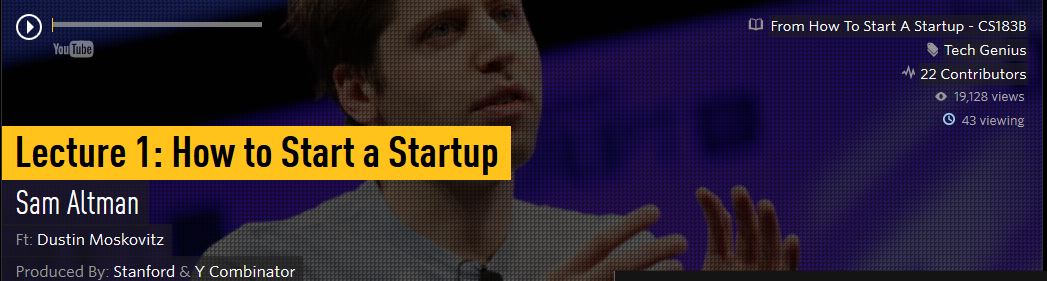
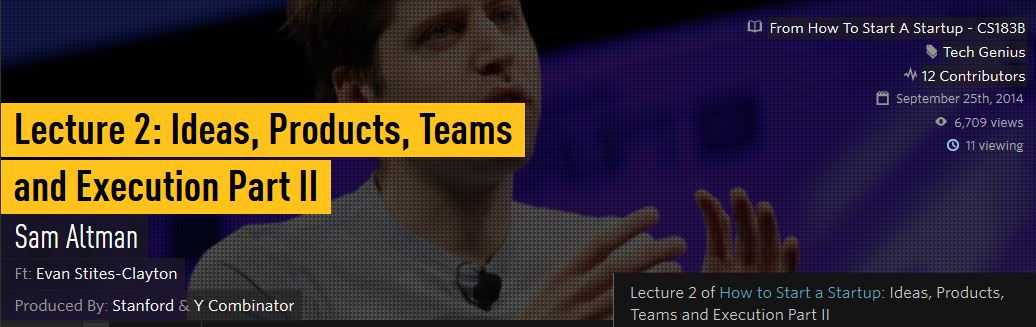
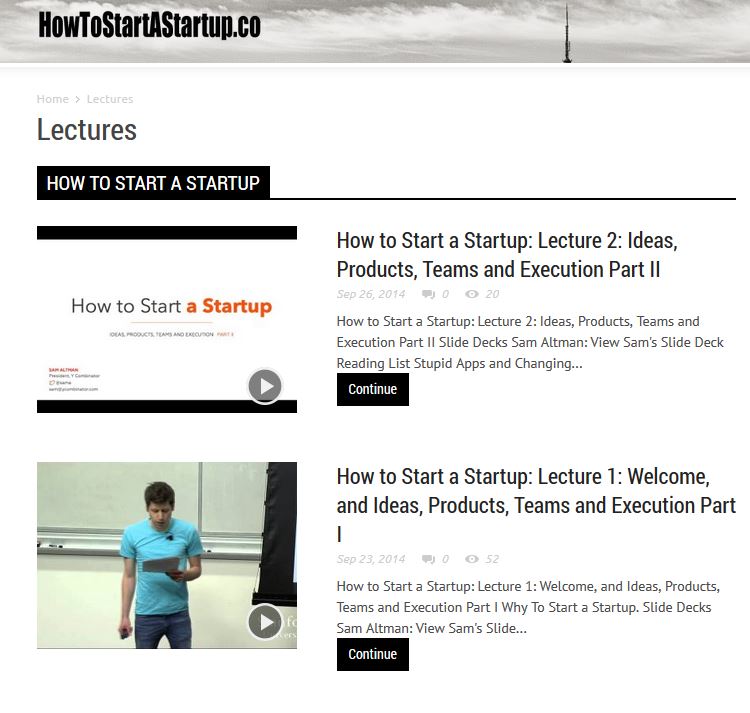
There are tons and tons of courses and videos about high-tech entrepreneurship. In 2013, the star was probably Peter Thiel. In 2014, it seems to be Sam Altman, President of Ycombintor with his How to Start a Startup The first 2 lectures have been very good with a focus on the ingredients a start-up requires:
1- an idea,
2- a product,
3- a team,
4- an execution.
Altman added in a typical American manner that hopefully you do not execute the team in step 4. You can find the videos on the web site How to Start a Startup, and also the full text of the lectures here:
HSS-01
Lecture 1: How to Start a Startup by Sam Altman – Ft: Dustin Moskovitz. The slides anc content can be found on another nice web site: howtostartastartup.co
Altman’s slides: here.
Dustin Moskovitz ‘s slides: here.

HSS-02
Lecture 2: Ideas, Products, Teams and Execution Part II by Sam Altman
Slides: here.

More also here: howtostartastartup.co
HSS-alternative

Enjoy!

At the Frontier of Research – the Universe and the Brain – and how Science works?

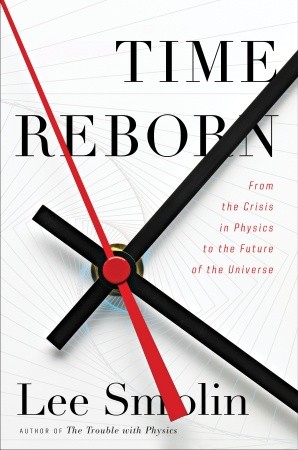
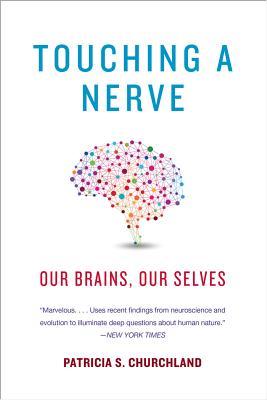
I just read two amazing books, which at first sight do not seem to have much in common, but indeed have. The first one is Time Reborn by Lee Smolin. The second one is Touching a Nerve by Patricia Churchland.

time_reborn

Beware Newton, Leibniz (not only Einstein) is back!

Lee Smolin revisits the current challenges of the physics of the universe – the incompatibility of general relativity and quantum physics – and tries to bring new ideas such as thinking again about what Time is. It’s not a difficult book but it is so rich with ideas, I am not sure what is the most important. His main idea is that time matters. For example, the law of physics may evolve over time. He also believes that Leibniz’s philosophy is very helpful to understand the universe. [What I remembered of Leibniz is Voltaire critics of him in Candide, with the recurrent “best of all possible worlds“]. Let me just quote Smolin: “the picture of the history of the universe given by causal relations realizes Leibniz’s dream of a universe in which time is defined completely by relations between events. Relationships are the only reality that corresponds to time – relationships of a causal sort.” [Page 58, Penguin 2014 edition]

There is something as stimulating: “Leibniz’s principle has some consequences that should constrain a cosmological theory. One is that there should be nothing in the universe that acts on other things without itself being acted upon.” [Page 116] This is the principle of no unreciprocated actions. I had learnt this when I was shocked to understand that the earth attracts me and keep me from flying, but I also attract the earth. With Einstein, matter modifies space. So if laws act on the universe and its components, then the reverse is true. Laws can evolve and Smolin thinks that this is following a Darwininian natural selection…

Smolin concludes his book with more general considerations about science and society, which are also very interesting. I had already mentioned here his previous book The Trouble with Physics. His views about science are not original but strong. For example “to be scientific, hypotheses must suggest observations by which they could be verified or falsified.” [page 247] and he indeed hates some features of politics in science. Truth is the ultimate even if unreachable goal. “Scientific communities and larger democratic societies from which they evolved, progress because their work is based by two basic principles:
(1) when rational argument from public evidence suffices to decide a question, it must be considered to be so decided,
(2) when rational argument from public evidence does not suffices to decide a question, the community must encourage a diverse range of viewpoints and hypotheses consistent with a good faith attempt to develop convincing public evidence.”
[page 248]

And I will conclude on Smolin with a final quote: “We need a new philosophy, one that anticipates the merging of the natural and the artificial by achieving a consilience of the natural and social sciences, in which human agency has a rightful place in nature. This is not relativism, in which anything we want to be true can be. To survive the challenge of climate change, it matters a great deal what is true. We must also reject both the modernist notion that truth and beauty are determined by formal criteria and the postmodern rebellion from that, according to which reality and ethics are mere social constructions. What is needed is a relationalism, according to which the future is restricted by, but not determined by, the present, so that novelty and invention are possible”. [p 257]

touching_a_nerve

As a transition to the brain, I cheat here and quote Smolin one final time (promised!): “By the problem of consciousness I mean that if I describe you in all the languages physical and biological sciences make available to us, I leave something out. Your brain is a vast and highly interconnected network of roughly 100 billion cells, each of which is itself a complex system running on controlled chains of chemical reactions. I could describe this in as much detail as I wanted, and I would never come close to explaining the fact that you have an inner experience, a stream of consciousness. If I didn’t know, from my own case, that I’m conscious, my knowledge of your neural process would give me no reason to suspect that you are. […] Suppose we mapped the neuronal circuits in your brain onto silicon chips and upload your brain into a computer. Would that computer be conscious? […] Would there now be two conscious beings with your memories whose futures diverge from there.” [pages 268-69]

Patricia Churland begins her book with the “fears” that scientific research brings when you are at the frontier. “I hate the brain, I hate the brain” is what a philosopher said at a conference, maybe to explain his discomfort with the importance of biology to explain the mind processes. Churchland adds that discovering that the earth is not the center of the universe, or the heart is just a pump had similar results in society: fear and denial. But Churchland is not afraid of knowledge and of progress. “My business is to teach my aspirations to conform themselves to fact, not to try and make facts harmonize with my aspirations”

Near the end of her book [page 240], she addresses the topic of consciousness:
In about 1989, psychologist Bernard Baars proposed a framework for research on consciousness with a view to fostering a coevolution of psychology and neurobiology.
First, […] sensory signals of which you are conscious are highly integrated and highly processed by lower-level (nonconscious) brain networks. That is, when you hear [something], you are not first conscious of a string of sounds, then conscious of figuring out how to chunk the string into words, then conscious of figuring out what the words means, then conscious of putting it all together to understand the meaning of the sentence. You hear [it]; you are aware of what [it] meant.
Second, the information stored concerning [the event] are suddenly consciously available to help you decide what to do in this novel situation. This means there must be integration of sensory signals with relevant background knowledge—with stored information.
The third important point is that consciousness has a limited capacity. You cannot follow two conversations at once, you cannot at the same time do mental long division and watch for dangerous eddies in a fast-moving river. When we think we are multitasking, we are probably shifting attention back and forth between two or possibly three tasks, each of which is familiar and which we can perform with minor vigilance.
Fourth, novelty in a situation calls for consciousness and for conscious attention. If you are fighting a barn fire, you must be alert and vigilant. On the other hand, if you are a veteran cow milker, you can milk the cow and can pay attention to something else.
Fifth, information that is conscious can be accessed by many other brain functions, such as planning, deciding, and acting. The information can be accessed by the speech areas so that you can talk about it. Conscious information is kept “on the front burner,” so to speak. That is, the information is available for some minutes in working memory so that your decisions are coherent and flow sensibly together. The widespread availability of a conscious event was a hypothesis that Baars proposed, not an established fact, but it seemed completely plausible and provoked other questions, such as the regulation of access and the range of functions that can have access.
None of these five features is a blockbuster on its own, but notice that collectively they yield a sensible and rather powerful framework for guiding research into further matters, such as how information is integrated and rendered coherent in our experience. Wisely, Baars avoided trying to identify the essence of consciousness, realizing that essences are an old-fashioned way of thinking about phenomena that impede making actual progress. This contrasts with the approach favored by some philosophers, whereby they tried to identify the defining property of consciousness, such as self-referentially, which is knowing that you know that you are feeling an itch or pain.

But in between you might also learn about the role of DNA and genes; of proteins and hormons and other molecules such as androgen, cortisol, dihydrotestosterone, dopamine, estradiol, estrogen, melatonin, nitric oxide synthase, noradrenaline, oxytocin, serotonin, testosteron, vasopressin; and the multiple modules and subsets of our brain.

Both Smolin and Churchland have the highest respect for scientific research and researchers on a quest for truth. Just for that reason, you should read them!

Stanford University, where Optimism Meets Empathy

People who know me well might be tired of my enthusiasm about Stanford University. My kids laugh at me, even some former professors do! Still, often, when I hear something about Stanford, it reminds me of the good old days. Not only. Stanford mostly looks at the future! I was reading yesterday night the Stanford Magazine and was attracted by two articles, which illustrate my nostalgia (and by the way, EPFL has some similar features today…):

– Stanford and Silicon Valley are not known for their interest in art. However, the university will open a new Art Gallery (close to the Rodin sculptures) on its campus, showing a major private modern art collection from the Anderson family. More in The Collection of a Lifetime

StanfordArtGallery
The New Anderson Collection building at Stanford University

– The President column also said very true things, such as “I’m often asked what sets Stanford apart. The university’s entrepreneurial spirit is certainly a distinguishing characteristic. But there is another vital component: the desire to make the world better for others.” Again one may laugh at this, but I really invite you to read “Optimism Meets Empathy” by John Hennessy.

John Hennessy
John Hennessy

Brussels, Street Art and Space Invader

Two articles tonight on my blog. A serious one coming, a huge criticism of Christensen’s disruptive innovation and an equally important one on Street Art. Yesterday there wwa a magnificent athletics meeting in Brussels where two high jumpers soared ever higher, and tried in vain for the world record at … 2.46m. It was beautiful to see. It was the perfect opportunity to show the work of Invader in Brussels in March 2012.

01-Gallery3

Here is the pdf file: Space Invader in Brussels. He obviously did not fail to invade the symbol of the city!

05

Street art again: Space Invader in Grenoble

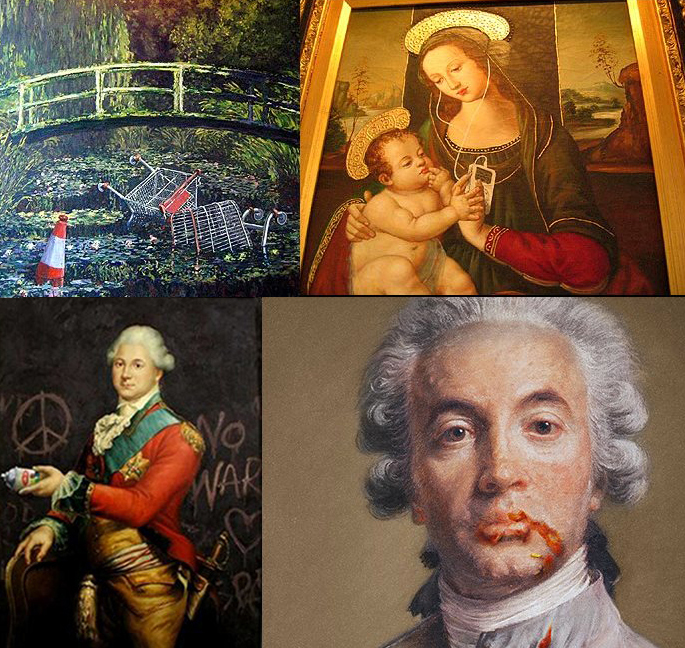
Street Art is a strange combination of references to art of course, but also to sociology, politics and economy. It might be why I became interested in the phenomenon and mention it here, in a blog related to start-ups which are also a strange combination of creation, social policy and economy. Both reconsider the established world, the institutions. Street Art interferes with private property and invades places it is not allowed to touch in theory. Street Art revisits consumerism and capitalism in a very interesting manner. And in the end, it became a part of consumerism, capitalism and the established art world. In a way, it’s exactly the same thing with start-ups. The successful ones become a part of the established economy. Also, both appeared without a clear objective. The computer, the Internet were nearly as useless as art in its first years. In the next picture, what does belong to advertising and what to art?

banksy-ad

Whatever I continue my virtual and real visits to street artists with Space Invader in Grenoble in 1999. As you may imagine, there is not much left, but still a lot online! Attached is my pdf compilation of Space Invader Grenoble invasion.

SI-Grenoble-Map

PS: You can find my compilations of Banksy in New York, the beautiful mosaic-mirrors of Pully and the invasions of Lausanne, Geneva, Bern, Basel, and Toyko under the tag Street Art.

Space Invader in Tokyo

Summer is not the season for start-ups, news is rather thin, with the exception perhaps of the GoPro IPO. I also use this blog to talk from time to time about street art and in particular of Space Invader. I also found an indirect way to discover a city, physically or virtually, is to start looking for these ephemeral works.

SpaceInvaderTokyo

Japan has always been an attracting place for me, so I became interested in what the artist has done there. There are dozens of photographs online, some maps, so I made ​​my own synthetic work in pdf format. [Other examples of SI fans in Tokyo include Nalice_Malice or True2death.]

Here is an updated version (May 2015) of my pdf file with more images.

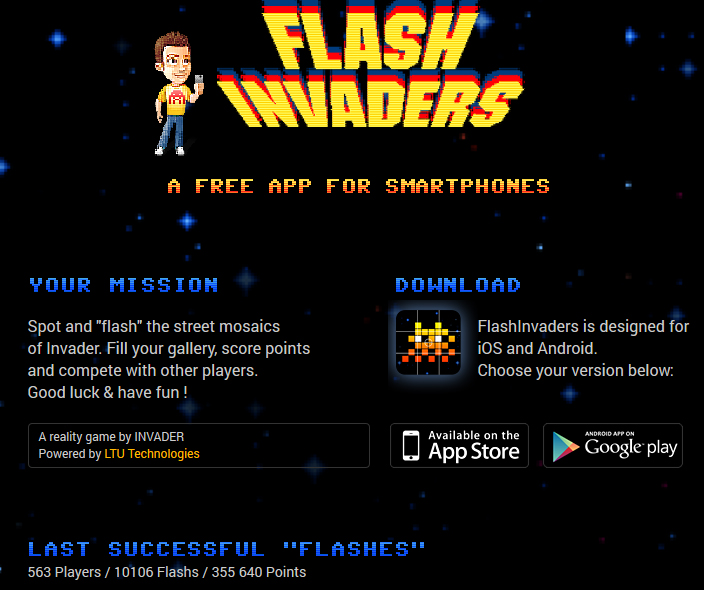
I still have to make the actual discovery … Latest topic, Invader has launched its application for smart phone, Flash Invaders. It is perhaps this slight argument that will change my device!

flashinvaders

If you want to be a high-tech entrepreneur, don’t read this. Or should you?

Is this a strange time or am I growing old? The point is my recent readings were not optimistic views of high-tech entrepreneurship or of Silicon Valley. I just think of
– Horowitz’s The Hard Thing about hard Things,
– Morozov’s To Save Everything, Click Here (which is so negative, I have not written a post yet!)
HBO’s Silicon Valley – nice & funny but slightly depressing.

In a way there’s always been creations which were not absolutely optimistic, but there was always some positive point. I think of
– Bronson’s The First $20 Million Is Always The Hardest,
– Edwards’ I’M Feeling Lucky – Falling On My Feet in Silicon Valley,
– the very good Harboe Schmidt’s The Ultimate Cure or
– even very short and funny The Anorexic Startup by Mike Frankel.

NoExit

Now I just read No Exit, Struggling to Survive a Modern Gold Rush by Gideon Lewis-Kraus (thanks David!). The passion, the excitement have disappeared. The entrepreneurs are honest enough to show they are exhausted. And the gold rush again will have more casualties than winners.

I initially thought it was a fiction, but the author is a journalist for Wired. That’s why my initial reaction was it’s not a good work, I could not see the style, the rythm. After I understood it was not fiction, I was less negative, thought it’s not the best document I’ve read. But here are some interesting quotes/lessons.

“The Valley has successfully elaborated the fantasy that entrepreneurship – and, more broadly, creativity – can be systemized; this is the basic promises of accelerators (Ycombinator et al.) that success in the startup game can be not only taught but rationalized, made predictable.” (31/847 – Kindle reference) and later “Silicon Valley’s most bought book, Eric Ries’ The Lean Startup, is a spirited pamphlet of winning exhortations to hunger, speed, agility, and unsentimentality. Almost every founder in Silicon Valley has read the first 30 pages of that book.” (618/847) If you do not know the book, it’s about spending little and pivot fast and I agree there is something wrong about all these fantasies. Indeed even Steve Blank agrees now. Check Blank’s statement about learning entrepreneurship.

Even worse, “[…] the Series A crunch. Due in part to the rise of startup accelerators like Y Combinator, as well as to the surplus capital washing around the Valley from recent IPOs, it has never been easier to raise a small amount of money, say $1 million. And it has never been easier to build a company—especially a web or mobile product—from that small amount of money, thanks in part to the proliferation of cheap, easy development tools and such cloud platforms as Amazon Web Services. But the amount of “real” VC funding (i.e., Series A rounds) to be allocated hasn’t kept pace. The institutions that write the big checks, those that might support and sustain real growth, can survey what a hundred companies have managed to do with a small check and put their real money on the propositions that promise the greatest yield with the least risk” (41/847) and “The problem in 1999 was that to get $5 million you didn’t need very much. You needed one or two Stanford résumés, an idea for a prototype, and a live body to give the money to.” It’s hard to get that $5 million now in part because it’s so easy to get $500,000, especially if you’re coming out of an accelerator. One way to look at it is that the $5 million that went to one company of 10 people in 1999 is now going to 10 companies of two people. You’ve lowered the bar 10X” (753).

And the consequences are slightly different… “The Valley is the place where the astounding success of the very few has been held out to the youth in exchange for their time, their energy and, well, their youth” (60). “You know the odds on any given company’s success are long, but that’s why you make a lot of bets. In the first dotcom boom, the risk was largely carried by the investors. Now that the financiers have gotten a grip on the market, and specialized engineering knowledge has become a commodity, the risk has been returned to the youth” (760). “The worst thing is that these guys get their funding tomorrow and are stuck doing this for another year. So far, they only lost one” (778).

His comments are right, but isn’t this true of any bet you make in life, becoming an artist, a scientist. You can go for a safer life for sure. Lewis-Kraus is pessimistic, he sees the people who do not win. And this exists anywhere people try. I have more optimistic views. Even if I know it is a tough experience… I prefer what Latour said of his experience with Everpix: “I have more respect for someone who starts a restaurant and puts their life savings into it than what I’ve done. We’re still lucky. We’re in an environment that has a pretty good safety net, in Silicon Valley.”

A final quote I liked (related to my previous post about age): “There’s been a lot written recently about the age divide in Silicon Valley, but even the more thoughtful pieces — such as those in The New York Times Magazine and The New Republic — tended to miss the obvious: Older people don’t typically work at startups because they have families and can no longer stomach the perpetual crisis. It’s exactly the same reason that people in their fifties tend not to be magazine freelancers or underground-club bassists. As one investor put it to me, When I see a 40-year-old in a Series A meeting, I want to pull him aside, put my hand on his shoulder, and tell him to just go get a job.” (706).

PS: it’s still a challenge for me to read an e-book all the more with these references which are not pages anymore. So I cheated, created a pdf and printed the stuff to take notes and later copy/paste the pdf…

The Ends of the Internet by Boris Beaude

The Internet is only a reflection of technological change and globalization. As with these two issues, social and political tensions have naturally emerged, but are even more acute because of the specifics of the Network and the revolution it created in much less time than the previous World developments. (I will add below that the disappointments caused by excessive expectations from technology have also played a role.)

les-fins-d-internet-de-boris-beaude-fyp

The cover page of the book The Ends of the Internet says that the Internet has revolutionized the world in the fields of information, production, collaboration and transactions. Its author, Boris Beaude, is a geographer by training, which is an important point for the topic addressed here. Beaude has a strong contribution to the discussion about the constraints created by the Network. It is synthetic, and detailed, thanks to a short book (95 pages) however dense and exciting.

(I would not say the same of Evgeny Morozov’s book, To Save Everything, Click Here, which is also dense on related subjects, but too provocative or extreme to be totally convincing. I might come back on that book later in another post.)

Morozov-ToSaveEverything

The Internet (just like globalization) has revolutionized the World (page 15) by re- balancing the priorities (and re-creating tensions) between:

Before the Internet Since the Internet
Equality Freedom
Society Individual
Privacy Public Life / Transparency
Property Free

Beaude also mentions (page 24) problems linked to:
– Freedom of expression,
– Collective intelligence,
– Openness,
– Decentralization,
– Neutrality,
which are the topics of his chapters.

The Internet thus disturbs the local values in the territories, but the Internet (which is “a proper name just as well as France or the European Union” – page 14) is anything but virtual; it is an intangible space. Yet it must be able to survive private interests. The Internet makes distance (and time) less relevant without abolishing them, which “makes clear its disjunction with the plurality of territorial spaces” (page 23). It disrupts the States that have put some values higher than freedom (safety, property in the USA to which must be added dignity, privacy in Europe). Beaude is geographer!

He adds: “A common space for humanity is clearly not enough to spontaneously create common values. But the social contracts are at the heart of politics. They offer to give up freedoms by collectively delegating authority in the name of freedoms seen as more fundamental” (page 29). See the “my freedom ends where someone else’s begins.” The Internet is both a space of freedom and space of absence of law (intellectual property, widespread surveillance, private use of the data; the list is long.)

And this is where is one of the worst issues – among others. Not only in the world of the Internet, but also in the field of technological innovation where experts often impress politics and society. This creates a tension between the individual and society, between private and public entities, between experts and decision makers. “The computer code is now the law” (page 47).

About Collective Intelligence: “Believing in the potential of individuals is precisely not to believe in one only, and it is to accept individual fallibility, while recognizing the power of appreciation that resides in anyone” (page 38). Then follows a section on democracy and “its difficulty in organizing common will/good with individual will/good” (and the famous, the “worst system except for all the others.”) In addition, the largely minority character of the contributors to the collective intelligence on the Internet (e.g. 0.0002 % of users for French-speaking Wikipedia) is an additional limit, not to mention the loss of their independence and the privatization of this intelligence (pp. 40-46).

You should also read his excellent synthesis on free and property. The emerging intellectual property concepts of Copyleft and Creative Commons. Free only exists because a third party pays; not only advertising but also sponsors in the case of Wikipedia or Mozilla. This is not so new since both Press and TV used these methods. It is just a matter of scale and strong dematerialization. The minimal costs of copying and transmission revolutionize the world, but the initial production of goods must still be financed. Netflix and Spotify show that new models are possible, but only if only the aggregator or distributor is correctly paid, the content producers may disappear if not in quantity, at least in quality… And at the same time, Beaude reminds us that free is also a freedom factor.

Another subtle topic: hypercentrality (Google, Facebook, Twitter) poses fantastic problems, not least being the circumvention of laws and taxation (page 75). For example, the “weak links” (those which are neither daily nor intense) are also essential. And threatened?

Beaude interestingly mentions the Fourth Amendment of the U.S. Constitution, which requires a warrant for any search. It raises the constitutionality of the monitoring carried out by the NSA (page 81).

How has the Internet reached the point where the results of Google and Twitter differ depending on the country and offers by iTunes, Netflix or YouTube are different or even inexistent with geography? (Page 85). This missing neutrality will lead to the neutralization of the Internet, even its death (page 89). “Neutrality and self-organization are part of the libertarian options […] and are inconsistent with politics. […] Humankind must seize this opportunity to revisit what we consider to be important, really important. […] The challenge is unusually complex. We will have to choose between the end of the Internet and the globalization of politics” (pp. 91-93).

Beaude therefore indicates that the dilemma is simple: “If in accordance with the national social contracts, the Internet is partitioned according to the Nations. By not respecting national social contracts, the Internet might be partitioned even more in the relatively near future” (page 35). “The Internet enables the emergence of a global political space, but it is still to be invented. Before this invention comes, the Internet will probably be gone!”(Page 36)

As usual my synthesis is imperfect, but if you’re interested or intrigued, read Beaude!

Thiel-FlyingCars

Finally, and this is not quite the subject of Beaude, there is also some disappointment with the promises of technology and the Internet in particular… Just read again Thiel’s motto – “We wanted flying cars, instead we got 140 characters” – that I have already mentioned here. This only would not be so bad. But then what about the citation of the former CEO of TF1 – “what we sell to Coca-Cola is human brain time made available. […] Nothing is more difficult than getting this availability” – or that of Jeff Hammerbacher (thanks Martin for the reference): “The best minds of my generation are thinking about how to make people click ads, that sucks.” Which brings me back to Morozov whose arguments on centrism and solutionism of the Internet seem very excessive. It is not the exaggerate promises of the Internet that are so much delusional, but the risk of drift and disappearance of the Internet that is the real problem – but this is another topic!