Category Archives: Innovation

Is there an ideal age to create?

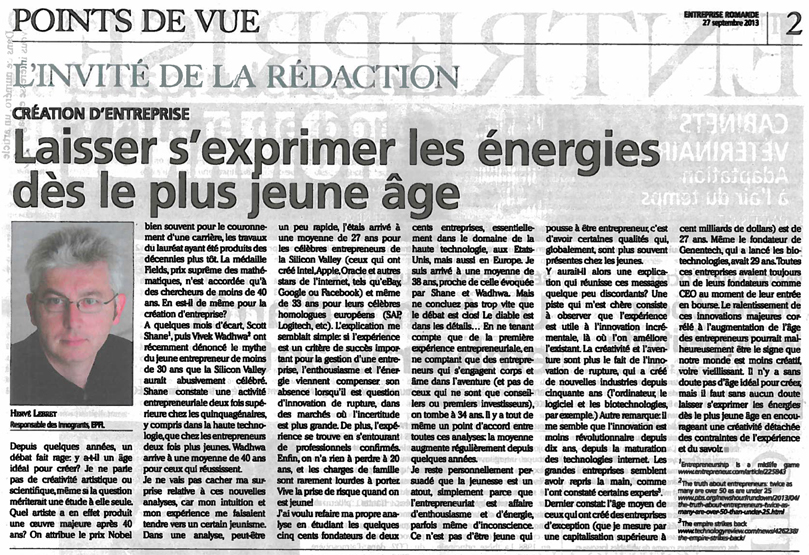
Here is my new contribution to magazine Entreprise Romande, which they entitled “Let the Expression of Energies Emerge from the Youngest Age.”

ER-Sept13-72dpi

In recent years, there’s been a recurrent debate: is there an ideal age to create? I ‘m not talking about artistic and scientific creativity, even if the question deserves a study in itself alone. What artist has indeed produced a major work after 40 years? The Nobel Prize is often awarded for the culmination of a career, but the work had been produced decades earlier. Finally, the Fields Medal, the highest prize in mathematics, is given to individuals who are under 40 years. Is it the same for the creation of business? In a few months, Scott Shane [1], and Vivek Wadhwa [2] have recently denounced the myth of the young under-30 entrepreneur that Silicon Valley would have unduly celebrated. Shane finds entrepreneurial activity twice as much with individuals in their fifties, including in high technology, as with young entrepreneurs. Wadhwa concludes with an average of 40 years for those who succeed.

I will not hide my surprise with these new analyzes because my intuition and my experience made me move towards a cult of youth. In an analysis, – perhaps a little fast-, I had found an average of 27 years for famous entrepreneurs in Silicon Valley (those who founded Intel, Apple, Oracle and other stars of the Internet such as eBay, Google or Facebook ) and even 33 for their famous European counterparts (SAP , Logitech, etc.) The explanation seemed simple: if the experience is an important criterion of success for the management of a company, enthusiasm and energy will compensate for its absence when it comes to breakthrough innovation in markets where uncertainty is greater. In addition, the experience can be provided by surrounding oneself with experienced professionals. Finally one has nothing to lose and family responsibilities are seldom hard to bear when being 20-year old. Enjoy risk-taking as long as you are young!

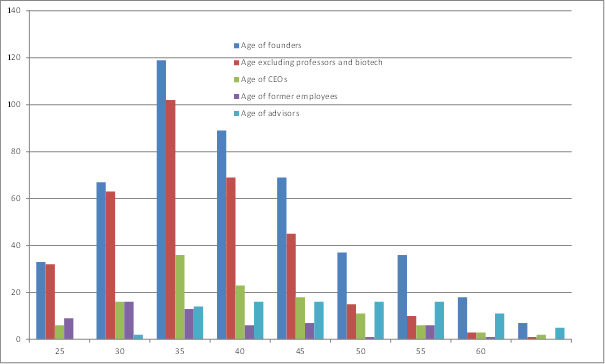
Age of founders

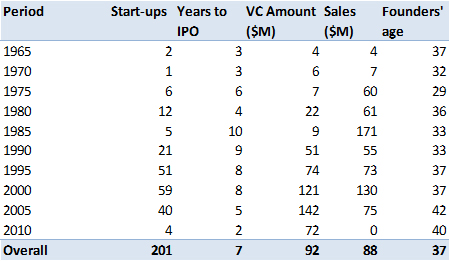
I decided to do again my own analysis by studying the 500 founders of 200 companies, mainly in the field of high technology in the U.S. but also in Europe. I got an average of 38 years, similar to that suggested by Shane and Wadhwa. But do not conclude too quickly that the debate is over! The devil is in the details… By considering only the first entrepreneurial experience, counting only entrepreneurs who commit their body and soul in the adventure (and not those who are advisers or early investors) it drops to 34 years. There is however a point of agreement between these analyzes: the average has been steadily increasing in recent years.

Age-through-years

I still personally believe that youth is an asset, simply because entrepreneurship is about enthusiasm and energy, and sometimes unconsciousness. Entrepreneurship is not about being young so much as what motivates to be an entrepreneur, is to have certain qualities which, overall , are more often found in young people. Would there be an explanation that bring closer these rather discordant findings? An idea that is dear to me is to see that experience is useful for incremental innovation, where one improves what already exists. Creativity and adventure are related to disruptive innovation, which has created new industries for 50 years (computers, software and biotechnology for example.) Another remark: I think innovation has been less revolutionary in the last 10 years, since the maturation of internet technologies. As a consequence, large companies seem to have taken the hand, as some experts noticed [3].

Last observation: the average age of those who have created exceptional companies (I measure it with higher than $100 billion capitalization) is 27 years. Even the founder of Genentech, the company which was at the origin of biotechnology, was 29 years old. All these companies still had one of their founders as CEO at the time of IPO. The slowdown in major innovations correlated with the increasing age of entrepreneurs could unfortunately be a sign that our world is less creative because older. There is probably no ideal age to create, but we must encourage the expression of enthusiasm and energy from an early age by encouraging creativity, loose from the constraints of experience and knowledge.

References:
[1] Entrepreneurship Is a Midlife Game http://www.entrepreneur.com/article/225843
[2] The Truth About Entrepreneurs: Twice As Many Are Over 50 As Are Under 25 http://www.pbs.org/newshour/rundown/2013/04/the-truth-about-entrepreneurs-twice-as-many-are-over-50-than-under-25.html
[3] The Empire Strikes Back. http://www.technologyreview.com/news/426238/the-empire-strikes-back/

On a similar topic, I was a little puzzled by a short article I mention here, from Swiss magazine Bilan. The future, a question of youth (link to French article: L’avenir, affaire de jeunes, by Stéphane Benoit-Godet)

The future, a question of youth
Google wants to extend the lives of people and defeat death. An event that has not been so noticed. Yet it is not only an announcement effect. The possibility of downloading our own memory in thirty years so that a part of us can survive represents a formidable challenge to humanity and creativity.
Is this crap? There are many “deniers of progress”, those who fight in vain their time because they do not understand its implications. There is however an exciting movement in the science that envisions o convergence of engineering, information science and neuroscience.
Patrick Aebischer is a pioneer in Europe with the vision he imposed at EPFL. Others work hard at the convergence of these different techniques to get to the mother of all scientific epics, the understanding of the brain.
If Google decides to work at this breakthrough, we must be interested because the resources the Silicon Valley firm dedicates to its special projects division are enormous. And when it comes to processing data on a gigantic scale, its founders are experts.
Henry Markram who has raised 100 million from the EU for his Human Brain Project at EPFL also fits perfectly in this revolution. What has been made possible here thanks to the will of one man – Patrick Aebischer had a good part of the establishment against him when he arrives at the EPFL – has spread further.
If Larry Page and Sergey Brin, at Google, dare to embark on this adventure, it is because they are immersed in the bath of innovation that is Silicon Valley. The place where are created start-ups that disrupt social interaction (Facebook), technology (Apple), how to learn (Twitter), move (Tesla and SpaceX) or consume (PayPal).
Ironically, the head of that company, David Marcus, a Geneva serial entrepreneur who moved to California, is shaping the future of money when Swiss bankers have never been in such bad shape.
This culture is still missing here. The trigger is perhaps encourage people in their 20s and under to start their own business. As the crazy visionaries in Silicon Valley who have a mission to improve the lives of people, the desire to create and the entrepreneurial enthusiasm could lead to huge success.

What makes an entrepreneur great? (according to Max Levchin)

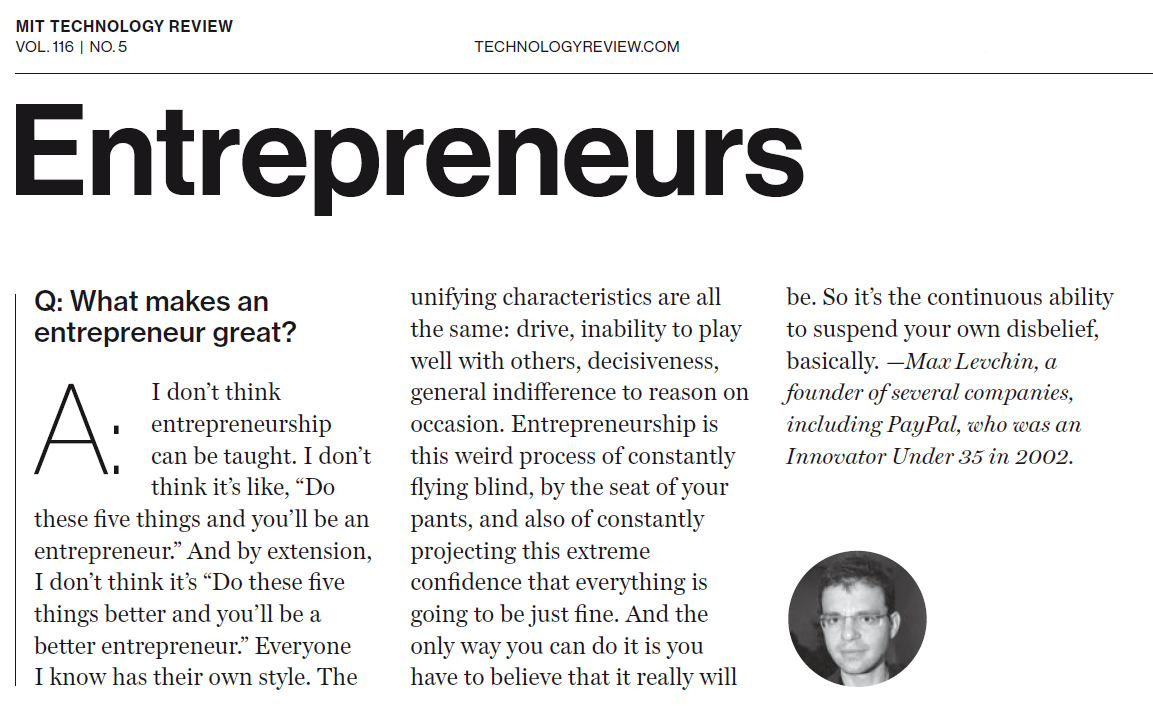
Ashort quote from Max Levchin taken from the latest issue MIT Technology Review. Q: What makes an entrepreneur great?

A: I don’t think entrepreneurship can be taught. I don’t think it’s like: “Do these five things and you’ll be an entrepreneur.” And by extension, I don’t think it’s: “Do these five things better and you’ll be a better entrepreneur.” Everyone I know has their own style. The unifying characteristics are all the same: drive, inability to play well with others, decisiveness, general indifference to reason on occasion. Entrepreneurship is this weird process of constantly flying blind, by the seat of your pants, and also of constantly projecting this extreme confidence that everything is going to be just fine. And the only way you can do it is you have to believe that it really will be. So it’s the continuous ability to suspend your own disbelief, basically. —Max Levchin, a founder of several companies, including PayPal, who was an Innovator Under 35 in 2002.

Levchin on Entrepreneurship

In addition I just read an interview of Bernard Dallé, General Partner with Index Ventures in Entreprise Romande, in the same special issue dedicated to failure where I wrote a short note entitled “Does the Swiss culture tolerate failure?”. Bernard is asked about common features of entrepreneurs. He just says: “Often they are not attracted by money. They are not afraid of failure. Their goal is to have an impact on society.”

What’s a start-up? (part 3)

My colleague Jean-Philippe Solvay recently asked me to a react to a Facebook post asking what is exactly a start-up. And as you may read there, it is not so easy to answer. One of the best references given in the post is swombat.com rather exhaustive analysis.

In the past, I wrote two posts: “part 1” was in 2011, where I had given my definition: “A start-up is a company which is born out of an idea and has the potential to become a large company” as well as the very good definition by Steve Blank: “startups are temporary organizations designed to search for a scalable and repeatable business model.” (There is something I am not comfortable with Steve Blank’s: I would delete “model”, as a start-up may know what it wants to do, but has not validated it yet. And start-ups copying existing business models would not be ones…)

Then in “part 2” in early 2013, I added the following: “A start-up is a corporation which explores, which is looking for a business model, a market, customers and is trying to innovate. It usually looks for a big market (“scalable”) and therefore service businesses do not qualify (except on the web) as they do not often scale. It is also a matter of strong and rapid growth in emerging markets because the competition is tough and there will be few winners. It often go fast. That is why it is more about a mindset: you are curious, in an uncertain world, trying to bring new things to the world. Because you are looking for a business, you do not have enough paying customers, and you will most likely need external capital (business angels, venture capital) except if your future customers accept to pay a lot in advance. This is why there is a strong correlation between being a start-up and having investors.”

I agree with most features given in the facebook or swombat contributions: “start-ups are new firms focusing on innovation and growth in situations of high uncertainty (or risk)”. They do not have to be about technology and if so, they are called high-tech start-ups. Maybe innovation is not so important, as many just copy others, but growth (through scalability) is critical. Consulting or service firms usually do not qualify because the growth is linear, not exponential (with the number of jobs).

Let me add another point: if the start-up term, was created, there has to be a good reason! When was it created? Wikipedia claims it became popular with the dot.com bubble of the late nineties. However, I found the term in Saxenian’s Regional Advantage (1994) and even in Silicon Valley Fever (1984). There is no doubt the term emerged with the technology clusters Route 128 and Silicon valley, the reason why it is associated with high-tech as well as venture capital. But not all start-ups belong to these geographic clusters. Microsoft and Amazon are based in Seattle, which is (at least was) not really a cluster. When they do not belong to a geographic cluster, they belong to a technology cluster, mostly IT (electronics, software, internet) or biotech/medtech. Tesla Motors is considered a start-up because it belongs to the Silicon Valley ecosystem though it is in an industry where very few start-ups exist. I do not think EasyJet was ever called a start-up because it belongs to no (technology or geographic) clsuter. So I would finally define a start-up as “a new firm focusing on growth in situations of high uncertainty, and belonging to a technology or geographic cluster”.

PS: while looking into the topic again, I found a debate on how to spell the word… In 2007, I had decided for “start-up”, but “start up” and “startup” also existed. It seems “startup” is now more and more popular. I stick to “start-up” for the time being, just to be consistent with what I always did.

Does the Swiss culture tolerate failure?

Here is my fourth contribution to Entreprise Romande. I realize now it is often about failure and innovation. This new article maintains the tradition. And because it was a special issue about failure, let me provide a translation of the editorial.

ER_20130705

Entreprise romande – July 5, 2013 – Véronique Kämpfen, rédactrice en chef:

Tolerance for failure favors growth

We are not all equal vis-à-vis failure. The fact is confirmed by a detailed study published by Barclays in late 2012. First, Europeans have more difficulty seeing failure as positive (69%) than Americans (71%), Asians (80%) and Middle Easterners (91%). Second, entrepreneurs have a less negative attitude towards failure than the rest of the population. They often think that failures have shaped their character, that this event has taught them a lot and they were able to bounce back quickly. Entrepreneurs are also far more optimistic than the rest of their fellow citizens. This phenomenon is described in the medical literature: it seems that a high number of successful entrepreneurs are characterized by a genetic form of psychiatric bias, which predisposes them to be creative, enthusiastic and somewhat less apprehensive vis-à-vis risk taking. John Gartner, the psychiatrist at the origin of this study, highlights the specific features of these characters: “Having that kind of confidence can lead to blindness when facing risk, because these individuals do not believe they can fail. (…) However, if they fail, they will not stay down for long and will soon be energized by a completely new idea”.

More generally, the Barclays study shows that tolerance for failure is essential to growth. The process of “creative destruction”, that is obsolete ideas, technology and business models give way to new impulses, is essential to economic progress and job creation. For this process to be effective, we need entrepreneurs who want to take risks, and an environment that supports their efforts. Until now, Switzerland seems to have done OK, as evidenced by its economic health and its high ranking in terms of innovation and competitiveness. As the Swiss are not the champions of tolerance for failure, they must be supported by appropriate framework conditions and encouraged so that those who have the entrepreneurial spirit may try … without taking too much risk! These topics are covered in great detail in the Magazine Entreprise romande. The taboo of failure and bankruptcy is analyzed in all its forms and put into perspective with practical advice and testimonials from entrepreneurs. Happy reading … enjoy the summer!

and here is my contribution:

Does the Swiss culture tolerate failure?

“The Swiss Society gives us so many slaps in the face through education that we are afraid of being creative, because we show then our weaknesses. By expressing our dreams, we do an intellectual striptease; it is feared that others see them as bad, not good, not nice and not fair.” So speaks Elmar Mock, inventor of the Swatch and founder Creaholic. The Swiss school system is indeed not known for its creativity. The famous (in French speaking Switzerland) « faut se gaffer » (“don’t be goofy”) might make you smile. Our teachers too seem to give more importance to the rigor than to the creativity of our little darlings. The room for error is unconsciously repressed. If one accepts the idea that innovation is above all creating in situations of uncertainty, the statement is worrying. Yet Switzerland is world champion of innovation in almost all global reports. Is there a contradiction?

Innovation is a subtle thing. Innovation is not limited to invention and innovation is not about technology only; it is the result of a process, following which are created products, services or new processes that will have to demonstrate that they answer a (commercial or non-commercial) need. The process leading to innovation is long, unpredictable and hard to control, innovation cannot therefore be planned and we have to accept failure.

Clayton Christensen, a professor at the Harvard Business School, built a theory explaining the process of disruptive innovation, the one innovation which allows the emergence of new revolutionary products such as the Internet, the mobile phone, but also the low-cost airlines, the one innovation which also allows new players to emerge and replace their older competitors. According to Christensen, disruptive innovation cannot occur within established institutions. The best companies are listening to their customers and those only want to improve existing products and will rarely desire new products. The U.S. has seen more than 80 major new companies emerge since 1970, and France, only 4. And Switzerland?

Switzerland is world champion of innovation firstly because the framework conditions are excellent. Everything is done for businesses to succeed, minimizing barriers and constraints. Then, because there is a culture of work well done. Apprenticeship, in the early years of training, helps in maintaining this tradition and Swiss companies are known to be listening to their customers in order to improve existing products in the right direction. But what kind of innovation are we talking about? Probably not about the one which enables technology breakthroughs. No, rather of a different type of innovation, incremental innovation, made of “gradual, continuous improvement of techniques or existing products; usually incremental innovation does not fundamentally change the dynamics of an industry, or does not require a change in behavior,” according to wikipedia. Switzerland is champion of incremental innovation through a dense network of highly performing SMEs. Failure is relatively absent, when the attention to every detail is permanent. But is it enough?

Not only the Swiss school system is not known for its creativity, but furthermore our academic spin-offs create few jobs. If we accept the corollary that innovation is a source of growth and new jobs, we might not be as innovative as it might be desired. We are obviously efficient for incremental innovation, but certainly not as good when it comes to disruptions. Except for one example that comes easily to my mind, the Swatch. But Nicholas Hayek was not the product of the Swiss culture! I could add Nespresso, but Eric Favre, inventor of the product, had suffered a strong initial reluctance from Nestlé to the point of saying: “The Swiss economy lacks real entrepreneurs!” The difficulty of integrating risk and radical innovation can make anyone short-sighted when experiencing ongoing changes and cause much bigger failures, as evidenced by the grounding of Swissair, which was seen as a national trauma. The United States has lost TWA and PanAm, but Americans have invented the concept of low cost airlines with Southwest or JetBlue, which have happily replaced the old players. In Europe, EasyJet and similar companies only followed the American model.

The Swiss start-ups never die. They have a survival rate of 90% after 5 years. Whereas across the Atlantic and even in Switzerland for traditional businesses, this rate is less than 50%… This may mean, quoting Xavier Comtesse, that “startups are protected by the academic system or federal funding.” Because failing is an unacceptable stigma? Or because taking risks, an inevitable cause of a greater failure rate, would be too dangerous? Without being so pessimistic, I would add that our start-ups are often excellent engineering offices, with great know-how. With a service business model eventually outweighing new products, the company survives without significant creation of jobs and without growth. I often asked entrepreneurs who failed to share their experience. A real failure! Our experts and mentors do not grow our young entrepreneurs in this direction, and I have heard it so often that I almost got used to it. Our business angels have a great distrust of more aggressive venture capitalists and they fear their more binary approach of “make it or break it. ”

Daniel Borel, the iconic entrepreneur: “In our industry, if we do not innovate constantly, if we do not have the courage to take risks, we disappear. This is why I prefer to get into seven projects even if it means failing three, as not to fail in anything, by chance, having focused on a single project.” […] “We only learn from our failures, rarely from succcess. Success can be your worst enemy: it makes you think you are strong, very strong; you could even walk on water. And it is at this point that you drown. ”

The Swiss culture has certainly a very small tolerance for failure. It promotes a type of innovation (incremental) which may explain its strengths. Its network of strong SMES is probably the result of this conservative and demanding culture. There is reason to be proud of it. But I like the quote from the former star of Hockey, Wayne Gretzky: “I skate to where the puck will be, not where it was.” The question is whether Switzerland will be tomorrow at the right place to get the puck …

The cradle of European Innovation

Sometimes, giving an interview has interesting and strange results. I do not read Korean so I cannot really help! But apparently what was kept from the conversation is that “it is important to make a culture where we are not afraid to fail”. As well as ” Culture is important to propagate entrepreneurship in universities. Even if the (academic) system is very good, it might be far from starting a business without this culture.” I had learnt my name is Russian was Эрве Лебре. Now I know it in Korean: 에레 레브레. And what about my new look according to a Korean photographer… Here is the full article.

◆ 창조경제의 요람 유럽대학 ① ◆

기사의 0번째 이미지
“대학에 기업가정신을 퍼뜨리기 위해서는 문화가 중요합니다. 제도가 아무리 좋아도 문화가 뒤따르지 않으면 창업은 요원한 일입니다.”

스위스 로잔공대 이노베이션파크에서 만난 이노그랜트 프로그램 총괄 책임자 에레 레브레 박사는 “유럽의 대학생들도 한국과 마찬가지로 기업가정신이 부족한 편”이라며 “미국 실리콘밸리처럼 기업가정신이 대학 곳곳으로 퍼질 수 있는 문화를 만들어야 한다”고 강조했다.

이노그랜트는 창업을 원하는 교수나 학생에게 조건 없이 창업자금을 지원하는 프로그램이다. 2005년 스위스의 한 은행이 학교를 위해 내놓은 100만달러를 종잣돈으로 삼아 만들어졌다. 레브레 박사는 “로잔공대에는 기술사업화와 창업을 지원하는 다양한 프로그램이 있었지만 `스타트업`을 중점적으로 돕는 프로그램이 필요하다고 판단했다”며 “이노그랜트 프로그램을 만든 뒤 지난 7년간 56개 아이디어에 자금을 지원했고, 이를 통해 25개 새로운 회사가 탄생했다”고 밝혔다.

이노그랜트 펀딩의 대상자가 되면 교수와 학생을 구분하지 않고 1년간 창업에만 열중할 수 있다.
창업에 실패한다고 하더라도 받은 돈을 학교에 반납할 필요가 없다. 레브레 박사는 “이노그랜트의 펀딩을 받으면 연구나 수업에서 제외된다”며 “1년간 생활자금을 지원해 주기 때문에 돈 걱정 없이 창업 준비에만 신경을 쓰게 된다”고 했다.

이 같은 혜택에 힘입어 이노그랜트 프로그램에 창업을 하겠다며 지원하는 프로젝트는 연간 40~50건에 달한다.

[로잔(스위스) = 원호섭 기자]
[ⓒ 매일경제 & mk.co.kr, 무단전재 및 재배포 금지]
http://news.mk.co.kr/newsRead.php?year=2013&no=583051

Korean-lebret

After posting this article, I received an English translation from the author. here it is:

Create a culture that is not afraid to fail
(This article is a part of the special series of articles titled “Visit European universities, Cradle of the creative economy”)

The EPFL is a unique place of innovation and competence. The EPFL handles innovation through its VPIV. The VPIV is responsible for the technology transfer, supporting start-ups through the Innogrants program and the coordination of all relationships between industry and EPFL. The EPFL turned out 156 new companies between 2000 and 2012. Hervé Lebret, the manager of the Innogrants said “Even if there was a best system, startups are still far-off without culture. It’s about culture. Just like Silicon Valley, we have to make a culture which can spread the entrepreneurship throughout the university.” The Innogrants were created by the EPFL in 2005 to encourage the entrepreneurial spirit and support start-ups. To date, 56 ideas were funded which enabled the creation of 25 start-ups. An Innogrant is a 12-month salary for the project owner in an EPFL laboratory and the beneficiary is freed of teaching or research activities so that the project owner fully concentrates on that project.

In Innovation Quest, Regions Seek Critical Mass

Very good article by the MIT technology review about technology clusters: In Innovation Quest, Regions Seek Critical Mass. Nothing really new, but it shows again and again how difficult it is to build such clusters and to promote an innovation culture. I just extract a few quotes:

“Clusters exist—it’s empirically proven,” Yasuyuki Motoyama, a senior scholar at the Kauffman Foundation, told me. “But that doesn’t mean governments can create one.”

The problem for governments is that they often try to define where and when innovation will occur. Some attempt to pick and fund winning companies. Such efforts have rarely worked well, says Josh Lerner, a professor at Harvard Business School. Governments can play a role, he says, but they should limit themselves mostly to “setting the table”: create laws that don’t penalize failed entrepreneurs, reduce taxes, and spend heavily on R&D. Then get out of the way.

But can entrepreneurs succeed in creating clusters where governments have had so much difficulty? “The conflict now is between two logics on how to create an ecosystem,” says Fiona Murray, a professor at MIT’s Sloan School, who consults as a kind of therapist to clusters, including London’s TechCity. One is “a government logic that says it’s too important to leave to entrepreneurs, and that you that need specialized inputs, like a technology park.” The other is “purely focused on people and their networks.” Murray believes the answer lies somewhere in the middle. Governments are good at organizing but poor at leading.

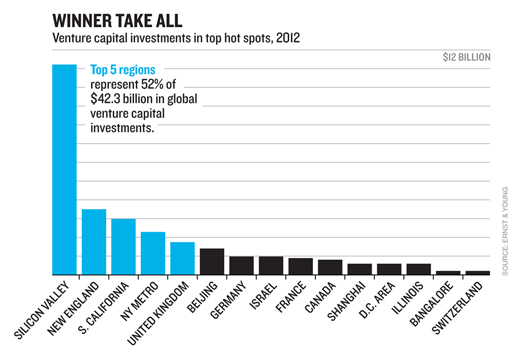
I will finsih by reminding you the power of SV in the cluster leadership…

WinnerTakesAll

When age does not hinder creativity: a rare example in mathematics

I seldom (but sometimes) talk about Science or Mathematics. Mostly when it helps me illustrate what innovation or creativity is about, and sometimes when I see analog crises in all these fields (see for example the posts on Dyson, Thiel or Smolin). And there is another related point: it is often claimed that major scientific discoveries or entrepreneurial ventures are done at a young age.

YitangZhang
Yitang Zhang

You probably never heard of Yitang Zhang who has stunned the world of mathematics last month by proving a centuries-old problem. He is a totally unknown mathematician and more surprising, he is (over) 50-year old. For those interested in the problem, you can read Nature’s First proof that infinitely many prime numbers come in pairs. Basically, Zhang proved that there are infinitely many pairs of primes that are less than N apart. Mathematicians still dream to prove that N is equal to 2 – the twin prime conjecture -, but Zhang was first to prove that N exists … even if N is 70 million!

Against Intellectual Monopoly – (final) part 3

Here is my third and final post on Boldrin and Levine’s book. I cover here the final two chapters and the pharma industry (chapter 9) and their conclusions (chapter 10). As lazy as usual, it is mostly some copy-pastes. As a reminder you can find here part 1 and part 2.

The Pharmaceutical Industry

The traditional model predicts that there should be many potential producers of a medicine, that the industry should be dynamically competitive, and therefore highly innovative with newcomers frequently challenging incumbents by means of innovative superior drugs. […] Some people esteem the pharmaceutical industry and some people despise it: there is little middle ground. The pharmaceutical industry is the poster-child of every intellectual monopoly supporter. It is the vivid example that, without the sheltering patents provide inventors with, the outpouring of new wonder drugs we have grown accustomed to would have not materialized, our life expectancies would be a lot shorter, and millions of people would have died of the diseases Big Pharma has instead managed to cure. In the opposite camp, Big Pharma is the scourge of humanity: a club of oligopolistic white men that, by controlling medicine around the globe and refusing to sell drugs at their marginal cost, are letting millions of poor people die. […] This sounds utterly complicated, so let us handle it with care and, for once, play the role of the wise fellows: in media stat virtus, et sanitas. […] How strong is the case for patents in pharmaceuticals? While Big Pharma is not necessarily the monster some depict, the case for patents in pharmaceuticals is a lot weaker than most people think. [Pages 242-243]

The authors make a long and interesting analysis of the history of the chemical industry with France and the UK blocking while Germany and Switzerland could innovate.

[Page 249] Here is how Murmann summarizes the main findings from his historical study of the European synthetic-dye industries during the 1857-1914 period. British and French synthetic dye firms that initially dominated the synthetic dye industry because of their patent positions but later lost their leadership positions are important cases in point. It appears that these firms failed to develop superior capabilities in production, marketing and management precisely because patents initially sheltered them from competition. German and Swiss firms, on the other hand, could not file for patents in their home markets and only those firms that developed superior capabilities survived the competitive home market. When the initial French and British patents expired, the leading German and Swiss firms entered the British and French market, capturing large portions of sales at the expense of the former leaders.

The authors also analyze Italy and India, which did not have until recently strong IP policies. “Interestingly though, we have not been able to find a single independent analyst claiming that the additional amount of pharmaceutical innovation patents may stimulate in the Indian industry, will be substantial and large enough to compensate for the other social costs. More to the point, the positive consequence of patent adoption in countries like India is, according to most analysts, a consequence of beneficial price discrimination. The argument goes as follows: monopoly power allows price discrimination – that is, the selling the same good for a high price to people valuing it a lot (usually people richer than average) and for a low price to people valuing it little (usually people poorer than average). Due to the absence of patent protection, there are very many new drugs that are not marketed in poor countries by their original producer, as the latter is not protected by reliable patents in that country.” [Page 253]

[Another] doubt comes from the following observation: if it were really true that imitating and “pirating” new drugs is that easy, absent patent protection local firms would be already producing and marketing such drugs in the country in question. [Page 254]

Pharma today
A few additional facts : the top 30 firms spend about twice as much in promotion and advertising as they do in R&D; and the top 30 are where private R&D expenditure is carried out, in the industry. Next we note that no more than 1/3 – more likely 1/4 – of new drug approvals are considered by the FDA to have therapeutic benefit over existing treatments, implying that, under the most generous hypotheses, only 25-30% of the total R&D expenditure goes toward new drugs. [Page 255]

Summing up and moving forward, here are the symptoms of the malaise we should investigate further.
– There is innovation, but not as much as one might think there is, given what we spend.
– Pharmaceutical innovation seems to cost a lot and marketing new drugs even more, which makes the final price for consumers very high and increasing.
– Some consumers are hurt more than others, even after the worldwide extension of patent protection. [Page 256]

Where do drugs come from? [Pages 257-260]
Useful new drugs seem to come in a growing percentage from small firms, startups and university laboratories. […]Next there is the not so small detail that most of those university laboratories are actually financed by public money, mostly federal money flowing through the NIH. The pharmaceutical industry is much less essential to medical research than their lobbyists might have you believe. In 1995, […] about $11.5 billion came from the government, with another $3.6 billion of academic research not funded by the feds. Industry spent about $10 billion. However, industry R&D is eligible for a tax credit of about 20%, so the government also picked up about $2 billion of the cost of “industry” research. […] In 2006, total was $57 billion while the NIH budget in the same year (the largest but by no means the only source of public funding for biomedical research) reached $28.5 bn.[…] it is wise to remember that the modern “cocktail” that is used to treat HIV was not invented by a large pharmaceutical company. It was invented by an academic researcher: Dr. David Ho.

It is a fact that, without the strong incentive the prospect of a successful patent induces, those researchers would not be working as hard as they do. That is true, so let us think the issue through once again. We observe that, while the incentive to patent and commercialize their findings should have been increased by the Bayh-Dole act allowing patentability of such research results, there is no evidence whatsoever that, since 1980 when the act was passed, major medical scientific discoveries have been pouring out of American universities’ laboratories.

It therefore remains an open question: did patentability of basic biomedical innovations create an incentive for engaging in more socially valuable research projects and investigations? Which medical and pharmaceutical discoveries are truly fundamental and where do they come from?

Here are the selected fifteen most important medical milestones: Penicillin, x rays, tissue culture, ether (anaesthetic), chlorpromazine, public sanitation, germ theory, evidence based medicine, vaccines, the pill, computers, oral rehydration therapy, DNA structure, monoclonal antibody technology, smoking health risk. How many entries in this list were patented, or were due to some previous patent, or were obtained during a research project motivated by the desire to obtain a patent? Two: chlorpromazine and the pill. […] Now the “list of Top Pharmaceuticals”, these are the current pharmaceutical products selling the most worldwide, and there are 46 of them. Patents had pretty much nothing to do with the development of 20 among the 46 top selling drugs. […] Notice though that of these 26, 4 were discovered completely by chance and then, 2 were discovered in university labs before the Bayh-Dole Act was even conceived. Further, a few were simultaneously discovered by more than one company leading to long and expensive legal battles, however, the details are not relevant to our argument. The bootom line is more than half of the top selling medicines around the world do not owe their existence to pharmaceutical patents.

Rent-seeking and redundancy. [Pages 260-263]
The next question then is, if not in fundamental new medical discoveries, where does all that pharmaceutical R&D money go? […] 54% of FDA-approved drug applications involved drugs that contained active ingredients already in the market. […] 35% were products with new active ingredients, but only a portion of these drugs were judged to have sufficient clinical improvements over existing treatments to be granted priority status. In fact, only 238 out of 1035 drugs approved by the FDA contained new active ingredients and were given priority ratings on the base of their clinical performances. In other words, about 77% of what the FDA approves is “redundant” from the strictly medical point of view. […] Sad but ironically true, me-too or copycat drugs are largely the only available tool capable of inducing some kind of competition in an otherwise monopolized market. ..] The ironic aspect of me-too drugs, obviously, is that they are very expensive because of patent protection, and this cost we have brought upon ourselves for no good reason. […] Insofar as new drugs are replacements for drugs that already exist, they have little or no economic value in a world without patents – yet cost on the order of $800 million to bring to market because the existence of patents forces the producers to “invent something” the USPTO can pretend to be sufficiently different from the original, patented, drug.

Libraries have been written on the obvious connection between marketing and the lack of competition. The pharmaceutical industry is no exception to this rule, and the evidence Professor Sager, and many others, point to has a simple and clear explanation: because of generalized and ever extended patenting, large pharmaceutical companies have grown accustomed to operating like monopolies. Monopolies innovate as little as possible and only when forced to; in general they would rather spend time seeking rents via political protection while trying to sell at a high price their old refurbished products to the powerless consumers, via massive doses of advertising.

The authors finish with an economic analysis of the social cost and benefit of patents and without patents, and propose solution in the final chapter.

Conclusion: The bad, the Good, and the Ugly

Edith Penrose, concluded that “If we did not have a patent system, it would be irresponsible, on the basis of our present knowledge of its economic consequences, to recommend instituting one. But since we have had a patent system for a long time, it would be irresponsible, on the basis of our present knowledge, to recommend abolishing it

But the authors claim: “On the basis of the present knowledge” progressively but effectively abolishing intellectual property protection is the only socially responsible thing to do. […] A realistic view of intellectual monopoly is that it is a disease rather than a cure. It arises not from a principled effort to increase innovation, but from a noxious combination of medieval institutions – guilds, royal licenses, trade restrictions, religious and political censorship – and the rent-seeking behavior of would be monopolists seeking to fatten their purse at the expense of public prosperity. [Pages 277-78]

A myriad of other legal and informal institutions, business practices and professional skills have grown up around them and in symbiosis with them. Consequently, a sudden elimination of intellectual property laws may bring about collateral damages of an intolerable magnitude. Take for example the case of pharmaceuticals. Drugs are not only patented, they are also regulated by the government in a myriad of ways. Under the current system, to achieve FDA approval in the United States requires costly clinical trials – and the results of those trials must be made freely available to competitors. Certainly, abolishing patents and simultaneously requiring firms that conduct expensive clinical trials to make their results freely available to competitors, cannot be a good reform. Here patents can only be sensibly eliminated by simultaneously changing also the process by which the results of clinical trials are obtained, first, and, then, made available to the public and to competitors in particular. [Page 278]

The authors look at many intermediate solutions including deregulation, private contracts, subsidies, social norms but they are clearly convinced (and convincing) that an evolution is needed, even if they are pessimistic:

Where, today, is a software innovator to find safe haven from Microsoft’s lawyers? Where, tomorrow, will be the pharmaceutical companies that will challenge the patents of “big pharma” and produce drugs and vaccines for the millions dying in Africa and elsewhere? Where, today, are courageous publishers, committed to the idea that accumulated knowledge should be widely available, defending the Google Book Search initiative? Nowhere, as far as we can tell, and this is a bad omen for the times to come. The legal and political war between the innovators and the monopolists is a real one, and the innovators may not win as the forces of “Stay the Course” and “Do Nothing” are powerful, and on the rise. [Page 299]

Certainly the basic threat to prosperity and liberty can be resolved through sensible reform. But intellectual property is a cancer. The goal must be not merely to make the cancer more benign, but ultimately to get rid of it entirely. So, while we are skeptical of the idea of immediately and permanently eliminating intellectual monopoly – the long-term goal should be no less than a complete elimination. A phased reduction in the length of terms of both patents and copyrights would be the right place to start. By gradually reducing terms, it becomes possible to make the necessary adjustments – for example to FDA regulations, publishing techniques and practices, software development and distribution methods – while at the same time making a commitment to eventual elimination. [Page 300]

Against Intellectual Monopoly – part 2

I promised a continuation to my post Against Intellectual Monopoly and here it is. The book is really a must-read for anyone interested in innovation. But maybe you want to begin with an direct explanation by the authors. Check the following audio interview.

So, as a follow-on, here are some very interesting elements about:
– Does IP increase innovation?
– Non-compete labor contract clauses inhibit innovation.

This is something I have been particularly sensitive to, as you will see below through past links. But before this, let us follow the book from where I had stopped.

Criticism of the Schumpeterian Theory
“Although originally not a mainstream view in economics, the Schumpeterian view is now close to becoming an orthodoxy in most circles. Schumpeter celebrates monopoly as the ultimate accomplishment of capitalism. He argues that in a world in which intellectual property holders are monopolists, competition is a dynamic process that is implemented via the process of creative destruction. […] How many industries can [one] mention where the mechanism described in the Schumpeterian model has been at work, with innovators frequently supplanting the incumbent monopolist, becoming a monopolist in turn to be ousted shortly after by yet another innovator?” [Pages 189- 190]

About secrecy and disclosure through patents/copyrights
“A common argument in favor of patent law is that in order to get a patent you must reveal the secret of your invention. […] Suppose that each innovation can be kept secret for some period of time, with the actual length varying from innovation to innovation, and that the length of legal patent protection is 20 years. Then the innovator will choose secrecy in those cases where it is possible to keep the secret for longer than 20 years, and choose patent protection in those cases where the secret can be kept only for less than 20 years. In this case, patent protection has a socially damaging effect. Secrets that can be kept for more than 20 years are still kept for the maximum length of time, while those that without patent would have been monopolized for a shorter time, are now monopolized for 20 years. Indeed, it is important to realize that outside the pharmaceutical industry, where the regulatory system effectively forces revelation, trade-secrecy is considerably more important than patent. Repeatedly, in surveys of R&D lab and company managers only 23%-35% indicate that patents are effective as a means of appropriating returns. By way of contrast, 51% argue that trade-secrecy is effective.” [Page 186]

“If instead there is a race for a patent, the incentive is to keep intermediate results secret so as to keep competitors from winning the race. In fact there is much evidence that secrecy and legal monopoly are complementary rather than alternatives. Despite copyright, producers of books, music and movies have aggressively attempted to encrypt their work with Digital Rights Management (DRM).” [Page 187]

Worse, [for Amazon 1-click purchase patent], “as can be seen, the “secret” that is revealed is, if anything, less informative than the simple observation that the purchaser buys something by means of a single click.” [Page 189]

“In the case of copyrightable creations, it can be argued that technological change – computers and the Internet – are greatly lowering the cost of reproduction, and so the conventional model in which ideas trade instantly at zero price is relevant. However, it is cost relative to the amount of competitive rent that matters. If indeed the Internet is reducing competitive rents, bear in mind that the same computer technology is reducing the cost of producing copyrightable creations. Take music, for example. Music editing capabilities that required millions of dollars of studio equipment ten years ago now require an investment in computer equipment of thousands of dollars. And long before the Internet swamps the markets with music and movies, authors will be able to create movies on their home computers with no greater difficulty than writing a book – and entirely without the assistance of actors, cinematographers, and all the other people that contribute to the high cost of movie making. […]Whether price falling to zero implies revenue falling to zero depends on the elasticity of demand, the mathematics of infinity times zero is complicated at times and this is one of them. If, in fact, demand is elastic, then price falling to zero implies (because so many more units are sold) revenue increasing to infinity. [Pages 193-194]

About the global economy
One often finds the argument that the increasingly freer trade, the growth of many Asian economies, and the lowering of transportation costs are creating a dangerous mix for our economic stability. In particular, it is argued, our ideas and products are increasingly being “unrightfully copied”, and this requires some kind of serious intervention by our governments. In other words, globalization is risky for our innovators, and we need to strengthen intellectual property protection and force emerging countries to do the same we do. [Page 194]

There is a […] perhaps more subtle but certainly not less relevant argument. As market size increases, two things happen. More consumers are added for all those ideas you are already producing or you would have produced in any case. Let us call these “good” ideas since they were good enough to be profitable even when the market was small. Also, additional ideas from new guys getting into the game become available. Let us call these “marginal” ideas, since if they had been good ideas they would have been introduced even when the market was small. Now, lowering intellectual property protection decreases the monopoly distortions for all consumers of the “good” ideas. With a larger market, many more consumers benefit from the greater usefulness and availability of all these “good” ideas. Second, lowering intellectual property protection makes it harder for “marginal” ideas to make it into the market. But in a larger market, more of these “marginal” ideas are going to be produced anyway, as there are more consumers to pay for the cost of inventing them. So the bottom line is that as the size of the market increases, by lowering intellectual property protection, you can get a lot more use out of “good” ideas at the cost of not getting quite as many “marginal” ideas as you would have.

“This simple rule of thumb would be that if the size of market grows by 4%, the length of protection should be cut by 1%. […]Unfortunately, in the case of copyright, terms have been moving in the wrong direction; they have grown by a factor of about four, while world GDP has grown by nearly two orders of magnitude. Hence, if the copyright term of 28 years at the beginning of the 20th century was socially optimal, the current term should be about a year, rather than the current term of approximately 100 years!” [Page 196]

And the authors add regularly that only already successful ideas are copied, not all of them, so yes there is less revenue and profit. Again how much is enough…?

Does IP increase innovation? [Chapter 8]
“A number of economic historians, Douglass North and his followers foremost among them, have argued that the great acceleration in innovation and productivity we associate with the Industrial Revolution was caused by the development of ways to protect the right of inventors, allowing them to profit from their innovations. Central among such ways was the attribution of patents to inventors, and their upholding either by Parliament or by the courts. Relative to the very poorly defined contractual rights of pre-seventeen century Europe, plagued by royal and aristocratic abuses of property and contracts, there is no doubt that allowing individuals a temporary but well defined monopoly over the fruits of their inventive effort was a major step forward. Even monopolistic property is much better than a system that allows arbitrary seizure by the rich and powerful. This does not, however, contradict our claim that widespread and ever growing monopolistic rights are not as socially beneficial as well defined competitive property rights.” [Page 209] “The issue, then, is the one we posed at the outset: does monopoly really lead to more innovation, on average, than competition? Theory gives an ambiguous answer, so let us look at evidence, supported by a bit of statistical common sense.” [page 210]

After an interesting analysis of music composition before and after copyrights [pages 211-213], the authors analyze patenting. “A number of scientific studies have attempted to examine whether introducing or strengthening patent protection leads to greater innovation using data from post WWII advanced economies. We have identified twenty three economic studies that have examined this issue empirically. The executive summary: these studies find weak or no evidence that strengthening patent regimes increases innovation; they find evidence that strengthening the patent regime increases … patenting! They also find evidence that, in countries with initially weak IP regimes, strengthening IP increases the flow of foreign investment in sectors where patents are frequently used.” [Page 216]

Innovation may lead to more patenting but more patents and stronger patent protection do not lead to more innovation. [Page 219]

About labor contract clauses: [Pages 224-227]
(Route 128 and Silicon Valley and restrictive “non-compete” labor contract clauses)

Legally preventing workers from spreading the knowledge they acquired in previous occupations is an inefficient way to internalize knowledge spillovers.

In 1965 both Silicon Valley and Route 128 were centers of technology employment of equal importance, and with similar potentials and aspirations for further growth. … By 1990, Silicon Valley exported twice the amount of electronic products as Route 128, a comparison that excludes fields like software and multimedia, in which Silicon Valley’s growth has been strongest.

What explains this radical difference in growth of the two areas? […] The only significant difference between the two areas lay in a small but significant difference between Massachusetts and California labor laws: A postemployment covenant not to compete prevents knowledge spillover of an employer’s proprietary knowledge not, as does trade secret law, by prohibiting its disclosure or use, but by blocking the mechanism by which the spillover occurs: employees leaving to take up employment with a competitor or to form a competing start-up. Massachusetts law is generally representative of the approach taken toward postemployment covenants not to compete by the great majority of states. California law governing covenants not to compete is both unusual and radically different from that of Massachusetts. “every contract by which anyone is restrained from engaging in a lawful profession, trade, or business of any kind is to that extent void.

The paradox of Silicon Valley was that competition demanded continuous innovation, which in turn required cooperation among firms. [Quoted from Saxenian. This is as you know one of my favorite topics as you might read from Silicon Valley – more of the same? or The spin-off virtuous circle].


The (not so) famous Wagon Wheel Bar, incarnation of knowledge spillover.

We know that there are good economic reasons why it must be so: competition is the mechanism that breeds innovation, and sustained competitive innovation, paradoxical as that may sound to those that do not understand it, often is best implemented via cooperation among competing firms.

While Route 128 companies spent resources to keep knowledge secret – inhibiting and preventing the growth of the high tech industry – in California this was not possible. And so, Silicon Valley – freed of the milestone of monopolization – grew by leaps and bounds as employees left to start new firms, rejoined old firms and generally spread socially useful knowledge far and wide.

About simultaneous inventions [Pages 229-235]
The authors add interesting examples when simultaneous discoveries were made, including the sad story of tesla vs. Marconi. “So, why did N. Tesla Broadcasting Co. not hold a complete monopoly over radio communications in the U.S. until late in the 1920s? Why did Nikola Tesla die poor while Marconi enriched himself, on his way to a Nobel prize? Because now like then, the game of patenting and intellectual monopoly is not all that democratic and open to the little guys as Ms. Khan’s recent and altogether interesting book would have us to believe. So it is the case that Marconi, supported by the likes of Edison and Carnegie, kept hammering the U.S. Patent Office until, in 1904, they reversed course and gave Marconi a patent for the invention of radio. We read that “The reasons for this have never been fully explained, but the powerful financial backing for Marconi in the United States suggests one possible explanation.”[…] The story of injustice to Nikola Tesla has a tragicomic ending: in 1943 the U.S. Supreme Court upheld Tesla’s radio patent reversing the earlier decision of the U.S. Patent Office. Of course, Tesla was dead by this time – and indeed that is why he was awarded the patent. The United States Government had been sued by the Marconi Company for use of its patents during the First World War. By awarding the patent to Tesla, they eliminated the claim by Marconi – and faced no similar claim from Tesla, who, being dead, was unable to sue. [Pages 232-33]

For reference Khan, Z. [2005], The Democratization of Invention. Patents and Copyrights in American Development, 1790-1920. Cambridge University Press.

More in part 3, soon…

The Black Swan and Start-ups

I am not sure how many posts I wrote on Taleb’s Black Swan. Whatever, I was asked by EPFL to add a contribution to its relationship with start-ups. This is my eighth contribution on start-ups to the EPFL web site. Here it is:

08.05.13 – What do natural disasters and unusually successful high-tech businesses have in common? They are both statistical outliers, and they both have outsized impact. This is the concept of the “Black Swan.”

EPFL-BlackSwan

The concept of Black Swan was created by Nassim Nicholas Taleb in his works on risk and randomness and popularized by a best-seller published in 2007 and sold over 3 million copies! Taleb explains the concept of Black Swan as follows: “There are two very distinct classes of statistics. The first defines the Mediocristan, the second defines the Extremistan. Without going into much detail, the Mediocristan exceptions occur, but don’t carry large consequences. Add the heaviest person on the planet to a sample of 1000. The total weight would barely change. In Extremistan, exceptions can be everything (they will eventually, in time, represent everything). Add Bill Gates to your sample: the total wealth may increase by a factor of 10,000. The first kind is of “Gaussian-Poisson” nature with thin tails, the second kind is of “fractal” or Mandelbrotian nature, with fat tails. But note here an epistemological question: there is a category of “I don’t know” that I also bundle in Extremistan – simply because I don’t know much about the probabilistic structure or the role of large events.” The Black Swans are unknown events, in Extremistan. These events are rare, very rare, unpredictable and have a huge impact. Ironically, we tend to rationalize them afterwards. The fall of the Berlin Wall, the events of September 11th, the Fukushima accident are examples of Black Swans.

The world of high-tech entrepreneurship is particularly well described with the concepts of Taleb. We have hundreds of start-ups in Switzerland. Thousands of start-ups are founded each year around the world. But a small number grows and survives. An even smaller number will become a great success. Logitech, Swissquote, Actelion in Switzerland. But if it were only about that kind of success, using the concept of Black Swan here would be misleading. Google and Apple are two real Black Swans. The extent of the success of these two former start-ups was simply unpredictable. Many authors have tried to rationalize the success after the fact, but failed, I think. Apple market capitalization is about twice as large as any other company. Steve Jobs, an unlikely entrepreneur, founded it in 1976 at the age of 21 and even more incredibly, he saved it from disaster with his comeback in 1997. Read the new book “I’m Feeling Lucky” on Google’s first steps and you will understand the extraordinary exceptionality of its two founders, Sergei Brin and Larry Page. Google is less than 15 years old, counts more than 50,000 employees and has nearly $40B in revenue.

Taleb is very controversial and provocative. He denounces the excesses of the statistical discipline, which sometimes makes us believe in the elimination of risks. He hates the “wisdom” of scholars to the point of attacking them personally. I remember a conference where the president of the session “blamed” my great passion for high-tech start-ups which according to him is only a fraction of firms. I did not try to hide my bias, but simply pointed out to him that their impact is far from being marginal and also that the field is fascinating in the difficulty in anticipating the potential success. Passion sometimes has to prevail over reason…

Taleb drove the nail with the publication last November of Antifragile, which is subtitled “things that gain from disorder.” This book is a multifaceted, sometimes messy, work, praising the artisan, the souk and the experimenter; he also criticizes the expert, often worn because too rational. Again Taleb’s ideas fit perfectly with innovation. “The fragility of every start-up is necessary for the economy to be antifragile, and that’s what makes, among other things, entrepreneurship work: the fragility of the individual entrepreneurs and their necessarily high failure rate.”

The Black Swan may have a quite simple explanation. It often has its roots in the weaknesses (for disasters) and genius (for the wonders) of the human species. Albert Einstein, Leonardo da Vinci, Steve Jobs and Lionel Messi are creators of genius. It is possible to quantify through science and technology many phenomena, but it is still difficult to measure human capabilities. Black Swans would probably not be as unpredictable if they did not have their root in the human interference in nature.