Category Archives: Silicon Valley and Europe

Palo Alto: a History of California, Capitalism, and The World.

Palo Alto: a History of California, Capitalism, and The World by Malcolm Harris is a remarkable work. Point !

Now there has been some debates about it as you can listen on NPR. It is a marxist analysis. But you cannot disagree with the claim of the Washington Post on the cover page : “Conviction and research burn through the pages and give coherence and urgency to a daunting subject”.

Usually, I cut my post in many when they were so long, but I make a big exception probably because I could not stop reading the book and could not stop adding here in a linear manner.

The beginnings – The XIXth century

Harris begins with beginnings. Early settlers, the Gold rush, but also agriculture and the early Chinese population. He introduces us to famous and less famous figures such as John Sutter, Amadeo Giannini or Leland Stanford. The story-telling is smooth and scholar at the same time. But that is not the point. Let me quote him.

The point of the story is not that […] was a bad man because he profited from [stolen…] The point is that the series of plagues visited upon California in the second half of the nineteenth century took the form of men, and we can see the character of the tendencies that shaped the state (and in turn, the world) reflected in the men seized by them. […] The state […] called out for discipline, for an ambitious outsider unbeholden to the finance elite to whip everyone into rational shape.

The impersonal force that animates this state, this country is capitalism. That’s the name we’ve given to the particular system of domination and production in which landowners, on their own behalf, proletarize the working class into being. It is a predictable system with consistent lawlike tendencies. As Karl Marx suspected at the time, California has a privileged place in that story.

What interests me is not so much the personal qualities of the men and women in this history but how capitalism has made use of them. To think that way is not to surrender to predetermination; only by understanding how we’ve made use of can we start to distinguish our selves from our situations. How can you know what you want or feel or think – who you are – if you don’t know which way history’s marionette strings are tugging ? […] Maybe we’re more like butterflies, pinned live and wriggling onto history’s collage. […] I began this project with the fact that the railroad that brought the mass of capitalist white settlers to California is the same railroad my classmates used to kill themselves. The man who built that railroad called himself Leland Stanford. [Pages 36—37]

This reminds me both of A People’s History of the United States by Howard Zinn and There will be blood by Paul Thomas Anderson.

I knew a little about Leland Stanford, who became rich with the railroad.
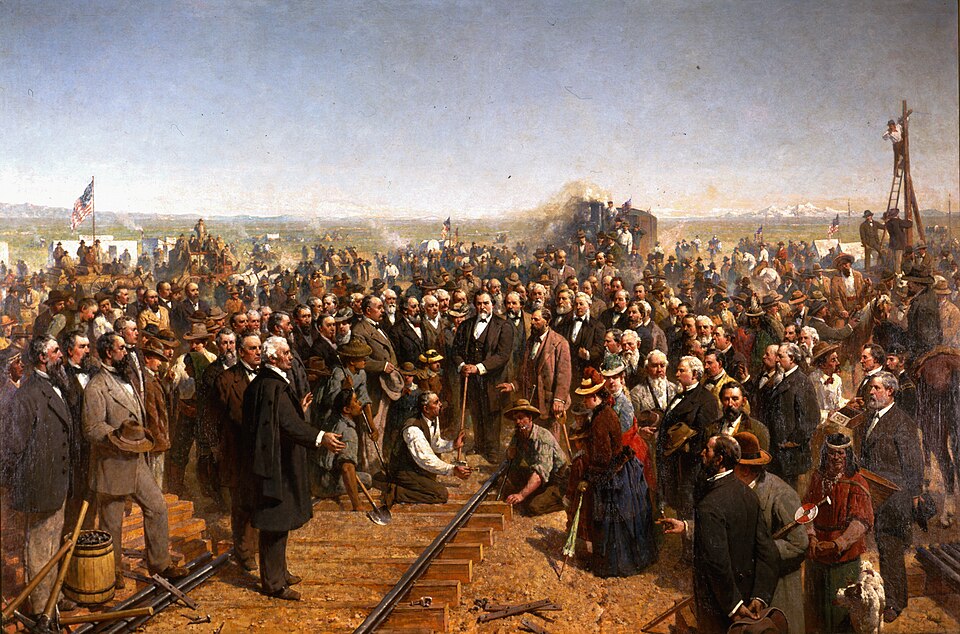

“The Driving of the Last Spike” painted by Thomas Hill – The painting depicts the ceremony of the driving of the “Last Spike” at Promontory Summit, UT, on May 10, 1869, joining the rails of the Central Pacific Railroad and the Union Pacific Railroad. It is worth noting that some of the people depicted in the painting were not at the Gold Spike ceremony (e.g., Collis P. Huntington, Charles Crocker, Edwin B. Crocker, Theodore Judah and Mark Hopkins). Only two of the members of the Central Pacific board of directors were present: Leland Stanford and Charles Marsh (who are depicted in the painting).

I did not know he fled San Francisco to buy a farm where he grew race horses.
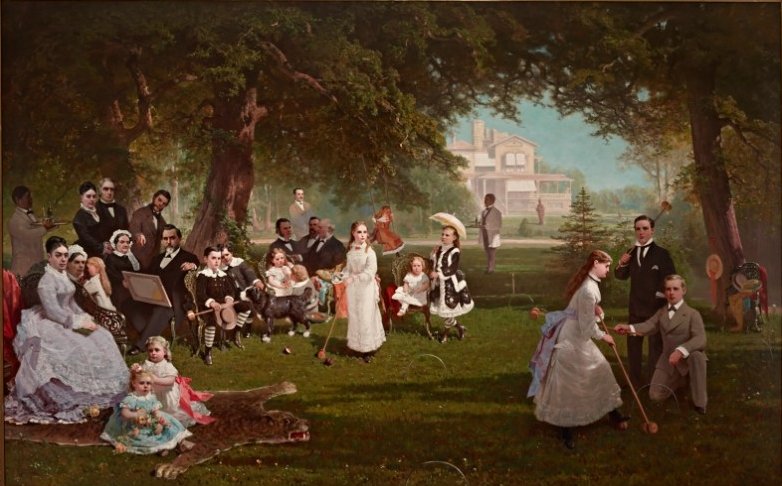

Palo Alto Spring by Thomas Hill The Stanford family, relatives and friends gathered on the lawns of their Palo Alto farm, which became the Stanford University campus. Jane Stanford, dressed in white, is shown on the far left. Leland Stanford holds a painting on his lap and rests his hand on the chair of his son, Leland Stanford, Jr. The artist, Thomas E. Hill, portrayed himself looking over his patron’s shoulder. The painting originally hung in the ballroom of the Stanford’s San Francisco mansion, which was destroyed in the 1906 earthquake.

I did not know Leland Stanford was at the origin of the first moving pictures by Eadweard Muybridge
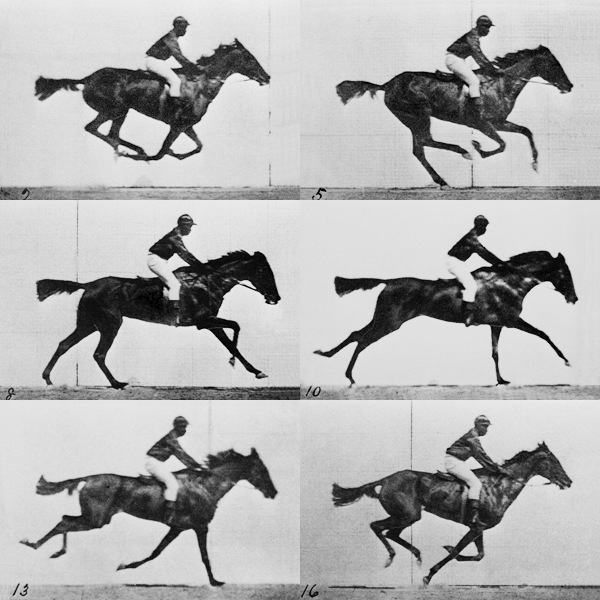
I did not know that this became both Stanford University and Palo Alto and that the tree after which the city is named is or was still around recently.

The XXth century until Second World War

There were things I knew and others I did not.

I did not know Jane Stanford was probably poisoned, and probably the responsible was David Starr Jordan, president of Stanford University. Once Jordan had full power, Stanford focused on bionomics, with people such as Lewis Terman. The Stanford-Binet IQ would be developed to select future geniuses in the student classes. However William Shockley would not be selected even if he would be awarded the Nobel Prize for the invention of the transistor in 1947. [As a side note, Shockley was also a pionneer of Operation Research and possibly creator of the man.month concept. A strange and somehow cynical count of return on investment, about the impact of bombs through a ratio of casualties on both sides…]

Silicon Valley did not exist yet, but the first technology companies were founded during that period, with Stanford alumni sometimes:
Federal Telegraph Company (FTC) founded in 1909 by Cyril Elwell (class of ’07).
– Russell and Sigurd Varian invented the Klystron in 1937 and founded Varian Associates in 1948. Russel was class of ’27 but not accepted for a PhD.
– Charles Litton (class of ’24) worked at FTC on the vacuum tube. He founded Litton Engineering Laboratories in 1931.
– Bill Hewlett and David Packard (both class of ’34) established Hewlett-Packard in 1939.

Much lesser known are political activists, for example:
– Kōtoku Shūsui founded the Social Revolutionary Party amongst Japanese-American immigrants, with links to the The Industrial Workers of the World (IWW), whose members are nicknamed “Wobblies”.
– Lala Har Dayal met Jordan in 1911 but would not stay at Stanford and created the International-Radical-Communist Anarchist Club by “weaving together atheism, Buddhism and Marxism” as well as the Bakunin Institute of California.
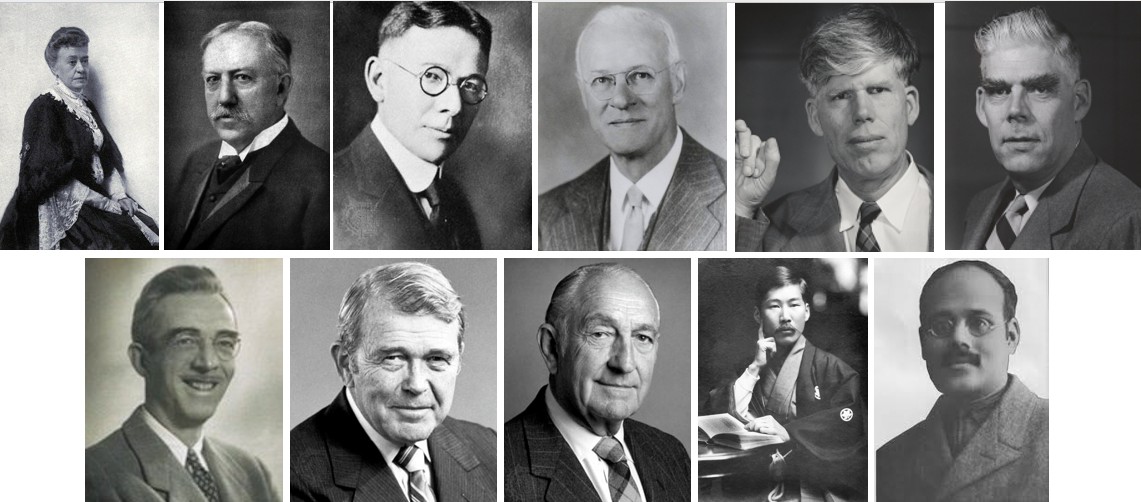

From left to right
Top line: Jane Stanford, David Starr Jordan, Lewis Terman, Cyril Elwell, Russell and Sigurd Varian.
Bottom line: Charles Litton, Bill Hewlett, David Packard, Kōtoku Shūsui, Lala Har Dayal.

The Chief

Herbert Hoover, aka “The Chief”, is another important personality of that History. I remember the Hoover Tower on Stanford campus, I had not always made the link to Hoover Dam but certainly to the Hoover Institution which I linked to the Republican Reagan/Bush period.

I was neither aware of his links to mining, agriculture and aeronautics. This is also the 1929 crisis followed by FDR’s New Deal. Capitalism against Communism. Agriculture implied modernization, engineering with the Hoover Dam and firms like Bechtel or Kaiser. In parallel, it was the development of Aeronautics with new programs at MIT, Stanford and Caltech. Hoover helped a few friends thanks to the Air Commerce Act : “The government facilitated leading men, who in turn facilitated the government’s facilitation. It wasn’t corruption that enabled Herbert Hoover, it was coordination, the way royal families arrange marriages.”
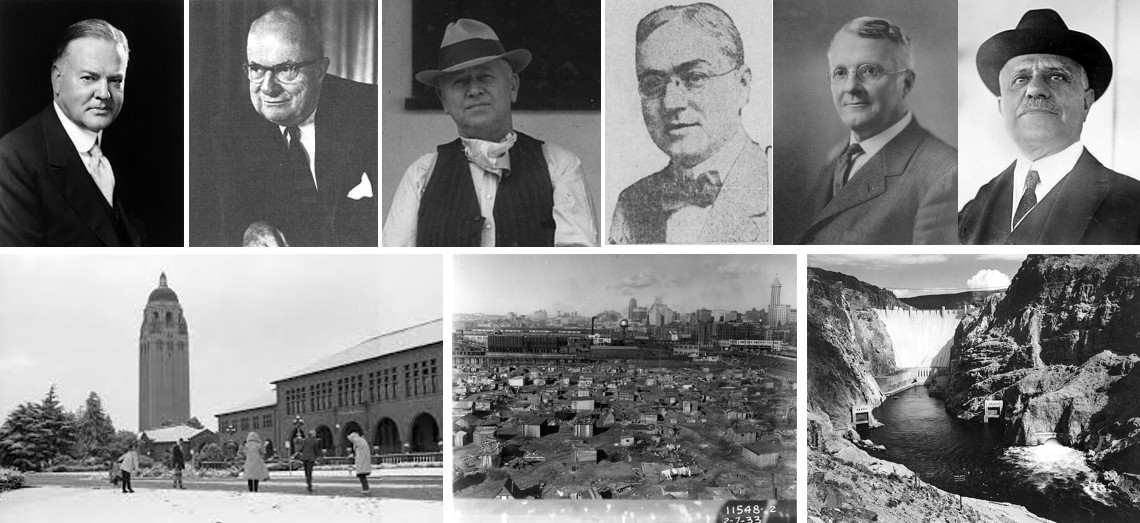

From left to right
Top line: Herbert Hoover, Henry Kaiser, Warren Bechtel, Henry Robinson, Harry Chandler, Daniel Guggenheim
Bottom line: Hoover Institution & Tower, Hooverville, Hoover Dam

The California Japanese

I did not know about the strange perception of race and gender in California : aristocratic, racist but in a weird way. Japan was superior, the “whites of Asia”. Stanford had women, Indian and Japanese graduates…
– Yamato Ishihashi, after a PhD at Harvard got the first Stanford endowed chair (by Japanese firms) in 1922.
– Noboru Shirai, one of the 22 Stanford’s Japanese students and only one of the 4 first generation immigrant, had opposite positions against the imperialist and criminal behaviors of his native countries.
Both would be interned in camps during 2nd World War though…
– Shuji Matsui, a left-wing progressive, would suffer beatings at Camp Tulelake
– Karl Yoneda would support strikes and be seen under “STOP THE JAPANESE AGGRESSION” banners.
“While David Starr Jordan was off shaking hands with the emperor and categorizing fish, American police were rounding up Japanese leftists and shippig them back as undesirable aliens to face imperial justice.” [Page 205]
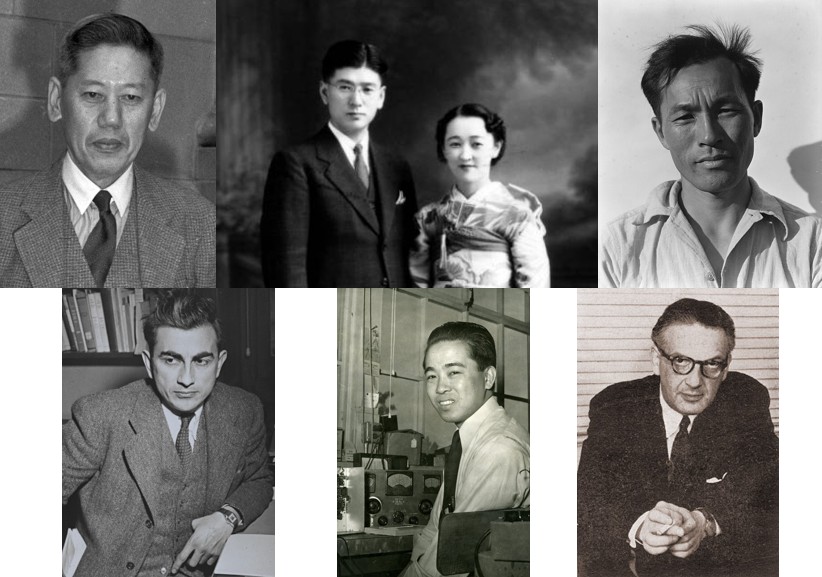

From left to right:
Top line: Yamato Ishihashi, Akiko and Noboru Shirai, Karl Yoneda.
Bottom line: Ernesto Galarza, Art Fong, Paul Baran.

A home front

Immigrants were not the only source of political fights as mentioned above but it was a strong element :
– Enersto Galarza (class of ’29) could have become an academic and decided to work all his life for better living conditions of working-class Latinos.
– Art Fong could not have housing in the while-only sector of Palo Alto despite having been hired by Bill Hewlett in 1946. “In my long career in Silicon Valley, I had always hoped that it would be my skill in science and computers that drew attention, not my race. And yet, I was often reminded of my Asian heritage. It’s a very strange thing, because in those early years, Asians seemed to have a difficult time everyplace. Other minorities like Jews, African-Americans, and Hispanics had similar problems. When we came to Palo Alto in 1946, we couldn’t find a place to live because all of Palo Alto had restrictive covenants written in the land deeds, for Caucasians only. It was illegal for me – a Chinese American – to buy or rent a house in the desirable parts of Palo Alto. But I was determined that wouldn’t stop me from trying. About that time in the post-war politics, local and national anti-discrimination activities were brewing. Soon there was US law passed which legally removed those covenants on the land deeds, all at once.” (quoted from here)
– Paul Baran, Russian-born and Stanford professor since 1949, would become the only tenured Marxist teaching economics in the USA.

After Word War II

During the post-war boom, Palo Alto developed thanks to military contracts. High-rise buildings were forbidden, zoning was carefully done, Santa Clara fruit-growing acres went down from 101’666 in 1940 to 25’511 in 1973. Thanks to the old public-private practice created since the XIXth century, “East Palo Alto went from white to 82% black within six years. When liberals suggested a north-south dividing to produce integrated schools, reactionaries created a high school right in the middle of East Palo Alto in 1958, which segregated the teenagers for the first time in a manner that endures to the present with few exceptions.” [Page 231-2]

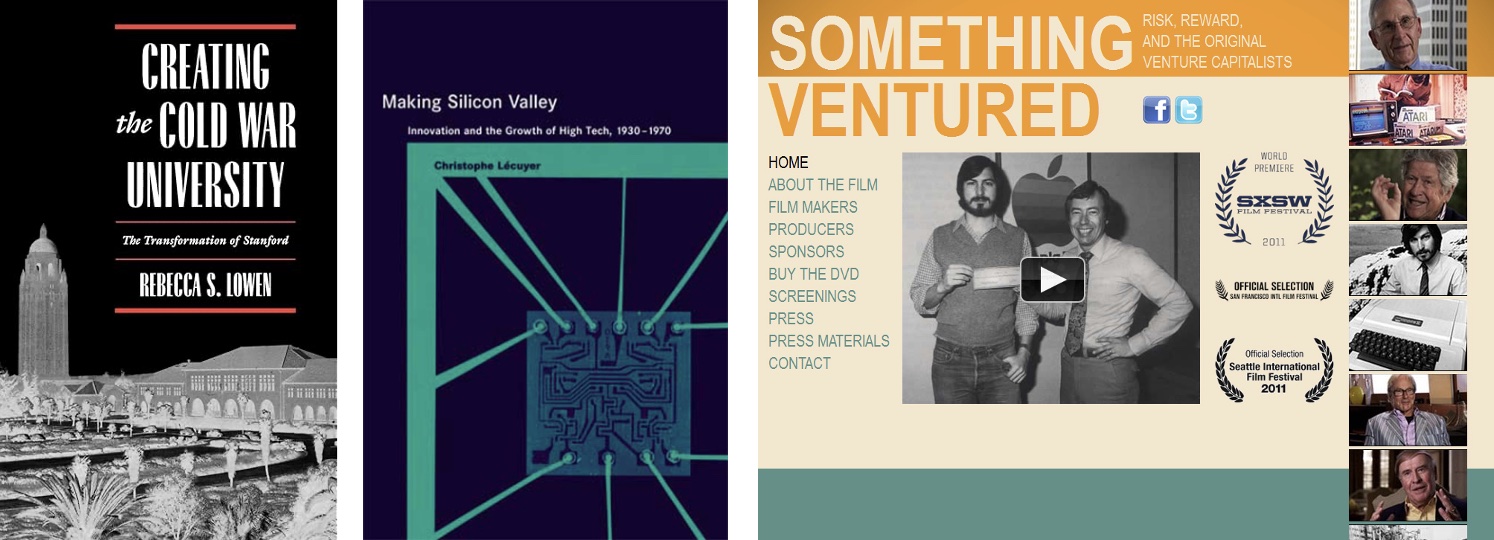
I am finally entering known territories. Malcolm Harris quotes Rebecca Lowen and Christophe Lecuyer to describe the impact of the transistor in the region. Fairchild, Intel, Arthur Rock.
And Malcolm Harris does not forget to add that the industry required a lot of low-cost workers. A tentative for a $1M machine was abandoned when workers could do the work three times faster. Fairchild would be the first to offshore with production in Hong Kong in the early 1960s (assembly work was 10 cents there vs $2.5/hour in the Bay Area and a transistor cost was 3 cents in material and 10 cents in labour.)

The Beat

“Surrounded by so much historical unfairness and noble defeat, how did white suburban winners in Palo Alto come to convince themselves and a surprising segment of the world that they were the real loser rebels?” [Page 294] This is probably the most moving chapter of the book. Again this was totally unknown to me. Artists which career never boomed. What would be the United States with a different outcome ? This reminds me of the concept of Lost Einsteins.


From left to right: Bob Kaufman, Joe Overstreet, Toy and Wing, Ruth_Asawa.

The book is worth reading for this chapter alone. Here is a poem by Bob Kaufman:

Aliens winds sweeping the highway
fling the dust of medicine men,
long dead,
in the california afternoon

Into the floating eyes
of spitting gadget salesmen,
eating murdered hot dogs,
in the california afternoon

And here is an excerpt from Alan Ginsberg [not easy for me and a bit out of context but which I wish to keep for my own archive]: Emerging up from 3rd class to First on great oceanliner – up the staircase to the deck – First thing I meet, huge faded negro Paul Robeson – in officer’s uniform – I salute him introducing myself which doesn’t mean much to him – he bows – I begin scheming immediately – Being a big officer Communist negro all these years perhaps he could get me a book in the NMU so I can ship out? I see he’s working on an open deck hole with a lift truck & wire lift placing 2nd hand turkish rugs in the hold – Old communist, I notice I am amazed at his calm – he is folding the dead in to carry that way – (Won’t they not smell up the exported carpets?) – I see one corpse in the hold lying face up on rug, he’s getting a layer of carpet to cover that. The corpse is a middle-aged man dead-faced & slightly rotten lying on a rug drest in a blue business suit. I wonder if I have the guts to face corpses like that negro communist. [Journals : Early Fifties, Early Sixties (Grove/Atlantic 2007) p177-78]

I had never thought that segregation was as high in California as it was in the South. But it was. Malcolm Harris illustrates it with many stories and I am unfair not to mention it much further. He also mentions a parallel fact about education that I found interesting : “So far I’ve focused on the state’s elite higher-education institutions [Stanford and UC Berkeley] but a number of historians give the California community college system at least as much credit for the region’s exceptional success in developing its various tech industries. . […] By the end of the 1920s, the state had 15’000 students across 34 junior colleges, more than one-third of the country’s junior college students among less than 5 percent of the U.S. population.” And this continued decade after decade. “The two-year schools switched their focus to vocational preparation, which critics alledged was designed to keep working-class youths away from professional paths, while defenders said it upheld the state tradition of the upwardly mobile technician.” [Pages 324-5]

Shoot (the computers)

There is so much violence in the history of the United States and of California in particular. More soon. Harris, again, is convincing thanks to the precision and high quantity of facts he shares with us. It is just a terrible history. Even worse: “it’s tempting to silo, say, the missile surburbs, microchip invention, the personal computer, and the political ’60s. But these developments weren’t just connected, they were the same thing.” [Page 334]

If the 60s were politically violent, the Kennedys, Martin Luther King, Malcolm X and his Ballot vs. Bullet speech, it did not stop there and went on until the mid seventies at least. If all of a sudden, it reminds me of American Pastoral by Philip Roth or more recent One Battle After Another, itself with links to Vineland by Thomas Pynchon, what should I say of Chapter 3.4, How to destroy an Empire. No doubt I did not know much about American revolutionary movements who were very close to physical violence. To protest against the war in Vietnam, the house of Bill Hewlett was firebombed. In December of 1971, militants bombed the Stanford Linear Accelerator Center.

There are again unknown figures to me. Stanford Professor H Bruce Franklin who moved from studying Hawthorne and Melville (“his thesis was based on a close reading of Moby Dick and Melville’s polyphonic use of mythology” [Page 336]) to Marx and Melville. He would not survive that long as a professor and [Lyman, then Stanford president] “suspended Franklin, obtained a court injunction banning him from Campus, and started the permanent removal process.” There are many more stories in particular in the April 3 movement web site, about Franklin or Aaron Manganiello, founder of Vencemeros. And what about these documents about SRI, Smash War Research (pdf) or even threats against David Packard (in pdf again) (who had become United States Deputy Secretary of Defense under Nixon even if for not long). In 1969, Angela Davis had been fired from UCLA.

“The dramatic dead end of the Bay Area armed struggle was a May 1974 shootout in Los Angeles. This was not the world Shockley’s equations promised. Battered first in Vietnam by the Vietnamese people and second on the home front by the Third World solidarity movement, America’s leadership came to grips with the unthinkable: losing the war. […] Partial defeat in the Cold War’s first half catalyzed a conservative revitalization as America’s ruling class came to understand the stakes. They abandoned the compensatory state and its equalizing mission to focus on individual rights. […] Tuition fees at the University of California system doubled in the ’80s then tripled in the ’90s.” [Page 357]

Another example is Cedric Robinson who “criticized his discipline’s concept of leadership and offered counterexamples of African “stateless societies” or “tribes without rulers” – particularly the anarchistic Tonga – the political science department lost its integrationist nerve. Faculty members declined to sit on his committee, passive-agressively consigning Robinson to academic purgatory.” [Page 358]

In 1975, after a series of layoffs at Fairchild, led in part by former assembly line worker Roxanne Dunbar, activists arrived to “find police snipers lining the roof of the plant building and tactical squads swarming the place in riot gear”. [Page 359]

Allard Lowenstein, a close advisor to Bobby Kennedy, spent his life trying to cool down the hard-liners and bring them into the left wing of liberalism. Dennis Sweeney, a likable Stanford student with a harsh family life (who according to others seemed to be like the first person back from Dachau) went to Lowenstein’s office in Manhattan in the spring of 1980 and shot him to death (because, mentally ill, he believed that Lowenstein was plotting against him.) Even if it was a tragic waste, there would be an unsigned editorial “No tears for Allard Lowenstein”.


From left to right: H Bruce Franklin, Venceremos, with Aaron Manganiello pictured on the right, Cedric Robinson, Roxanne Dunbar, Allard K. Lowenstein.

“With the growing unrest in the country, the increasing sophistication of saboteurs and the potential that computers offer for easily inflicted and costly damage, major precautions are necessary for data processing managers to fully protect their computers.” [Page 358]

“If the 60s and early 70s had been Power to the People, they were followed by the re-empowerment of owners relative to workers after the uprisings at home and abroad via unemployment and de-industrialization immigration, offshoring, and all manner of technological and organizational changes.” [Page 364]

Individualistic conservatism

Malcolm Harris enters a new subject with that new period : individualistic conservatism. “Immigration and offshoring were the two sides of the same coin.” He mentions again the cost of fabrication at home and assembly offshored. Even worse Shockley would become the hero of the pseudoscience of racial difference. The Vietnam war would have unpredictable consequences : “By 1984, Hewlett-Packard employed 4,000 Vietnamese immigrant workers in low-level jobs. These workers tended to be skilled, politically conservative and desperate. It’s not a coincidence that the South Bay maintains the country’s largest concentration of Vietnamese immigrants to this day. Silicon Valley firms were ready to absorb thousands of refugee workers at the same time and for the same reason they were refugees in the first place”. [Page 365] “It seems counterintuitive to pay some workers not to pay other workers, but by using stock options and grants to align professional employees’ interest with ownerhsip, firms could provide a paternalistic atmosphere for high-value engineers while keeping the aggregate wage low enough to generate double-digit profits even as prices fell. The labor-hostile surburb kept its production wages low by locking organized labor out of its factories.” [Page 366]

In 1994, AnnaLee Saxenian described the results of the previous couple of decades: “There are approximately 200,000 union members in the four-county [Bay Area] region, but virtually none work in high technology industries. No high technology firm has been organized by a labor union in Silicon Valley during the past twenty years, and there have been fewer than a dozen serious attempts.” It was a brutal period for workers and a correpondingly excellent one for the men who employed them. [Page 368]

White working-class homeowners began to identify as white and homeowners more than as members of the working class, and not without reasons. If their human capital was depreciating rapidly, their home values jumped. […] With home ownership also came guaranteed places in the California public school system, where the professionaals workers of the future were trained. […] The California dream was always about land speculation premised on racial exclusion and domination. [Pages 378-9] Education improved for the rich and got worse for the poor. [Pages 382]

Tax breaks the same… Reagan was soon to become president, and behind him the Hoover institution. Individualism, privacy, property, competition thanks to deregulation, privatization and tax cuts that reinforced each other. Workers benefited from pension funds but the unions didn’t generally manage their voting shares… [Page 406-7]

The huge capital-gains tax cut – more than 50 percent – and pension-investment deregulation helped turn venture capital from something small groups of well-connected buddies did in Cambridge. Capital in the funds quadrupled in the early 1980s, from $1 billion at the close of the 1970s to $4 billion in 1983. [Page 408]

Malcolm Harris again surprised me when I thought I was in known territory. On pages 408 and next, he begins with the Tragedy of the commons to explain the privatization of public goods. “This represented a change in the ideology, from recognizing the need to build up an intellectual property commons for new industries to creating the best investment climate possible by constraining the spread of new tech. Whereas lively antitrust enforcement ensured the proliferation of the first transistor licenses, the new state religion encouraged techno-monopolism on the public dime.” The Genentech story is well-known and I am a little surprised though with the argument here. I had the feeling the DNA patent was non-exclusive as the transistor one. I might be wrong but it seems to be mentioned here. I did not know either that Donald Kennedy, president of Stanford, had to resign in 1991 for the school’s alleged abuses of federal research funds.

New World Order

The Reagan era – which includes Carter’s presidency as well as George Bush Sr. and arguably, Clinton, George Bush Jr., Obama, Trump and Biden, at the time of this writing, put America back on its narrative track. The country’s time in the sun wasn’t over. […] Innovation was the new watchword, high-tech the new American brand. But what made this strategy more successful in this period than it was in the preceding years? Computerization didn’t add enough efficiency to the country’s manufacturing processes to make them competitive. […] The rapid Soviet acsent in science and technology proved there wasn’t anything special or inherently faster about the capitalist development road. […] The military Keynesian strategy succeeded in keeping a border with the reds – Japan, Taiwan, South Korea, and West Germany remained a solid buffer against failing dominoes. [So ? … but] As capital concentrated in fewer hands, it grew easier to get everyone on this same pager, a pager later named the Washington Consensus. Harris adds a few other points such as immigration both from this buffer countries as well as “by the end of the 70s, 99.7 percent of the more than one million people admitted under parole were from communist countries”. Harris also mentions corrupt regimes such as Iran or the Philippines which induced a lot of not to say hugh financial flows including the ones that would finance counterrevolutions all over the world. The section about Stanford Technology Corporation [pages 428-38] is particularly enlighting.

The anecdotal part about Steve Jobs and Trey (Bill) Gates is very well-known territory but again Harris’ analysis is original. “The true path of invention is rarely clean or simple, but when scientific credit fails to align with net worth, the second trumps the first in public memory. After all crediting inventors is notoriously difficult; every innovation building on the last, every inventor inextricably embedded in a series of communities. Two or more often alight on the same idea at the same time. Money provides a sort of scoreboard, an equivalent by which we can compare the otherwise incomparable.” Harris reminds us that “it’s the connectors who are more responsible than the inventors or even the specific siloed visionaries. […] More sophisticated than the Great Man version, this ecosystem analysis still takes its object for granted. The Great Region histories, like AnnaLee Saxenian’s *Regional Advantage* and John Markoff’s *What the Dormouse Said*, see Silicon Valley as a place of creation rather than transformation. By placing these stories in the context of statewide, national and global changes, we can better understand the microcomputer industry. Steve Jobs and Bill Gates are very important characters in the story, but they’re more meaningful as personifications of impersonal social forces. If Jobs and Gates hadn’t been themselves, some other guys would have been instead.” [Pages 453-54]

“There was an important difference between Gates and the hobbyist community: Trey Gates didn’t learn to code on a public system, not mostly. Gates got his computer training via an exclusive private school contracting with a private company that was financed by private capital. Trey Gates was an avatar of suburban bifurcation. […] The giants of Silicon Valley’s pre-silicon days tended to be handsome, athletic, and likable. […] Bil Gates and Steve Jobs, by contrast, had poor personal hygiene, didn’t play sports, and were both noted jerks. Neither served in the military, and both dropped out of college quickly. They ended up with two different corporate strategies, and occasionally became business opponents, but they personified the same historical forces. […] This has been described as the transition from “bureaucratic” to “nerd” masculinity. […] Any laborers a company couldn’t easily replace were aligned with ownership via stock option.” [Pages 455-59]

Then computers needed to be connected. This is the story of Bob Metcalfe and 3com, of Arpanet and wireless ALOHAnet, of ethernet and TCP/IP, of the router with William Yeager, Andy Bechtolsheim, Leonard Bosack and Sandy lerner, the last two being the founders of cisco Systems (which story of its neginnigns would be worse reminding [pages 463-4 or here at www.tcracs.org/tcrwp/1origin-of-cisco].

The Internet will soon follow and again even if the history is well documented, Harris provides an interesting point of view. America was pro-business and even if some presidents were Democrats, the Hoover institution distilled its ideology not just during the Reagan or Bush presidencies. I am not sure what Harris says of its influence over Trump. He provides interesting (Marxist) views on geopolitics and economics: “over half – up to 80 percent – of the country’s employment growth between 1984 and 1997 came in the form of externally contracted workers. And those were the jobs kept onshore; statewide, electric and electronic manufacturing employment fell 38.7 percent between 1980 and 1995. […] Capitalists were winning because their workers were losing, a reality well camouflaged by the whiz-bang excitement Silicon Valley produced.” [Page 474]. “America imported a bifurcated cohort of immigrants to fit a bifurcating pattern of employment, and for every Silicon Valley investor or board member or founder from the Third World, there was a family of refugees in a local basement performing the low-wage manufacturing labor that animated the computer industry’s numbers. Neocolonialism provided more than a market for Silicon Valley’s defense-ish electronics: it provided a labor force as well” [Page 475].

The 21st Century

His analysis of the parallel development of the coffee and cocaine markets is equally striking [Pages 479-484]. The Internet has disrupted many other markets. One need only note the stories of Netscape and the antitrust lawsuit against Microsoft [pages 485-90], recall Alan Greenspan’s famous “irrational exuberance” [page 488], the deadly competition between Healtheon and WebMD, between Pets.com and Petopia, between WebVan and Homegrocer, between Ticketmaster and tickets.com, between Rio, Naptser, Winamp and Realplayer. Republicans didn’t like Clinton, but their policies weren’t so different.

And again “Google could afford to contract low-wage workers to drive cameras around and to turn pages. . […] In the grand NorCal tradition of labor-market segregation, these laborers carried unique yellow badges, though that was hardly necessary to mark them, “it was the same group of workers, mostly black and Latino, on a campus of mostly white and Asian employees, walking our of the exit like a factory bell had just gone off”. They entered and exited at their own special scheduled times – 4:00am and 2:15pm – so as to spare the white-(employee), green-(intern) and red-(contractor) badged Googlers an awkward confrontation with that particular internal hierarchy” [Page 515 – you can also a longer description of Google from where this excerpt is coming from in The Artist Leaving the Googleplex by Andrew Norman Wilson]. Malcolm Harris emphasizes the harsh, not to say sometimes inhumane, working conditions (as seems to be the case in Amazon warehouses). The fact that this was also the case for Apple, or is the case for Google in the United States, is somewhat surprising, given the emphasis placed on an original and appealing approach to engineers’ working conditions. A significant discrepancy indeed.

Of course this globalization decentered the world towards Asia and China in particular. Foxconn would be its most visible illustration and not really for good. Suicides would happen there and Harris quotes a chinese poet and Foxconn employee, Xu Lizhi, who would commit suicide later [Page 540]. So I quote him too:


Xu Lizhi, Chinese poet (1990-2014)

“I Fall Asleep, Just Standing Like That” from libcom.com
拒绝旷工,拒绝病假,拒绝事假
Refuse to skip work, refuse sick leave, refuse leave for private reasons
拒绝迟到,拒绝早退
Refuse to be late, refuse to leave early
流水线旁我站立如铁,双手如飞
By the assembly line I stood straight like iron, hands like flight,
多少白天,多少黑夜
How many days, how many nights
我就那样,站着入睡
Did I – just like that – standing fall asleep?

“A Screw Fell to the Ground” again from libcom.com
一颗螺丝掉在地上
A screw fell to the ground
在这个加班的夜晚
In this dark night of overtime
垂直降落,轻轻一响
Plunging vertically, lightly clinking
不会引起任何人的注意
It won’t attract anyone’s attention
就像在此之前
Just like last time
某个相同的夜晚
On a night like this
有个人掉在地上
When someone plunged to the ground

Bifurcations

Continental divide, digital divide, educational divide. One may not view the world the way Malcolm Harris does. Politics seem to be closer and closer to religious faith. People do not look at facts to see some truth. What a strange world. But it is worth reading Palo Alto until the end. The high school created in East Palo Alto has finally been closed and replaced by a shopping mall with low wages employees. The mall “inaugural plaque acknowledges Bank of America and the David and Lucile Packard Foundation. At the very bottom: ORIGINAL SITE OF RAVENSWOOD HIGH SCHOOL. [Page 551]

If China has mainly invested locally, Russia has a different fate with oligarchs investing their money abroad. But again Harris claims these are two faces of the same coin. Yuri Milner and Alisher Usmanov invested big time in Silicon Valley through Digital Sky Technologies (DST): $200m for 2% in Facebook and more later to reach 8-10% of the startup, $380M in Twitter, some in Groupon, Zynga and Spotify and something I did not know, were major investors in Paul Graham’s YCombinator. “If tech companies – along with expensive art and luxury housing – were a bet on further bifurcation and inequality, then they gave the world’s oligarch community a chance to double down on its own prosperity. And it works – for Russian billionaires, for American billionaires, for Taiwanese billionaires, and even for most mainland Chinese billionaires. The value chain links ex-Soviet extractionists like Usmanov – convicted of and imprisoned for “theft of socialist property” in the 80s – with Foxconn’s company towns and their mandatory overtime, corporate dorms, and loathsome security patrols.” [Page 548]

In 2009, 42 people were arrested in East Palo Alto (EPA), dismantling the Taliban drug dealing gang on Sacremento St, “a cul-de-sac off University Avenue. The struggle for drug territory drove EPA’s violence in the period, giving it the country’s highest per capita murder rate in 1992”. (This is not new, the interested reader could watch French Documenary the Last Town on Arte or read here The Capital Sins of Silicon Valley). In another bifurcation well described by Harris by mentioninig My Posse Don’t Do Homework by LouAnne Johnson as well as Unforgetting: A Memoir of Family, Migration, Gangs, and Revolution in the Americas by Roberto Lovato, the author describes the No Child Left Behind as a “soft bigotry of low expectations”, a brilliantly phrased subtle attack on affirmative action. Whether they [kids] would be in better classes in better schools a separate question. […] Capitalists needed low-wage employees because that’s where the growth was. If all the kids in East Palo Alto became engineeers and doctors and lawyers, who would fill the hundreds of jobs at the new IKEA by the freeway [Page 557-8].

At the other end, a few entrepreneurs would create new teaching tools such as SCORE! and the Education Program for Gifted Youth (an online school at $28,610 tuition). “The schools are good because the houses are expensive, which makes the houses more expensive and the schools better, which makes the houses more expensive and the schools better, which makes the houses more expensive and the schools better“. [Page 562] When the Stanford student startup Instagram sold for $1B to Facebook, it only had 13 employees. “Beneath the mounting valuations are a relatively small number of hyper-competitive employees. The super-coders are the most notorious, having cultivated a professional mystique, but the non-technical managers are just as important for rapid growth. The coders certainly don’t work as fast without them. Bolstered by armies of unseen contractors, Silicon Valley’s high-IQ workers, the veterans of SCORE! fulfilled Lewis Terman’s wilded dreams.” […] It’s not behaviorism, it’s neobehaviorism. To heighten productivity, the paradigm of disciplination is replaced by the paradigm of achievement. Stanford’s horses were the original achievement subjects and they were proned to burn out as well. Society produces “depressives and loosers” as its human exhaust. Even the killers are nerds. [Page 562-5] Palo Alto is becoming the place that produces Baby Einsteins, but one of these students says: “We are lifeless bodies in a system that breeds competition, hatred, and discourages teamwork and genuine learning. We lack sincere passion. We are sick… It is time to realize that we work our students to death” (See below the article by Carolyn Walworth). Following the many suicides in Palo Alto’s high schools, With no smoking gun in the report, local leaders could adopt the same line Steve Jobs used with regard to the Foxconn suicides: “It’s sad, but sometimes people kill themselves”. Still, in both these environments, there was only so far anyone could spread the blame. In January of 2010, a Foxconn worker jumped to his death the day after a teenager in Palo Alto died on the tracks. In January of 2011, it happened again. The second time they were both nineteen years old. [Page 567] “The beauty of the design is that the rewards call forth the winners, and the winners create losers. It’s impersonal: forces not men.” [Page 568]

Harris published his book in 2022, there was no ChatGPT yet, there was no Trump II yet, but Harris mentions the PayPal mafia, including Musk and Thiel who employed JD Vance and sponsored Curtis Jarvin. He also mentions Theranos, Snowden, the Google buses, Uber and Palantir. “Compared to the past cohorts of successful Silicon Valley tech founders, the crab platform leaders made Steve Jobs look like Steve Wozniak” [page 580]. “Capital’s ever-accumulating need for profitable sinks is incompatible with the kind of democratic control over modern technology that the Black Panther Party put on its program. […] It may be that Silicon Valley is best understood as a particular expression of this impersonal drive: geographic, historical and imaginary. It represents the gold rush and the next gold rush and the one after that, from produce to real estate to radios to transistors to microchips to missiles to PCs to routers to browsers to web portals to iPods to gig platforms to… If California is Americas’s America, then Palo Alto is Americas’s Americas’s America” [Page 616].

I am not sure if the reader will follow Harris in his conclusion, which reminds me of the end of Fahrenheit 451. Let me add a final extract : “If the intergalactic capitalists win, if they do exhaust the earth and humanity then for the sake of my historical reputation and that of everyone I’ve ever loved, I hope the post-humans judge that we were already too late, that we never had a chance. Maybe that is the case – as I’ve argued, the general state of things is increasingly dire for many people – but I don’t believe it. Even if I could be made to believe it, I would choose not to. I am committed to this planet, which means I have to hold on the possibility of an alternative to capitalist exhaustion” [Page 619]. These words, his words are also mine.

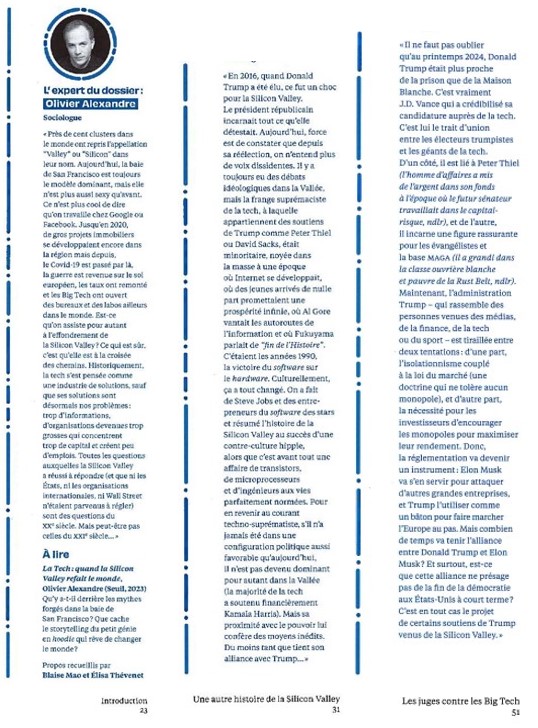
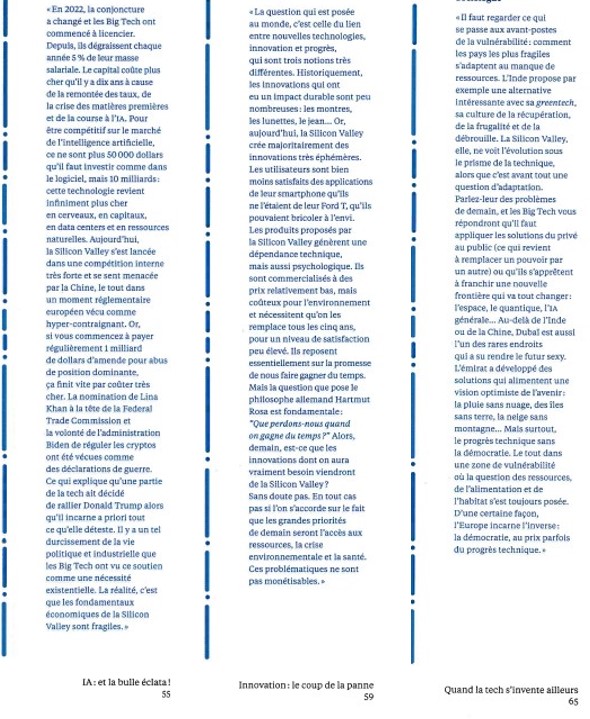
PS: I’m including here an excerpt from another book review by the excellent Olivier Alexandre, his “optimistic” conclusion to the current crisis: “In a highly competitive world, where nothing lasts, starting with tech companies (the tragic fate of Kodak, Nokia, BlackBerry, and Yahoo reminds us of this), this notion conveys the idea that a homogeneous category of actors has long since seized control of history, and will continue to do so for a long time. This overlooks, as the book reminds us, that this domination is entirely conditioned by the interplay of actors and a constantly evolving institutional framework. Moreover, the narrative is constantly being traversed, interrupted, pulled in one direction and then another by individuals and groups, companies, but also government agencies, hackers, whistleblowers, academics, and activists. Perhaps this is enough to offer a glimmer of hope to all those who feel trapped in the web.” It could have been a conclusion of Malcolm Harris book too!

PS2: I mentioned in the beginning an NPR account of the book. I found more critics worth mentioning :

The Children of California Shall Be Our Children: On Malcolm Harris’s “Palo Alto” by Ben Beitler, February 14, 2023 https://lareviewofbooks.org/article/the-children-of-california-shall-be-our-children-on-malcolm-harriss-palo-alto/

Greed, eugenics and giant gambles: author Malcolm Harris on the deadly toll of Silicon Valley capitalism by Lois Beckett, The Guardian, May, 11 2023
https://www.theguardian.com/books/2023/may/10/palo-alto-book-malcom-harris-interview

The Marvellous Boys of Palo Alto: From Silicon Valley Bank to Sam Bankman-Fried, the recent scandals upending the tech industry are rooted in a longer tradition of innovation and impunity by David Leavitt, The New Yorker March 20, 2023
https://www.newyorker.com/books/under-review/the-marvellous-boys-of-palo-alto

About the Silicon Valley Suicides

In Palo Alto’s High-Pressure Schools, Suicides Lead To Soul-Searching by Arun Rath, NPR, May 11, 2015
https://www.kqed.org/news/10521875/in-palo-altos-high-pressure-schools-suicides-lead-to-soul-searching

Why are so many kids with bright prospects killing themselves in Palo Alto? By Hanna Rosin, The Atlantic, December 2015 Issue
https://www.theatlantic.com/magazine/archive/2015/12/the-silicon-valley-suicides/413140/

Paly school board rep: ‘The sorrows of young Palo Altans’ by Carolyn Walworth, March 25, 2015
https://www.paloaltoonline.com/news/2015/03/25/guest-opinion-the-sorrows-of-young-palo-altans/

and a short text : The Price of Perfection: The Silicon Valley Suicides, Dec 16, 2015
https://thekimfoundation.org/the-price-of-perfection-the-silicon-valley-suicides/

The Atlantic published an article by Hanna Rosin entitled “The Silicon Valley Suicides: Why are so many kids with bright futures killing themselves in Palo Alto?” Rosin paints a picture of a place of affluence, success, and high expectations. However, at Gunn High School in Palo Alto, California, the 10 year suicide rate is four to five times the national average. By March of 2014, 42 Gunn students had already been hospitalized or treated for “significant suicidal ideation,” since the start of the school year. In a survey conducted in the same year, 12 percent of Palo Alto high-school students reported having seriously contemplated suicide in the past 12 months.

What is happening that is pushing kids to their breaking point? While we can’t pin point the exact reason why anyone ends their own life because of the complexity of suicide, there have been theories surrounding the high-pressure academic atmosphere that Palo Alto exudes.

Carolyn Walworth, a junior at Palo Alto High School and a school district student board member, wrote an article about her experiences as a student. She explains that as young as elementary school, children are either deemed “early” or “late” readers. While the “early” readers are labeled smart, the “late” readers are left feeling inadequate, and this constant cataloging follows them into high school.

“I like to think of this as the reason I lost my enthusiasm and confidence for math so early,” says Walworth. “How could I possibly feel intelligent when the class I was in was considered dumb?”
She describes the constant pressure to be in the advanced classes, participate in sports, school clubs, attend weekend SAT prep courses, obtain internships, and complete excessive amounts of homework, all while enduring the typical pressures of being a teenager. It is indeed exhausting and stressful. Walworth explains that this isn’t an issue of lack of coping skill, but merely an issue of too much to cope with.

In the late 1990’s, Suniya Luthar was an assistant professor in Yale’s psychiatry department. Luthar was doing research at a low-income, inner-city school in Connecticut. She wanted to find out whether misbehavior correlated more with poverty or with a stage of adolescents. Luthar needed a second school to use as a comparison and was connected with as upscale suburban school. What she found was shocking. The proportion of kids who smoked, drank, or used hard drugs was significantly higher in the suburban school, as was the rate of serious anxiety and depression. This anomaly started Luthar down a career-long track studying the vulnerabilities of students within what she calls “a culture of affluence.”

“We assume that because these kids have money and a good education, everything is fine,” Luthar says. “And in the long run, money and education will protect them, but in adolescence, the dangers posed by the culture of affluence can be quite potent.” However, that doesn’t mean kids who come from an affluent backgrounds are more likely to kill themselves. Studies on youth suicide have generally turned up few differences among social and economic classes. This finding simply means that there are a lot of youth from all walks of life suffering.

In the United States, there are about five youth suicide clusters a year and Palo Alto is well into its second. Whatever the reasons are, something must be done to change the culture of perfection among this community. Reaching out for help must begin to be viewed as strength, not as a weakness.

Why haven’t we created a Google yet?

A revealing debate on “Why haven’t we created a Google yet?” [in France]. It’s fascinating, irritating when you disagree, and exhilarating when you recognize yourself in the discussion. Needless to say where I stand… but I should add that my reading of the book *Palo Alto*, which I’ll be discussing here soon, compels me to add a great deal of nuance to the love-hate relationship that exists between the two continents.

The World of Startups according to Marion Flécher (Part 2)

In my post of November 8th, I promised to “read Marion Flécher’s book with great interest and will write to you in a future post to see if I find cause for resignation or optimism regarding the startup world.” I’m going to say both! The book is indeed excellent and perfectly describes the differences between France (which tried to claim to be a Startup Nation) and Silicon Valley (which never felt the need for such a claim).

The Difficulty of Defining the Word “Startup”

The heart of the book is not the comparison between the two regions, but rather what the French startup scene is like; I will return to this point. In her introduction, she explains the difficulty in defining the word, to the point of writing: “Making startups my subject of study was not a given. […] I was encouraged to use alternative terms such as innovative companies, technology companies, or high-growth companies” [page 16]. With a striking analogy, she adds, “as with the art world, in which players spend their time trying to determine what is art and what is not, it is by observing how a world makes these distinctions, and not by trying to make them ourselves, that we begin to understand what is happening in that world” [page 20]. Without naming Steve Blank, through a survey of entrepreneurs who gave her a multitude of definitions, she almost mentions my favorite definition: “a temporary organization in search of a repeatable and scalable business model”.

Silicon Valley, Heart of Startups

In her first chapter, Marion Flécher describes Silicon Valley, the region that gave rise to the semiconductor, the microprocessor, the microcomputer, software, the internet, social networks (and ultimately artificial intelligence, which had not yet emerged when she conducted her research). She demonstrates that the region was at the heart of a revolution that goes beyond technological innovation. This innovation was “accompanied by organizational and managerial innovations that led to a profound ideological redefinition of the entreprise” [page 52].

Yet, she shows that pinpointing the moment of their emergence is just as difficult as defining startups. “For many historians and ethnologists specializing in Silicon Valley, it is Intel’s invention of the microprocessor that constitutes the true starting point of the region’s technological boom and rise to power” [page 39]. She does not, however, neglect to note the importance of Hewlett-Packard (founded in 1939) and Fairchild (founded in 1957) in this dual revolution, including the development of project-based work in small teams, the upheaval of dress codes, and the implementation of new incentive structures [pages 52-53]. The complexity of the region’s origins also stems from the existence of other significant influences such as free software and the “Do It Yourself” culture [pages 55-56], and from a diversity of major players including venture capital funds, the federal government, and the companies themselves. A world, as the author describes it, an ecosystem.

Another difficulty addressed by Marion Flécher, at least for a Silicon Valley enthusiast like myself, is: when did the word “startup” first appear? “The term ‘startup’ seems to have been used for the first time in 1976, in a Forbes magazine article, to refer to young technology companies in Silicon Valley” [Author’s note: The Unfashionable Business of Investing in Startups in the Electronic Data Processing Field]. “The term ‘startup company’, which associates the startup with a specific type of business, appeared a year later in an article entitled ‘An Incubator for Startup Companies, Especially in the Fast-growth, High Technology Fields,’ published in Business Week in 1977.” The author adds that the term acquired its current meaning and spread worldwide during the 1990s, even though this new business model can be traced back to the 1940s. NB: I confirm this in a blog post: When was the word “start-up” first used?


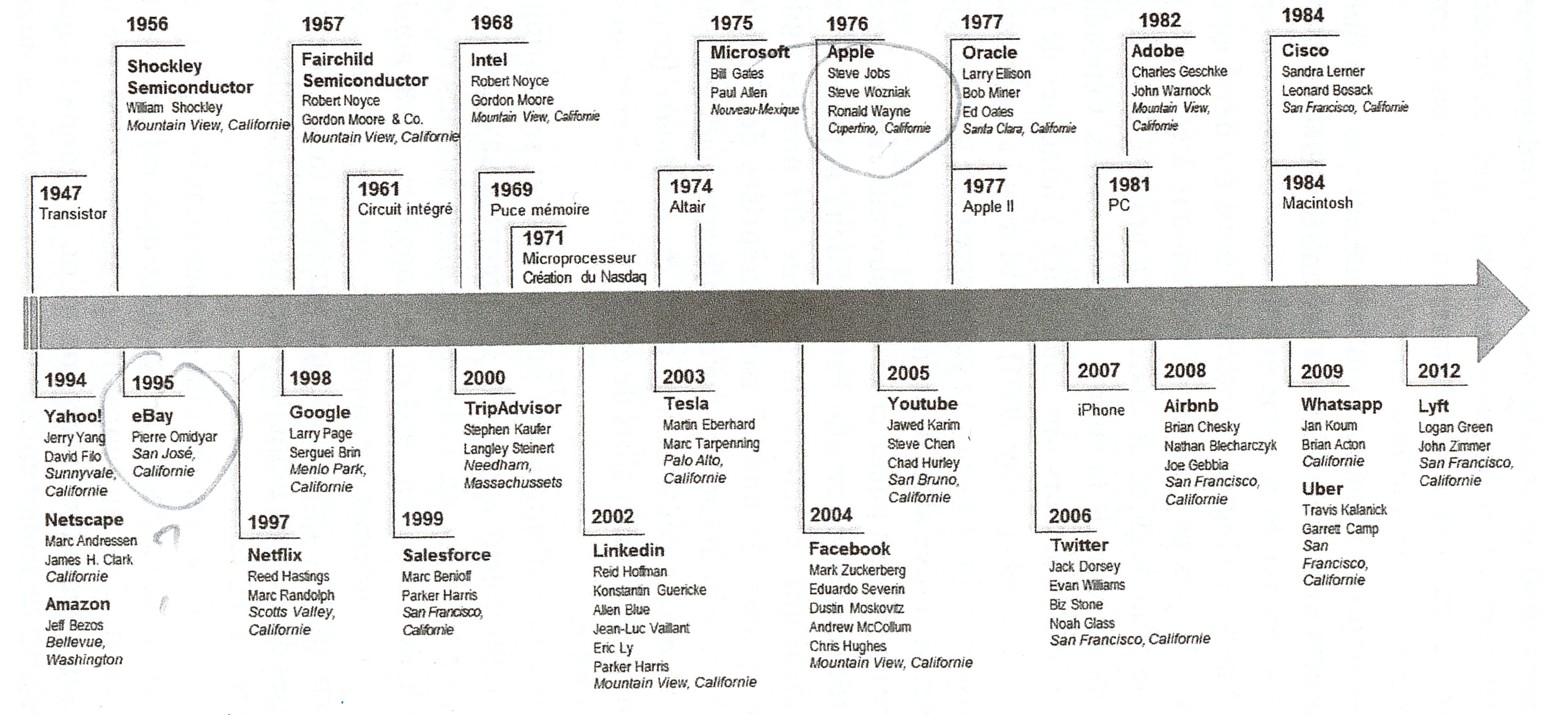
Scan of Figure 2 [page 43]: Timeline of the main Silicon Valley technology companies. I circled two things by hand while reading. My surprise at seeing only one founder for eBay; I thought Jeff Skoll was a co-founder, but apparently he may have only been the first employee. And my other surprise at seeing three co-founders for Apple, which is rarely mentioned. Ronald Wayne is often forgotten. And then a rather unimportant note for Marion Flécher: Wo[lk]zniak is misspelled on page 41!

Risk and Uncertainty

In a brief but equally excellent section on venture capital, Marion Flécher explains that “unlike risk, which refers to a situation that can be predicted by probability and in which actors can reason rationally […] uncertainty refers to a situation in which the degree of singularity is such that it cannot be compared to any other. By developing disruptive innovations, Silicon Valley entrepreneurs create situations of radical uncertainty in which actors can only make speculative judgments” [page 46]. This explains why the term [ad]venture capital is very different from the term capital-risque in France (which is undoubtedly indicative of dissimilar worlds). “Nevertheless, these players have resources that allow them to transform the uncertainty of a situation into a quantifiable risk. Their activity requires, first and foremost, a sound knowledge of the technical environment, which enables them to assess the growth prospects of projects. Most investors […] are thus often former engineers or entrepreneurs” [page 47]. This is undoubtedly another major difference between Silicon Valley and France.

Since I mentioned personal surprises in the commentary on the figure above, I take this opportunity to add a few more personal comments (for myself, the author, and any potential reader!):
– Without a doubt, the startup world is a new illustration of capitalism, and this has undoubtedly been misunderstood. Startups have never been liberated companies; trade unions are very rare, not to say unwelcome. I already mentioned this point in my first post.
– Marion Flécher emphasizes intellectual property (Microsoft’s proprietary software, Intel’s microprocessor patent), which creates near-monopolies favored by a state that “seems to have implicitly supported market concentration” [page 49]. Yet it was the state that forced Bell Labs to grant licenses for the transistor, for which the company held the patent. Intel certainly had a near-monopoly on the microprocessor, even though IBM and AMD were genuine competitors. But competition in new sectors has made Intel a declining player in recent years (telecommunications, artificial intelligence). I would say that the US government is protecting the country at a macroeconomic level by defending its technological lead rather than protecting any individual company. OpenAI might replace Google, which could have replaced Microsoft, just as Nvidia or even AMD might replace Intel. The same goes for mobile phones. The US remains the leader.
– Another minor point of doubt: “Between 1998 and 1999, venture capital almost doubled, going from $3.2 billion to $6.1 billion” [page 48]. I have the impression, and I could be wrong, that the amounts were about ten times larger and that these figures correspond more closely to the 1980s.
– Finally, I see confirmation of a personal impression regarding the decrease in the number of IPOs: Silicon Valley had 417 IPOs in 2000 compared to only 14 in 2021 [page 51]. Indeed, for years I’ve been compiling market capitalization tables and dreamed of quickly reaching 1,000, but the IPO drought is slowing my ambition… On the other hand, M&A acquisitions still seem as prosperous as ever, since Marion Flécher mentions more than 90 acquisitions by Facebook since its creation (see my posts on Cisco and Google). A startup may not be destined to become a long-term business, but it’s also possible that the monopolistic concentration mentioned above is at its peak…

France, a nation of startups?

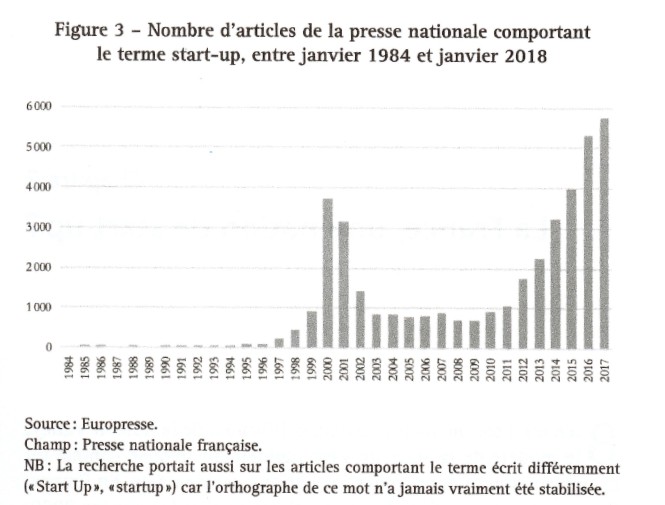
That’s the title of Chapter 2. And the second page of this chapter includes the following figure. It’s easy to see that the French press began to take an interest in the subject during the dot-com bubble and then again from 2012 onwards. Manon Flécher explains that this second period is significant, coinciding with the arrival of Uber and Airbnb in France, but also with the creation of BPIFrance and the French Tech initiative. Equally interesting, the author reminds us that General de Gaulle visited San Francisco in 1960, Georges Pompidou 10 years later, and François Mitterrand in 1984. The author doesn’t mention the creation of Sophia Antipolis in 1969, which Paul Graham mocks, more or less gently (see my post from 2011). Presidents Hollande and then Macron have been apparently much more involved in the topic.

Is France a startup nation? The answer is clear if you’ve read the preceding paragraphs. But the debate runs deeper, as I indicated in *Politics vs. Economics: A Country Is Not a Startup*, translating the article Non, la France ne doit pas devenir une start-up. I didn’t know, or had forgotten, that Emmanuel Macron had then used the term “hyper-innovation.” But the doomsayers are always ignored, and hyper-communication too often trumps reality and facts.

Marion Flécher also addresses this by stating that “despite this growth, the State remains the primary funder of startups in France” [page 71]. Her footnote on page 69 is revealing. “In 2015, business angels reportedly invested a total of €41 million, which was still half the amount in the United Kingdom and 2.5 times less than in Germany. […] In 2023, the United Kingdom continued to lead other European countries with €307.4 million invested by business angels, compared to €198.5 million for Germany and €142.5 million for France.” BPIFrance represents two billion euros in direct investments in company capital [page 72].

My post is already too long, which is convenient since I’m at this point in my reading of Le Monde des startups. Yet I haven’t even started on the main topic: the sociology of startup founders. A sequel coming soon!

Post-scriptum : On a related note, I just bought *Palo Alto: A History of California, Capitalism, and the World*, one review of which says, The most comprehensive — and incendiary — history of the place that we’re ever likely to get. A sweeping and unsparing critique, it’s also well written, frequently surprising and, because history tends to rhyme, increasingly urgent. You may never think about Stanford, iconic tech companies like Hewlett Packard or, indeed, the Valley itself the same way again. I won’t.” LOS ANGELES TIMES

The introduction already haunts me: the author promises to explain that the inhabitants of California, Silicon Valley and Palo Alto have not all forgotten the ghosts that surround them and without which the region could not have become what it is… To be continued!

The World of Startups by Marion Flécher

The startup world has been the core of my professional life for almost 30 years. I know it perhaps too well, and I also read almost everything I can get my hands on. So I feel compelled to read a book that takes this subject as its title. Marion Flécher is a lecturer in sociology at the University of Paris Nanterre, and her book, *The World of Startups* (Le monde des startup) is based on her doctoral thesis, entitled *The Startup World: The New Face of Capitalism? An Investigation into the Modes of Creation and Organization of Startups in France and the United States*. (Le monde des start-up, le nouveau visage du capitalisme ? Enquête sur les modes de création et d’organisation des start-up en France et aux Etats-Unis).

Marion Flécher just post an article on LinkedIn pand she was alos the guest of Guillaume Erner yesterday morning on France Culture.

As you may have guessed, I haven’t read the book yet, but I will as soon as I receive it. I’m always a bit ambivalent when I read critical analyses of this world, and of Silicon Valley in particular. Here’s what the publisher says on the book’s page: “The book compares the promises made by startups (success stories, meritocracy, flexibility) with the reality on the ground (failure rates, mass layoffs, pressure to perform, burnout). For the past fifteen years or so, young, innovative companies grouped under the term “startups” have occupied an increasingly prominent place in the media and political arena. Symbols of modernity and Capitalism 2.0, they are being held up as a genuine economic and organizational model. How can we understand this enthusiasm? (…) Dismissing the mythical figure of the self-made man, she sheds light on the reality of this social world and defines the profile of those, and more rarely those women, who launch startups and claim this label. While they claim to break with the hierarchical rigidity of traditional firms, startups offer a new face of capitalism, one whose gentler and more colorful aspects have allowed it to recover from its critics. In the digital age and the era of new technologies, what do they foreshadow for the future of work?”

I am ambivalent for two reasons :

The first reason is that it seems to me France has gone from a profound ignorance of this world to a critique of its excesses that is undoubtedly justified but harsh.

About ten years ago, Professor Libero Zuppiroli brilliantly criticized the unfulfilled promises of innovation in *The Utopias of the 21st Century*. A few years earlier, he had teased me about the fact that startups didn’t represent much at all. That was the subject of another post.

He was right, at least for Europe, to the point that neither France nor Europe has generated any real success stories. My previous post last week celebrated an EPFL’s success story at $3 billion, and Criteo, Mistral, and others are all modest in size compared to the behemoths that the GAFAMs have become. SAP, Spotify, ARM, and only a few others in Europe can be compared to American successes. I am therefore sometimes torn between comparing and criticizing two continents that have little in common. France has moved very quickly, not to say too quickly, from a lack of understanding to a criticism of this world without grasping the reasons for its appeal and success.

The second reason is that this criticism has existed for a long time, and I’m saddened that communication takes precedence over information. Startups have never been a paradise; they are rarely liberated companies, so storytelling has transformed a few exceptions into a universal model.

For example in 1986 in Startup fever, one could read “The Silicon Valley has been called “one of the last great bastions of male dominance” by the local Peninsula Times Tribune. […] They are under-represented in management and administration. Few women have technical or engineering backgrounds. […] Why there are few women in positioning of responsability in Silicon Valley is complex and puzzling. Until recently, the overwhelming majority of engineering graduates were men. […] Scientific and engineering professionals in the finance community and in start-ups are likely to be men: these power-brokers rely exclusively on their personal networks. […] Twenty of the largest publicly held Silicon Valley firms listed a total of 209 persons as corporate officers in 1980; only 4 were women. The board of directors of these 20 firms include 150 directors. Only one was a woman: Shirley Hufstedler, serving on the board of Hewlett-Packard.” But the authors are optimistic: they explain that any woman with a technical background or an interest in high-tech has opportunities: “A Martian with three heads could find a job in Silicon Valley. So for women with a technical background, it’s terrific. […] An exception to masculine dominance is Sandy Kurtzig. “I wanted to start in a garage like HP, but I didn’t have one. So I started in a second bedroom of my apartment.” At first, Kurtzig did sales, bookkeeping and management of her start-up. As long as she had only five or six employees, they worked out of her apartment. It went into rapid growth and had annual sales in 1982.”

And what about Anna-Lee Saxenian in 1999 : “In 1979, I was a graduate student at Berkeley and I was one of the first scholars to study Silicon Valley. I culminated my master’s program by writing a thesis in which I confidently predicted that Silicon Valley would stop growing. I argued that housing and labor were too expensive and the roads were too congested, and while corporate headquarters and research might remain, I was convinced that the region had reached its physical limits and that innovation and job growth would occur elsewhere during the 1980s. As it turns out I was wrong.” Returning to the earlier statement (France has moved very quickly, not to say too quickly, from a lack of understanding to a criticism of this world without grasping the reasons for its appeal and success), I believe it is essential to read and reread the remarkable works of Professor Saxenian (Regional Advantage, The New Argonauts). She has been able to explain the reasons for these attractions and successes, which persist today despite the excesses.

I’ve arrived at these compromises, which the great Bernard Stiegler helped me develop:
– In a 2016 post, “Has the World Gone Mad? Perhaps…,” I wrote that Stiegler’s main thesis is that capitalism has gone mad and that the absence of regulation and controls can lead to madness. “Disruption” can be beneficial when followed by a period of stabilization.
– That same year, in “Disruption and Madness According to Bernard Stiegler”, I noted that in ancient Greece, the term Pharmakon referred to both remedy, poison, and scapegoat. Medicine becomes harmful if consumed in excess…

I will therefore read Marion Flécher’s book with great interest and will write to you in a future post to see if I find cause for resignation or optimism regarding the startup world.

Post-scriptum: I regularly wonder about the nature of French society’s relationship with science and technology. All the pitfalls of technology are clear, and I regularly mention them here; for example, I’m thinking of François Jarrige’s *Technocritiques*. I’m not sure that the criticism is as severe for science or mathematics, as if they were more neutral. We hear less often about the fact that very few women have been Fields Medalists: two female laureates in 2014 and 2022, compared to 80 laureates in total since 1936.

Science in the media is neglected in France, generalist journalists and even French intellectuals have a rather deplorable scientific culture. Science doesn’t attract many girls, or at least they are discouraged from pursuing it for complex reasons. This wasn’t the case in the former Eastern Bloc countries (whatever the reasons may be). The relationship with technology, and therefore with innovation and startups, is perhaps a consequence of this, or simply a correlation. This might explain some of my sadness or frustration, even though I haven’t lost my enthusiasm. And in those moments, Churchill’s quote comes back to me: “Success is going from failure to failure without losing your enthusiasm.”

Two references in French.

– Mathématiques : deux femmes récompensées depuis 1936 : https://www.lemonde.fr/les-decodeurs/article/2019/03/20/mathematiques-deux-femmes-recompensees-depuis-1936_5438858_4355770.html

– Maryna Viazovska, deuxième femme lauréate après Maryam Mirzakhani : https://information.tv5monde.com/terriennes/medaille-fields-maryna-viazovska-deuxieme-femme-laureate-apres-maryam-mirzakhani-2933

Nexthink, a Lausanne-based startup, acquired for 3 billion dollars

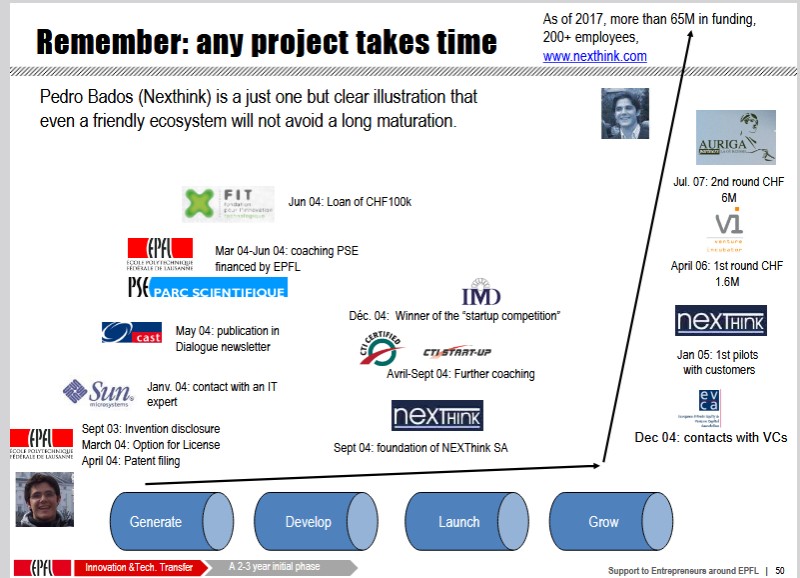
This doesn’t happen that often in a lifetime [1], so it deserves a pause: Nexthink, a spin-off from EPFL, has just been acquired for $3 billion [2] — you read that right, $3 billion!! Admittedly, Nexthink isn’t exactly young anymore; it was co-founded in September 2004, by Pedro Bados, who came (I believe, to do a master’s internship as part of the Erasmus program) in the artificial intelligence lab. AI wasn’t what it is today. His project was based on Bayesian methods… As luck would have it, I met Pedro then to analyze the intellectual property he had generated and what could be done with it. Pedro wanted to sell the patent that EPFL had filed, and when he discovered it wasn’t generating as much interest as he had imagined, I suggested, “Why not a startup?” That became my main role. I also helped him structure the initial deal, I mean who he would work with, within EPFL and outside, and made some introductions at the time. The rest is history !

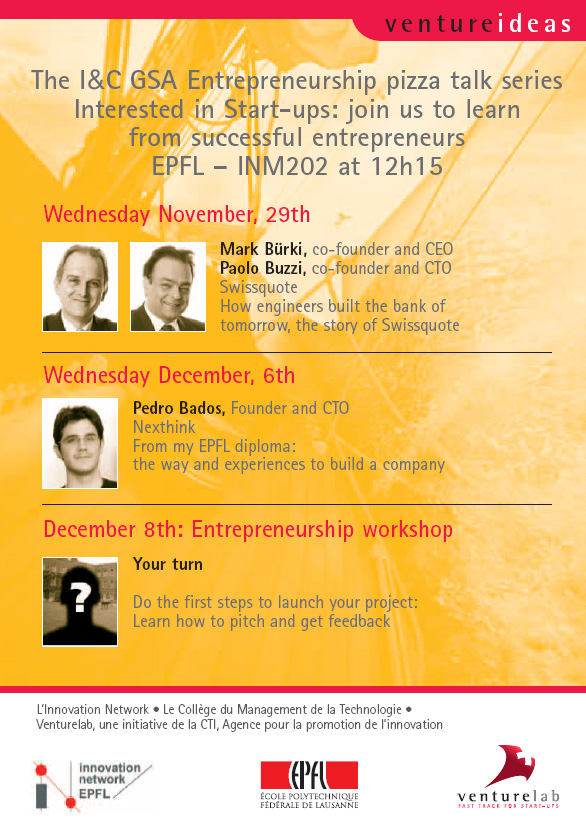
Pedro has become a discreet but essential figure in the Swiss ecosystem [3]. He was our guest for ventureideas as early as 2006, along with Jordi Montserrat.

Here are notes taken at the time from his présentation (pdf).
NEXThink notes

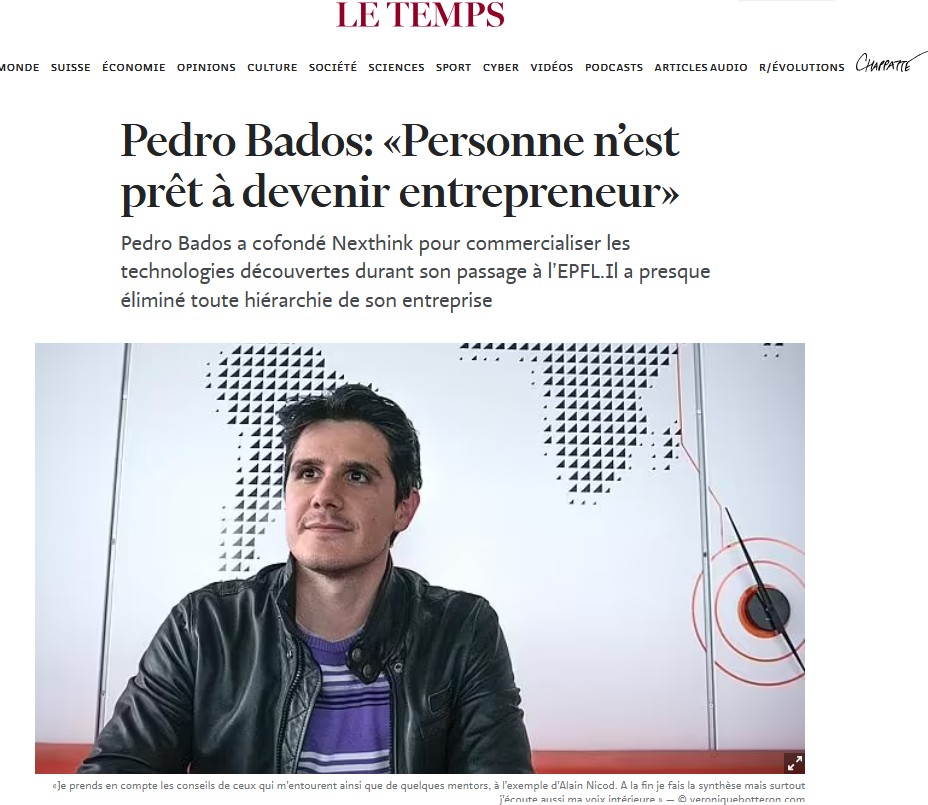
He also gave a beautiful interview ten years ago to the newspaper Le Temps (in French): Nobody is ready to be an entrepreneur

I’ve had some wonderful experiences in my professional life, in scientific research first between Paris and Stanford University, then in venture capital with Index Ventures, finally at EPFL for 15 years, and for the last 6 years at Inria. Nexthink will certainly remain one of the best ones, and I hope to experience a few more. As I said 15 years ago [4], my professional passion is to encourage these kinds of ventures (see the Stanford interview): “A love of entrepreneurship, a passion that I took back home to Europe after studying here [at Stanford University]. I want to see a stronger entrepreneurial culture there, and I am working in more than one way to effect that change.”

A few notes:

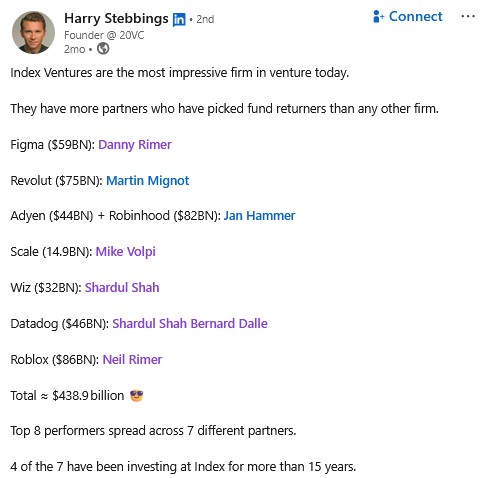
[1] I was struck some time ago by this post about Index Ventures and its stratospheric performance :

8 startup with an exit above $10B : Figma – $59B, Revolut – $75B, Adyen – $44B, Robinhood – $82B, Scale – $14.9B, Wiz – $32B, Datadog – $46B, Roblox – $86B. So what does $3B represent for Index? And I don’t have a list of their exits above a billion. I remember Virata, Numerical Technologies, The Fantastic Corporation, and Skype before 2005. I might ask them!

[2] Some more news and archives – What I found online about Nexthink acquisition, mostly LinkedIn posts by its founders and investors as well as press articles
Nexthink News autour acquisition


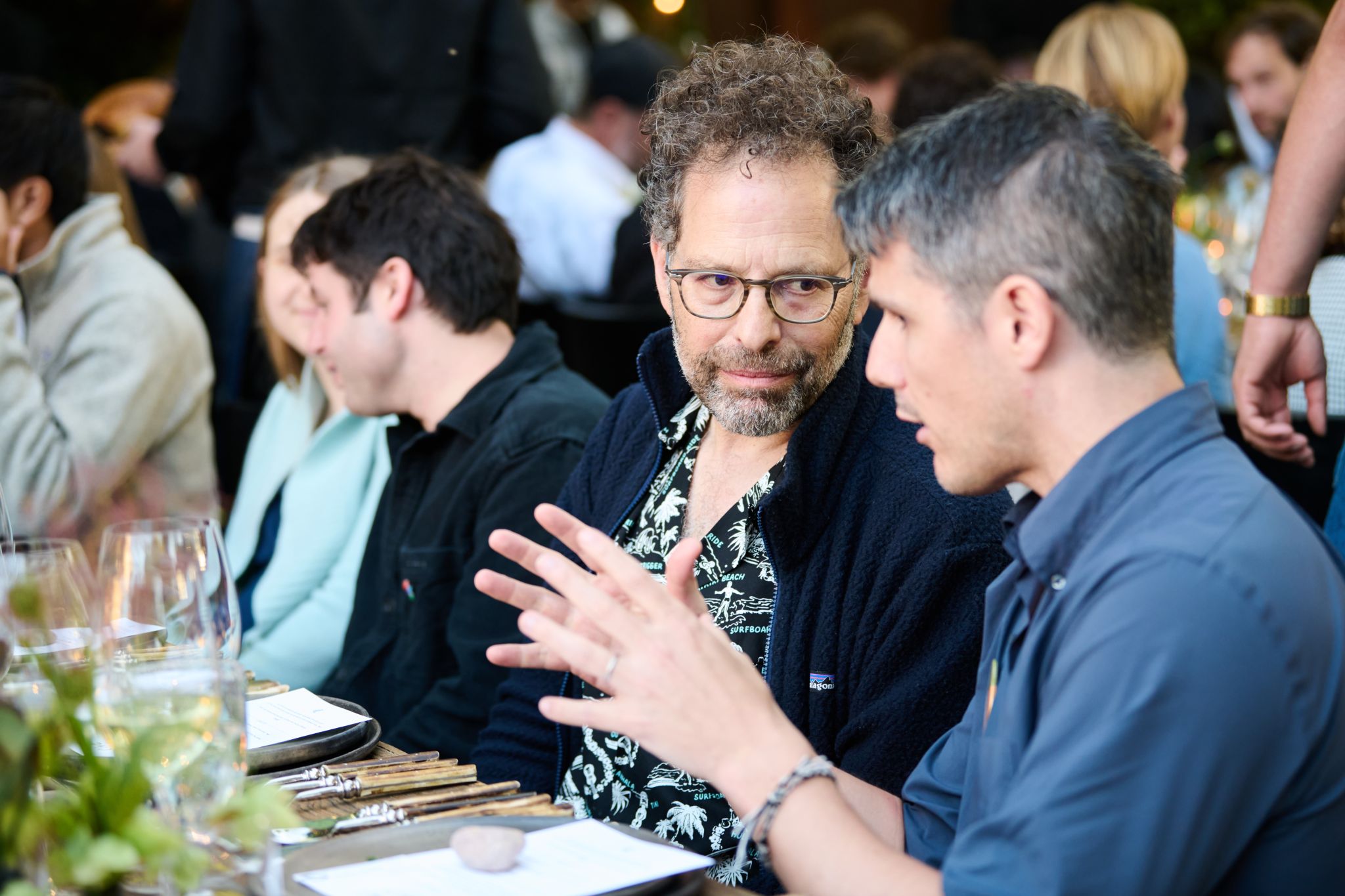
Neil Rimer (Index ventures) and Pedro Bados I am not sure where and when

[3] A short presentation of the EPFL ecosystem to its alumni before 2010 that mentions Nexthink (pdf)

a3angels10-herve_lebert-innogrants

[4] Thanks to my favorite search engine, an exchange about what I thought of startups, Silicon Valley in 2008 where I mention Nexthink. I am not sure things have changed that much…

Stanford HL

Why is Silicon Valley Silicon Valley ? A debate initiated by AnnaLee Saxenian

I should go back to Silicon Valley to ask AnnaLee Saxenian what she thinks of Silicon Valley today and, more importantly, if her analysis is still valid today (which I think it is !)

I fall by accident on a short 6-page article that she wrote in 1999 entitled Comment on Kenney and von Burg,‘Technology, Entrepreneurship and Path Dependence: Industrial Clustering in Silicon Valley and Route 128’ that you can easily find on the net, for example on Researchgate.

Why do I care about a 25-year old article about innovation ? Because I often have the feeling Europe and France in particular miss the point about what matters. Saxenian’s argument can be summarized with an extract from that article: It is precisely the openness, multiplicity and diversity of interconnections in Silicon Valley that allows economic actors to continually scan the environment for new opportunities and to invest in novel technologies, markets and applications with unprecedented speed. The autarkic structure of firms and institutions in Route 128, by contrast, have historically discouraged precisely the decentralized flows of information, skill and capital that encourage such technological experimentation. [Page 5]

The analysis is subtle because one might get the impression that Europe has understood the role of collaboration, but I fear that it has remained institutional and not informal. Has there ever been a Wagon Wheel Bar in Europe?

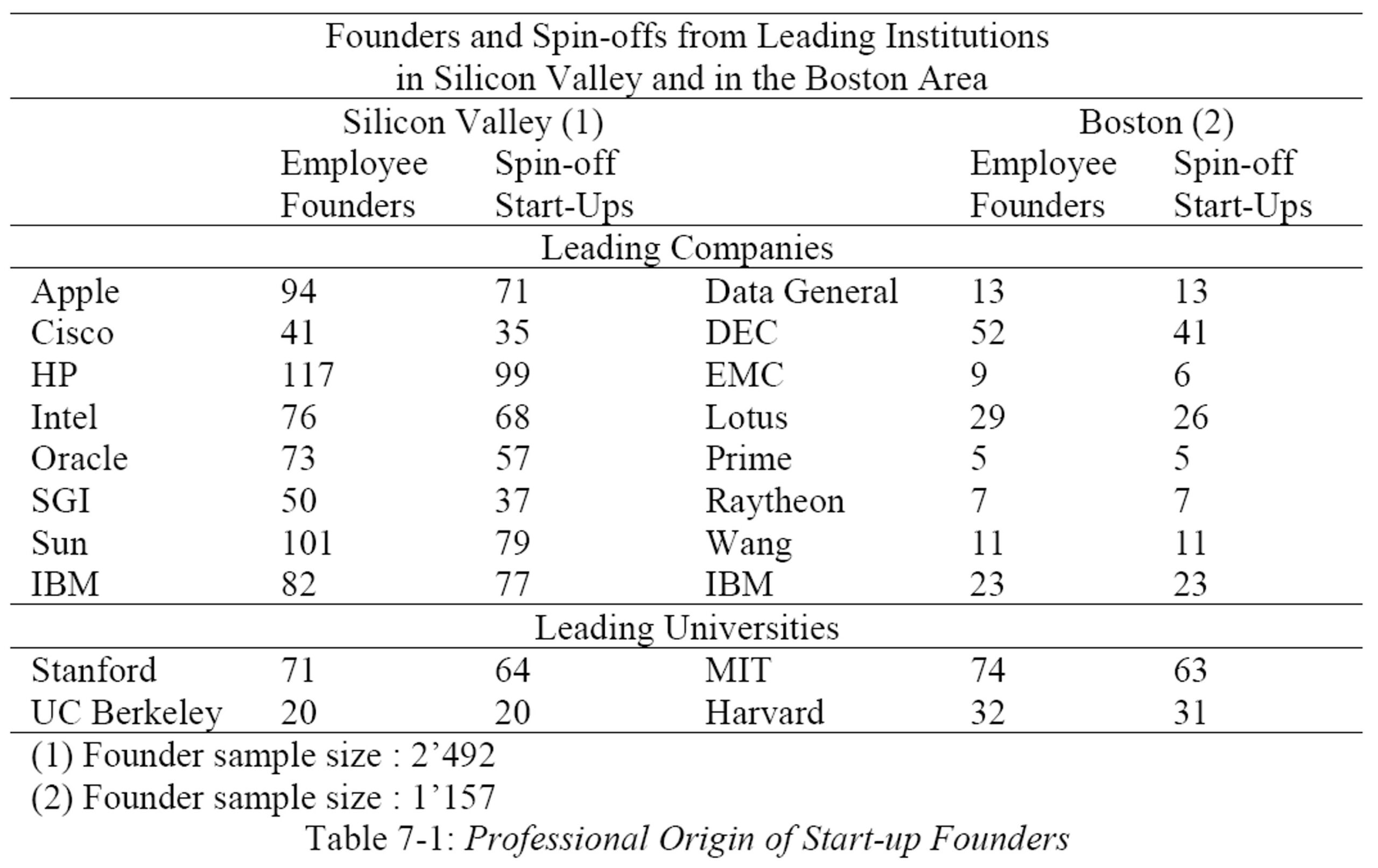
Again the article is short and worth reading. The debate is also about the role of big firms in technology clusters. The figure which follows is a perfect illustration:

Source: J. Zhang (2003) compiled data from VentureOne based on VC-backed spin-offs from 1992 to 2001

Zhang had worked with Saxenian and the table shows that from an academic standpoint, entrepreneurship was as strong at MIT/Harvard as Stanford/Berkeley. But if we just look at IBM West vs. IBM East, the difference is striking. “Individuals in Silicon Valley regularly leave jobs at established firms to join start-ups, and vice versa, all the while maintaining networks of cross-cutting personal and professional relationships. Nor is it uncommon for individual engineers working at large firms to make angel investments in promising start-ups — or for established firms to organize venture divisions to support new ventures in related industries.” [Page 4]

I have been using it since I discovered it years ago, particularly when I was giving classes about startup and Silicon Valley. With a little nostalgia, I put my introductory pdf below where I emphasized on the role of culture in entrepreneurship.

eLab01 - SiliconValley

Deeptech Startups and their Challenges in France (continued)

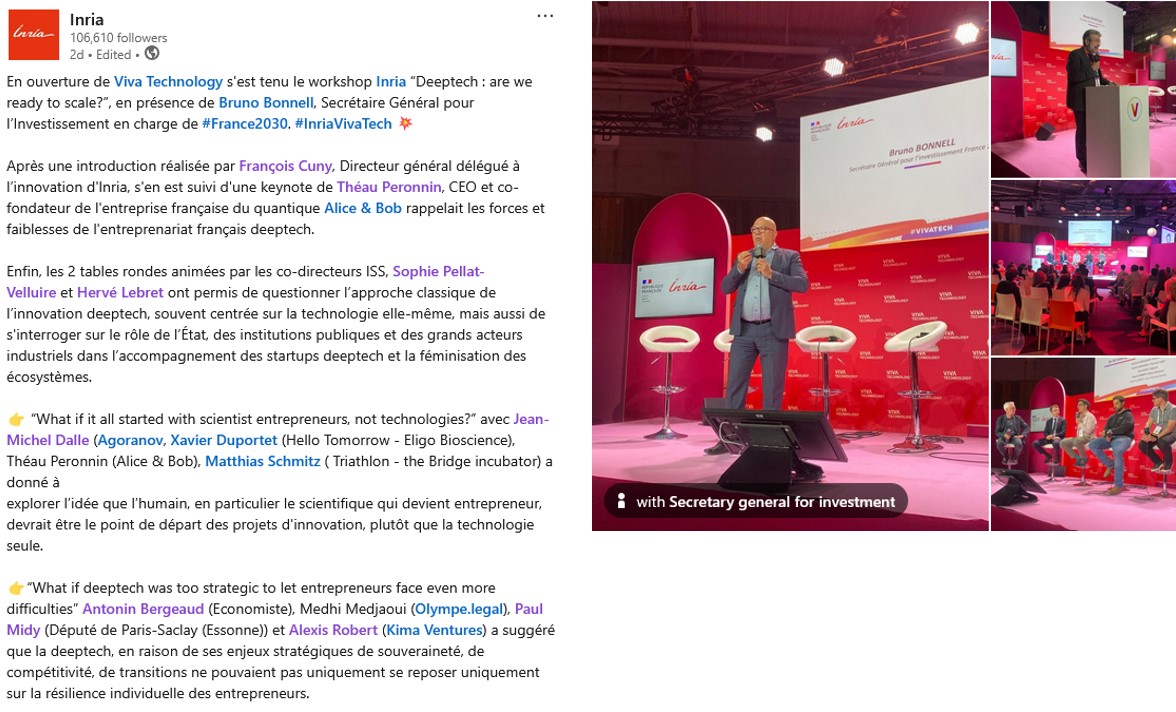
As indicated in my previous article, I preferred to cut out my summary of the workshop on the subject “Deeptech: are we ready to scale?” organized by Inria during the Vivatech trade fair

If the first round table spoke about bipeds, the second was about ecosystems, about “rain forests” more than “French gardens”!

Antonin Bergeaud, I listened to you when you received the award for the best young economist in France, particularly about technological innovation, on France Inter and France Culture and you said at one point that you were drawing a parallel between your childhood dream of being an astronomer and your situation as an economist by saying that you wanted to understand the complexity of the world but that in the economy, there is the human factor which there is not with the stars. Is that our challenge or are there other elements that interest you so that we have European Gafam tomorrow?

“We have the impression that the level of complexity is really in hard sciences but in the human sciences there are a lot of interactions that make things very complicated and in particular because we have little regularity so we have to deal with the fact that there are biases. Like what was mentioned that in Europe we are less enthusiastic than the Americans, but we don’t know how to measure this very well. There are a lot of features that we have to take into account and since the challenge is to try to inform and shed light on why we have such difficulties, for example having a Tech sector that is of the same magnitude as the one we have in the United States or why companies have difficulty obtaining financing in Europe, we are obliged to take into account all these dimensions and it is true that it is quite complicated, so that is a bit where the parallel ends, it is that it is complicated. I think that now there is a kind of consensus beginning on the structural difficulties that we have in France and in Europe, which does not mean that we are going to correct them but at least we are beginning to understand a little better what is happening.” […]
– we don’t have enough entrepreneurs and we don’t have enough engineers trained in France and Europe […] there’s a real training issue that needs to be addressed, largely because you have a lot of losses, a lot of entrepreneurs and engineers leaving for the other side of the Atlantic.
– the second difficulty in Europe, because all the French problems are quite real everywhere in Europe, is getting universities to connect with businesses. For example, all patents filed by all companies in the world must provide the academic references they use in the patent description, and what we see is that for certain technologies, where Europe is practically non-existent in terms of technology production and marketing, we are actually relatively dominant or at the same level as the United States in the production of ideas, except that these ideas are not cited by French or European patents; they are cited by Chinese or American patents. So, basically, we have scientists and researchers who produce very relevant ideas, including on very, very recent technologies, and ideas are supposed to circulate freely. They circulate freely, but they circulate a lot from Europe to other countries, and a little less in the other direction.
– the third problem is indeed financing, which was discussed a lot earlier. I think that in Europe we have a relationship with risk that is really specific to our continent. Perhaps it is not necessarily negative, and I don’t think we should necessarily give it up, but we must be aware that it poses a certain number of difficulties in growing companies quickly, particularly in disruptive technologies, because we tend to move more towards bank financing, because we have less venture capital funding, because we have a market that is very fragmented, particularly in terms of financing innovation, and because we have institutions and regulations that are much more restrictive, at least from a growth point of view, than what is done in the United States.

Paul Midy, I could call you Mr. Start-Up at the National Assembly. What would you like to add?

“I would put the issue of financing number 1 by far. Fundraising in Europe seems to be three times lower than fundraising in the United States, even though we are generally roughly the same size, we generate roughly the same GDP. When you put your money into a company like Mistral, a deeptech company, you don’t get it back the following year, it’s at least 20 years later that you get it back; it’s long-term capital. And this long-term capital exists mainly in retirement capital, and so I would say that the number 1 factor is the fact that we have a pension system in France, and many in Europe too, which is a pay-as-you-go system that is not a capitalization system. We don’t have pension funds or we have very few. We have to realize the enormous gaps that this generates in France. Long-term savings and what can look a bit like capitalization are 200-300 billion euros; if I take the whole European Union, it’s 6,000 billion and essentially it’s the democracies of northern Europe at 70%; if I take the United States it’s 42,000 billion. You can supply a New York Stock Exchange with 25,000 billion and supply a Nasdaq with 25,000 billion and on the other side in France you have Paris the Paris Stock Exchange 3,000 billion Frankfurt 3,000 billion London 3,000 billion so we have a stock of capital which is much less important and so for fundraising the result of all this is that our start-ups last year raised 50 billion in the United States it’s 150 billion. […] I call for us to make a CIP, a common innovation policy at least as ambitious as the CAP, the common agricultural policy. A third of the budget of the European budget is the CAP. Another third is the social cohesion funds. Very important. Innovation is less than 10% of Europe’s budget. It must at least be three times more immediately. […] I am a politician, so we are trying to change the system. Either we say to ourselves, it’s a culture, that’s how Europeans are, and they like risk less, they are a little more grumpy and everything, and so there is nothing to be done. I can’t accept that, so I’m trying to understand why the Americans are in a different situation; it’s not genetic. I think we need to set ourselves the goal of making Europe the richest, most prosperous continent in the world, therefore the most innovative, capable of defending itself, and then everything will flow from that.

Alexis Robert, you work for Kima Ventures, which is Xavier Niel’s fund, whose recent book “Une sacrée envie de foutre le bordel” (A Real Desire to Cause Trouble) I read, and which sometimes puts himself at odds with the system. Do you also, by working for the Kima Ventures fund, have a slightly more atypical view of these things, or how do you want to build on what we just shared?

“In fact, what happens when you are early stage, while what you mentioned is true in late-stage for Series B financing and above, but in fact today what we see is that in the seed rounds, preseed/seed there is in fact a little too much capital, and in fact today the VCs, the problem that there is and why we have difficulty finding GAFAMs is if we actually go back to the history of French venture capital, in fact they are spin-offs of banks and then over time they actually recruited the sons of their LPs [Limited Partners] or people who were in their network or people who thought like them who actually have a finance mindset. There are very few engineers, very few scientists who are actually in these VCs. […] To create GAFAMs, to create for example openAI, Sam Altman comes from the world of Computer Scientists, look at Elon Musk, he is a Computer Scientist, you look at Mark Zuckerberg, he is a Computer Scientist, and in fact to create the GAFAMs of tomorrow it will actually come from people who have a strong scientific culture or who have cultures that are different it can be people who perhaps did not graduate from engineering schools, people who are very different but the VCs are stuck in a mindset and the people in the ecosystem in general too. […] For example Mistral at the time when Arthur Mensch, Guillaume Guillaume Lample and Timothée Lacroix did their first fundraising, uniformly all the VCs all said ah yes what they do is great “yeah but hey they are researchers anyway”, they do not know how to break out of the mold of CEO who went to HEC.”

Mehdi, we supported you at the start-up studio, but before talking about business, we’ll come back to that later. I remember maybe you don’t want to talk about it too much, but you wrote a wonderful essay on what a functioning ecosystem is for entrepreneurship. I reread it two days ago, it was in 2017 I think. Do you have the same vision of the ecosystem’s weaknesses and what a country must do to promote people like you 8 years later?

“So yes, and even more unfortunately, even more so, and I’ll explain why. Yes, money is an issue, but even Sam Altman today, who is at the head of OpenAI, who has just made, who has just said that he has an annual turnover of 10 billion, has financing problems. But for me, the problem, the big problem in the ecosystem, is ambition, it’s the ambition of European entrepreneurs. In California, he would tell you, “I’m going to change the world,” they have an ambition that has no limits, and be careful, it’s not genetic, they are trained for that, they have accelerators like Ycombinator, they have advisors, they are often coached by other entrepreneurs who have had exits or who have made very large companies, and they are fueled by ambition, which I think we lack here. [What’s also missing] is investors who also work on feeling, who work on entrepreneurial ambition, who will go and fight for a billion or a hundred billion dollar case. Money is not the main problem for me because there is money, especially in seed funding in France with the BPI. After that, it is the ambition that must match, and the execution of course, the execution is not simple, but Arthur Mensch raised 100 million on slides in 3 months because he had an ambition at that time. “Unfortunately in Europe we are still in an ecosystem where we make technology with money where others make money with technology.” […] Sam Altman coached close to 1000 startups when he was at the head of Ycombinator, he saw an ecosystem, he saw innovators, he trained himself, that’s why today he says we will make a generative AI, an AI that will be a company that makes 1 billion, a person will be able to make a billion in value thanks to an AI and a only employee but because they are trained. Now look these are what Alain Damasio calls hyperstitions [https://en.wiktionary.org/wiki/hyperstition] we are beyond superstition sometimes, we fall into lies, we fall into ideology so we in Europe we are a little more careful. [In the USA we say] “go for it, go for it, we support you, we will go with you” but today I do not know anyone in Europe who would act like that because they are trained in the USA. It is really an INSEP of entrepreneurs that we need.” […] Entrepreneurship is like playing poker you have cards in hand and then there are cards that arrive and as you go you have to adapt. We need people who will free us up, not just as entrepreneurs!, but who will free up the bandwidth to be able to understand what is happening. For me, these are advisors who have made the Champions League.”

Alexis Robert: “I am very aligned with Mehdi […] there are [so many people who] reject you because in fact you do not speak in the languages ​​of the mold. In fact that is the problem today, is that in fact the entrepreneur feels alone and certain types of entrepreneurs who have a scientific and technical background do not know where to turn and today what is happening in San Francisco, what makes San Francisco great, is because in fact you get off the plane directly you have the feeling of being accepted as a geek, you have the feeling of being at the right place, you have “role models” who are there for you, who pull you up, you have the feeling that you too can be able to do this and in addition there is a sense of community which is extraordinary; you arrive, you are in the street, you speak with a VC, well, he listens to you or not, you have Sam Altman who passes in the street and you can say hello, you sit in a cafe and you talk, you have entrepreneurs to talk to, speaking is easy, introductions are easy and fluid, you can surround yourself with people who allow you to learn and improve because, as was said in the first panel, if you have understood general relativity, succeeding in pitching is not very complicated, you will succeed in doing it and in fact that’s what I wanted to say.”

I stop here and the people said much more. This is unfair not to share everything… But I think it gives you a feeling of what are challenges and opportunities are !


The Tour Triangle designed by Herzog and de Meuron, at the exit of Salon Vivatech, see also Instagram

Deeptech Startups and their Challenges in France

During the Vivatech trade show, Inria organized a workshop on the topic “Deeptech: Are we ready to scale?”

The discussions were rich, in-depth, and fascinating. I’m obviously biased since I was a co-organizer, but I’ve rarely had such a pleasure discussing the topic. So, I’ll provide a subjective summary, adding my own comments on various topics that are dear to my heart. [They will be in brackets and italics.]

What is Deeptech?

This was the starting point for Théau Peronnin, founder and CEO of Alice & Bob. “Above all, it’s a technology that has two fundamental attributes: the first is it has very deep roots in science. If you can understand this technology straight out of business school, it’s perhaps because it’s not quite deeptech yet. […] Its second attribute is the ability to create companies, players, or products that will have a strategic impact on the economy.”

[During another roundtable, I heard that the term appeared when the internet, B2B/B2C, and SaaS had diluted the technology into the excesses of “pet.com”, but that fundamentally, the high-tech of the 1980s and the deeptech of the 2010s are two sides of the same coin. I would add that if something is patentable, it’s undoubtedly deeptech.]

Théau Peronnin then gave his perspective on the challenges facing the French ecosystem. “I can tell you very simply: in France, we are extremely strong on the initial opportunity, we have incredible talent. We are still tied for first place in the number of Fields medals with the Americans, even though we are five times fewer in number.” […] “And then we have an early-stage venture capital ecosystem that has managed to establish itself in recent years, perhaps even a little too much; we could finally say that it is slightly saturated.” […] “The weaknesses are really in the later stages of a deeptech’s life. We have a subject that is perfectly known but which is far from being cracked, which is that of financing the so-called growth stages, this moment when companies like Alice and Bob will seek to raise capital of several tens of millions of euros, several hundreds of millions of euros to continue this R&D race at the international level.” [This is a subject that will be addressed later and I am not sure that it is the main subject, but the debate undoubtedly exists. See below!] “There are no suitable European players, which creates an anticipation effect across the entire value chain and there is a certain reluctance among funds to really deploy this capital with intensity and audacity in deeptech.” […] “Silicon Valley takes its name from the deeptech of the 70s, 80s, 90s in silicon, which created generations of fortunes of individuals with a very strong appetite for this deeptech and who therefore subsequently directed their capital towards these investment funds which continue to invest in this field. In Europe, there are no such fortunes, they were made elsewhere, they are in other fields and therefore we do not yet have these good products, hence the important role of the State in priming the pump.”

“One last point to introduce the round table on the human factor, which is the relationship to risk-taking. France has a school in any case, a view of studies and the academic world very focused on excellence which is perhaps the downside, or rather the cliché, of saying that we have a certain fear of failure and this is seen in my opinion in certain systems which deserve to be rethought, notably that of the Pacte law for the part-time activity of researchers and there it is a very personal opinion that I wish to share with you which is that of saying that there is no entrepreneurship without risk-taking. You have to get your hands dirty, you have to put your career on the line somewhere, you have to have “skin in the game” as the Anglo-Saxons say and perhaps in this system there is therefore in this part-time activity, a comfort in knowing that you are still well protected within your research organization while trying to enjoy the pleasure of entrepreneurship. In my opinion, we have to go all out and that means being able to come back to the academic world after a startup failure and so perhaps the lever to allow more audacity is to make the academic world more attractive for profiles with hybrid careers that have gone through the world of entrepreneurship. That’s to launch this round table on the theme of the human factor, these men and women who are making the entrepreneurs of tomorrow.”

Deeptech is, above all, about bipeds!

Théau Peronnin returned to the subject of humans through a real problem: “A very difficult issue we have is that of parity, gender diversity, which is horribly difficult to crack because we arrive at the very end of the food chain for training these profiles. Above all, technical profiles, a lot of self-centeredness regarding the fact of going through the Grandes Ecoles with all the sociocultural bias there is in these Grandes Ecoles, and even with international diversity, we must have between 20 and 30 nationalities, 30% of non-French speakers in the team, so this gives you a little demography.”

Xavier Duportet amplifies this human aspect: “We have people who are a little crazy because to get started in deeptech [where] less than 2% of projects reach a mature product on the market […] to get started you have to be a little crazy, you have to be naive too, I think, and you have to think that what is impossible can become possible. There are lots of things we don’t know and so the unknown is part of our daily work.” […] “The most important thing for us is not necessarily experience, it’s above all curiosity and that people are enterprising because in deeptech you can’t just apply the principles, apply the things you’ve already learned, you always have to be ready to face failure almost every day and so you need people who are willing to question themselves and who deep down are truly enterprising people.”

Jean-Michel Dalle: “There are motivated bipeds who come to talk to us about the microbiome, or motivated bipeds who come to talk to us about quantum computers. Anyone who doesn’t see things from that perspective, that is, from the bipeds’ perspective, is missing something. Of course, we’re going to check that the quantum computer project isn’t just anything, that they didn’t invent it on a Sunday morning after the market. But if we don’t look at it through the eyes of the founders, in my opinion, we need to change careers.”

Théau Peronnin: “The real issue is that the researcher’s passion is to understand, but the problem with that is that we reap the rewards of the pleasure of our work very early in the product’s life. I understood what I had to break to bring this machine to market, but unfortunately, we only did 5 or 10% of the work to truly deliver the system.” Behind this, we need to strengthen, produce, distribute, reposition. There is a whole issue: how do we learn to take pleasure not in having understood but in making the other person understand, but even more than that, in making the other person adopt what we have cracked, and that is a muscle to develop which is quite different.

Xavier Duportet: “It’s not a technology, it’s not a science that’s going to change the world or save the world, but a product, and that’s often where it falls short. We still see a lot of researchers who only think about science, only technology, and who can’t make the switch in their minds, saying, ‘How come I’m not selling my science, but I’m making people dream, I’m making these serious people [investors] dream, that I’m going to be able to be that person who will transform science into a product that will generate added value for society, but above all, for investors.'”

Marie Paindavoine: “I was lucky at the beginning to be supported in entrepreneurship by structures from the academic world, first by INRIA and then by the University of Berkeley in the United States, which has an acceleration program, and it’s true that thanks to them, it allowed me to learn how to transform this scientific discourse into an entrepreneurial discourse; and moreover, at the acceleration program at the University of Berkeley, for six months, we just repeat the company pitch and learn how to convince, in fact, because ultimately, and they tell us, ultimately, you’ve done the hardest part, you have great technology, you’ve managed to write a thesis in cryptography, well, you’ve done the hardest part, Marie, now learning marketing will take you two months, but you have to get down to it for two months, and that’s where we need to surround ourselves, to have this ecosystem that allows people to train because, after all, if we’ve managed to do a doctorate, we’re able to continue to train in the profession of entrepreneurship, but we need to find those people who can see not the value of scientific technology as it can be presented today, but a sort of projected value of this technology.”

Xavier Duportet: “On people and the network and the ecosystem, I also had the chance to do a thesis between INRIA and MIT. At first I wanted to be a researcher and when I arrived at MIT, I saw all these people who were starting up, these professors who were becoming entrepreneurs, that’s when I understood I was inspired by this generation of entrepreneurial researchers saying to myself but in fact if we really want to change the world it’s not research it’s entrepreneurship and today in the US, there is Silicon Valley, it was created 20 years ago, 30 years ago as Théau said there is this whole generation now, not grandpas but slightly older people who have succeeded and so in fact there is a “network effect” in the US which is super important, it’s the generation of entrepreneurs who have already succeeded who are there to help and pass on they did it they made mistakes and they really serve as mentors and that’s where we have a pretty interesting opportunity, and in France we can’t want to put the cart before the horse, we have what the BPI has done, all the research institutes, the change that has been underway for 10 years, we are starting to have these companies which are becoming leaders on the international level.”

Matthias Schmitz: “What we have started to do recently is to invest in an entrepreneurial mindset much earlier in the education of our students so we are trying to roll out programs where we bring entrepreneurship into all the faculties. For example, the university of Saarland is investing €1.5M every year with the goal that every single student that we have, whether it is a business student, whether it is a Romanistic student or an engineering student has at least one time during his studies thought whether entrepreneurship can be a career option for himself and by doing that I think we try to solve the problem a little bit earlier, bring the mindset in the heads of the people and not having to have people jump into the too cold water at the moment where they are already at the PhD level.”

Marie Paindavoine on being a female entrepreneur: “do you want the version we hear in France or the United States? both! So we don’t hear the same thing in France and in the United States. In France, I was immediately asked if I intended to partner with “un” CEO, emphasizing the “un”. I was already asked after my presentation, well, anyway, I’m not going to do them all actually because it’s of no interest, but there is indeed a halo of suspicion, let’s put it like that. In the United States, then I’m not saying that they are better than in France because I arrived at the University of Berkeley, at the University of Berkeley accelerator, 2,000 applications, 30 start-ups selected, 2 women CEOs, so they are not much better. On the other hand, once we reach this level of selection, when I say I’m starting a business with children, people tend to congratulate me on the level of energy it requires instead of asking me how I’m going to arrange childcare and if my husband agrees with me starting a business with my children, something I’ve already been asked in France.

I’ll stop here and do a new post about the second roundtable!

Silicon Valley : The Collapse?

Excellent issue of FUTU&R, the magazine by Usbek & Rica, which main feature is entitled Silicon Valley, Chronicle of a Collapse. It’s not a good time to be a fan of the region these days. If you follow my blog, you’ve seen my struggles to understand what’s going on there. This issue contributes to this, and you’ll discover dubious characters like Curtis Yarvin, Balaji Srinivasan, Palmer Lucky, in addition to the famous Peter Thiel, Marc Andreessen, David Sacks, and even Larry Ellison. The issue is a bit biased, but that’s the name of the game, since the magazine “imagines how the Tech Eldorado could collapse.”

The magazine had the good idea to add the informed opinion of Olivier Alexandre, often mentioned on this blog, notably as the author of La Tech. I scanned the contributions in low resolution and I hope the magazine will forgive me for this breach of copyright. I obviously encourage you to buy a copy!

I will just comment on what Olivier Alexandre says and I will end this post by discussing a related subject through a fairly recent scientific article, The Role of Universities in Shaping the Evolution of Silicon Valley’s Ecosystem of Innovation (pdf)

“Are we witnessing the collapse of Silicon Valley? What is certain is that it is at a crossroads. Historically, tech has thought of itself as a solutions industry, except that its solutions are now our problems. […] It is clear that we no longer hear dissenting voices. There have always been debates in the Valley, but the tech supremacist fringe, to which Trump supporters like Peter Thiel and David Sacks belong, was a minority, drowned in the mass. […] Steve Jobs and software entrepreneurs have been made stars and the history of Silicon Valley has been reduced to the success of a hippie counterculture, when it is above all a story of transistors, microprocessors, and engineers with perfectly standardized lives.”

Indeed, the region was a republic of engineers, with back-and-forths between fierce competition in a global world and deregulation and occasional isolationism allowing monopolies. In the 1980s, the threat was Japan, and the semiconductor industry had appealed to the Federal State for its survival (after having benefited from the flow of public money at the height of the Cold War in the 1960s.) I recently spoke of my difficulty in finding dissenting voices too.

“In 2022, the situation changed and Big Tech started laying off employees. Since then, they’ve been cutting 5% of their payroll every year.”

On this point, I slightly disagree with the observation. In 2009 and 2013, for example, Google also reduced its workforce by 5%. I had heard that Cisco was shedding 5% of its “lowest-performing” workforce each year. The region was so dynamic that it was rarely discussed. Working conditions have always been “harsh and demanding.” A world of engineers, no doubt. It brought us computers and smartphones, the internet, and therefore opportunities to behave differently. It also contributed to creating immense biases because, without a doubt, the use of science and technology is never completely neutral.

“The question being asked of the world is the link between new technologies, innovation, and progress, which are three very different notions. Historically, innovations that have had a lasting impact are few: watches, eyeglasses, jeans… However, today, Silicon Valley mostly creates very ephemeral innovations.”

Tom Kleiner went further, mentioning the printing press, the steam engine, electricity, and finally the transistor as innovations that changed civilization. This is undoubtedly close to reality.

And Olivier Alexandre adds a beautiful question: “The products offered are essentially based on the promise of saving us time. But what do we lose when we save time?”

And he concludes (provisionally): “Dubai is one of the rare places that has managed to make the future sexy, an optimistic vision of the future: rain without clouds, islands without land, snow without mountains. But above all, technological progress without democracy. All this in a vulnerable area where the questions of resources, food, and housing have always arisen. In a way, Europe embodies the opposite: democracy, sometimes at the cost of technological progress.”

This isn’t the first time that the future of Silicon Valley has looked bleak. For example, you can find AnnaLee Saxenian’s predictions in a post titled Is Silicon Valley crazy (again)?: “In 1979, I was a graduate student at Berkeley and I was one of the first scholars to study Silicon Valley. I culminated my master’s program by writing a thesis in which I confidently predicted that Silicon Valley would stop growing. I argued that housing and labor were too expensive and the roads were too congested, and while corporate headquarters and research might remain, I was convinced that the region had reached its physical limits and that innovation and job growth would occur elsewhere during the 1980s. As it turns out I was wrong.”

There’s no doubt the region is at a new crossroads! But I’m not finished yet, see below.

I promised above to talk about a scientific article dating from 2020. I found its conclusion interesting even if overall the content well-known. So I copy paste :

Silicon Valley—a Metaphor in search of a Structure?

Silicon Valley is a metaphor for a region that lacks a viable governmental structure. It is at the stage of New York, before its 1989 consolidation into a unified city. With the notable exception of the ecology of the Bay, a downside has emerged, a public-private imbalance revealing gaps in housing and transportation Spread across multitudinous counties, towns and cities, Silicon Valley lacks sufficient governance capabilities to address the negative consequences of its overweening success.
An additional imbalance in academic capacities is, in part, a consequence of a more than half century old master plan strictly segmenting the public academic sphere that has limited individual institutional advancement. This gap has been partly redressed by establishment of branch campuses by universities in other parts of the country, like Carnegie Mellon and the Wharton School that ironically treat the region as an under-developed area, at least in its academic capabilities. Moreover, state government funding for public universities
has declined drastically, from providing 40% of Berkeley’s budget in the 1980’s to 14% percent at present. This gap is being redressed by a massive fund-raising campaign that expects to raise 6 billion dollars and increase the universities tenure track positions in coming years.
Re-balancing the Triple Helix will also require increased interaction among the spheres, a phenomenon that has declined in recent decades, placing the long-term innovation and carrying-capacity of the region at risk. The innovative and sustainable economic development of Silicon Valley not only depends on the presence of strong universities, but on how they interact and overlap roles with the other agents of the Triple Helix model, looking for mutually strategic objectives and identifying cross-cutting issues which none of them can adequately deal individually. Interactions between university, industry and government in a highly dynamic and volatile environment, represent a unique opportunity to recover from economic downturn, create new jobs, and promote a prolific, inclusive and economically sustainable development of regions in the long run.