Category Archives: Start-up data

Research and Development (R&D) in Tech Startups (A short follow-up)

A short follow-up to my yesterday’s post Research and Development (R&D) in Tech Startups (vs. Sales & Marketing) as I was not fully satisfied with and I am still not !

I could not draw any conclusion and worse the results were not easy to read. I am not sure this will be any better, but in addition to the mean and median values of R&D intensity (relative to Revenues or Sales & Marketing), I add here a few more figures illustrating the frequencies of these values.

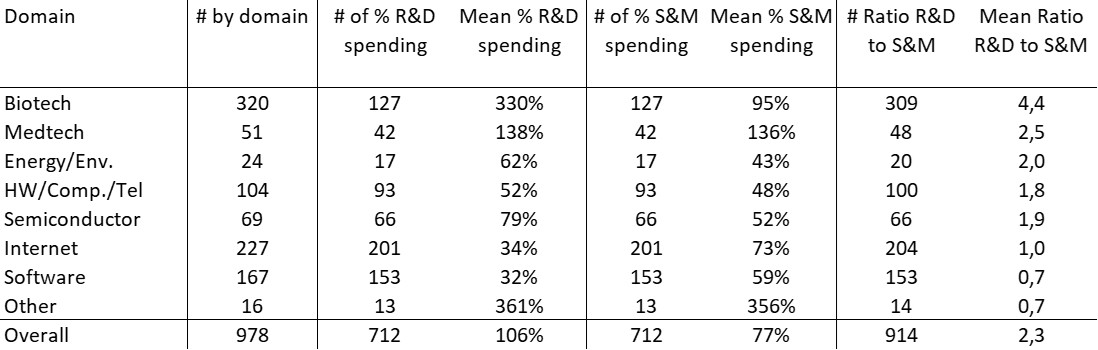
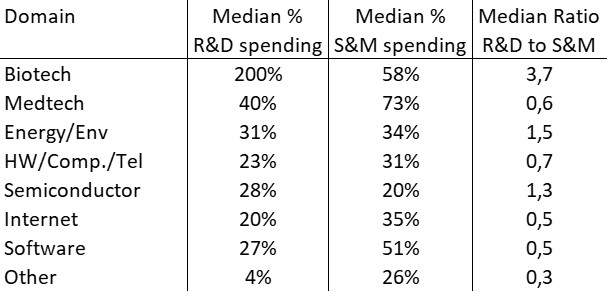
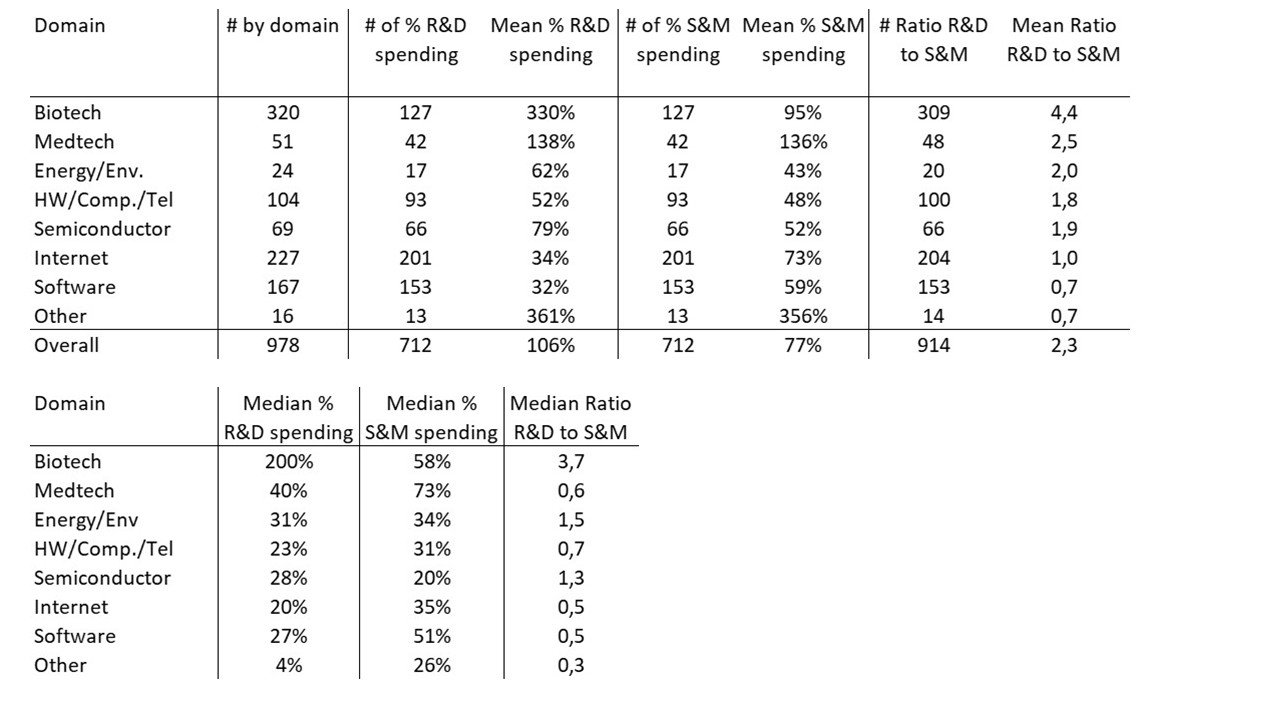
First a reminder of the mean and median values per field

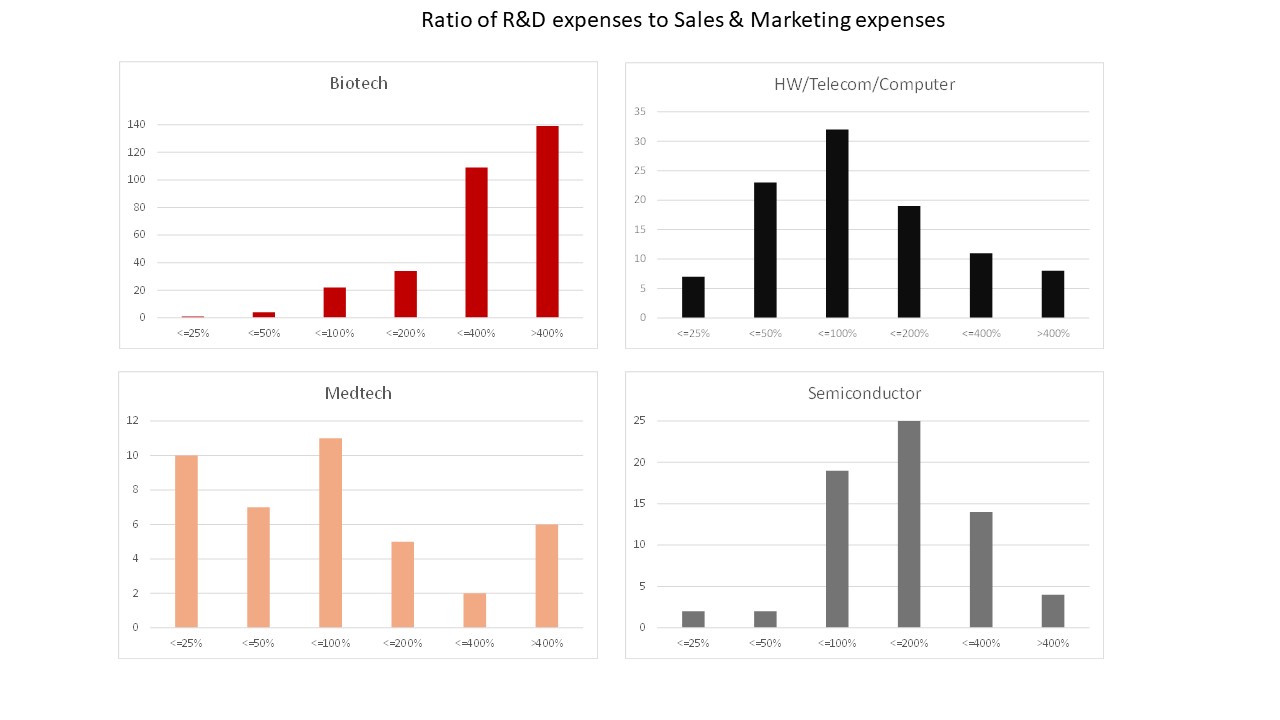
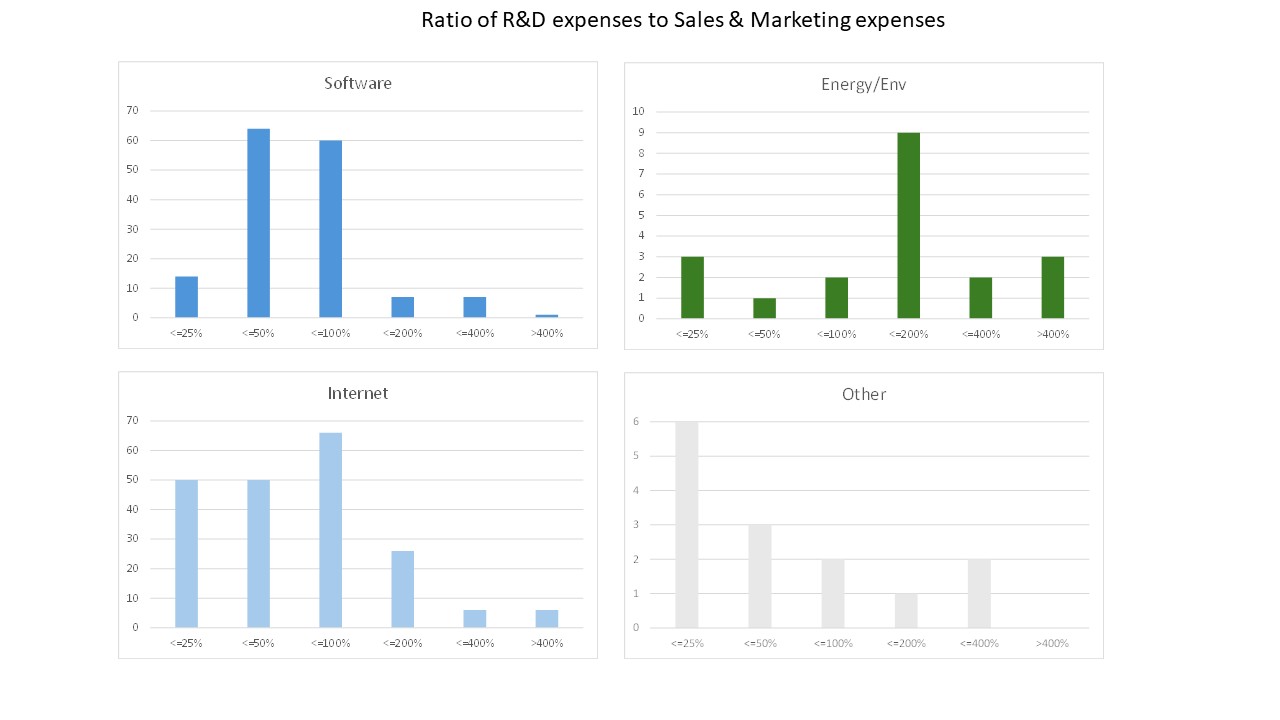
Second, the ratio of R&D (research & development) to S&M (sales & marketing) in the 8 different fields

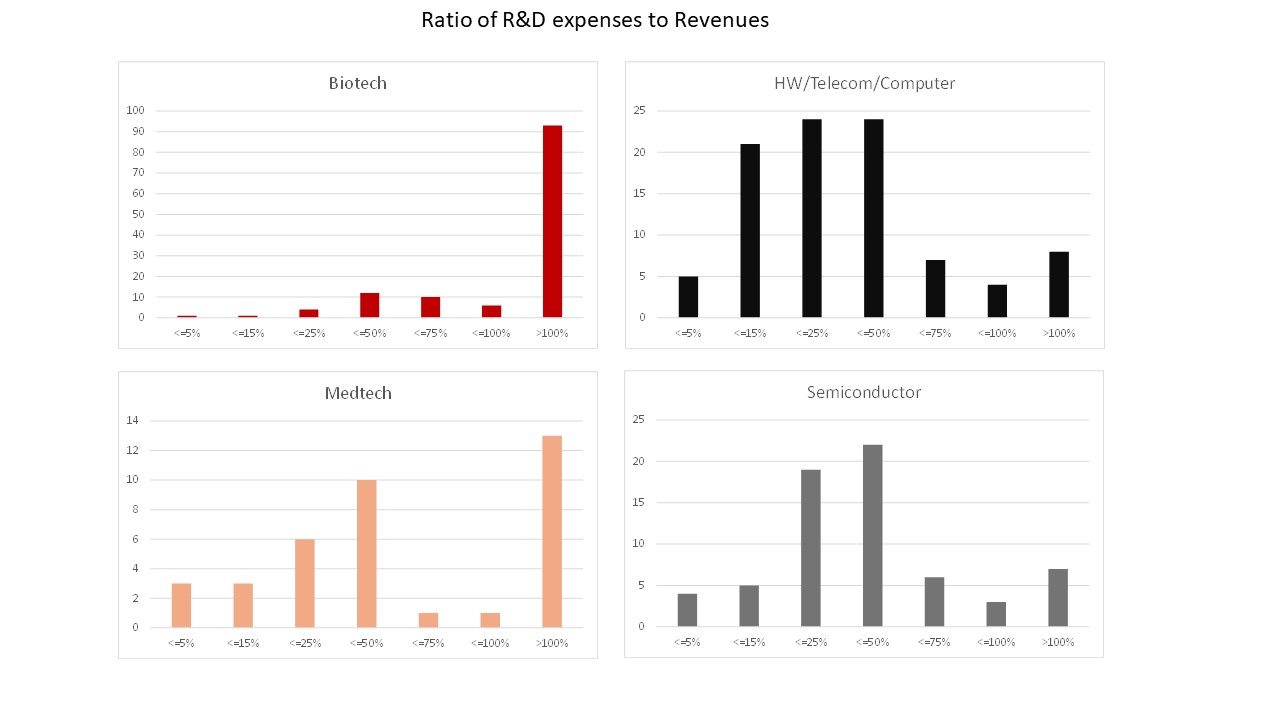
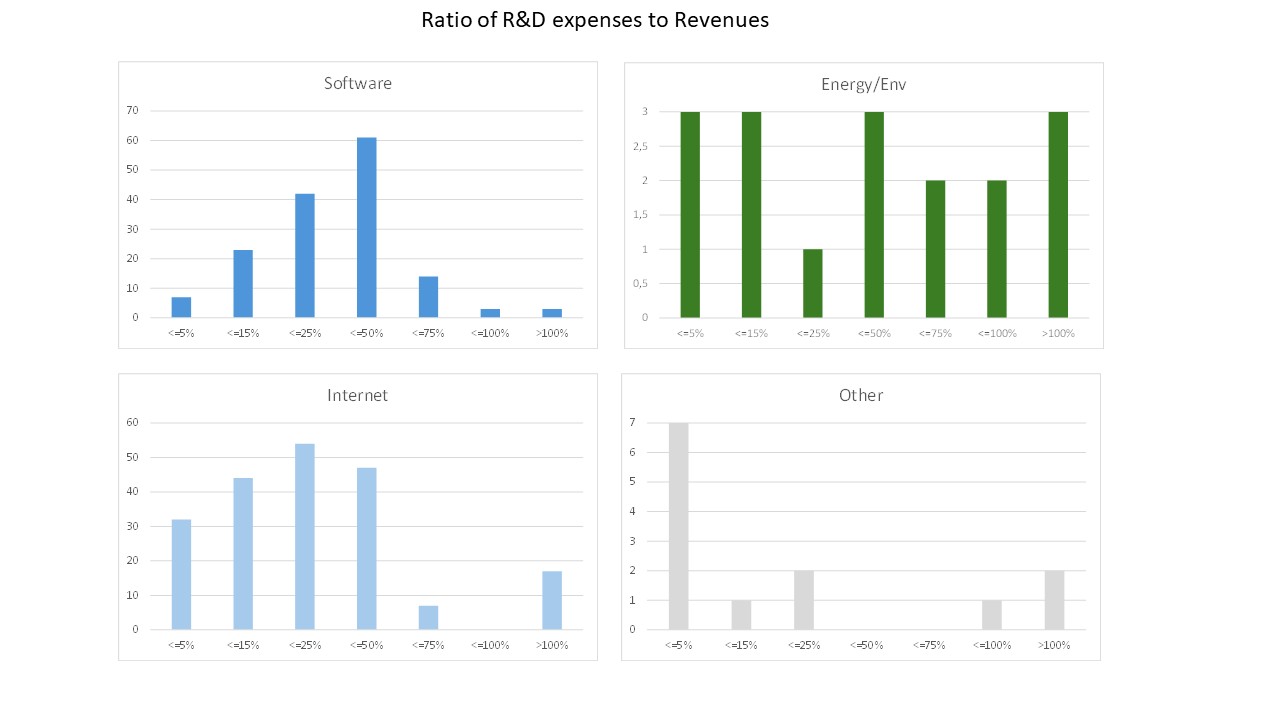
Third, the ratio of R&D (research & development) to revenues in the 8 different fields

It’s clear, I think, how different software and the internet are in terms of R&D investment, but even so, nuance is still essential. I can only leave you to your own interpretation or conclusions.

Research and Development (R&D) in Tech Startups (vs. Sales & Marketing)

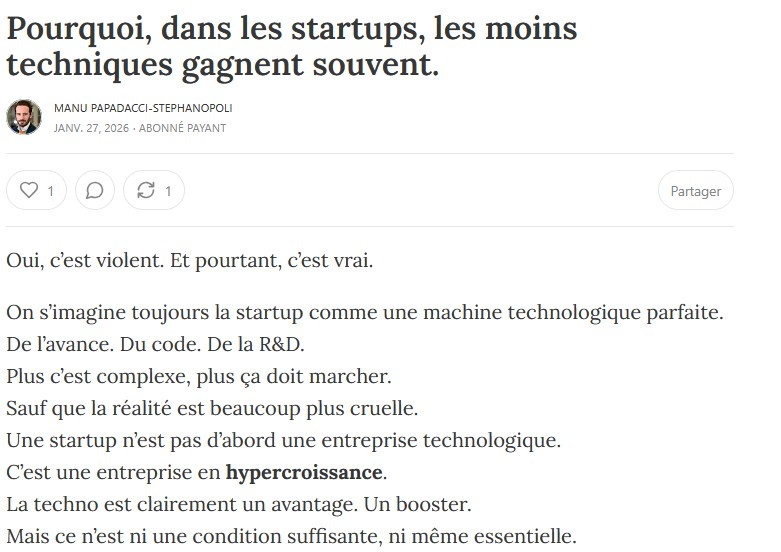
This strange post was motivated by my colleague Antoine (thanks!) who asked me what I thought of a recent article which claimed that in startups, technology is not as important as many think. The article is in French Pourquoi, dans les startups, les moins techniques gagnent souvent and was written by Manu Papadacci-Stephanopoli.

So let me translate the claim : in startups, the least technical often win. Yes, it’s harsh. And yet, it’s true. We always imagine a startup as a perfect technological machine. Ahead of the curve. Code. R&D .The more complex it is, the better it must work. Except that reality is much harsher. A startup isn’t primarily a technology company. It’s a hypergrowth company. Technology is clearly an advantage. A booster. But it’s neither a sufficient condition, nor even essential.

I never really thought deeply about it, probably because I fully agree and learnt this during my VC years. Technology is important but it is far from sufficient. And selling is tough. Google was the best example that “First mover adavantage was a myth”. So I agree again with Manu Papadacci-Stephanopoli when he adds later “In its early days, Google didn’t have the best algorithm for linguistic analysis. Its competitors were more advanced. But Google exploited something else: metadata, hyperlinks, the famous “backlinks,” the collective intelligence of the web. Less spectacular. But simply more effective.” (À ses débuts, Google n’avait pas le meilleur algorithme sur le plan linguistique. Ses concurrents étaient plus avancés. Mais Google a exploité autre chose : les méta-données, les liens hypertexte, les fameux “back-link’, l’intelligence collective du web. Moins spectaculaire. Mais juste plus efficace).

So I had to go one step further, dig deeper and here is my analysis.

20260228 Equity List Lebret

Some of you may know I am a kind of crazy data cruncher. I love data. They provide food for thought. Since 2008, when I published my book, I have been compiling data about startups such as cap. tables. I have now 978 such tables and the last time I published about them was in July 2025 and June 2024. I will celebrate with a long update when I reach 1000 but I have been slow recently with about 20 new tables per year. So we’ll see if the celebration will be in 2026 or 2027.

I studied something new here which is the R&D intensity in technology companies and startups. Let me develop. Most of the techology companies I study went public or at least filed to go public at some point in their history. Some were still startups (they might not have validated their business model), some were not anymore. But as technology companies, they often publif the level of R1D investments, but also the level of their expenses in sales & marketing (S&M). As I have data of companies since the 1960s, it would not be fair to look at absolute numbers in $M. SO i tried to llok at relative numbers, the ratio of R&D and S&M compared to total revenues. When the revenue was zero or very weak, this ration does not mean much so I also study the ratio of R&D vs. S&M.

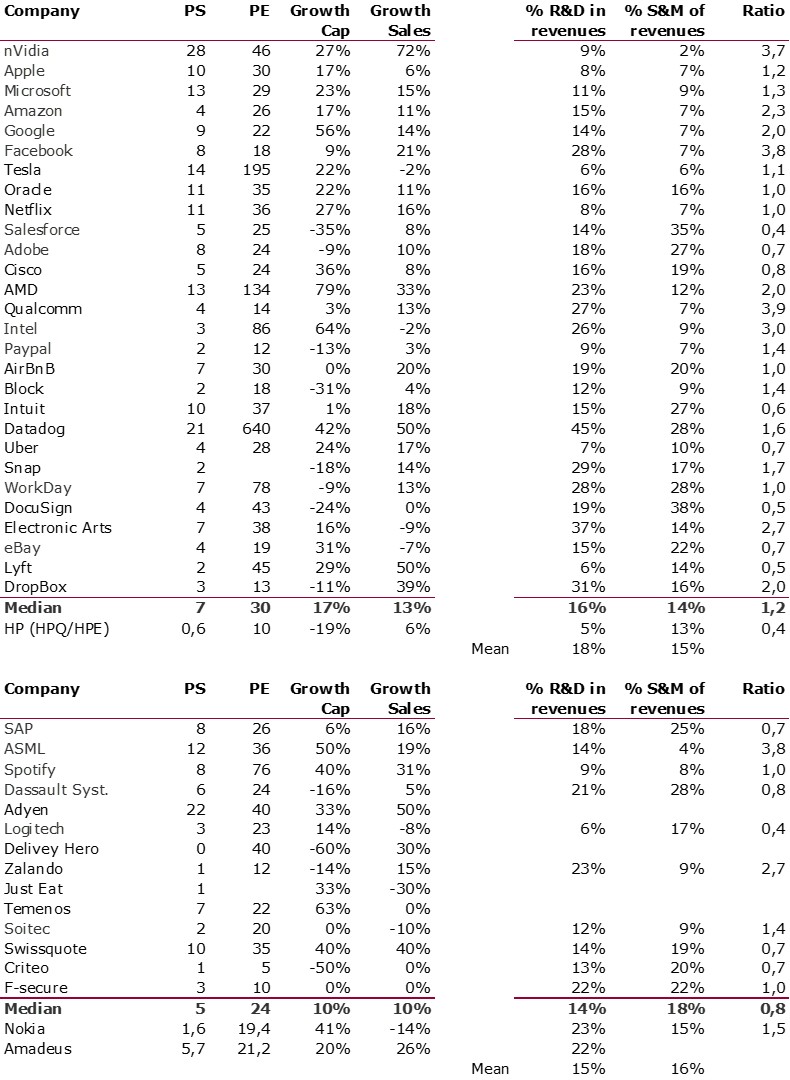
For example, as a first illustration, let us have a look at “my giants”.

It’s no easy to draw conclusions from this first series. Except that for these “technology giants”, R&D is not as high as I would have thought. R&D is on average close to 15% and rarely at the 25% that I thought common. Still R&D is in general higher than S&M. This relatively low levels are probably linked to the fact that these companies have huge revenues, very high profitability and there is a limit to what you can spend in R&D and S&M.

Now let us have a look at the data from the 978 startups.

So whether I look at the mean or median, R&D is really high in tech startups. But Sales & Marketing is really high too. It is not sufficient to build things. There is a huge effort to sell them.

Second, the R&D intensity (as well as S&M) is particularly high in Biotech and Medtech. However this probably come form the fact that the revenue levels are lower in these fields at UPO.

Third, the R&D intensity is the lowest in Software and internet probably because there is less need for R&D but S&M is relatively higher and this shows to in the relative ratio which is 0,5 for the media value of both.

No conclusion but an important Post-scriptum

I will not draw any conclusion but indicate a number of caveats :

– in many cases, R&D is not strictly mentioned but sometimes replace by technology development or product development. Probably for good reasons : in startups, it is not clear there are available resources to do strictly research.

– in many cases, sales and marketing is not mentioned and replaced by selling, general and administration, or even general and administration only. This probably means the focus on sales and marketing is not high enough to be considered separately. In that case, I took what was available.

The World of Startups according to Marion Flécher – final post : the sociology, & not coolness

I just finished reading *The World of Startups* by Marion Flécher, and I can confirm that it’s an excellent book, even if it’s a bit depressing at times — I’ll come back to that. In a previous post, I described her comparative work between French and “Silicon” startups. But the core of her research deals, on the one hand, with a sociology of entrepreneurs that seems to shatter the myth of the self-made man, and on the other hand, with the internal workings of startups, which are far removed from the sweet and colorful “coolness” of these so-called liberated companies.

A sociology of entrepreneurs

Marion Flécher criticizes the idea that entrepreneurs owe their success solely to their own merit [page 83]. She illustrates this point with the education level of this population. 92% hold a Master’s or Doctoral degree (compared to 27% of traditional business founders). She also illustrates this point by noting that a large majority held salaried positions before launching their businesses [page 87].

Furthermore, all these entrepreneurs benefited from a state-supported ecosystem, notably through the numerous initiatives of BPIFrance (for training, networking, and access to subsidies, without which only those with significant financial resources would launch their businesses). This analysis, reminiscent of Bourdieu, demonstrates that entrepreneurs possess economic, social, and cultural capital.

She convincingly returns to an analogy with the art world: just as an artist doesn’t create a work of art alone in their studio, startup founders don’t create their companies in isolation [page 97].

As a result, the social inequalities of Western societies are amplified here. Gender discrimination, of course: Manon Flécher uses the expression “Entrepreneurship + Technological Innovation = Sexism Squared” [page 109]. But also geographical discrimination: the startup world is very urban and bourgeois. Entrepreneurs from the suburbs, lacking the necessary codes, information, and networks, are rare.

Ultimately, nothing is really new. I experienced similar things in my school and professional life (at a time when social mobility was a reality, a more optimistic and enthusiastic era), and indeed, technological entrepreneurship comes at the end of the path of scientific training and management career.

Entry modalities for entrepreneurship

Her multiple correspondence analysis of startup founders resonated strongly with my own experience in this world. She classifies them into three groups: independent or career entrepreneurs, salaried entrepreneurs or entrepreneurs by opportunity, and young startup founders or novice entrepreneurs [pages 128-131].

The book is essential reading for a nuanced description of this population. Some individuals “seek to rediscover meaning and autonomy; a logic of seeking prestige and social distinction; and a strategic logic that leads them to seize (or not) the opportunities that arise” [page 133]. Others create based on a novel idea with which they hope to “change the world,” which is reminiscent of the Schumpeterian entrepreneur [page 136].

A long personal note, or rather a few notes, at this point in my synthesi of the book. For years I’ve been studying entrepreneurs in my own way. I’ve built a very personal sociology of them, as scientific as possible:
1- It’s undoubtedly an elitist world, even more so if you focus on tech startups. It’s difficult to launch a business without a solid education, often acquired through a doctorate, and self-taught entrepreneurs are very rare. (However, we shouldn’t forget this group: school dropouts who decided to interrupt their studies to embark on this adventure, and Steve Jobs, Mark Zuckerberg, and Dylan Field are a few examples. But be aware, they would undoubtedly have had brilliant academic careers at the best universities had it not been for this interruption.) In fact, my main study on the subject concerns entrepreneurs from Stanford University. Could it get any more elitist?
2- I’ve finally discovered a categorization of entrepreneurs that groups together, on the one hand, novices under 30 and, on the other, more seasoned entrepreneurs aged 30 to 50. It’s quite rare to find such an analysis, and I’ve too often read that entrepreneurs are generally experienced, with an average age of 39. This reminds me of my analysis of “serial entrepreneurs” and, on the other hand, the age of entrepreneurs. Whereas Marion Flécher seems to show (and I hope I’m not mistaken) that in France, experience is an advantage, I’ve tried to demonstrate that value creation is correlated with the inexperience of the founders (who, of course, are not alone as they progress through their ventures).
3- Societal discrimination is a crucial issue. I love mentioning the Lost Einsteins, the Marie Curies lost in Morbihan. I don’t have many more solutions than others to remedy this; I can only observe.

Fortunes and misfortunes in the world of startups

I now come to what I consider the most depressing part of the book. Few innovative companies manage to become sustainable — according to some studies, 90% of startups end up closing or filing for bankruptcy before their tenth year — and even fewer reach the expected growth level to become “unicorns”: only 1% of startups created in the United States achieve this, and only 25 of the 15,000 created in France, or 0.1% [page 147].

The author’s descriptions of fundraising (page 155), growing startups (page 182), and even startups in their early stages (page 204) are sometimes chilling. It’s difficult to deny these realities, even if they are not the only ones. It contains expressions such as fundraising as a test of strength (page 160), co-optation logics unfavorable to women (page 165), making a virtue of misfortune, a strategy of dominant people (page 172), from well-being to control: when moments of conviviality lead to over-investment of workers (page 188), the creation phase: a “joyful mess” not always so joyful (page 205), interns abandoned in the face of demanding work (page 207), a work environment not conducive to the emergence of collective mobilizations (page 228) so that the choice is reduced to “leave or stay” (page 232).

Marion Flécher also notes general advice from the ecosystem that has always struck me as wrong, not to say toxic, at the risk of diminishing the quality and scale of potential successes:
“In the startup world, failure is both a common and symbolically valued phenomenon” [page 172]; however, I encourage you to read a different perspective from the founder of Zendesk, who doesn’t celebrate failure at all;
“The ability to pivot is a condition for the success of entrepreneurial projects” [page 173];
“Startup founders are advised to build teams with complementary profiles; above all, you mustn’t duplicate skills” [page 99]; here again, a different vision of entrepreneurship from Charles Geschke, co-founder of Adobe.

The conclusion: Start-ups, the new face of capitalism

The conclusion is also a bit depressing, so I’ll add a few more personal notes!

Startups are a unique model of companies due to at least three fundamental characteristics (pages 237-243):
– economic, which is not geared towards profitability but towards strong and rapid growth through innovation, made possible by external funding;
– organizational, which utilizes horizontal structures, cooperation, autonomy, and well-being;
– ideological, which values ​​entrepreneurship as the main driver of economic and social progress and merit as the ultimate principle of success and social justice.

But the author’s ambition was to deconstruct these ideals and promises by confronting them with reality. Deconstructing
– the myth of risk and merit, which serves to justify the enrichment of a few by obscuring the decisive role of the State
– the meritocratic myth of the self-made man, which renders inequalities of access invisible
– the myth of the liberated company, which in reality perpetuates, in renewed forms, logics of exploitation, control, and segmentation of the workforce.

More personal comments: the power law and the exceptional nature of this world?

The analysis is correct, but isn’t the picture painted too bleakly? Everyone should form their own opinion, and the facts should help. I’m even surprised that Marion Flécher didn’t cite Mariana Mazzucato and her book, *The Entrepreneurial State*.

The debate surrounding this undoubtedly abnormal world, like the art world for that matter, is not surprising. It’s full of exceptions rather than averages, to the point that some believe Gaussian statistics don’t apply. Power law should be used instead.

We’re closer to a (more or less absolute) monarchy than a democracy. Founders are practically kings. Additional note: in my data on nearly 1,000 startups (961 to be precise, as of today), 60% of CEOs are founders, and even 70% in the software and internet sectors. And only 40 CEOs are women… (and even worse, 88 female founders out of 1,733 male founders).

In fact, neither entrepreneurs nor investors behave in a completely conventional way. Take, for example, the founders of Apple: The two of them did not make a good impression on people. They were bearded. They didn’t smell good. They dressed funny. Young, naive. But Woz had designed a really wonderful, wonderful computer. […] And I came to the conclusion that we could build a Fortune 500 company in less than five years. I said I’d put up the money that was needed.

This is an important book about startups. It’s quite rare in French, and anyone interested in the subject should read *Le Monde des Start-up*.

Nexthink, a Lausanne-based startup, acquired for 3 billion dollars

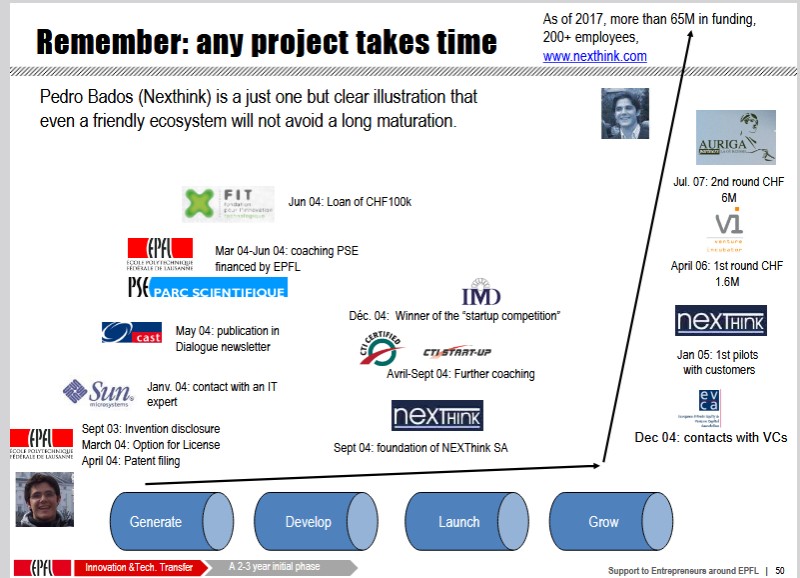
This doesn’t happen that often in a lifetime [1], so it deserves a pause: Nexthink, a spin-off from EPFL, has just been acquired for $3 billion [2] — you read that right, $3 billion!! Admittedly, Nexthink isn’t exactly young anymore; it was co-founded in September 2004, by Pedro Bados, who came (I believe, to do a master’s internship as part of the Erasmus program) in the artificial intelligence lab. AI wasn’t what it is today. His project was based on Bayesian methods… As luck would have it, I met Pedro then to analyze the intellectual property he had generated and what could be done with it. Pedro wanted to sell the patent that EPFL had filed, and when he discovered it wasn’t generating as much interest as he had imagined, I suggested, “Why not a startup?” That became my main role. I also helped him structure the initial deal, I mean who he would work with, within EPFL and outside, and made some introductions at the time. The rest is history !

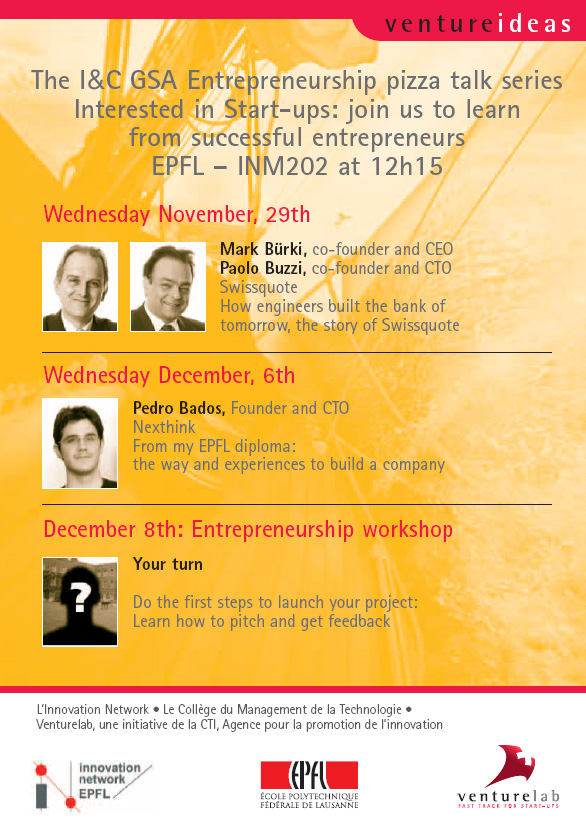
Pedro has become a discreet but essential figure in the Swiss ecosystem [3]. He was our guest for ventureideas as early as 2006, along with Jordi Montserrat.

Here are notes taken at the time from his présentation (pdf).
NEXThink notes

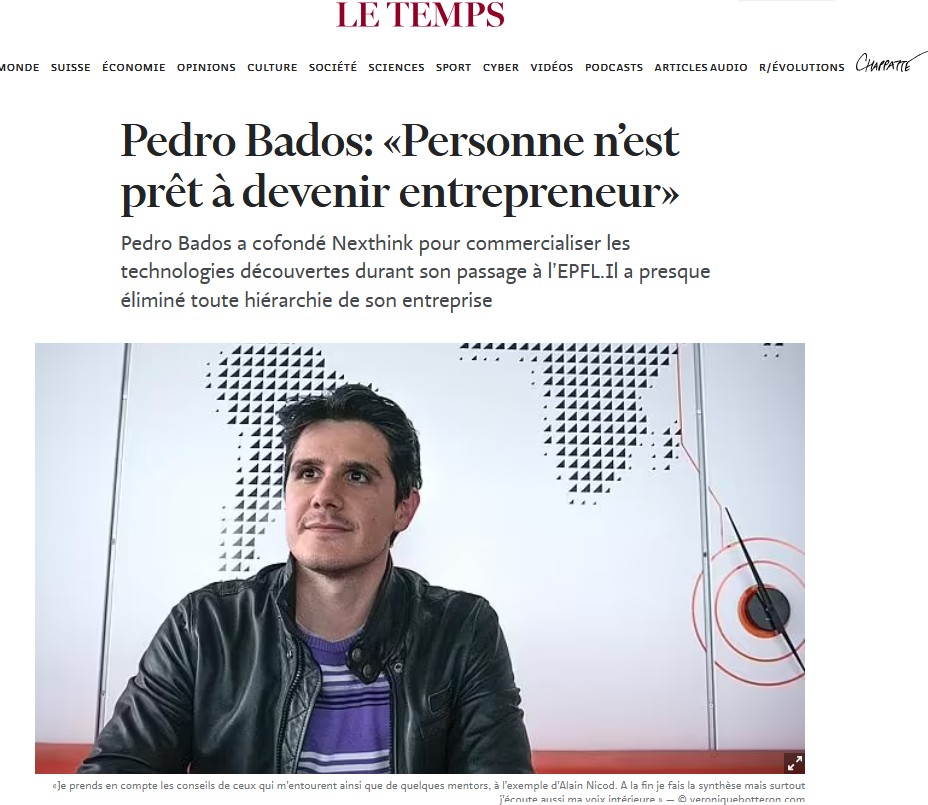
He also gave a beautiful interview ten years ago to the newspaper Le Temps (in French): Nobody is ready to be an entrepreneur

I’ve had some wonderful experiences in my professional life, in scientific research first between Paris and Stanford University, then in venture capital with Index Ventures, finally at EPFL for 15 years, and for the last 6 years at Inria. Nexthink will certainly remain one of the best ones, and I hope to experience a few more. As I said 15 years ago [4], my professional passion is to encourage these kinds of ventures (see the Stanford interview): “A love of entrepreneurship, a passion that I took back home to Europe after studying here [at Stanford University]. I want to see a stronger entrepreneurial culture there, and I am working in more than one way to effect that change.”

A few notes:

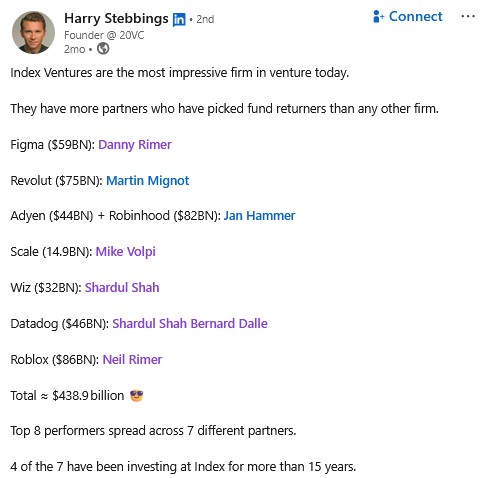
[1] I was struck some time ago by this post about Index Ventures and its stratospheric performance :

8 startup with an exit above $10B : Figma – $59B, Revolut – $75B, Adyen – $44B, Robinhood – $82B, Scale – $14.9B, Wiz – $32B, Datadog – $46B, Roblox – $86B. So what does $3B represent for Index? And I don’t have a list of their exits above a billion. I remember Virata, Numerical Technologies, The Fantastic Corporation, and Skype before 2005. I might ask them!

[2] Some more news and archives – What I found online about Nexthink acquisition, mostly LinkedIn posts by its founders and investors as well as press articles
Nexthink News autour acquisition


Neil Rimer (Index ventures) and Pedro Bados I am not sure where and when

[3] A short presentation of the EPFL ecosystem to its alumni before 2010 that mentions Nexthink (pdf)

a3angels10-herve_lebert-innogrants

[4] Thanks to my favorite search engine, an exchange about what I thought of startups, Silicon Valley in 2008 where I mention Nexthink. I am not sure things have changed that much…

Stanford HL

Coreweave, another IPO, more IPOs and the link to VC

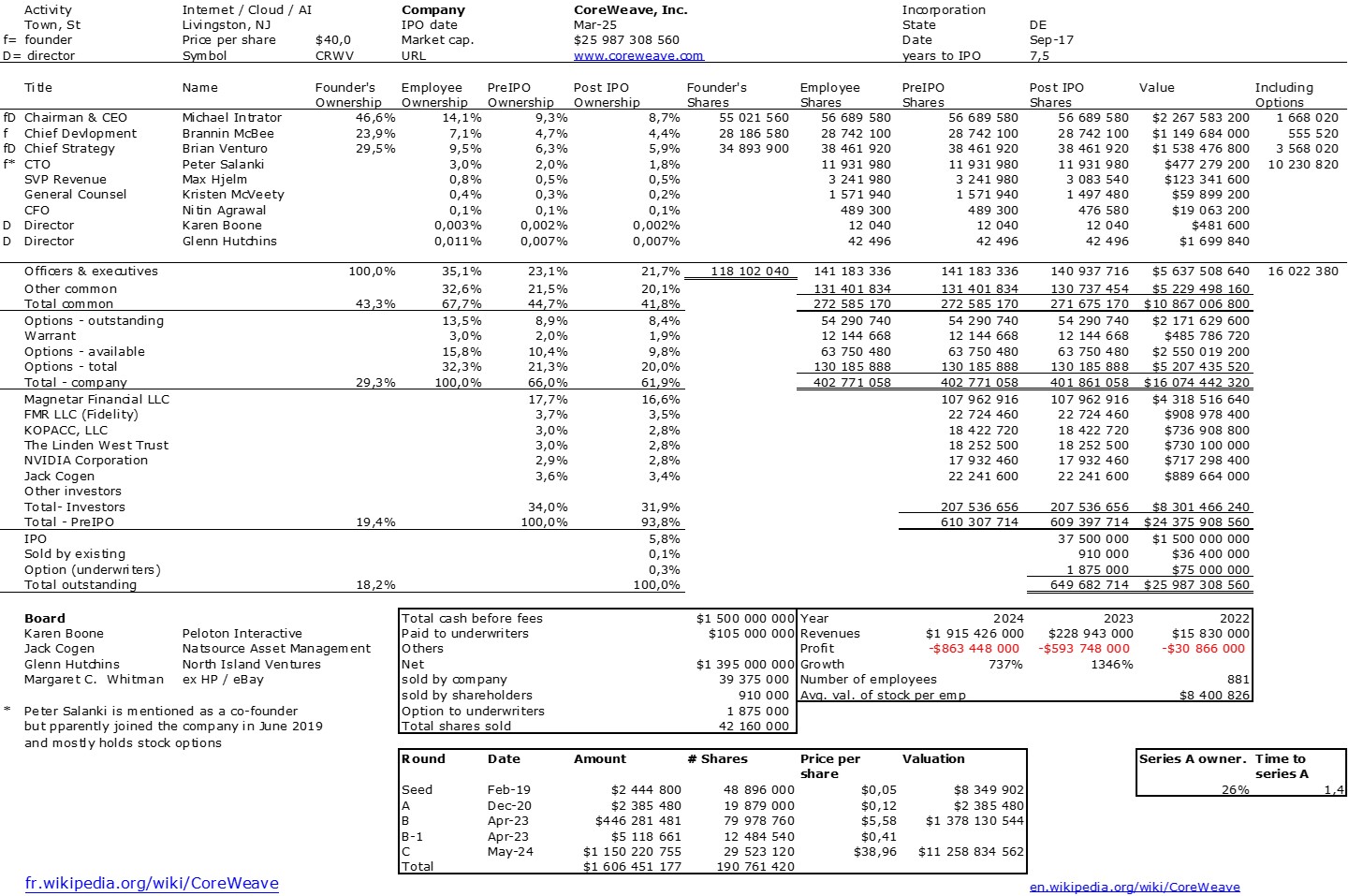
I should thank a colleague of mine for mentioning the surprising not to say crazy IPO of Coreweave. A new cap. table in my list which has now 948 companies. I will update my stats in the final pages of the pdf (available at the end of the post) when I reach 1’000 companies except I have been struggling with IPOs in the recent years. I will expand on this after the Coreweave case.

It’s really a strange story that I did not know and discovered on Wikipedia. 3 founders who were commodity traders launched a crypto currency mining company with obviously a data center and tons of GPUs. They pivoted in 2019 to providing cloud computing in a very aggressive manner. There is a 4th cofounder, the CTO but he apparently joined with the pivot (and mostly own stock options). A crazy growth in revenues (and losses) as the quaterly results show in the next table. Apparently there is cautiousness becuase Microsoft represents 60% of the revenues and the debt is alos about $800M. Impressibe but maybe fragile…

Now the IPOs !

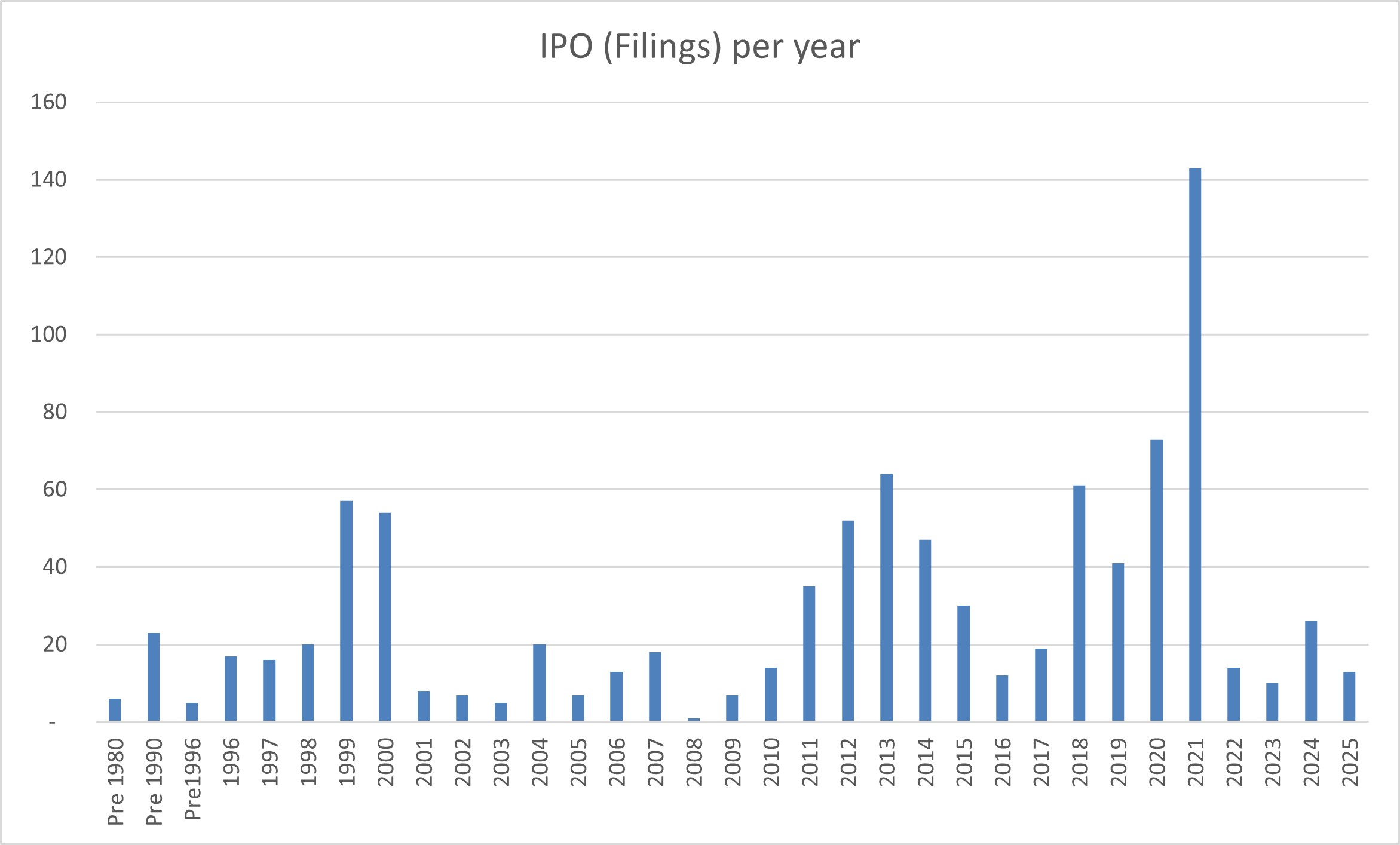
The figure above represents the number of companies in my pdf by year of exit (mostly IPO filings, and much more rarely M&As). [Of course I do not have all IPOs and I found a document which shows I have 27% and 87% of the IPOs of years 2011-22.]

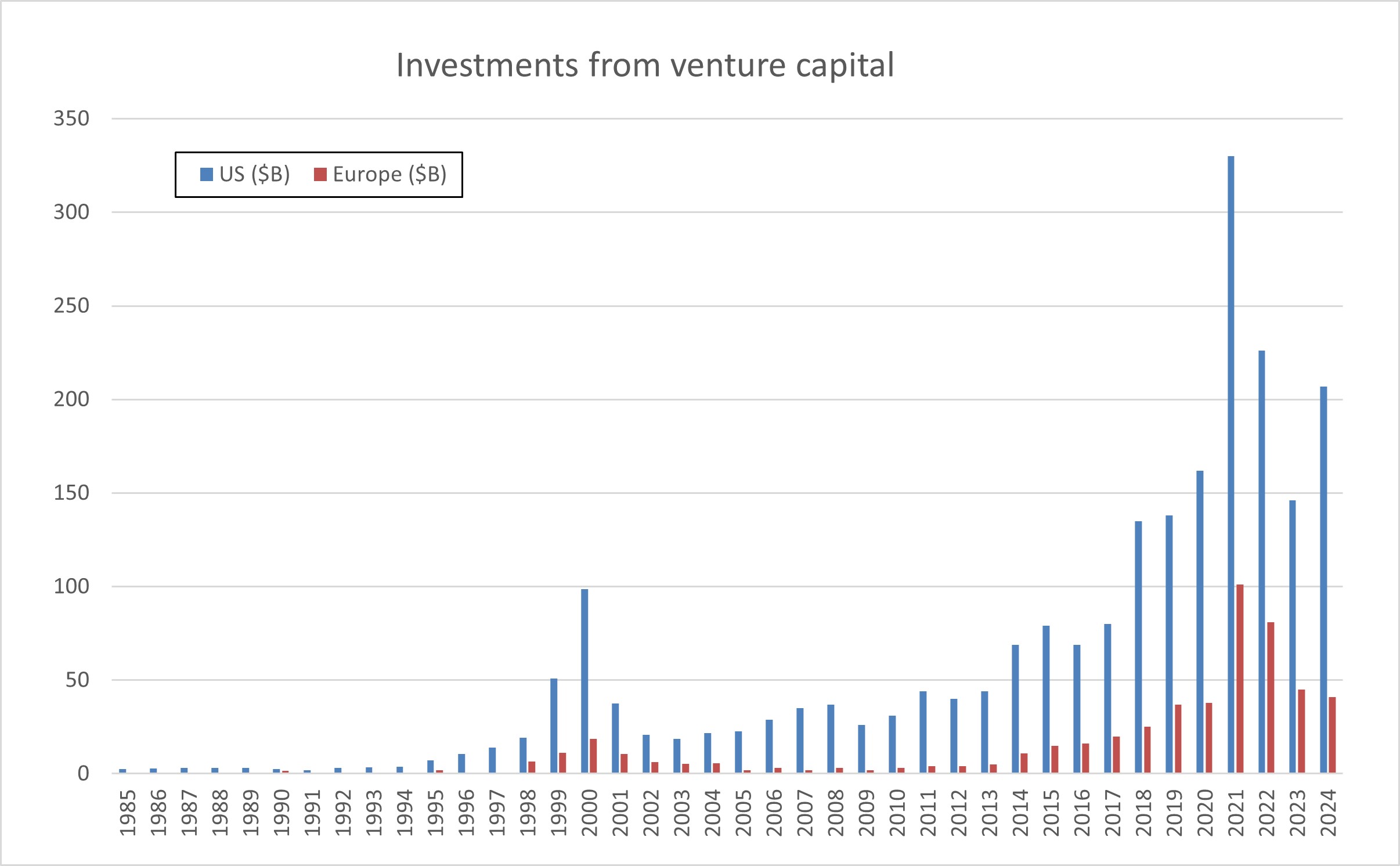
I had forgotten there was such a bubble and crash in 2021 so I had a look at VC investments over decades which gives the following figure. But with so few IPOs, LPs will become more and more impatient putting pressure on VCs all the more money is not as cheap as before…

Now when I hear that VC is in a crisis and I look at the levels of investments in the 7 years compared to the previous decades, I cannot help btu think there is a lot of money available…

Finally the promised pdf, but at this rate it will take me another two years before I release new statistics : Equity in start-ups – Historical data from 900+ companies.

20250717 Equity List Lebret

Figma again, now an IPO

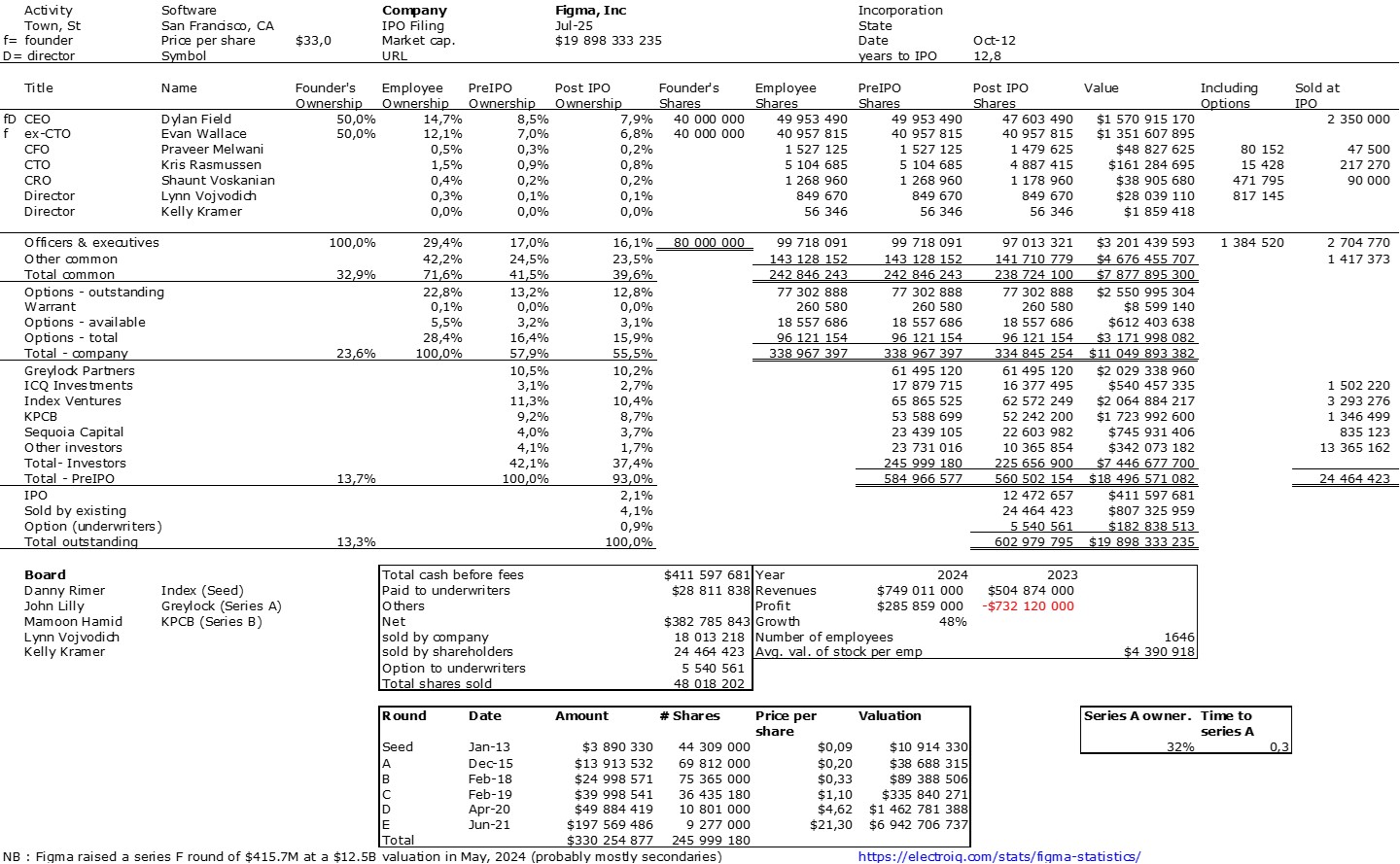
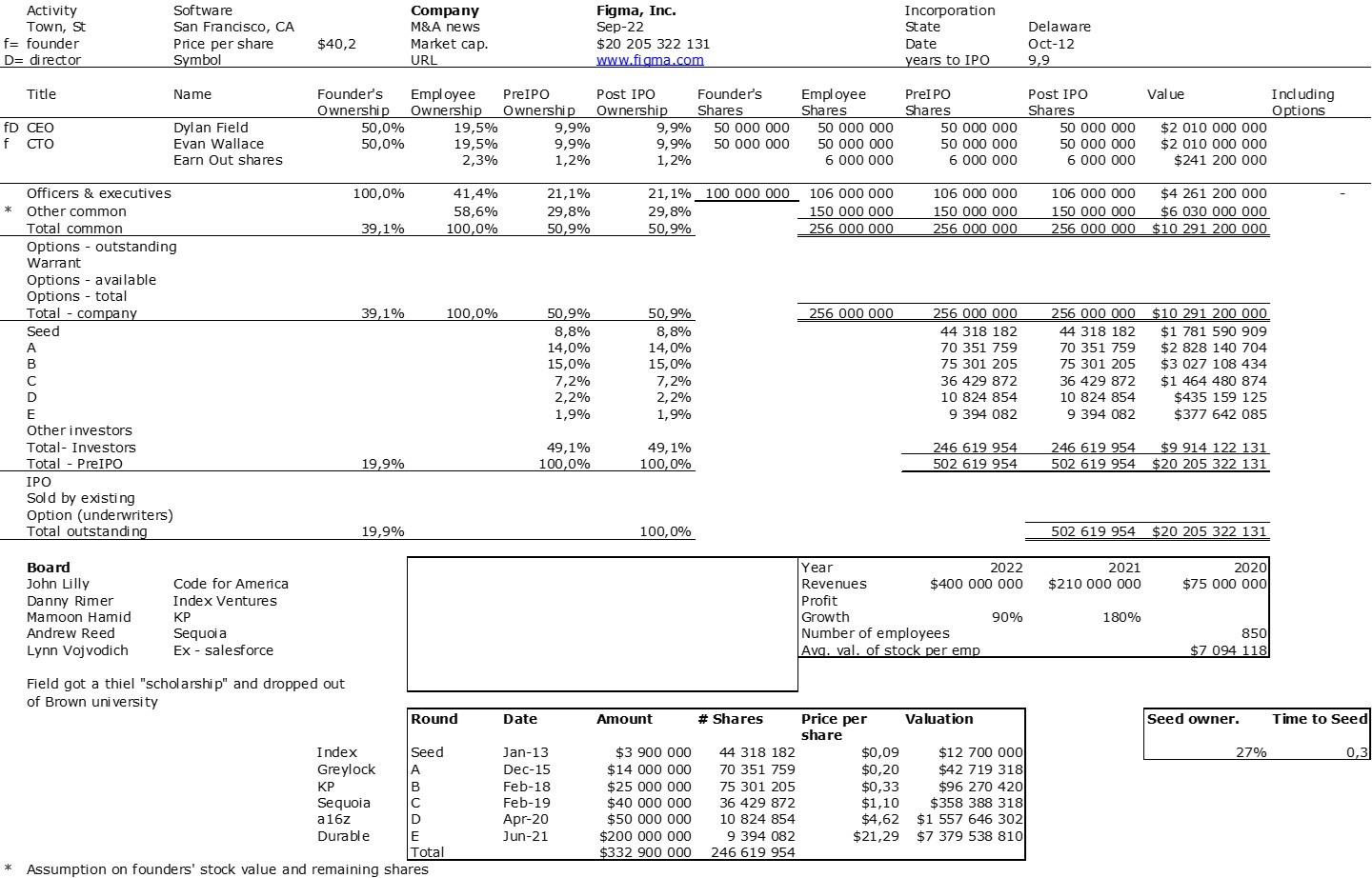
I published a post about Figma in October 2022 when it was announced it would be acquired by Adobe for $20B. Here is the article. At the time I could not find official data about the startup and I built a cap. table based on public data available online (see at the bottow).

This morning I found a SEC filing document published in Nov. 2022 that I had not seen before, which says much more. So I built a revised cap. table and you can compare it also below close to the older one. They are not that different though. My motivation for looking for such a document is that Figma has confidentially filed for an IPO. So if it happens, updated numbers will emerge like fundrasising between 2022 and 2025, real revenues, profit (or loss) and employee count. Still I had to publish this revised version.


Figma cap. table as revised in July 2025


Figma cap. table estimated in October 2022

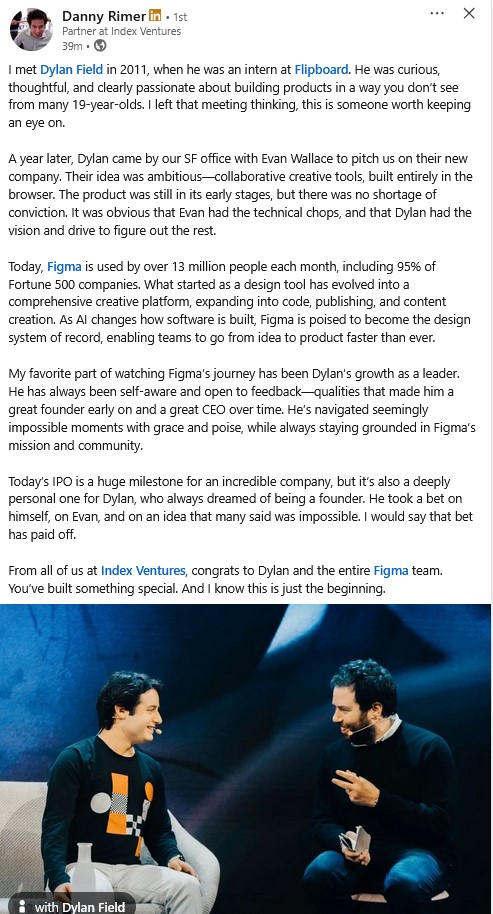
And cherry on the cake, a LinkedIn post by Danny Rimer :

Two great recent startup stories (not in Silicon Valley, but both acquired by Google) – part 2 : wiz.io

Reading a few articles about Deepmind (part 1 of this post) and the founders of Adallom and wiz.io, I remembered other stories of European startups or those founded by Europeans. I’m thinking of Spotify (see my posts in 2022 and 2018) or VMWare (see an older post from 2010). We see that more or less curbed ambition has led to different results. Wiz or Spotify have valuations in the tens of billions, Deepmind, Adallom and VMWare (first acquisition) in the hundreds of millions, while the second acquisition of VMWare was also in the tens of billions. I don’t know if there’s a pattern or if I’m creating it artificially, but it’s a bit as if an acquisition in the hundreds of millions was a semi-failure linked to the fear of too much competition or the impossibility of pursuing an independent adventure.

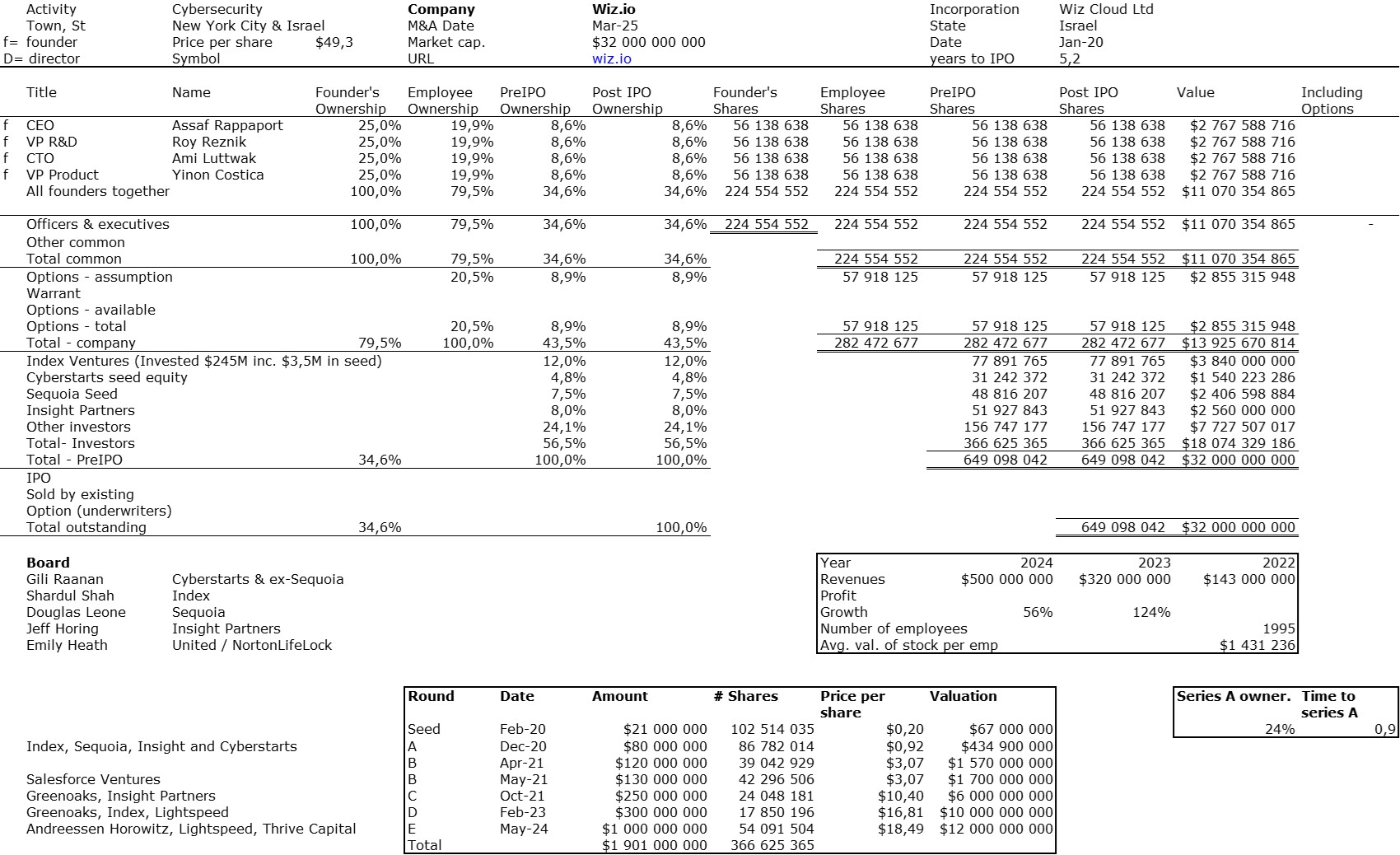
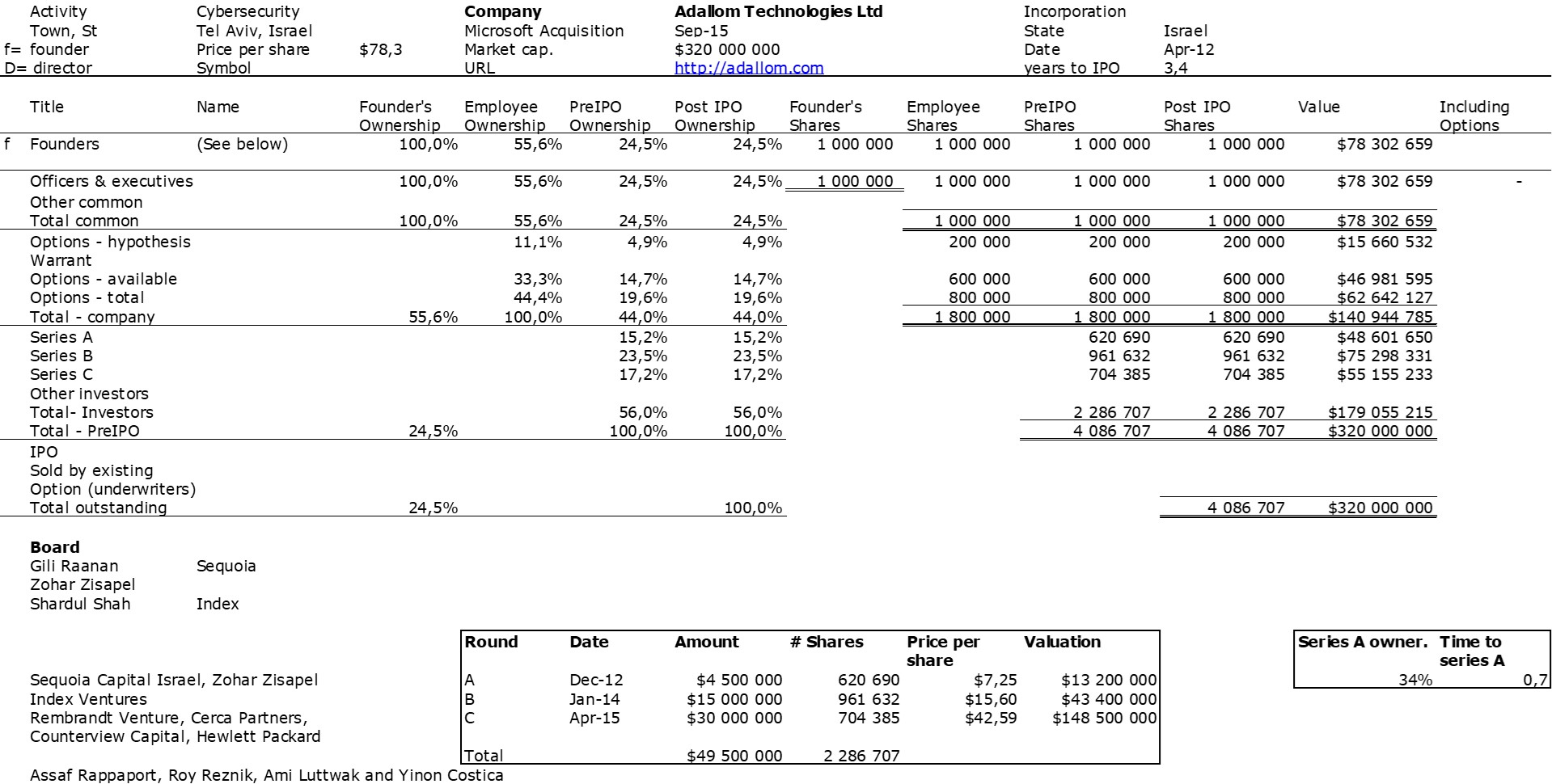
The double adventure of the founders of Adallom and Wiz.io goes a little in that direction. I read a few articles which reference you will find at the end of the article. And I will give the lessons learned by Assaf Rappaport from these two stories. A first success, Adallom bought in 2014 by Microsoft for $320M then a second, wiz.com which Google offered to buy a few days ago for $32B (i.e. 100 times more…) Unlike Deepmind, I did not have access to specific documents, so I had to make some assumptions like some others (see [2]) and cross-check the information available online. Here are the two capitalization tables. But here too, the advice given (which I repeat below) is just as important as this data.

First of all, what I take from the tables:
– Four founders whose story is a classic in Israel (see [1]) created Adallom and then wiz.io. In reality, I am not a big fan of the concept of serial entrepreneurs, but wonder if wiz.io is not rather the scaling up of Adallom like VMWare (2nd period) was for VMware (1st period) or by pushing very hard the Nobel Prize of Demis Hassabis the scaling up of Deepmind! We read in the press that the founders had earned around $25M with Adallom according to some sources and $3B with wiz.io, also a factor of about 100x.
– The same venture capital funds and partners are the investors – Gili Raanan for Sequoia then Cyberstarts and Shardul Shah for Index. These are rare enough to be mentioned especially since these funds intervened at the seed stage.
– For Adallom, multiples of 24x for Series A, 7x for Series B, and approximately 2x for Series C.
– For wiz.io, multiples of 475x for Seed, 73x for Series A, 20x for Series B, 5x, 3x, and 2.7x for Series C, D, and E.

All of this is arguable, but not uninteresting, and there’s a bit of a lottery aspect to it. Don’t get me wrong. Success is rare, never guaranteed. I remember a startup that was offered a $300 million acquisition. The founders and/or investors declined, thinking they were worth more. In the end, the acquisition price was $10 million.

About the ambition and uncertainty, it is also worth reading Shardul Shah (Index) on LinkedIn (Index Ventures just cemented its place as one of the all-time VC greats). Here are some quotes : “I don’t know why we’re talking about averages — none of us are in the business of mean reversion.” […] “I’m not seeking average returns. I’m not seeking good deals—I’m looking for outliers.” […] “I don’t seek comfort. You have to be comfortable with being uncomfortable. We’re in the business of taking risk. I’m not a value investor, right? I believe in the power law.” […] “The hardest thing is identifying if you’re delusional or if you have conviction. Sometimes it can feel like a thin line.”

Finally I extract the lessons from Assaf Rappaport:
1. The team is more important than the idea. A startup is built not around an idea, which is going to change anyway, but around a team. The really good VC funds invest in talent, and not in products, ideas or business plans. And also: Don’t drag your feet when it comes to meeting with the best funds. Don’t leave them till the end.
2. One who listens to problems will find ideas. When you meet with customers, you’re not coming to convince them; rather, you’re there to learn from them. If you’re the one who spoke for more than a quarter of the meeting, it wasn’t a good conversation. Customers have problems that you didn’t even know existed, and the way to discover them is with question marks, not exclamation marks.
And also: You need some luck.
3. ‘No’ is the correct answer to determine whether the investor is serious. No matter what kind of offer you get – investment or acquisition – there’s only one response: ‘I really appreciate your offer, but no thanks.’ This kind of answer never deterred a determined investor or company – and if they’re not determined, they won’t invest in any case. And also: You need to prepare a media plan, both internal and external; when things leak, you’ll have only enough time to hit the Send button.
4. The exit is just the beginning of the hard work. On the day after being merged into a giant corporation, don’t sit back and wait until the options mature. Instead, adopt the commando approach: We’re part of a big army, but we belong to an elite unit.
5. Don’t be afraid of activism. In every company, a moment comes when you have to give the conservative corporate people a kick, and then go ahead and act. To be the best workplace and to recruit the best workers, you need to be brave and take a stand, engaging in social activism that gives rise to tremendous team spirit.
6. Take a deep breath and don’t exhale too soon. You shouldn’t be blinded by big money, instead, use it to quickly acquire paying customers, turn down acquisition offers of hundreds of millions of dollars, and grow the company rapidly so it will become a unicorn.
7. Today, it’s possible to overtake everyone with a computer and Zoom

Once again, risk-taking and limitless ambition.

References :
[1] : 7 lessons from reaching a $1.7 billion valuation in just one year https://www.calcalistech.com/ctech/articles/0,7340,L-3904610,00.html
[2] : WIZ, Esprit, es-tu là? Comment les fondateurs de Wiz refont des miracles après le succès d’Adallom https://trivialfinance.substack.com/p/wiz-esprit-es-tu-la

Two great recent startup stories (not in Silicon Valley, but both acquired by Google) – part 1 : DeepMind

I probably have to admit a bias in favor of startups led by tech founders. It is what I have been advocating for decades now. So when I read about stories going that way, I am more than happy. Recently I was mentioned by friends a documentary movie entitled The Thinking Game.

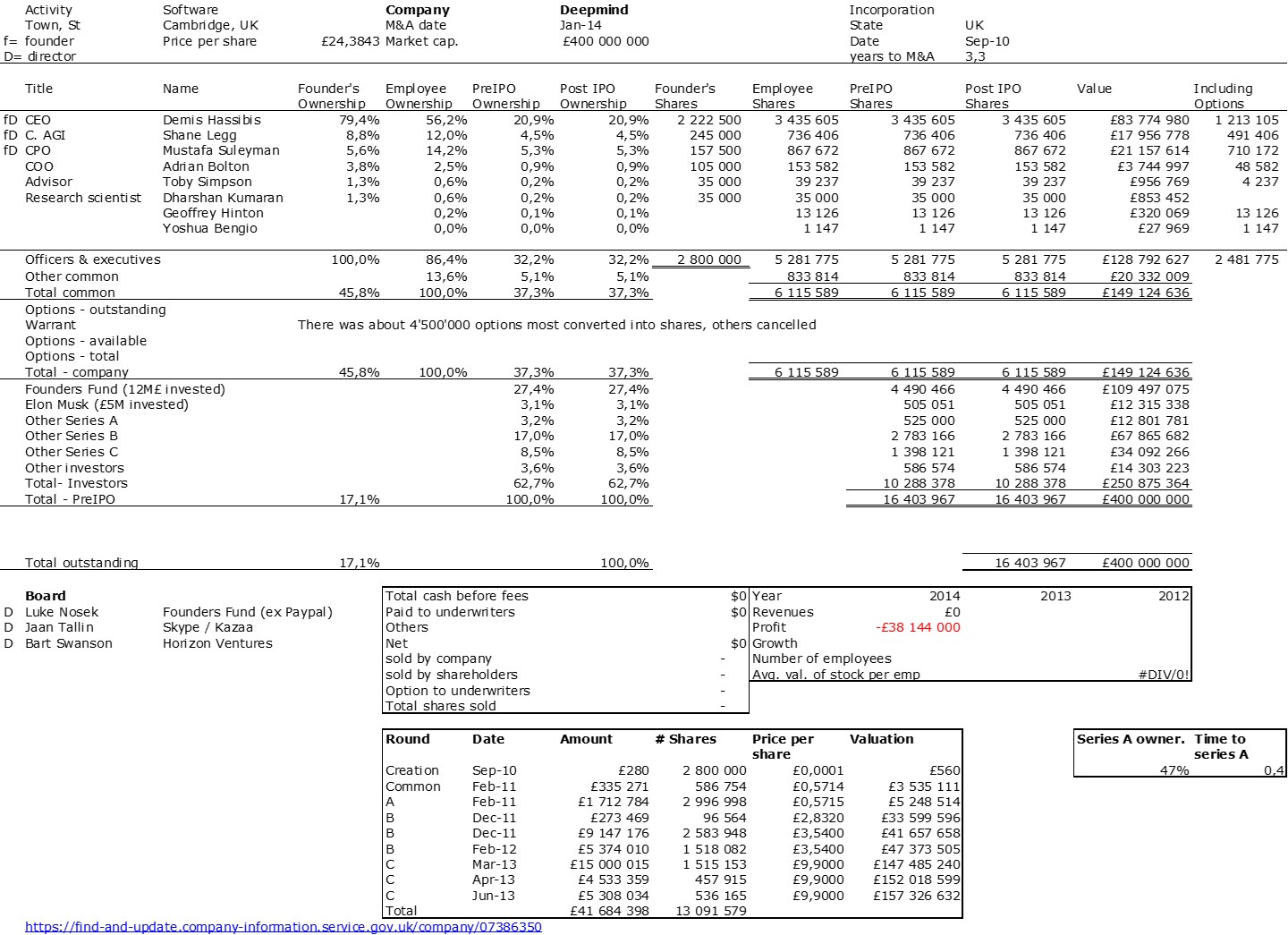
I do not know why I had not looked at DeepMind before all the more it is pretty easy to get information about British companies and this is a British startup. So you read me, I built its cap. table when it was acquired by Google in 2014 for about

What I read in the table:
– 3 or 4 main cofounders, but Demis Hassibis had the biigest initial stake (80%),
– investors took high risk as the company did not have that much but talent initially, (and no revenue until acquisition ?)
– the main or at least most famous investors were Peter Thiel and Elon Musk,
– the company did not raise that much money : 2M£ in Feb. 2011, £15M in Dec. 2011 / Feb. 2012, finally £25M in 2013 before the £400M acquisition by Google in Jan. 2014.

That’s it for the basic facts. More importantly, the lessons in the article my friends sent to me are:
– First, DeepMind combines crystal-clear strategic clarity with never-ending tactical flexibility. What comes across in the film is the company’s extraordinary willingness to experiment wildly and fail persistently.
– Second, DeepMind’s mission has helped it recruit some remarkable scientific talent, critical to its success. In a discussion after the movie, Hassabis explained that he had always resisted investor pressure to move to Silicon Valley and had been determined to remain in London. “The UK has always been very strong in science and innovation and has a rich history in computing,” he said. “We are trying to carry on in that tradition.” Hassabis reckoned that there was a lot of under-utilised academic talent in Europe, and elsewhere, that could be attracted to London. So it has proved.
– Third, what was essential for DeepMind’s success was its ability to scale rapidly. Back in 2010, few VCs were prepared to go anywhere near a startup with such extravagant ambitions and no business plan. Much of its initial capital came from US investors, including Peter Thiel and Elon Musk. The company also felt compelled to sell out to Google in 2014 to give it the capital, data and computing firepower necessary to stay at the leading-edge of AI. (The extra resources were essential for recruiting and retaining top talent, too).

Often not to say always the same lessons about risk taking and ambition…

PS: I have not watched the movie yet, so I may amend this post in the near future.

nVidia, the new giant

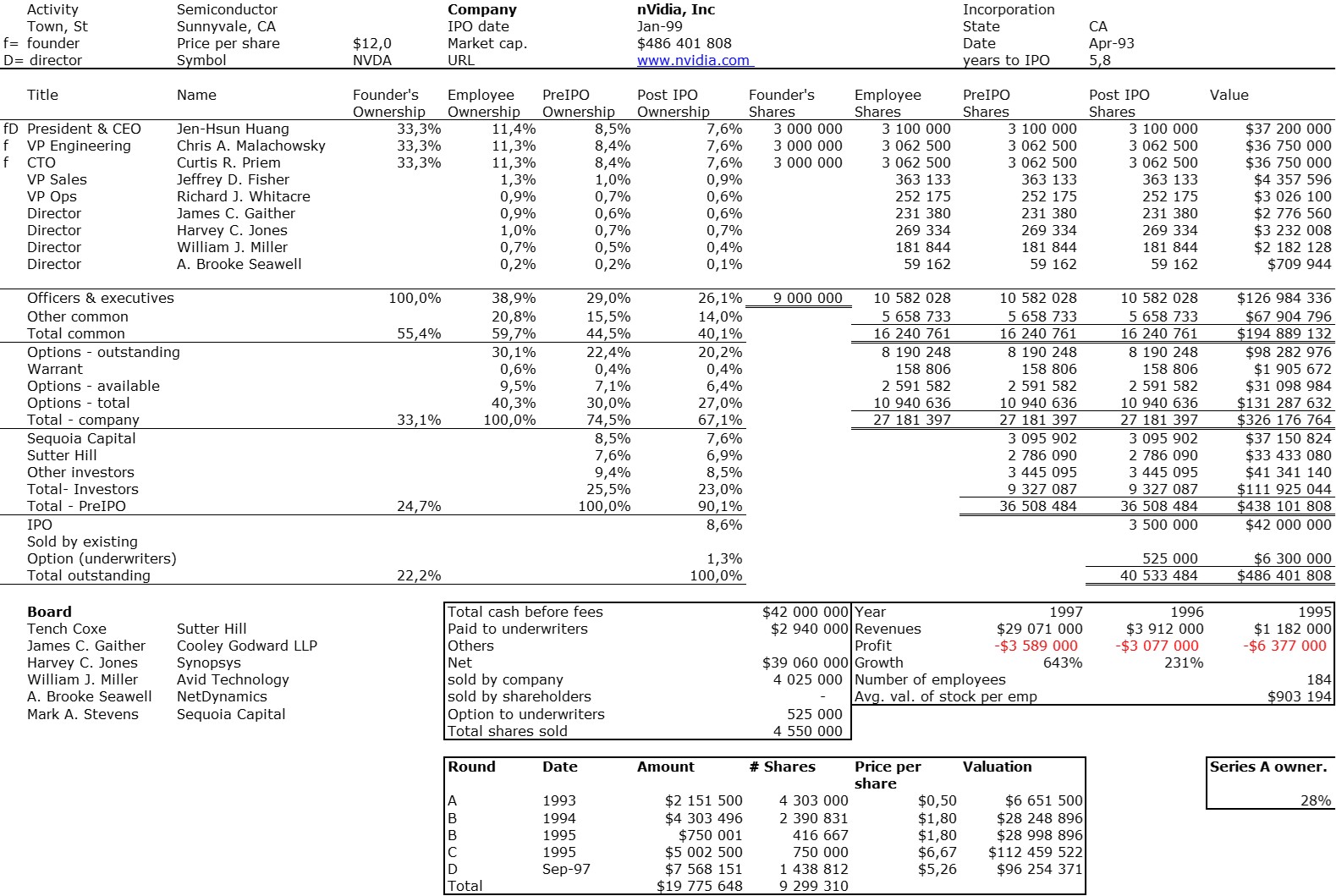
nVidia has made the headlines recently as its stock value jumped by 25% to reach a valuation close to $1T ($1’000B) joining a small club of companies generally called the GAFA(M) or BigTech. I knew nVidia as just another Silicon Valley success story, a big one, but just one more. It belongs to my 800+ startup list and here is my typical cap. table.

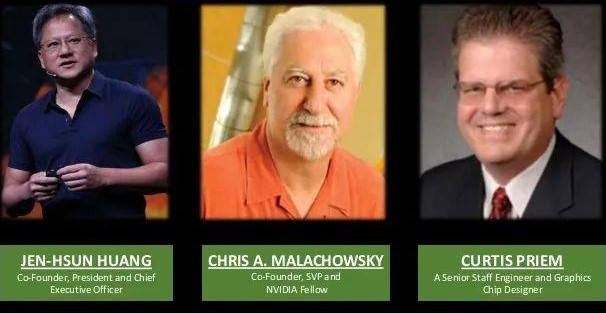
Nvidia was founded in 1993 by Jen-Hsun “Jensen” Huang, Curtis Priem, and Chris Malachowsky and is headquartered in Santa Clara, California.


There would be so many little things to mention about how typical it is, but here are a few:
– The founders were young engineers (29, 33 and 33), one from Stanford University, the two others from solid even if lesser known schools. One is of Taiwenese origin. They worked in big tech companies before founding their startup, and they are still leading it. They had equal ownership at foundation.
– There was a typical support of venture capital, a total of $20M in 4 rounds between 1993 (the foundation) and 1997 (the IPO), followed by an IPO in 1999, less than 6 years after the incorporation. The VCs were Sequoia (which also funded Apple and Google), and Sutter Hill. The board included experts from Synopsys (its cofounder) and Avid.
– Employees owned at least 20% of the company through stock options (and maybe even 35%+ throug additional common shares).
– It went public at a $500M valuation, more than decent and was a leader in computer graphics chips until nVidia applied its technology to AI. Hence its current popularity.

Equal ownership of founders in startups ?

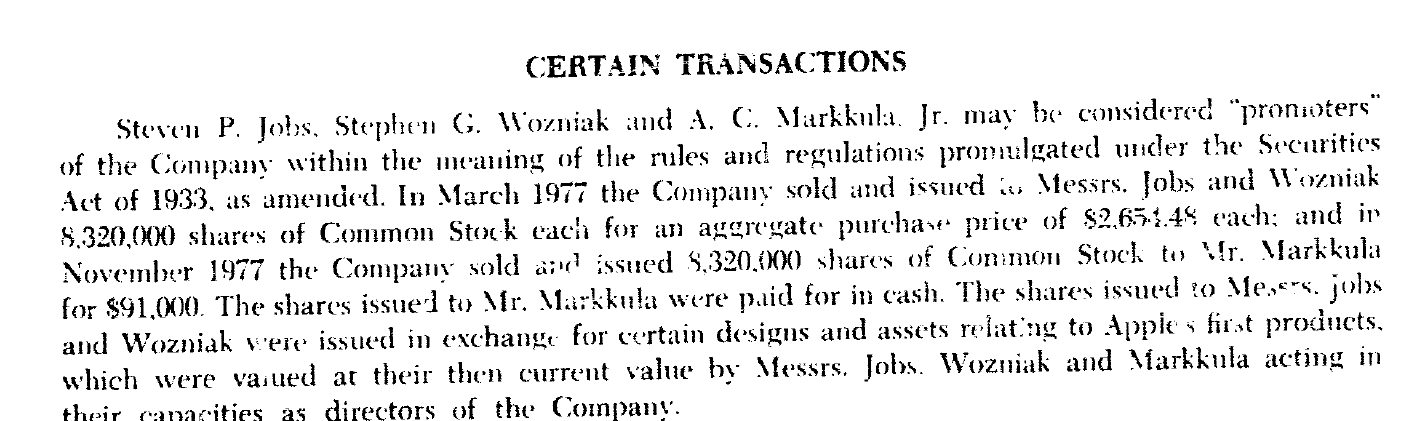
Yesterday I had a short debate about Wozniak and Jobs initial ownership in Apple Computer. It is true that at the IPO Wozniak had much less ownership than Jobs, but this can be explained by the fact that he gave or sold at a low price shares to employees (whom he thought deserved it and Jobs did not). But at the origin, they had equal shares as the extract from the prospectus shows.

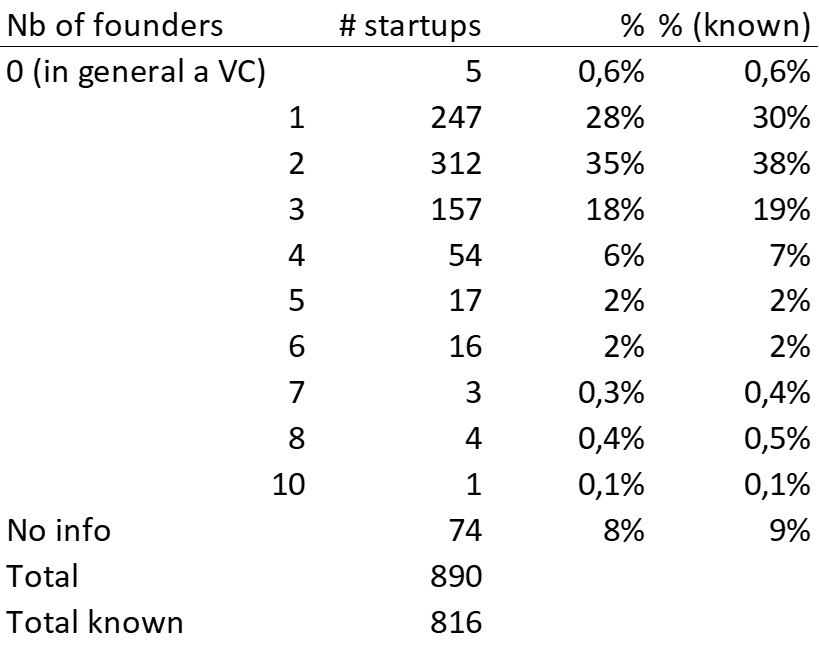
So I thought of having a look at my startup database (currently having 890 cap. tables) and I studied the numbers. Here they are:

So what are the lessons?

First majority of startup have between 1 and 3 founders, and 1 founder (contrarily to intuition maybe) is not so rare. Now there is a caveat: the history of a startup is never fully known. Apple had initially (and for 2 weeks) 3 founders! The third one was Ronald Wayne

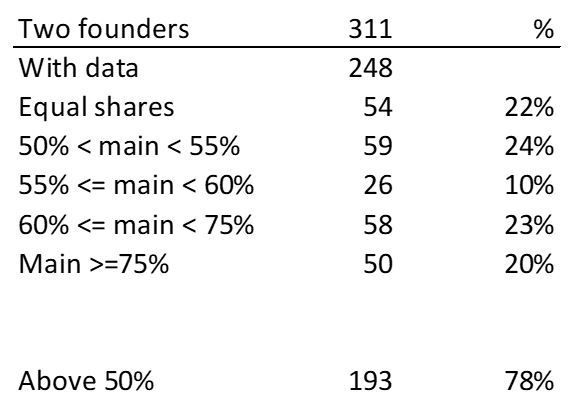
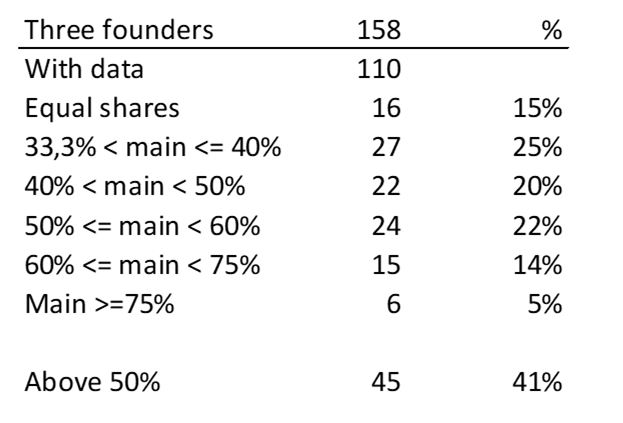
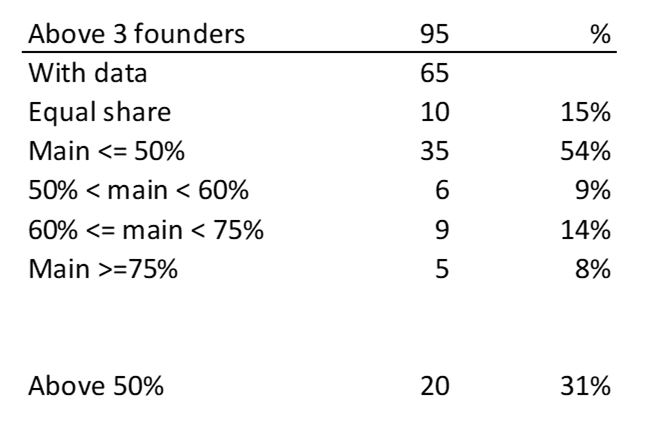
Second, equal ownership is not the majority but it is not rare. Around 15-20%.

But this does not mean, one founder owns more than 50%. Of course yes with 2 founders. But for 3 founders, this happpens in 41% of the cases. When more than 3 founders, this is 31% of the cases. I did not check (yet) if geography or fields of activities have an impact…

Finally, if you read this blog, you should know that statistics do not say it all. Startups are a world of exceptions (and the statistics are seldom Gaussian but follow a power low, so beware of means of %). Therefore more anecdotally, but still important, here are some famous examples:

Famous startups – 2 founders with equal shares
Adobe
Akamai
Apple
Atlassian
Broadcom
Cisco
Genentech
Google
Intel
Netscape
Riverbed
Skype
Soitec
Spotify
Tivo
Yahoo
Zalando

Famous startups – 3 founders with equal shares
Airbnb
Checkpoint
Compaq
DoubleClick
Equinix
Marimba
nVidia
Palantir
Revolut
RPX
WeWork

Famous startups – 3+ founders with equal shares
AMD
Regulus
ROLM
Xiaomi

Famous startups – founders with non-equal shares
Cypress
DropBox
Etrade
Eventbrite
Facebook
Lyft
Microsoft
Mysql
Oracle
Pinterest
Salesforce
Sun Microsystems
Twitter
Uber