Posts Tagged ‘Entrepreneur’

Is there a recipe for entrepreneurship?

Tuesday, June 17th, 2008

Students from the Ecole Hôteliere de Lausanne who naturally have a taste for good food asked me the question recently. I took inspiration from Paul Graham and Steve Jobs to provide the ingredients. The text is available in pdf. Here is the full answer…

stvoi.gif

Is there a recipe for entrepreneurship?

“Launching a start-up is not a rational act. Success only comes from those who are foolish enough to think unreasonably. Entrepreneurs need to stretch themselves beyond convention and constraint to reach something extraordinary.” Vinod Khosla, founder of Sun Microsystems

Europe is aware that it is not as efficient with entrepreneurship as the USA, and Silicon Valley is the extreme illustration of the American model. Google, Yahoo, Apple, Cisco, Oracle, Intel are only a few examples. What are ours? What did we do wrong? My answer is that we have not bet on passionate individuals ready to take risks and face uncertainty: young people who may fail but will learn from their mistakes.

If you are not convinced or surprised with the argument, let me quote some Silicon Valley icons. Steve Jobs said about Silicon Valley success: “There are two or three reasons. You have to go back a little in history. I mean this is where the beatnik happened in San Francisco. It is a pretty interesting thing…You’ve also had Stanford and Berkeley, two awesome universities drawing smart people from all over the world and depositing them in this clean, sunny, nice place where there’s a whole bunch of other smart people and pretty good food. And at times a lot of drugs and all of that. So they stayed… I think it’s just a very unique place.”

The main investor in Apple, Steve Jobs’ company, Don Valentine adds: “Founders are genetically impossible by choice. There were only two true visionaries in the history of Silicon Valley. Steve Jobs and Bob Noyce [Intel’s founder]. Their vision was to build great companies… Steve was twenty, un-degreed, some people said unwashed, and he looked like Ho Chi Min. But he was a bright person… Phenomenal achievement done by somebody in his very early twenties… Bob was one of those people who could maintain perspective because he was inordinately bright. Steve could not. He was very, very passionate, highly competitive.” By the way, Bob Noyce mentored Steve Jobs.

Let me add one more quote by another investor, Tom Perkins: “The difference is in psychology: everybody in Silicon Valley knows somebody that is doing very well in high-tech start-ups; so they say to themselves “I am smarter than Joe. If he could make millions, I can make a billion”. So they do and they think they will succeed and by thinking they can succeed, they have a good shot at succeeding. That psychology does not exist so much elsewhere,”

Quotes may not be any proof, but consider the age of the Silicon Valley entrepreneurs: Steve Jobs was 21, the Google founders were 25, the eBay founder was 28, and the Yahoo founders were 27 and 29. Do not think this is linked to the Internet. Mister Hewlett and Packard were 26 and 27 in 1939 when they founded HP. Founders often come also as a team of two; many are foreigners, immigrants who have something to prove, “hungry people”.

But if we would try to find a recipe, a recipe that Europe could use to bake fresh Entrepreneurs for their economies, what would it be? Paul Graham, an entrepreneur whose blog, www.paulgraham.com, is a must-read, has his strange advice: two main ingredients are needed, rich people and “nerds”. In my recent book, “start-up”, I use his advice for my very own recipe:

- Take rich people and nerds.

- Do not add any bureaucracy, do not add concrete.

- In order to attract and keep enough nerds/cooks in a place, there is a need for a large and nice plate.

A university is a good choice, it needs personality, and it needs to be creative. Not only on its campus, but also in its surroundings, so that the ingredients feel comfortable in the plate.

- The ingredients should be fresh, i.e. they should be young and dynamic.

Graham also mentions liberal environments, which, he claims, tolerate strange and brilliant individuals. [Read again what Jobs said above about SV].

- Then the ingredients have to be put in the oven for a very long time.

Silicon Valley began in 1957. It took ten years, even twenty years, to make this region successful; it is about the time it takes to grow infants into adults.

- The oven should not be too hot, so that the desire is not killed, then the temperature should be increased to maintain the enthusiasm.

A temperate, pleasant climate is therefore necessary.

If all the conditions are in place, the result will probably be interesting.

Lausanne has many assets to become such a place. Lausanne has EPFL, Unil, EHL, IMD. It has rich people. It has a nice climate and nice food, a rich cultural environment. So what we “just” need is the desire to try. Of course, ideas and projects have to be well managed. But first and foremost, we need young people, not afraid of being ambitious. As a final word, I think we should also take more inspiration from Silicon Valley. First, visit the place and understand it better; second, invite back the Europeans who live over there and have experienced this unique culture. We have to learn from them. So you have my recipe for entrepreneurship. The recipe for success is more an Art than a Science and listen again to what Steve Jobs said in 2005 at the first graduate diploma ceremony he ever attended: “Stay foolish, stay hungry.”

Sources:

Paul Graham and Silicon Valley
http://www.paulgraham.com/siliconvalley.html

Steve Jobs at Stanford
http://news-service.stanford.edu/news/2005/june15/jobs-061505.html

“Start-up, what we may still learn from Silicon Valley
http://www.startup-book.com

Cap. Table: Kelkoo

Tuesday, May 6th, 2008

Kelkoo is a great case study. It was one, not to say the, success story of the Internet in France and even in Europe. It was acquired by Yahoo for €475M in 2004. It was extremely ambitious from its foundation and had an amazing pan-European strategy thanks to acquisitions in Spain, the UK and Scandinavia: DondeCom, Shopgenie and ZoomIT. Kelkoo raised more than €45M in less than 12 months! Therefore the founders faced a huge dilution linked to three rounds of financings and these three mergers & acquisitions (“M&As”).

The capitalization table and the figures below show the evolution of the numbers. I am aware that these data are dry, tough to read, but if the reader accepts to follow me, he or she may find them of interest. Let us begin by the last table which describes the financing rounds. In 1999, Kelkoo was founded by five individuals (Chappaz, Lopez, Amouroux, Odin and Mercier) and immediately financed by two venture capitalists (“VCs”): Banexi and Innovacom. The two funds provided €1.5M in December 1999 (A round) and then a little more than €4M in March 2000 (B round). There is an important detail to notice: there was a 1 to 50 stock split between the two rounds; it explains the huge difference in the numbers as well as the fact that the price per share of €24.67 of the A round is equivalent to €0.50 after the split. The price per share of the B round was €1.45. The five founders had shared their stock as 1/3 to Chappaz, 1/3 to Lopez and the remaining between the three others. However options were granted to Chappaz and Mercier at B round to give a new founders’ balance. The pies below give therefore different ratios. Dominique Vidal is not a founder but was working with Banexi when Kelkoo was founded. He joined the founders to become a managing director and received initially 338’000 shares. He received more shares with time but the final number is not known (so I make an assumption in his case). Finally a stock-option plan was created to incentivize employees. Those had virtually 19% of the company at round B. We were only in March 2000 and the data are already complex. The capitalization table can be read on the right part with number of shares or on the left part as percent of the company.

(Click on pictures to enlarge or download)

kelkoo.gif

The situation is even more complex with the acquisitions. First DondeCom (Spain) and ShopGenie (UK) in June 2000. Kelkoo kept about 50% of the shares and the new entrants the other 50%. Also in June 2000, Kelkoo raised its C round of €30M. In September another €6M were raised with the same terms. Initially the price per share was €1.99. But there was a major condition: Kelkko had to provide an exit, a liquidity event to the investors in 2001 or the price per share would decrease to €1.70. There was no IPO or M&A for Kelkoo, i.e. no exit, so that the investors received free shares to reduce the price per share. This implies a valuation of €96M for the C round and the investors of that round owned 37% of Kelkoo. Then came the ZoomIT acquisition, which gave a little less then 30% to the new comers.

Yahoo bought Kelkoo for €475M meaning a price per share of €5.7 if the reader accepts that the total number of shares is correct. The last column therefore gives the value of their shares for all stockholders (but it does not indicate it much these cost; this cost would have to be deducted to know the profit before tax). I can not be too far from real numbers but as I said with my previous examples (Skype, mysql) these numbers are never sure at 100%. The capital increases are however well described in documents from the register of commerce that I bought for this study. The exact number of exercised shares is however unsure. These documents were my only source of information for this study. The history of Kelkoo is also written in the book “Ils ont réussi leur start-up” at Village Mondial (Pearson France). Pierre Chappaz is today the CEO of Wikio and is also the author of an excellent blog, Kelblog. Finally, Pierre made a great presentation of his stroy at EPFL in 2005.

Source: www.euridile.fr

(Click on pictures to enlarge or download)

kelkoo-share.gif

Cap. table: Skype

Thursday, April 17th, 2008

Following the mysql case, here is the Skype capitalization. Skype was founded in November 2003 and acquired by eBay in September 2005 for about $2.6B. The deal was complex as it had a cash component as well as an equity one and because there was an upside potential, up to $4B. The SEC document said “Skype shareholders were offered the choice between several consideration options for their shares. Shareholders representing approximately 40% of the Skype shares chose to receive a single payment in cash and eBay stock at the close of the transaction. Shareholders representing the remaining 60% of the Skype shares chose to receive a reduced up-front payment in cash and eBay stock at the close plus potential future earn-out payments which are based on performance-based goals for active users, gross profit and revenue.” In October 2007, eBay announced the final earn-out to be $530M. I consider here the acquisition was $2.6B.

The two founders, Janus Friis (Danish) and Niklas Zennström (Swede) were the previous founders of Kazaa and had created a holding company, Maitland Holdings, which would own their founder’s shares in Skype. It is not clear if other people had shares in Maitland and I made the assumption that the team of Estonian early developers (Toivo Annus, Jaan Tallinn, Pritt Kasesalu and Ahti Heinla) had such shares but it is possible they had options only. Because the sharing is unknown, I plainly assume that the two founders had about 40% each and the Estonians shared equally the remaining 20%. This is not fully consistent with SEC documents where the Estonians seem to have 5.6% of the eBay shares at acquisition. But I could not find hard facts. However the number of common shares, stock options and preferred A and B shares comes from Legilux, the Luxembourg register of commerce and is therefore correct (see sources below).

Skype had two main rounds and also a seed round before the creation of the company (a convertible loan). The Legilux documents help is assuming that Skype raised €600k of seed money in 2002-2003 with Bill Draper and other angels, its first round of €1.5M in Nov. 2003 (led by Mangrove and Bessemer) and a €14.5M B round in March 2004 (led by DFJ and Index Ventures). The number of shares and the amounts in each round imply in each case a specific price per share.

Skype seemed to have a strong board with its investors, Tim Draper (DFJ), Danny Rimer (Index) and Mike Volpi (Cisco). Volpi later became CEO of Joost, Friis and Zennström’s new venture. Skype had about 200 employees at acquisition; its revenues were $7M in 2004 and expected to be $60M in 2005.

Click on pictures to enlarge or download

skype.gif

skype-share.gif

Sources: SEC, Legilux, Kazaa and Skype, Eestit Ekspress

Next posts: Kelkoo, Addex.


Nurturing Science-based Ventures

Monday, April 14th, 2008

Nurturing Science-based Ventures - An International Case Perspective by Seifert, Ralf W., Leleux, Benoît F., Tucci, Christopher L.

nsbv.jpg

A new book about start-ups has recently been published and it is mainly centered on Swiss (including EPFL) ventures. The authors do indeed have a strong knowledge of this environment as they are faculties from IMD or EPFL. What is unique with this book is that it does not describe success stories only, but also failures or not famous firms. Indeed failures are often better lessons than successes. You do not always know why you succeed and it may be easier to understand a failure. The authors have built their book as a process and describe in detail the development of start-ups; they begin with the opportunity recognition (chapter 1), they follow with writing a business plan (chapter2), financing a start-up (chapter 3), growing a company (chapter 4) to finally harvesting value creation (chapter 5). The final chapter is dedicated to corporate entrepreneurship (“Intra-preneurship”). I have not read it yet (it is more than 700 pages!) but the numerous case studies (more than 20) look rich and detailed. It is not the first book on the subject but it might be the first one with such a focus on European start-ups.

Cap. table: mysql

Thursday, April 10th, 2008

As a follow-up to my recent post on Scandinavia, I begin, with mysql, a series of posts which are close to Chapter 3 “Founders of start-ups”: it is quite interesting to analyze the capitalization table of a start-up at an exit event (IPO or M&A). Entrepreneurs and employees may learn there what to expect in terms of dilution because of investors, stock-option plan. The recent acquisition of mysql by Sun Microsystems for $1B shows that there are European success stories. Interestingly enough, mysql follows Skype, another Swedish start-up. Also of interest, let me add that founders were Swedes but not only (Danish for Skype and Finnish for mysql). Luxembourg was used as a base for the founders’ equity. The article “Focus on Sweden” recently published by the Library House in Cambridge shows the importance of Scandinavia and the Baltic countries. You, reader, may not remember, but Scandinavia had very nice success stories such as Navision, Qeyton, Altitun. The Trolltech acquisition by Nokia recently is another even if smaller example.

Let me come back to mysql. In the same way I built data about many success stories in chapter 3 and 8 of “Start-Up”, here is some data point about mysql: mysql (as a project) was formed in 1987 by three founders, two Swedes and a Finn: David Axmark, Allan Larsson and Michael “Monty” Widenius who had worked together in the 80’s. Marten Mickos, their CEO, joined the company in 2001. In 2001, mysql also raised its first round ($1M) led by ABN Amro. It then raised $19.5M in June 2003 with Benchmark and Index. In February 2006, a final round of $18.5M was led by IVP, and included Intel, Red Hat, SAP. Though an open-source company, mysql generated revenues through support, maintenance. The growth is impressive. (Disclaimer: the numbers are subject to errors as the company was private and did not communicate about its revenues. I found these numbers on the web)

Year Revenues
2002 $6′500′000
2003 $12′600′000
2004 $20′000′000
2005 $34′000′000
2006 $50′000′000
2007 $75′000′000

The board of the company included strong personalities such as Bernard Liautaud, founder of Business Objects and Tim O’Reilly. Finally, the capitalization table at the time of acquisition is probably not far from the one below. I had to use different (public) sources to build the table but just as with revenues, these numbers might be subject to errors.

Click on pictures to enlarge or download

mysql.gif

mysql-share.gif

Sources: Di.se Legilux

Next posts should be about Skype, Kelkoo, Addex.

The Art of the Start

Tuesday, March 4th, 2008

artofstart.jpg

The Art of the Start is a great book because it inspires. Guy Kawasaki, the author, does tell you how to build a convincing vision, a convincing pitch. It is not about writing a 40-page business plan. It is about the “value of making meaning” which may induce making money. The book is clear, simple and once you have read it, you will not see things the same way… go, run and buy it!

A brief quote from the book which illustrates why start-ups are important.

“Innovation often originates outside existing organizations, in part because successful organizations acquire a commitment to the status quo and a resistance to ideas that might change it” - Nathan Rosenberg.

The Man Behind the Microchip

Tuesday, February 5th, 2008

berlin.jpg

The Man Behind the Microchip is one of the best biographies about technology and entrepreneurship. This book is a pleasure to read from beginning to end. It is full of important facts about Silicon Valley, its history and its development.

I will just quote Robert Noyce, the hero of this book, founder of Fairchild and Intel:

Look around who the heroes are. They aren’t lawyers, nor are they even so much the financiers. They’re the guys who start companies

and also author Leslie Berlin adds:

Noyce testified against an industrial policy managed by the Federal government. He referred to his own experience with Apple to strengthen his argument: “If I was not capable of identifying the future champions of technology, how could we believe that the government could do better?”

This a must-read book for anyone interested in start-ups and high tech.

About Peter Druker

Thursday, January 17th, 2008

Drucker

Far from my previous post about Perkins, Peter Drucker’s book Innovation and Entrepreneurship was a paradoxical reading. The first chapters were painful even if brilliant. I understood there that innovation is a process which will be successful if carefully planned and managed. Fortunately, chapter 9 completely changed my perception when the author dealt with knowledge-based innovation, which includes innovations based on science and technology. So let me summarize the main points of this chapter:

1- the characteristics of knowledge-based innovation:

a. the time span between the emergence of the technology and its application is long, 20 to 30 years,

b. it is a convergence of several knowledge and until all the needed ones are available, this innovation can not succeed,

2- the requirements:

a. a careful analysis of the required factors, i.e. the available knowledge and the missing ones,

b. a clear focus on the strategic position, i.e. you have to be right the first time or others will take your place,

c. learn and practice entrepreneurial management, because most tech. innovators lack management skills ,

3- the risks:

a. first, even after a careful analysis, knowledge-based innovation remain unpredictable and turbulent (see also Moore’s books about the chasm and the tornado), and this is linked to its characteristics above; this has two important implication:

i. time plays against innovators,

ii. survival rate is low,

b. there is a limited window where new ventures start, and when it closes, there is a general shakeout, where few survive; who survives is also unpredictable. The only chance of surviving is to have a strong management and resources,… and luck;

c. there is also a receptivity gamble. Even market research does not work with these innovations and the reason why an innovation is accepted or not is also unpredictable.

I have to admit this confirms an intuition I had since my VC years: you have to make a bet and then work hard. But there is no way, you can really plan the success of knowledge-based innovations.

The end of the book is quite good, in particular its conclusion: “The first priority in talking about public policies is to define what will not work: Planning is actually incompatible with an entrepreneurial society and economy. Innovation has to be decentralized, ad hoc, autonomous, specific. It had better start small, tentative, flexible. […] It is popular today [1983!], especially in Europe, to believe that a country can have “high-tech entrepreneurship” by itself. But it is a delusion. In fact a policy which promotes high-tech and high-tech alone will not even produce high tech. All it can come with is another expensive flop, another Concorde. […] The French are right, economic and political strength requires high tech but there must be an economy full of innovators with vision and entrepreneurial values, with access to venture capital, and full of economic vigour.”

Technology Billionaires in 2007

Friday, October 12th, 2007

When Forbes published its list of billionaires, I tried to filter those who became rich through technology start-ups and I also tried to compare the USA and Europe. The following table is quite interesting. In Europe, it seems that only SAP created that level of wealth.

Rank Name Country Wealth ($B) Origin Age
1 Bill Gates USA 56 Microsoft 51
11 Larry Ellison USA 21.5 Oracle 62
19 Paul Allen USA 18 Microsoft 54
26 Sergey Brin USA 16.6 Google 33
26 Larry Page USA 16.6 Google 34
30 Michael Dell USA 15.8 Dell 42
31 Steven Ballmer USA 15 Microsoft 51
76 Pierre Omidyar USA 8.8 Ebay 39
116 Eric Schmidt USA 6.2 Google 51
119 Hasso Plattner Germany 6 SAP 63
132 Steven Jobs USA 5.7 Apple, Pixar 52
188 Jeffrey Bezos USA 4.4 Amazon 43
204 Jeffrey Skoll USA 4.2 Ebay 42
243 Gordon Moore USA 3.6 Intel 78
287 Klaus Tschira Germany 3 SAP 66
369 Ray Dolby USA 2.5 Dolby 74
369 David Filo USA 2.5 Yahoo 40
407 Mark Cuban USA 2.3 Broadcast.com 48
432 John Abele USA 2.2 Boston Scientific 70
432 Henry Nicholas III USA 2.2 Broadcom 47
432 Jerry Yang USA 2.2 Yahoo 38
458 Omid Kordestani USA 2.1 Google 43
458 Henry Samueli USA 2.1 Broadcom 52
538 Hans-Werner Hector Germany 1.9 SAP 67
538 Peter Nicholas USA 1.9 Boston Scientific 65
538 Andy Bechtolsheim USA 1.9 Sun, Google, 51
557 John Morgridge USA 1.8 Cisco 73
583 Irwin Jacobs USA 1.7 Qualcomm 73
583 Mike Lazaridis Canada 1.7 RIM (Blackberry) 46
583 Kavitark Shriram USA 1.7 Google 51
583 Theodore Waitt USA 1.7 Gateway 44
618 James Balsillie Canada 1.6 RIM (Blackberry) 46
664 Amar Bose USA 1.5 Bose 77
664 Thomas Siebel USA 1.5 Siebel Systems 54
717 David Cheriton USA 1.4 Google 55
717 Scott Cook USA 1.4 Intuit 54
717 Todd Wagner USA 1.4 Broadcast.com 46
754 Richard Egan USA 1.3 EMC Corp 71
754 Margaret Whitman USA 1.3 Ebay 50
799 David Duffield USA 1.2 Peoplesoft 66
799 Dietmar Hopp Germany 1.2 SAP 66
840 James Clark USA 1.1 Netscape 63
891 Weili Dai USA 1 Marvell 45
891 John Doerr USA 1 Venture capital 56
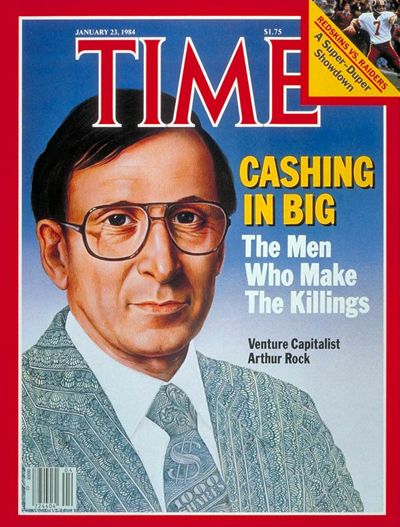
891 Arthur Rock USA 1 Venture capital 80
891 Charles Simonyi USA 1 Microsoft 59
891 Sehat Sutardja USA 1 Marvell 45
New Vinod Khosla India 1.5 Sun, Venture capital 52
New Michael Moritz USA 1.3 Venture capital 52