Author Archives: Hervé Lebret

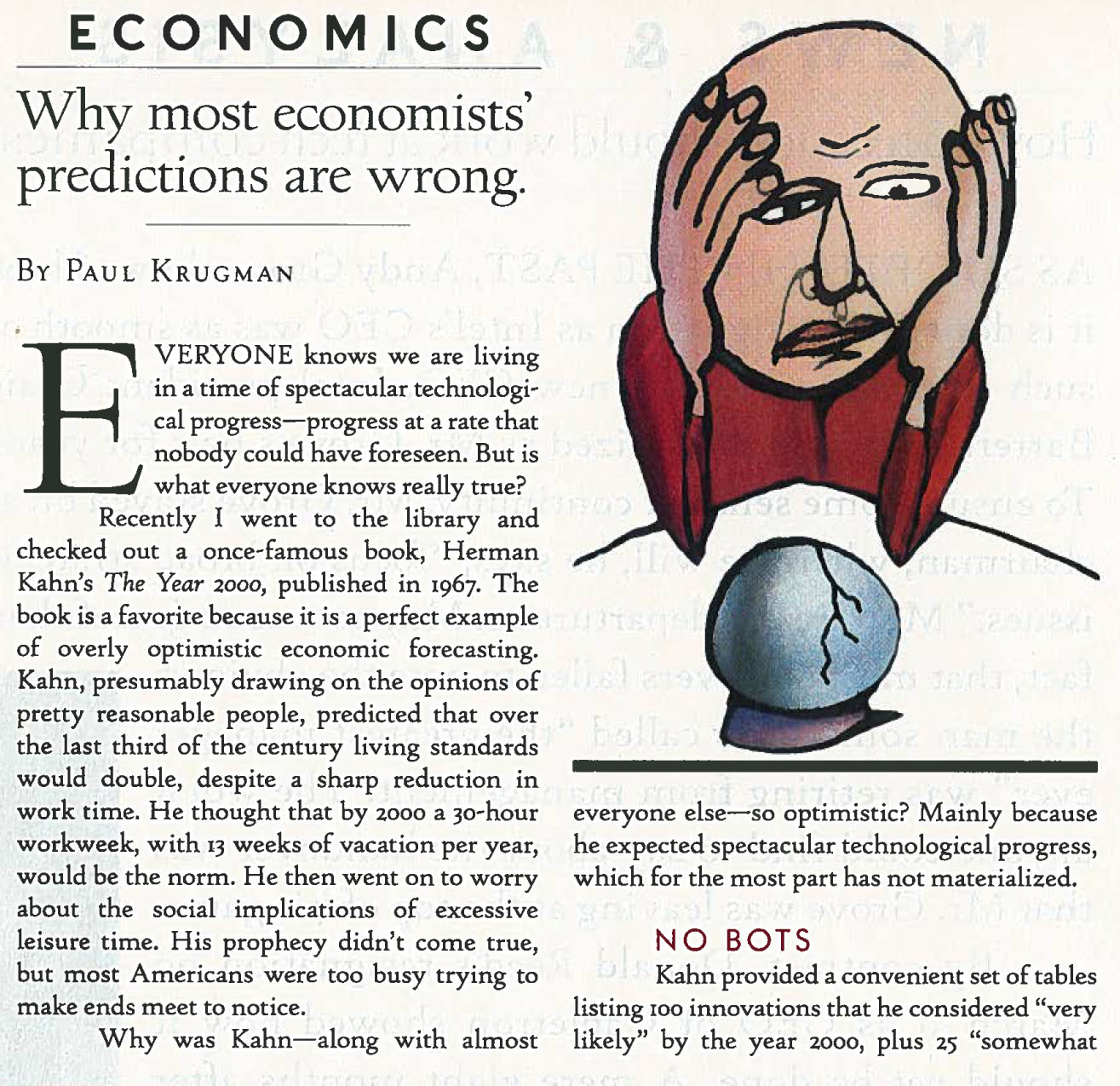
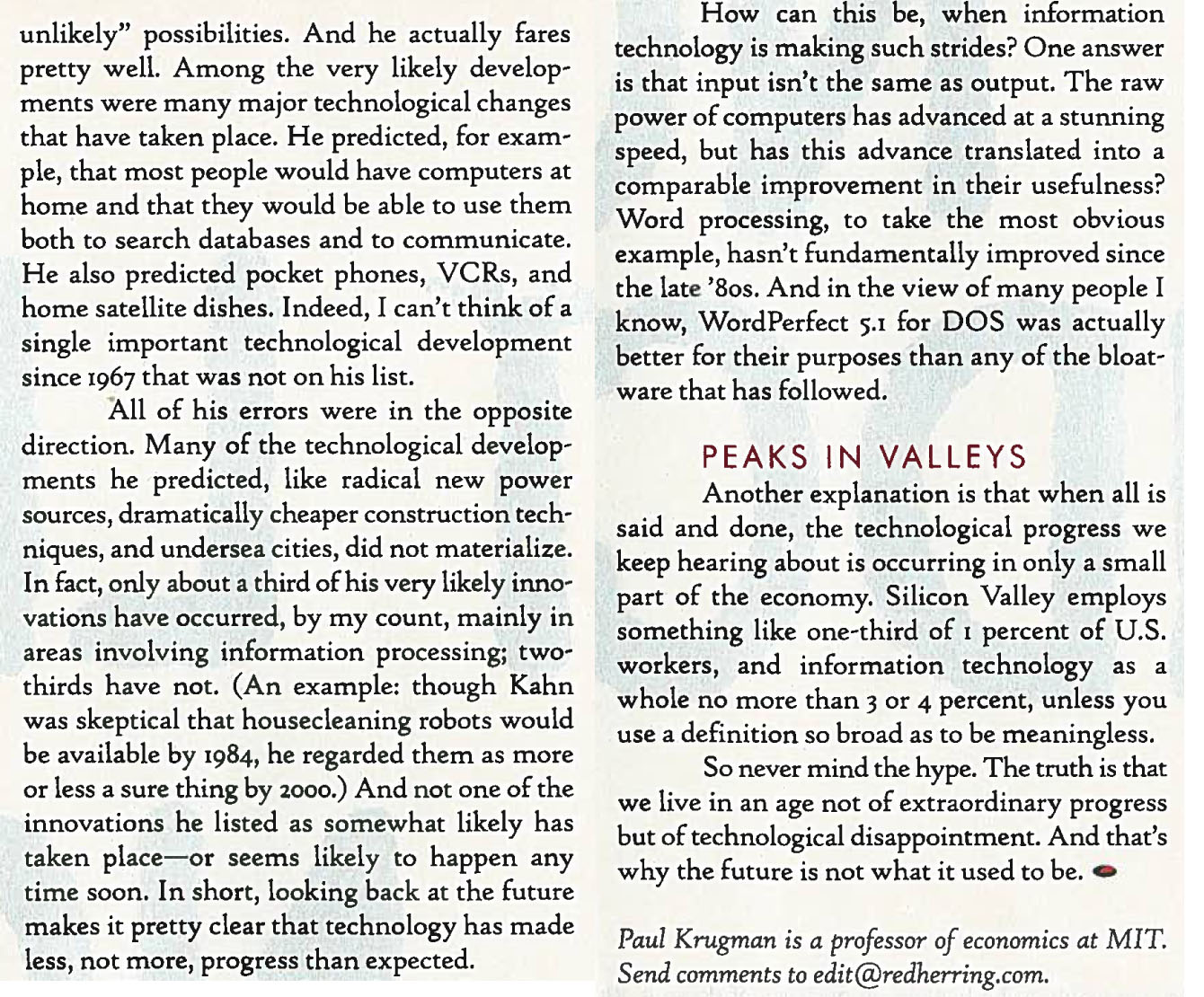
Why most economists’ predictions are wrong

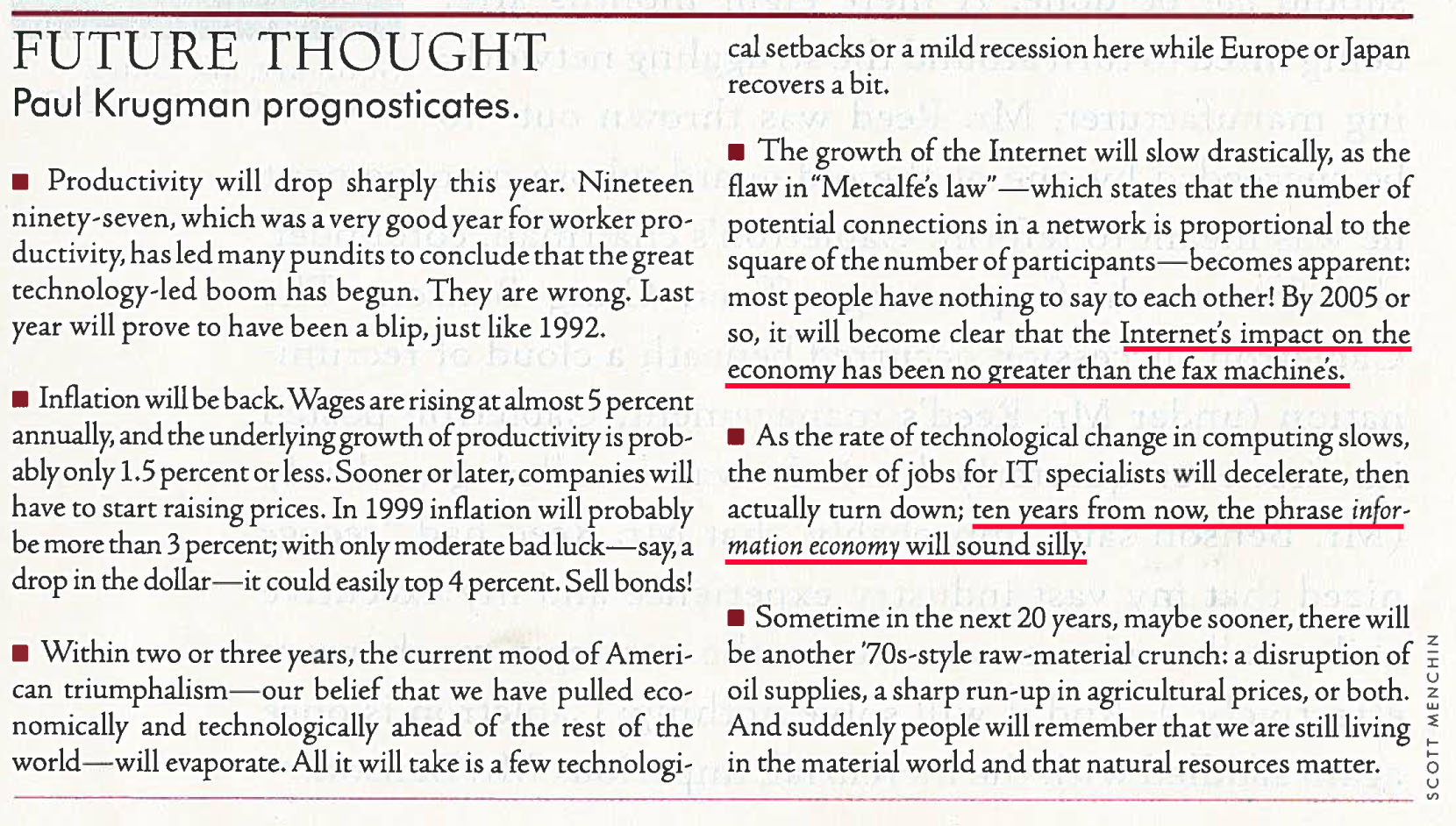
In the continuation of my reading of old Red Herring magazines, here is a very interesting article from June 1998. It is even funny in its wise comments and surprising mistakes. But first read what he says about the difficulty in predicting. It reminds me an old post on Peter Thiel, Technology = Salvation.

Yes sometimes, “The truth is that we live in an age not of extraordinary progress but of technological disappointment. And that’s why the future is not what it used to be.”

But then what about his predictions and in particular the ones I marked in red…

Super angels: recycling of old stuff?

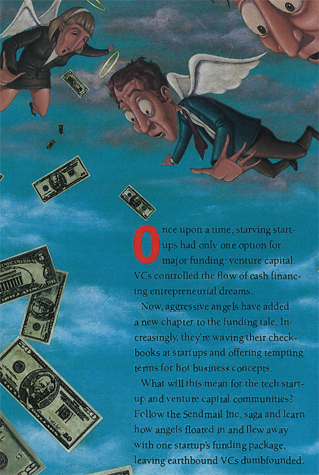
In my current reading of old Red Herring and Upside magazines (see for example Google in 2000 and Funny Data in the Internet Bubble), I just discovered an interesting ar4ticle about how angels may replace venture capitalists (Upside 1999).

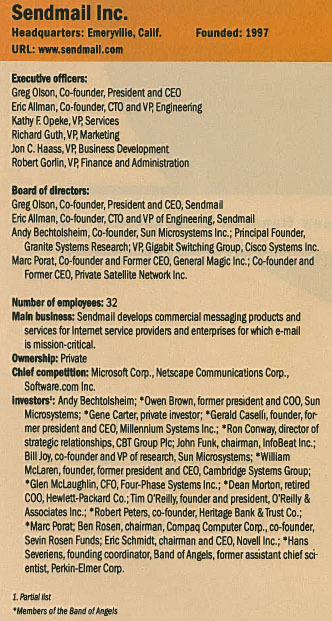
They take a one example sendmail which did not go with Kleiner Perkins, Accel or IVP but closed a $6M round with business angels at a $20M valuation. The article also mentions the Band of Angels, agroup of then 120 investors having invested a total of $44M with an average investment of $600k and the Angel’s Forum with 20 investors putting up to $500k per start-up.

Sendmail raised $35M in 2000 (series D), $14M in 2002, as well as debt financing (at least $7M) as recently as 2009. Sendmail is still private so difficult to say if it is/will be a success or not.

I had doubts in a recent post on Super Angels being new stuff, this shows it is clearly not that new…

The Startup Game by Bill Draper

As I wrote in my previous post on a few Indian tech start-ups, I just read The Startup Game by Bill Draper. In general, that kind of books is of average quality, this one is much above the average, though this is just my personal feeling. I like what is written and here my summary.

Bill Draper is one of the fathers of venture capital and belongs to a interesting genealogy. His father was a grandfather of VC and his son is currenlty an active investor
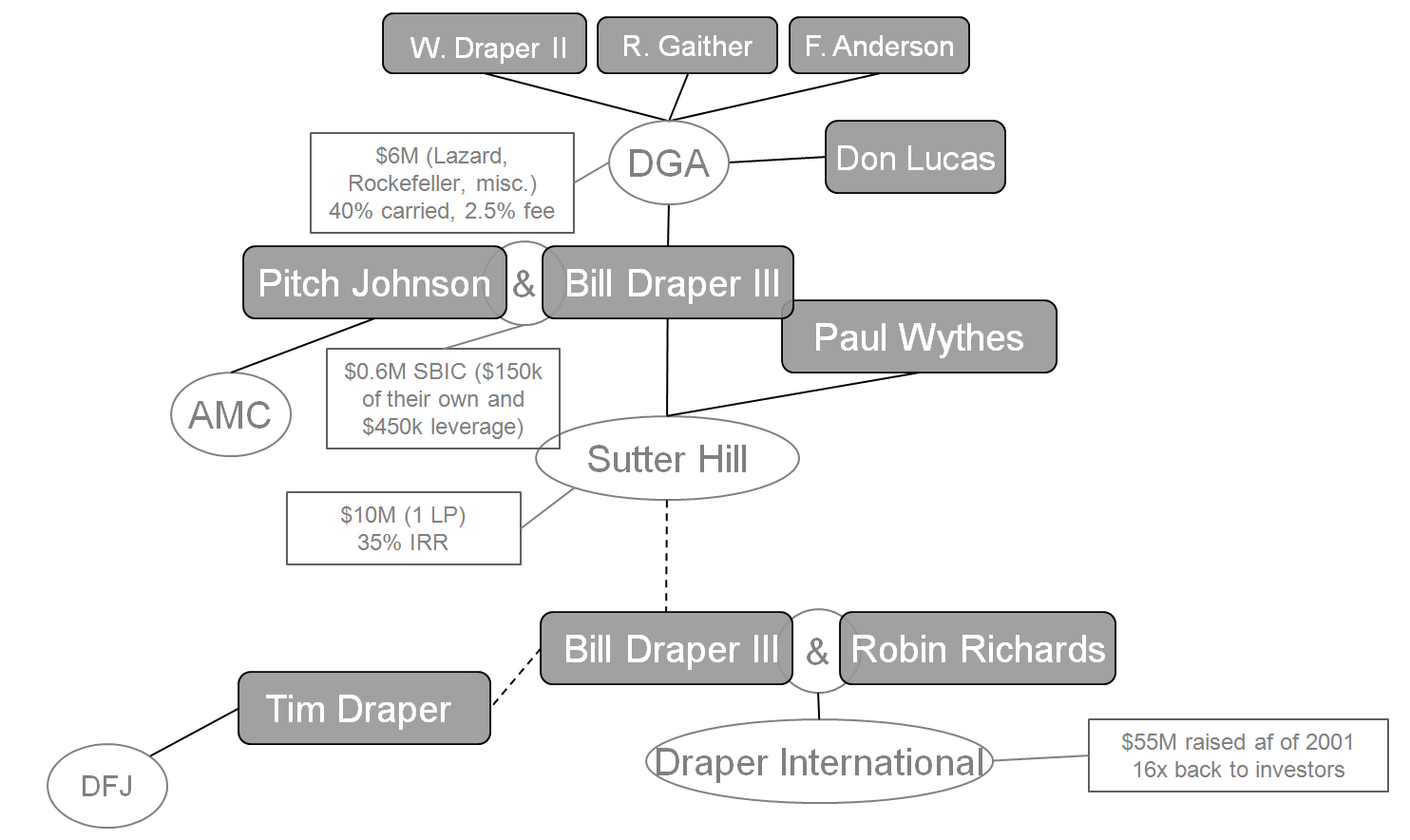
More in the chapters of my book about venture capital!

Draper’s book begins with Buck’s, one of the famous meeting places of Silicon Valley (SV). SV is known as an open environment, where people meet easily, and public places such as bars and restaurants have become famous for this. There was the Wagon Wheel Bar, there is Buck’s or Il Fornaio and a few more.

He also mentions -page 5- another famous component of the SV legend, the Garage. He explains how he missed Yahoo even if he visited their famous trailer donated by Stanford when “Yahoo was space-intensive”, a place “legendarily littered with overheating terminals, pizza boxes, dirty clothing and golf clubs”.


Clockwise: HP, Yahoo, Google and Apple garages.

Of course, if his book was about anecdotes only, Draper would be of small interest. He gives also many lessons. For example:

– Hire managers “ambitious enough to help…. Adventurous enough to take a flyer on an almost untested vision of the future.” – Page 8.

– “Don’t invest money you can’t afford to lose.” An important lesson about venture capital (Page 12)

– Again on what is venture capital, when he planned an investment in real estate in Hawai, a Rockefeller partner had him fly in NY: “We don’t need you to put our money in real estate and then collect a fee and a carry, to add insult to injury. We became a partner in DGA because you told us you were going to invest in technology and honest-to-god entrepreneurs. It would have been far and away the best investment DGA could have made… although I cannot disagree with his main point that we should have focused on opportunities in our own neighborhood.” (Page 27)

– On what is a good venture capitalist (page 30):

  1. Good judgement
  2. Record of success in another form of business
  3. Warm and friendly personality
  4. Intuitive sense of where the world is going

– On the venture capital model (page 41), when he asked about his son’s first six investments: “dead, dying, bankrupt, probably won’t make it, and not so good”
Uh-oh I said to myself. And what about the sixth investment, Tim?” I asked, trying to sound upbeat.
He looked up and paused. “Home run!”.

And he adds later, “a young man can succeed in venture capital with a small amount of money, a willingness to sift through a lot of chaff to get to the wheat, a tolerance for risk, and a reasonably good calibration of the potential of various entrepreneurs. It is also evident that luck plays a part, but the old adage comes to mind: the harder one works, the luckier one gets.”

– On the entrepreneurs (page 54): “[Arthur] Rock feels that the most important ingredient in any company is the brains, guts and vision of the leader. If the product turns out to be wrong, the visionary leader will come up with a new one. If the market shrinks, the leader will stir the whole team toward another one.”

– Then page 55: “the entrepreneurs with the lowest risk of failure are those who know their field intimately.” Then senior managers of a successful company backed by the same VC are second in importamce, then again those with the ability to recognize their own limits and agree that they can be replaced.

– On entrepreneurs and investors (page 64) , he nearly copies Don Valentine (see below). “A fifty-fifty attitude: VCs put all the money, entrepreneurs all the blood, sweat and tears.”

– Another legend of SV (and I think it is true) “SV is the home of the handshake. Your word is your bond – or you’re in trouble.” (page 99).

– Could there be something changed in the SV culture? I mean too much finance people and financial engineering? Draper mentions investors should keep their shares in a company (chapter 7, page 173), at least if they believe in the future growth potential of the company value. But when in it comes to Skype acquisition by eBay (page 188), Draper sold his stock at $45.21 through some complex combination of puts and calls in less than a week after the closing of the deal. When Skype was bought, eBay’s share was $44.96… Six months later, eBay was trading at $33 a share.

Finally, the top 10 avoidable mistakes by entrepreneurs (page 75) :

  1. Creating overly optimistic projections
  2. Underestimating timelines.
  3. Trying to do everything yourself.
  4. Failing to master the elevator pitch.
  5. Not downsizing when necessary.
  6. Being inflexible.
  7. Not developing a clear marketing plan.
  8. Building a board that consists only of friends.
  9. Not taking action in a recession.
  10. Not knowing the right was to approach venture capitalists.

He concludes with his vision of opportunities for the future (page 224):
– The quantum computer
– Synthetic life form
– Decode and reprogram information systems of biology
– Life science in general (diagnostics, therapeutics, medical devices, healthcare IT)
– Voice and storage will be free
– Small nuclear power plants (sic)
– Changes in transportation

In a simple conclusion; a good book where you will learn some good lessons from Silicon Valley and elsewhere (i did not mention Draper spent 10 years with the UN and then created the first VC firm in India, through Draper International).

Note: Don Valentine said about entrepreneurs and investors: “When people come as a team (usually it is three or four people and typically heavyweight on engineering), it is a complex process. But I think all of us have seen it in the earlier days, times when I can remember saying, “Well, look, we’ll put up all the money, you put up all the blood, sweat and tears and we’ll split the company”, this with the founders. Then if we have to hire more people, we’ll all come down evenly, it will be kind of a 50/50 arrangement. Well, as this bubble got bigger and bigger, you know, they were coming and saying, “Well, you know, we’ll give you, for all the money, 5 percent, 10 percent of the deal.” And, you know, that it’s a supply and demand thing. It’s gone back the other way now. But, in starting with a team, it’s a typical thing to say, well, somewhere 40 to 60 percent, to divide it now. If they’ve got the best thing since sliced bread and you think they have it and they think they have it, you know, then you’ll probably lose the deal because one of these guys will grab it.” Transcript of oral panel – the Pioneers of Venture Capital – September 2002

Bubble? You said bubble. Just read about it….

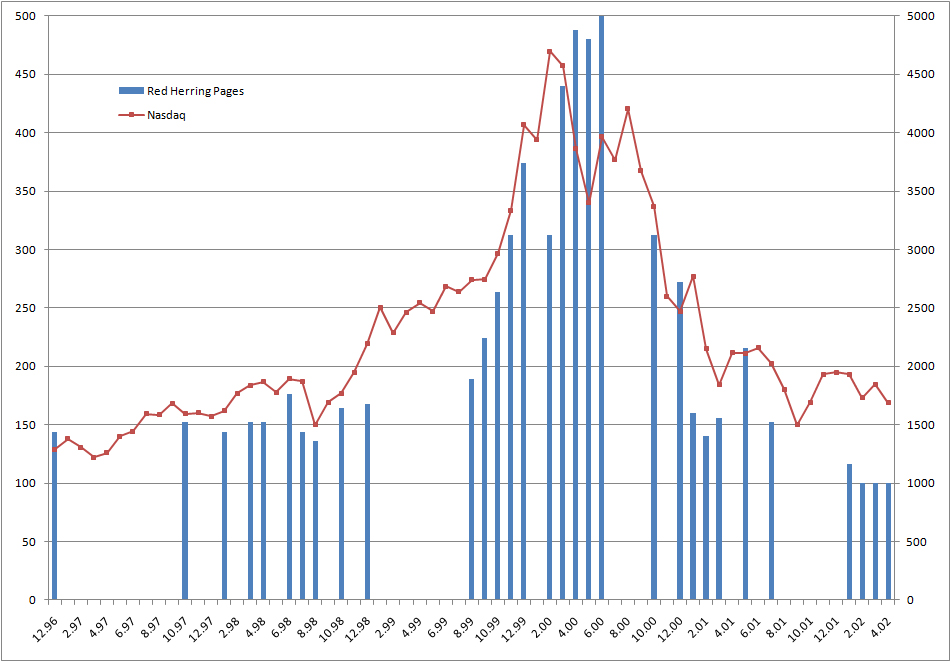
As I mentioned recently, a friend of mine gave me a collection of old Red Herring magazines. A funny byproduct of this gift is that I noticed that the number of pages of the Red Herring seemed to follow closely the Internet bubble. A decent number of pages before 1999, a peak in early 2000 and then a crash. I quickly did the exercise of comparing and here is the result!

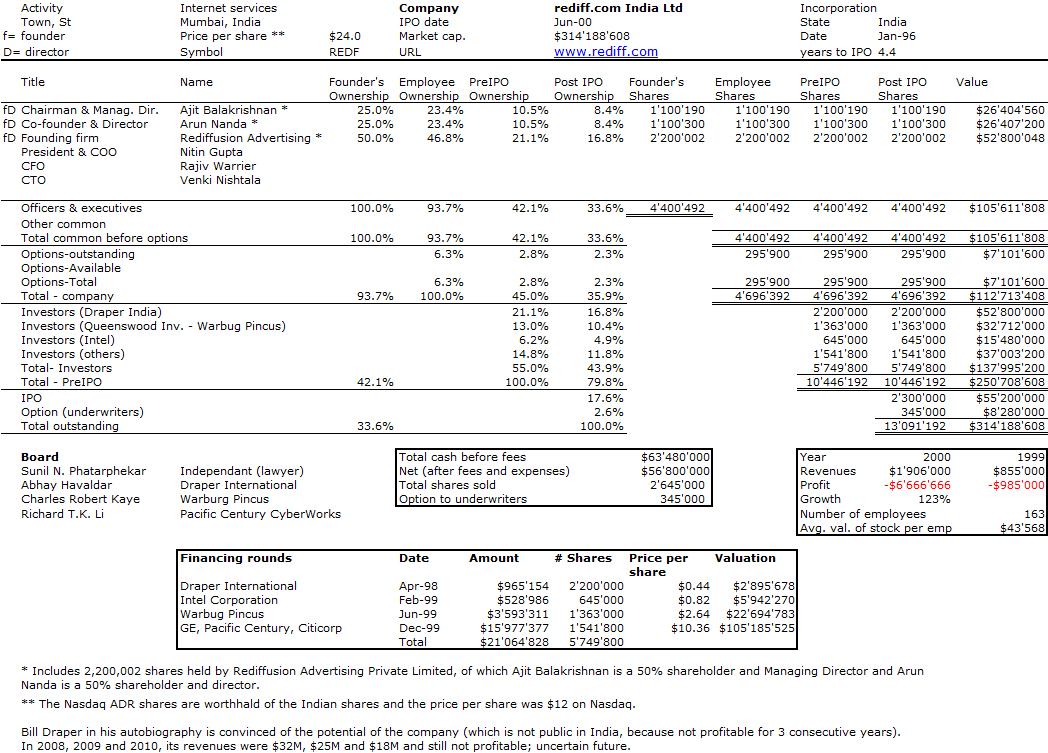
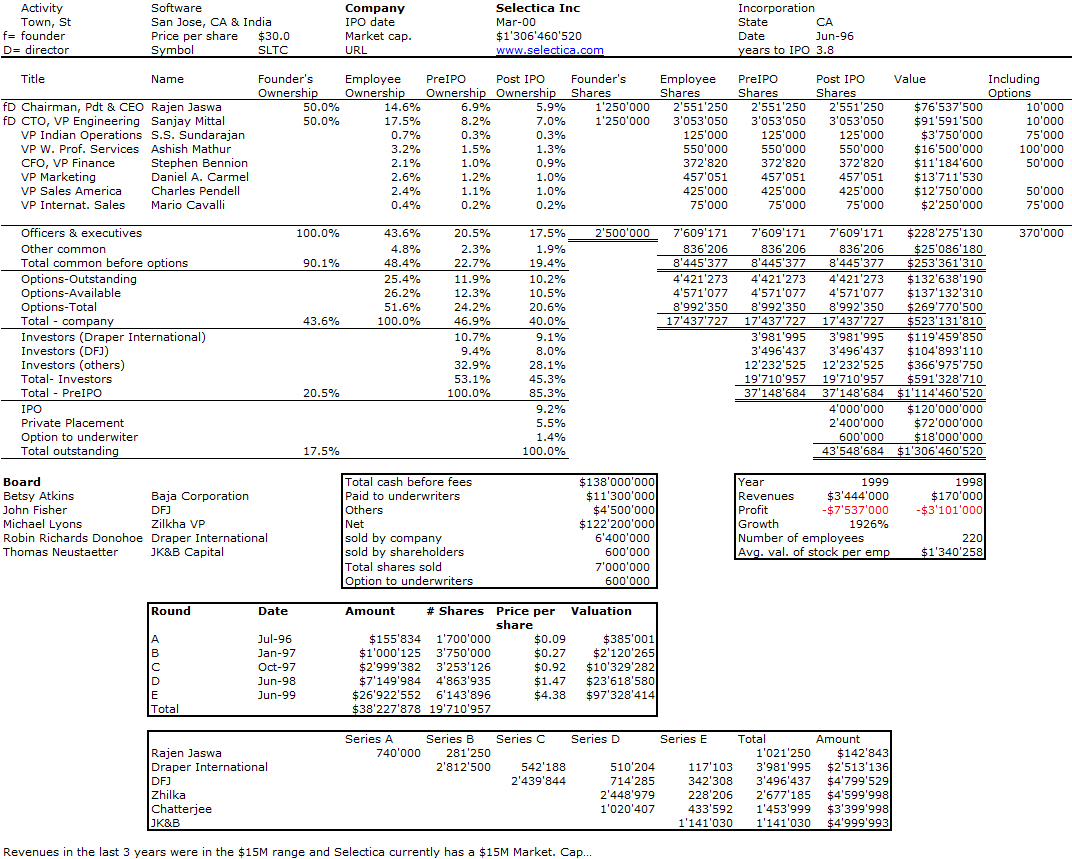
Going public when you are not a US start-up – part 5/4: India

As my stupid “part 5/4” shows, I had not planned to add two other non-US companies, this time with Indian roots (to my previous 4 posts on Europe and China). I am currently reading The Startup Game by Bill Draper. It is a very interesting book by one of the most famous Silicon Valley venture capitalists and I will write soon a post on what I liked (as soon as I am finished with reading it).

Bill Draper founded a fund specialized in Indian start-ups in the mid-90s. He was not the first VC to leave the USA (some had done it in Europe in the 60s and 70s) but he was probably the first one to be succesful with such a venture.

Rediff and Selectica went public in 2000, both were founded in 1996. They are very similar to US start-ups, indeed Selectica was founded as a California start-up. Rediff is stranger as it is an Indian company and because it was not (and is not yet) profitable, it is still private in India.

Here is Rediff Cap. Table when it went public

and here is Selectica’s:

As a short conclusion, Bill Draper certainly had higher hopes for both companies which individual revenues were less than $50M in the last 3 years. There is no doubt that being an overseas company is not optimal both for customers and perception by investors…

Going public when you are not a US start-up – part 4/4: Baidu

Baidu ends my small series of non-US start-ups. What is interesting is that there are some anecdotal differences. At least for the European ones, it was not an easy adventure with many tough financing rounds. Alibaba was not totally clear. Now Baidu…

As a first word of conclusion, the value creation of the two Asian companies is much larger than the European ones. It might be linked to the fields (Transmode and Envivio are more in the high-tech infrastructure, where as the two Chinese companies are internet services). It might also be the perception of different dynamics in both continents…

Baidu was founded by two Chinese citizens, Robin Yanhong Li and Eric Yong Xu. Li “went to SUNY-Buffalo in the US to study computer science towards a Doctoral degree. He received his Master of Science degree in 1994 after he had decided to discontinue his PhD program work” (Wikipedia). Xu “received his Ph.D. degree from Texas A&M University, post-doctorate from University of California at Berkeley, and his B.S. and M.S. degrees in Biology from Beijing University. Dr. Xu was also a candidate of the Stanford University Sloan Masters program”. (Bio on Bioveda Fund website).

Baidu is quoted on Nasdaq. Is there a link between the background of the founders and/or the fact they have investors such as Draper, IDG and Google? (Remember that Alibaba has Yahoo as a major shareholder – even if the relationship was quite tensed recently).

PS: I may come with a fifth story soon, an Indian startup quoted on Nasdaq I read about just yesterday…

Going public when you are not a US start-up – part 3/4: Alibaba

I leave Europe with two recent filings (Envivio, Transmode) to China. There would be much to say about China, my recent post on venture capital shows the growing role played by the country in high-tech. At the same time, I don’t know many Chinese success stories, with the exception of Alibaba and Baidu.

I should add Foxconn, the famous computer company which produces Dell and Apple machines, but I have not much about it. Alibaba was founded in 1999 and went public on the Hong Kong stock exchange in 2007, even if its major shareholders are Yahoo and Softbank.

It was tough to build the capitalization at table. There is about 30% of the company shares which I could not link to individual or institutional stockholders. It could be linked to that fact that the Chinese entitity owns these shares. I cannot avoid adding that just like in Europe, the filings of non-US companies are sometimes more cryptic than for American companies. But it might be just because I did not spend enough time on the documents. It might be also that I made a confusion between the quoted company and the mother company which is not quoted (check this 2009 newsrelease that I discovered while writing the post!)

What else? The founders have similar ownership to US start-ups. Another thing which puzzles me is the fact that Alibaba is not quoted on Nasdaq or NYSE and that in parallel, some major stockholders are from the western world… But the founding team has strong chinese roots which balances the overall picture.

Next: I will compare the situtation with Baidu, the other Chinese success story I studied.

Going public when you are not a US start-up – part 2/4: Envivio

Envivio follows my recent post on another start-up with European roots, Transmode. Envivio has similarities and differences. Both have roots in the Telecom industry, Transmode with Ericsson and Envivio with France Telecom. Both were founded in 2000, 11 years before the IPO or filing.

Both had complex financing rounds, including “down rounds”. You can see that in the Transmode case, the price per share went from $5.5 in the B round to $1 in the C round. These down rounds are usually terrible for founding teams. And indeed, there is not much info about Transmode founders.

Envivio had raised $41M until 2008 and the price per share increased steadily to $2 per share. Difficult to give precise dates for the rounds, but the investors were a combination of corporate investors (France Telecom, Intel, Bertelsman, Philips), and financial (Global Accelerator, Crédit Lyonnais – now Crédit Agricole). Then the G round in 2008 was a down round at $1.25 and the H round, less than 2 years later, even lower at $0.34. With such events, it is not surprising to discover that the investors own 87% of the company before the IPO. Obviously, this would have been very dilutive to the founder, Julien Signes, without the possibility of granting new (stock option) shares that you discover in the right column.

There is another interesting difference with Transmode: Envivio is filing to go public in the USA, it is indeed an American start-up, and not much shows its French roots (the R&D is based in Rennes, Britanny though). Even if Julien Signes studied and worked in France initially, he worked also for France Telecom in San Francisco and I would be curious to know if this had an impact in his entrepreneurial path. I asked him and am waiting for an answer, but it is possible that Envivio is not allowed to communicate in the pre-IPO period.

It is one my thesis that Europeans who had a US experience have digested better the start-up dynamics (whether they moved to the USA and became entrepreneurs there – De Geus, Bechtolsheim, Brin – or they became entrepreneurs in Europe but had lived in the USA – Liautaud, Borel, Haren). This does not prevent European high-tech start-ups to exist and succeed, but I have to admit, the numbers are not exactly the same.

Again, because the company is not public yet, I had to guess what the price per share might be at IPO. I have put a small price, using multiples of market cap. to revenues of 7x. I will make an update when I know more…

Next: Alibaba

NB: an explanation from the filing on the issuance of incentive shares: “In September 2008, we sold 1,532,372 shares of Series G1 convertible preferred stock and 13,359,323 shares of Series G2 convertible preferred stock for $1.25 per share and received total consideration of an aggregate of $15.9 million. Also in September 2008, we converted the outstanding principal balance of our outstanding convertible promissory notes in the amount of approximately $8.9 million plus accrued interest in the amount of approximately $0.2 million into 467,628 shares of Series G1 convertible preferred stock and 6,829,154 shares of Series G2 convertible preferred stock simultaneously with our Series G financing. In June 2010, we sold 895,502 shares of Series H1 convertible preferred stock, 18,487,298 shares of Series H2 convertible preferred stock, 7,775,801 shares of incentive Series 1 common stock and 87,170,915 shares of incentive Series 2 common stock for $0.3351 per unit and received total consideration of approximately $6.5 million. In connection with this Series H financing, all outstanding shares of Series B, C, D, E and F convertible preferred stock converted into shares of common stock. Also in June 2010, we converted the outstanding principal balance of our outstanding convertible promissory notes in the amount of $1.0 million plus accrued interest in the amount of approximately $4,800 into 2,998,571 shares of Series H2 convertible preferred stock simultaneously with our Series H financing. The number of Incentive Shares to be issued was based on the series of the outstanding convertible preferred stock held by each Series H participant as follows: at a rate of 107.430618 shares of common for each share of the Series B, 77.588779 shares of common for each share of Series C, 1.492092 shares of common for each share of Series D, 1.865115 shares of common for each share of Series E, and 3.073709 shares of common for each share of Series F. As a result, the Company issued 94,946,716 Incentive Shares with the shares of Series H convertible preferred stock issued during the Series H financing.”

Going public when you are not a US start-up – part 1/4: Transmode

I was studying recent IPO filings and discovered (more by accident than on purpose), that some of these companies were not US-based. I wanted first to know more about Chinese success stories, Baidu and Alibaba, and at the same time heard of Envivio’s filing and Transmode IPO. Envivio has roots in France (just as Sequans which I also studied a few weeks ago) and Transmode is based in Sweden.

I remember visiting Transmode during my days with Index. Transmode was and is a start-up in the Telecom sector, providing solutions for fiber-based local networks. The company just went public on the Stockholm stock exchange, 11 years after its IPO. The prospectus was in Swedish so that the data should be handled with care! An interesting element of information, if we agree high-tech is a global business.

The cap. table that you just discovered shows the history of the company has probably not been simple. Transmode has raised $45M since 2002 but this is the “new” Transmode, which is the outcome of the merger of Lumentis, another Swedish start-up with the old Transmode. At the time of merger the combined entities had raised $61M. There is money available in Europe, no doubt. They were 7 founders in each firm, but none appears in the Transmode IPO filing.

Investors owned 76% of the start-up before the IPO, 56% after the sale of 25% of the company to the public. With about 700M Swedish Kronas in revenues (about $100M), the company is valued 2x its annual revenues. Nice but not great. Still a sign that high-tech is viewed more favorably than during the last decade.

Next: Envivio.

The IPO fever goes on: Groupon files to go public!

The latest IPO filing is 3 year-old Groupon. After raising more than $1B from its (famous) investors, the start-up hopes to sell $750M worth of shares at its IPO. I quickly build the capitalization table which follows (hoping there are not too many mistakes). I will update it when the IPO nears including the shares sold by existing stockholders, if any.

Worth noticing is the crazy valuation some “savvy” investors such as KP, Greylock or Battery paid for their shares. The other winners, besides the Groupon founders, should be the German start-up CityDeal launched by the Sawmer brothers (from the European Founders Fund).

I assumed a price per share of $19M but this is just to accomodate the $750M the company wants to raise with a consistent number of shares. I made no assumption on existing vs. new shares. Some analysts claim Groupon value would be more in the $20B range (i.e. a price per share of $60.)

Final comment for today: Groupon declined to be acquired by Google for about $6B last December. We’ll see soon if they were right to do so…