Category Archives: Silicon Valley and Europe

European Founders at Work

European Founders at Work is a very interesting book. It is the perfect complement to Founders at Work, particularly for the European dimension.
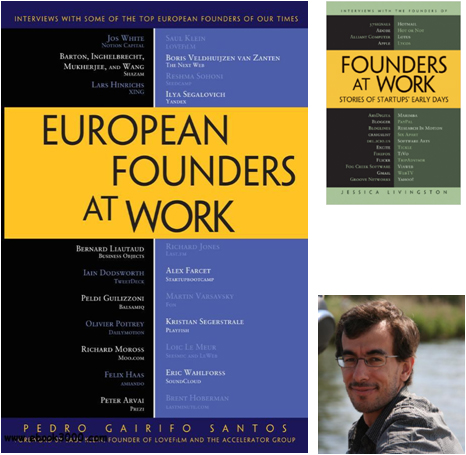
One comment though, I noticed 8 UK projects out of a little more than 20 and these 20 are mostly Software or Internet. More diversity may have been great. This being said, the lessons are great! Here are some… (and you will learn much more by reading the book entirely!)

About the US Market (for Europeans)

“I think that Europe has a lot of credibility in certain sectors, particularly media and the creative industry, but I think that in technology, generally, most of the world’s biggest companies were founded in the US and, therefore, the expectation in the US market is that in technology, they are going to be talking and buying from US companies. […] it’s important to become a US team in the US market. […] I think you need to be prepared to make a pretty big investment in the US and you need to be prepared to build up the business for several years,” Jos White – MessageLabs

“I would say that the IT sector, and especially enterprise software, is extremely global but remains dominated by US companies. There are very, very few examples of European IT and software companies that have managed to go global. I believe, the only way to make that happen is to go global very, very quickly, as we did from the outset.” Bernard Liautaud – Business Objects

“In my experience, if you come from a smaller European market, like Hungary or Sweden, you tend to think that it’s a nice next step to go to UK or Germany. The issue is that if you become successful there, it is still only a sixth of that of the US market. So, if you get a US competitor, you immediately become a regional player instead of a global player. So, very early on, I said we shouldn’t even be thinking about opening up offices in Frankfurt or in London because the way to make it globally was to first prove that we can make it on the world’s biggest market, which is the US. That’s going to be the truth at least for the next ten to fifteen years.” Peter Arvai – Prezi

“I think the reality is that it’s not about Europe vs. Silicon Valley. The best entrepreneurs in Europe understand Silicon Valley very well. They have spent time in Silicon Valley and developed relationships in Silicon Valley. Take all of that and all of the value that comes from that because you’re a fool if you think that Silicon Valley isn’t the most sophisticated, vibrant place for technology start-ups on the planet. It probably will continue to be so for the next twenty-five to fifty years because of the network. And the ecosystem is so profound there and keeps on getting stronger with Zynga, with Twitter, with Facebook, etc. I think any European entrepreneur or any entrepreneur in this space that doesn’t want to spend time or learn from Silicon Valley is foolish. But I think there’s a lot of things that you can learn and be aware of as an entrepreneur if you’re not in Silicon Valley, that you can use to your advantage.” Saul Klein – LoveFilm
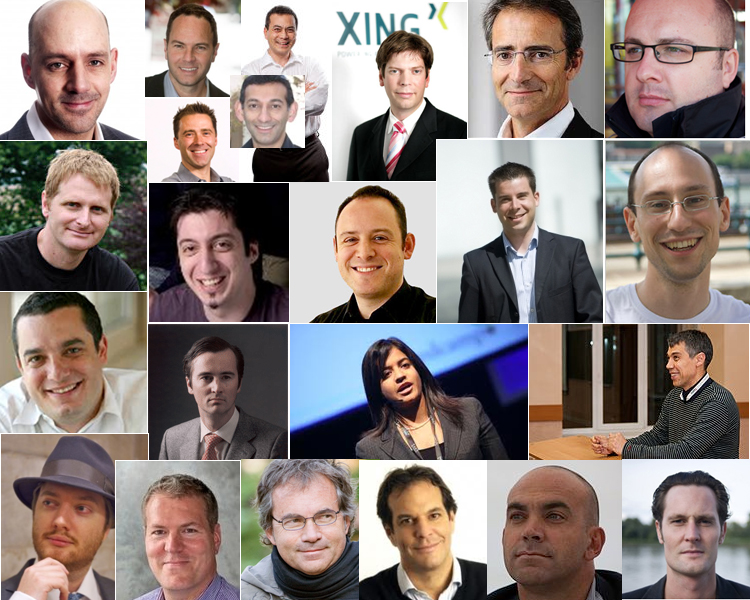

The interviewed entrepreneurs

About success and failure

“Any successful entrepreneur knows that it was a combination of skill and attitude, with luck, that really leads to success. And there are very fine lines between success and failure” Jos White – MessageLabs

“I learned that the game is never over: you should never give up, stubbornness is somehow a requirement to lead a company to success, and the road to success is inevitably paved with failures. When things start to go wrong, the worst thing to do is panic and change everything.” Olivier Poitrey – DailyMotion

“I think as an entrepreneur you fail all the time. You’ve got failure built into your business. Right? So you don’t really keep track of failure. You never really fail. I think that’s essential when you’re an entrepreneur, that you’re not afraid of failure. You embrace failure. Your whole business is based on trying out stuff, being ready for stuff to fail and just taking the next step as soon as you fail.” Boris Veldhuijzen van Zanten – The Next Web

About ambition

“Come up with an idea which is impossible then try to find somebody who can make it un-impossible and then do deals which have never been done before.” from the Shazam founders

“[A new trend is] You definitely see entrepreneurs being extremely ambitious.” Reshma Sohoni – Seedcamp

“I guess one advice is it’s more exciting if you feel like you’re changing the world in a positive and innovative way. So we’d love to see more of those out of Europe.” Brent Hoberman – lastminute.com

“But it is probably harder in Europe in that it innovates less, because you have less-crazy investors financing crazy entrepreneurs. [Advice:] One, international. Two, innovation and no copycat. And then, three, big ambition.” Loic Le Meur – Le Web

About the team

“There are very few founders that stay with their businesses beyond five years and quite often, in my opinion, it’s because they didn’t manage to surround themselves with the right team.” Bernard Liautaud – Business Objects

“But also obviously you hire people that are better than you” Ian Dodsworth – TweetDeck

“I also learned how hiring the right people from the start is key: the very first people to join will shape the company’s personality. And finding talented people you are pleased to work with is very important to generate emulation from new hires. Olivier Poitrey – DailyMotion

“A common mistake is building the team. If they’re quite scared to part with something … Like when they’re quite scared to part with equity or bringing on mentors. “Do you want to be a big fish in a small pond or a big fish in a big pond?” They’re too closed with their equity and they try to do everything.” Reshma Sohoni – Seedcamp

“Another common mistake is like a cliché now, but it’s just the classic: “I’ll just build another feature and I’ll focus on my product.” Alex Farcet – Startupbootcamp

About entrepreneurship

“The main advice is just start. Many people have hundreds of ideas, but they never really start their own project. And if you fail, start again. Entrepreneurship is, in my point of view, the best and the only way to personal development” Lars Hinrichs – Xing

“There are a lot of moments like that where you don’t know what you’re doing, but this was the whole point.” Giacomo Peldi Guilizzoni – Balsamiq

“Do it.” It’s the best decision I’ve ever done in my whole life. […] And I was studying engineering as well, and I had one hundred classmates. And I know that almost zero of them actually went on to start a company, which is kind of crazy because I know a lot of them have good ideas. But none of them quite felt that they were able to pull it off.” Eric Wahlforss – Soundcloud

“I have been lucky enough to be born with optimism.” Richard Moss – moo.com

“Hang in there. Don’t give up. I heard that most start-ups fail because the founders stop working on them.” Richard Jones – last.fm

“I would be realistic and I would say, “Look, if you think you are the lucky sperm that’s going to get the ovule, go ahead and start the business.” It’s a very difficult thing to do with a very high probability of failure. But it is essential for society and even those who try and fail are also helping society. So I encourage people to try, but at the same time warning them how difficult it is. I am tenacious and I am sometimes lucky and I’m good at spotting trends. But I was also lucky. Most people who try businesses fail. That’s the truth and people should be warned about that.” Martin Varsavsky – FON

As a conclusion let me quote Saul Klein in his foreword… “Right now, Silicon Valley is peerless at both supporting innovation and creating serious scale. There’s been no master plan, but the 60-year interplay of government as an early catalyst; academia and established companies as early customers and sources of talent; and of course, investors willing to take risks and a long term view, have given entrepreneurs fertile ground to sow seeds and try to grow monsters with dragon’s teeth ready to conquer the world.You need every element of this ecosystem working perfectly to create monsters. This is serious progress. But the straight facts are that while we are unquestionably masters of invention in Europe, we don’t yet have the ecosystem— or perhaps the attitude. […] For me, the big question is if we are truly able to do this.”

Post Scriptum: I am not finished yet. I love to add cap. tables and not so many of these entrepreneurs are running a publicly quoted company. Strangely enough, one is Russian, Yandex. Its foudner and CTO says something great about sales: “I think one of them is when you create a software product, you have to learn how to sell it, you have to learn how to make it a product. It’s a very basic skill. I think every engineer has to try that at least once, to sell the software he created, regardless of how bad it is. No matter how unpolished your product is, you have to try to explain why it is good for someone else.”

Here is Yandex amazing cap. table…
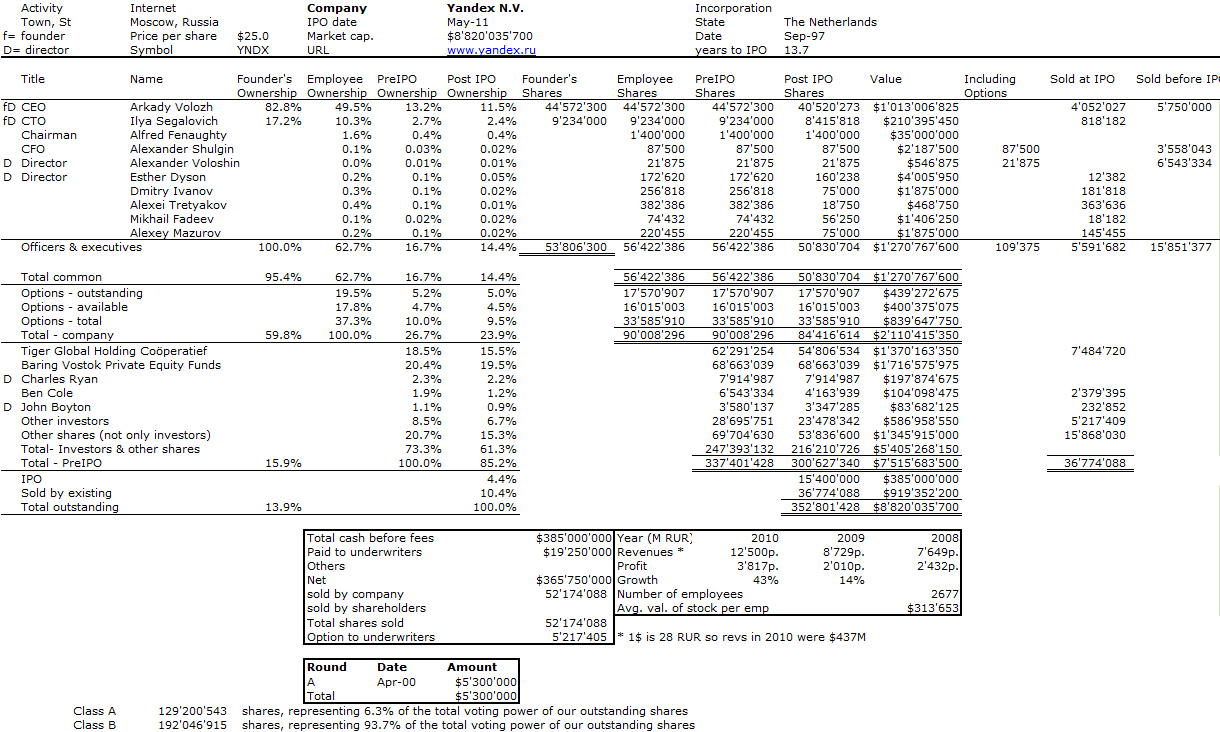
Click on picture to enlarge
The Startup Factories: The rise of accelerator programmes

The Startup Factories: The rise of accelerator programmes is certainly the best analysis I read on the new trend (the new hype?) in start-up support. “Early evidence suggests they have a positive impact on founders, helping them learn rapidly, create powerful networks and become better entrepreneurs. Although incubators are sometimes stigmatised as providing ‘life support’ to companies, these accelerator programmes are notable for the high quality of both mentors and startup teams they work with and the value they add to companies.” [Page 3]

You may not know what are accelerators, so here is what it is about: a programme that gathers a limited number of project owners with
• An application process that is open to all, yet highly competitive.
• Provision of pre-seed investment, usually in exchange for equity (a few $10k for 5-10%)
• A focus on small teams not individual founders.
Time-limited support comprising programmed events and intensive mentoring (usually 3 months)
• Cohorts or ‘classes’ of startups rather than individual companies (from 10 at seedcamp to 60 at Y Combinator per class)

In addition, the time-limited element puts pressure on entrepreneurs who also want to look good compared to their peers; a demo day / pitch sessions further pressure entrepreneurs to deliver prototypes and visions. Obviously founders, business angels, VCs and even corporates benefit from this new source of deal flow.

Most famous programmes are Y Combinator, Techstars, Seedcamp and Startupbootcamp.

So why have these programmes emerged. The rationals are the following:
– they provide new solutions to innovation [page 24]: “The problem that accelerators solve for venture capital funds is that they create new deal-flow. A number of investors told us that this was the compelling reason for supporting Seedcamp in London in the early days. There simply weren’t enough young founders and companies having any contact with the world of investment. The venture capital community has an interest in growing the overall number of good companies. If they can attract talented people to think about setting up startups rather than going to work for large organisations, that could be good news for the whole sector.”
– they provide access to quality mentors and investors to founders who receive an early validation from the selection from the accelerator process.
– at least in the web and mobile world, start-ups costs are shrinking,
– again in these worlds, it is easier to reach new customers and there are easier routes to revenues
– the concepts around lean start-ups (Eric Ries, Steve Blank) make product development more iterative thanks to efficient interactions with early adopters.

Now the accelerators are not proven models. They are first too young and second, they have been criticized already for the following reasons [page 32]:
– They only build relatively small companies.
– They divert talent from other high-growth startups.
– Good companies still fail after accelerator programmes.
– They exploit startup founders.
– They attract companies that are already struggling.
– They’re helping to create a bubble.
– They’re just ‘startup schools’.

In conclusion: they are interesting for the connections and filtering they provide. They are also of value for the education element including an open culture. But the business model is not validated and although they make sense for software, web and mobile apps, the model is less clear for other technology segments. If you want to know more, you should read this very good report 🙂

Is venture capital a universal solution?

Following my post from last Friday, here is a series I have been asked to write for EPFL start-ups. It is logical that it appears also here. This first chronicle is about Aleva, a great EPFL start-up, and it is also abotu venture capital. Here it is.

10.02.12 – Aleva Neurotherapeutics has succeeded in raising 10 million Swiss francs in venture capital. The EPFL start-up has shown that this type of financing is not out of reach for young Swiss companies.

For this initial article in the “start-up of the month” column, it was a “must” to talk about Aleva Neurotherapeutics. Andre Mercanzini, its founder, got his PhD at the Microsystems Laboratory (LMIS4) headed by Prof. Philippe Renaud. What was my motivation? André is a shining example of the enthusiastic and persevering entrepreneur. He obtained an Innogrant in 2008. This grant enables apprentice-entrepreneurs to devote their time to their start-up project for one year. The life of an entrepreneur is not exactly a bed of roses, and as well as enthusiasm you need courage. And you shouldn’t do it alone. By persuading another entrepreneur, Jean-Pierre Rosat, to join the adventure, Andre convinced three venture-capital funds (based in Lausanne, Basel and Zurich) to invest. But it was only in August 2011 that the raising of the 10 million francs became a reality, a full three years after Aleva was founded!

I’m not going to say much about the activity of this start-up. Aleva develops electrodes for neurosurgery and these are implanted in the brains of patients suffering from Parkinson’s disease or severe depression. I am not going to say more about Andre Mercanzini either; he can describe his adventure better than anyone else. On the other hand, I’ve noticed that Andre has already become a role model for other entrepreneurs from EPFL and that he himself had the opportunity to prepare his thesis in a very entrepreneurial laboratory. If you go to the page of LMIS4 mentioned above, you will see that no fewer than 13 start-ups originate from there. Emulation is a key element here.

Risk capital: for start-ups with rapid growth

What matters also to me, beyond the entrepreneurial qualities of the two founders, is to show that venture capital is not an unreachable objective. About 10% of EPFL start-ups have raised such funds. Some entrepreneurs who appeal to institutions in the venture capital area subsequently complain about their conservatism. Others avoid them like the plague, referring to them as “vulture capitalists”. This is open to debate. It’s undeniable that this type of investor is looking for companies with a potential for rapid and global growth, and not all start-ups can fulfill this criteria.

There is now available in the world, in Europe and in Switzerland, much more money than there was 20 years ago, even if there is a lot less than during the “irrational exuberance” period of the Internet bubble. It always has been, and will continue to be, difficult to find money (for any kind of project in fact). However, Aleva, but also Biocartis and TypeSafe (other start-ups from EPFL) have shown that it is possible. Is venture capital a must? I sometimes tend to think so when it concerns high-tech start-ups and I know that I’m sometimes reproached for giving it too much importance. I simply note that a very large number of successful American companies have applied for these funds and that boot-strapped companies are the exception in the USA. In Europe, it’s the opposite!

“In Switzerland, we prefer a small entity that you can control from A to Z”

I would like to finish with a quotation from Daniel Borel, another entrepreneur who studied at EPFL. “The only answer I can suggest is the cultural difference between the United States and Switzerland. When we founded Logitech, as Swiss entrepreneurs, we had to play the internationalization card very early on. The technology was Swiss, but the United States, and later on the world, defined our market, whereas the production quickly became based in Asia. I wouldn’t be at ease with myself if I were to paint a negative picture, because I think that many things evolve and that many good things happen in Switzerland. But it seems to me that in the United States, people are more open. When you obtain funds from venture capitalists, you automatically accept an external shareholder who helps you manage your company, but who can also sack you. In Switzerland, this vision is not so widely accepted: we prefer a small entity that can be controlled from A to Z, rather than a big undertaking that you can only control at 10%, which can be a limiting element.”

The New Silicon Valley(s)

Nice series on French-speaking Swiss Radio broadcast les Temps Modernes, this week about five stimulating experiments of high-tech clusters. Probably to fight the depressing mood around WEF and the economic crisis. (And not only because I was given the opportunity this morning to comment the last case! I was only invited on Wednesday… 🙂 )

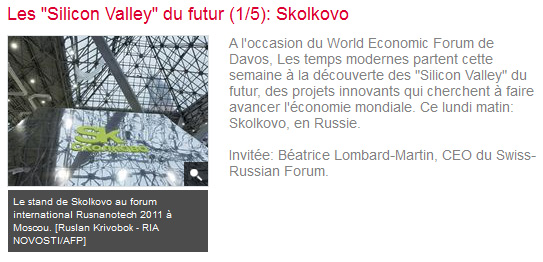
Monday it was about Russia’s Skolkovo, which I had mentioned in a post a few months ago.

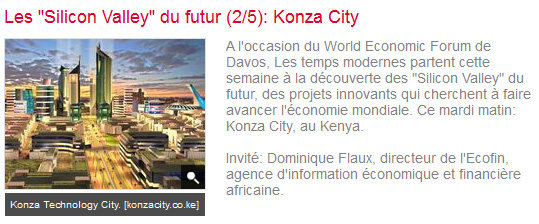
I did not know at all Kenya’s Konza, and this was really refreshing.

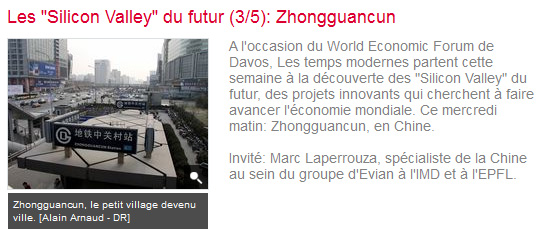
You cannot avoid China, but here also surprise, surprise, it was not Shanghai neither Shenzhen, but Zhongguancun.


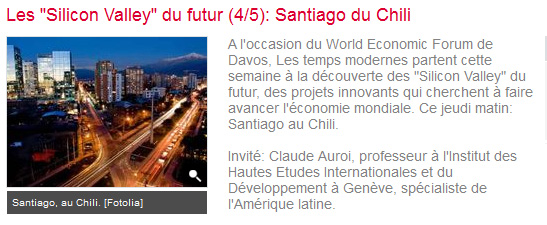
I had heard of Startup Chile, because Stanford supports the experiment in South America.

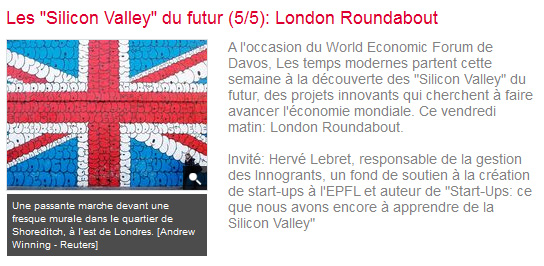
Finally, I could comment the stimulating British case, the Silicon Roundabout, in East London. You can listen to or download the mp3 file (in French).

A spontaneous emerging cluster, a name given by a local entrepreneur, no real support by decision makers, at least in the beginning and a nice and enthusiastic atmosphere. And all this attracts people from abroad. Is this finally the cluster Europe has been waiting for? We shall see… The experiment is really interesting and if you want to know more, you may wish to read (French) Le Monde, Le “Silicon Roundabout”, un succès britannique, or The Economist, Silicon Roundabout.

Silicon Valley – more of the same?

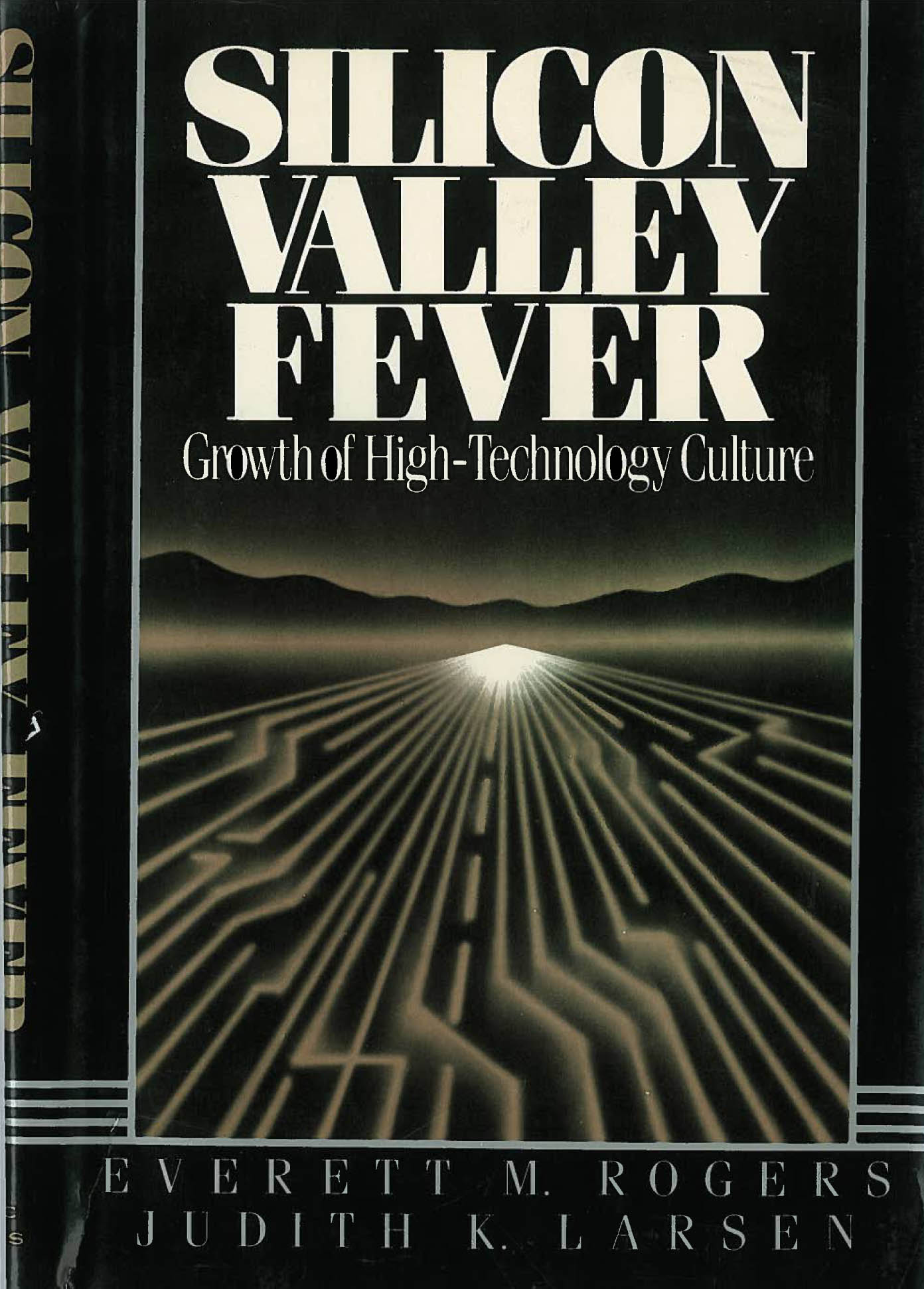
I was cleaning and filing old papers in my office, when I found “old” books about Silicon Valley and noticed how this amazing region has not really changed in the last 30 years. Let me just elaborate. The first book I looked at is Silicon Valley Fever.

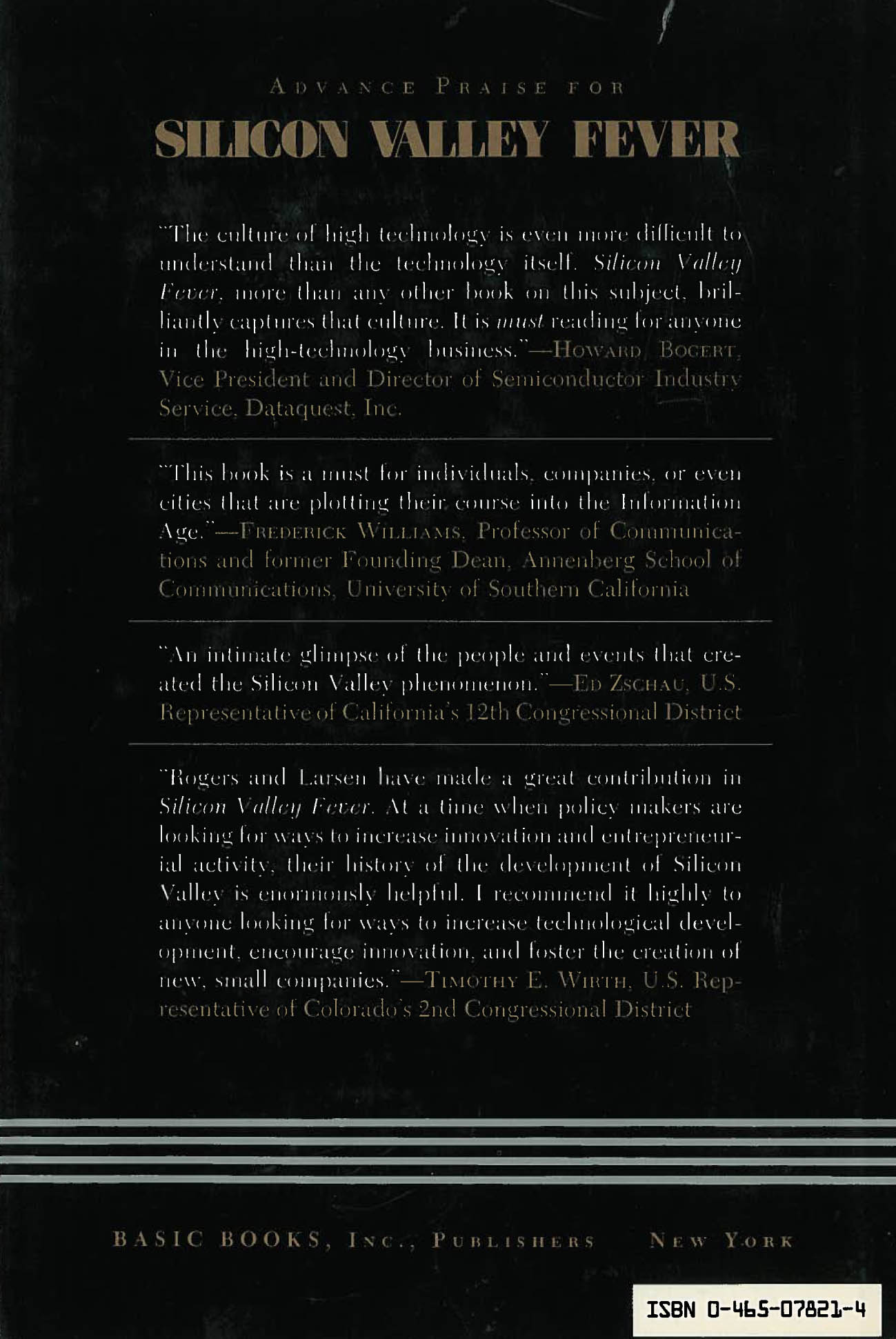
Here is the back cover:

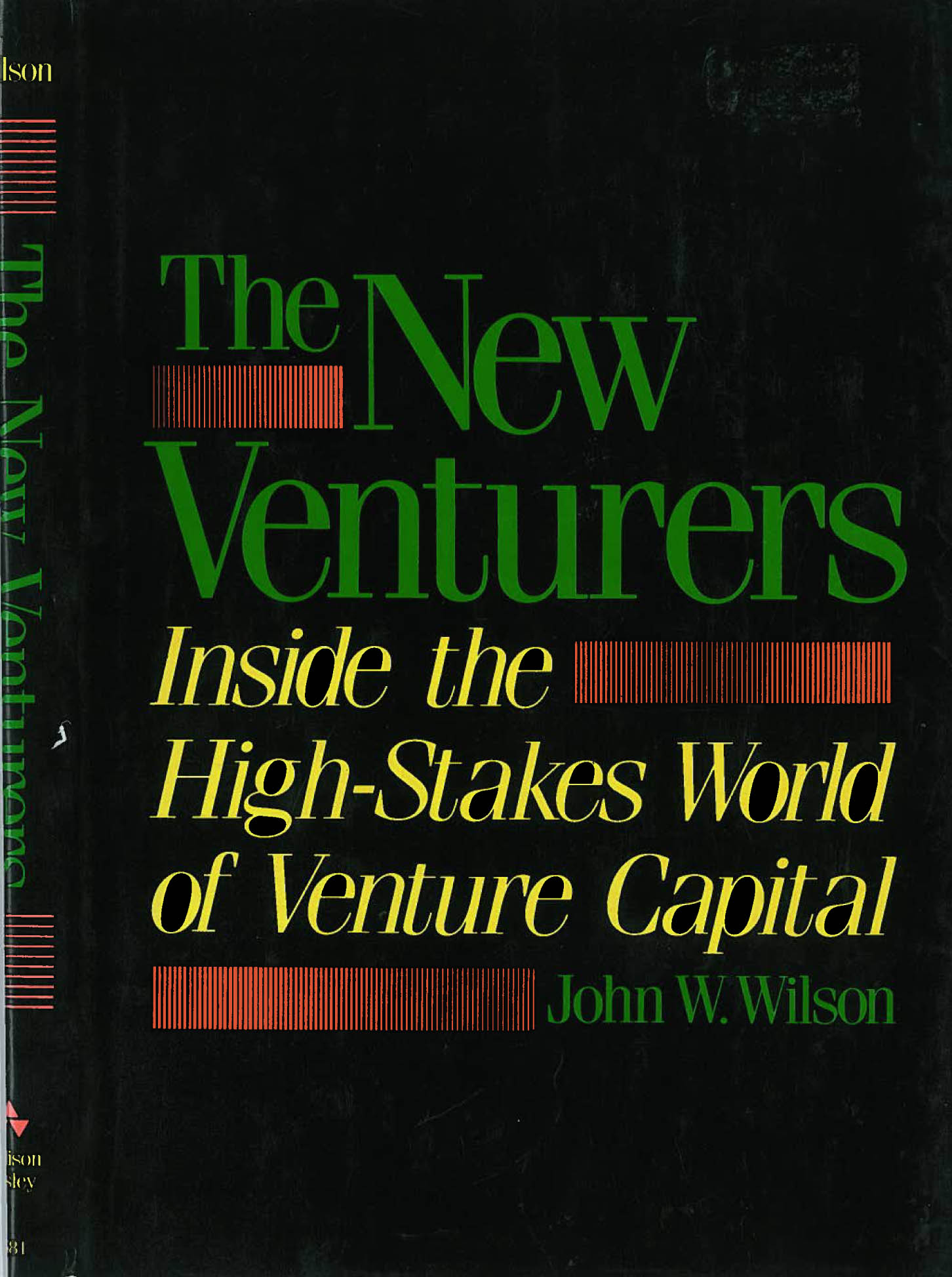
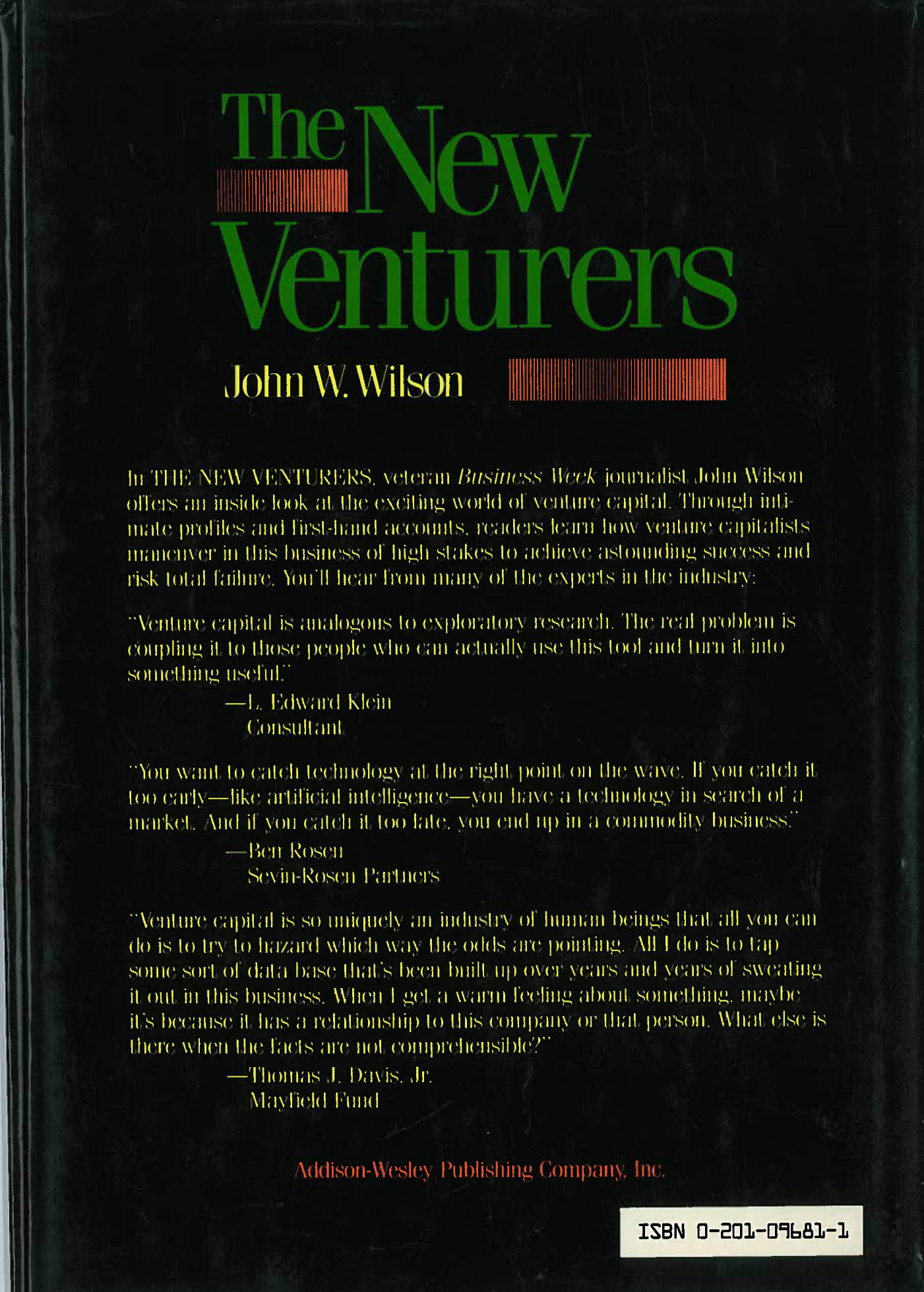
The next one is The New Venturers

with its back cover too:

Both were written in the mid-eighties. The New Venturers does not seem to be printed anymore and I wrote on Amazon in 2009, when I bought it, “In the mid 80s John Wilson published this book about venture capital. At the time, it was about business and how venture capital works. It has now become a history book and it shows how Silicon Valley developed in part thanks to venture capital. It is full of anecdotes, facts and figures. A great book… ”

Silicon Valley Fever is also out of print and there is no review for that one on Amazon! It is also a book I enjoyed reading. As a funny coincidence, the authors began their book with their history of Apple whereas my first chapter was the history of Google. Each decade has its role models. There is a section about Women and Entrepreneurship that Pemo Theodore would certainly appreciate: “The Silicon Valley has been called “one of the last great bastions of male dominance” by the local Peninsula Times Tribune. […] They are under-represented in management and administration. Few women have technical or engineering backgrounds. […] Why there are few women in positioning of responsability in Silicon Valley is complex and puzzling. Until recently, the overwhelming majority of engineering garduates were men. […] Scientific and engineering professionals in the finance community and in start-ups are likely to be men: these power-brokers rely exclusively on tehir personal networks. […] Twenty of the largest publicly held Silicon Valley firms listed a total of 209 persons as corporate officers in 1980; only 4 were women. The board of directors of these 20 firms include 150 directors. Only one was a woman: Shirley Hufstedler, serving on the board of Hewlett-Packard.” But the authors are optimistic: they explain that any woman with a technical background or an interest in high-tech has opportunities: “A Martian with three heads could find a job in Silicon Valley. So for women with a technical background, it’s terrific. […] An exception to masculine dominance is Sandy Kurtzig. “I wanted to start in a garage like HP, but I didn’t have one. So I started in a second bedroom of my apartment.” At first, Kurtzig did sales, bookkeeping and management of her start-up. As long as she had only five or six employees, they worked out of her apartment. It went into rapid growth and had annual sales in 1982.”

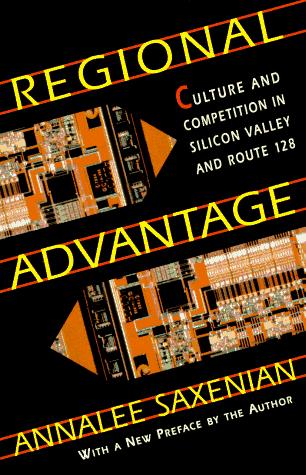
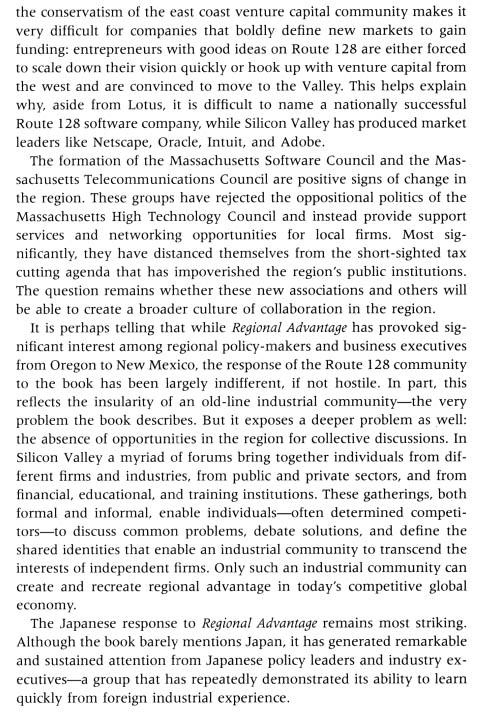
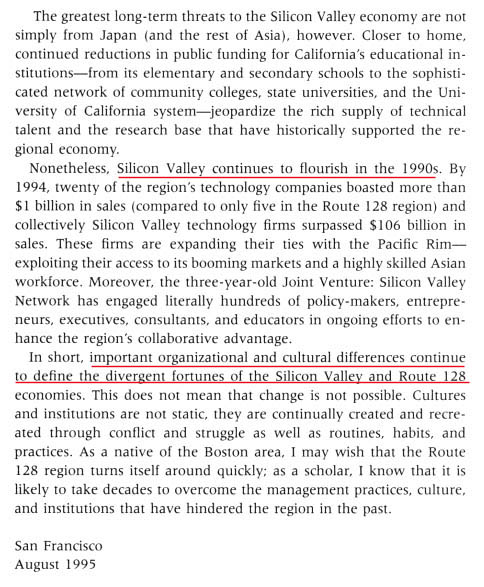
Part I of the book is historical, part II is the culture of Silicon Valley and part III is about its future (as foreseen in 1984). The final book I found is certainly not out of print. Written 10 years later by Annalee Saxenian, Regional Advantage is the reference book about Silicon Valley. It is one of my bibles. Saxenian compares the culture of Silicon Valley and Route 128 (the Boston cluster).

Funnily enough, she had this honnest recognition in 1998: “In 1979, I was a graduate student at Berkeley and I was one of the first scholars to study Silicon Valley. I culminated my master’s program by writing a thesis in which I confidently predicted that Silicon Valley would stop growing. I argued that housing and labor were too expensive and the roads were too congested, and while corporate headquarters and research might remain, I was convinced that the region had reached its physical limits and that innovation and job growth would occur elsewhere during the 1980s. As it turns out I was wrong.” (Source: A climate for Entrepreneurship)

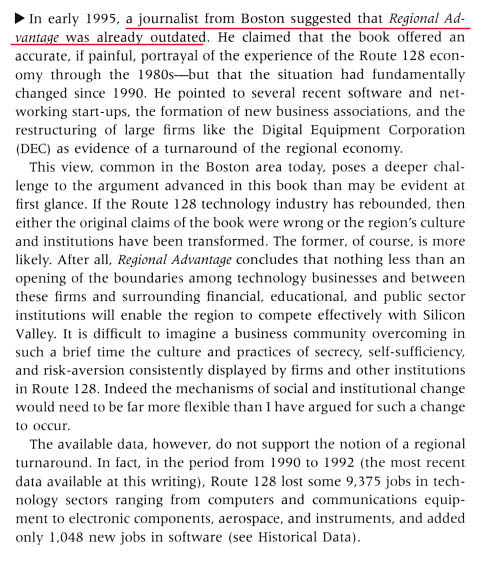
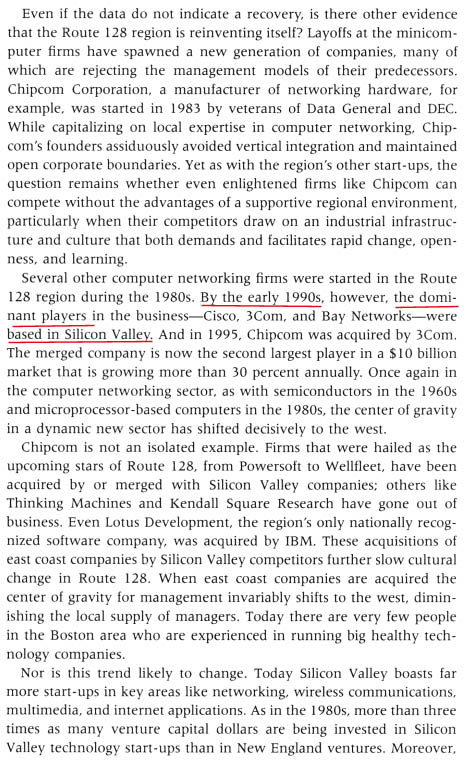
Let me just put here pictures of the preface of the book that you can find on Amazon or Google books. It is enlighting and will be my conclusion of this post: Silicon Valley was and is the innovation center with many ups and downs that these three books describe with their own style.

Atlantic Drift – Venture capital performance in the UK and the US

A new report on venture capital brings interesting conclusions and updates. Here is the summary that you can also fidn on the Nesta web site:

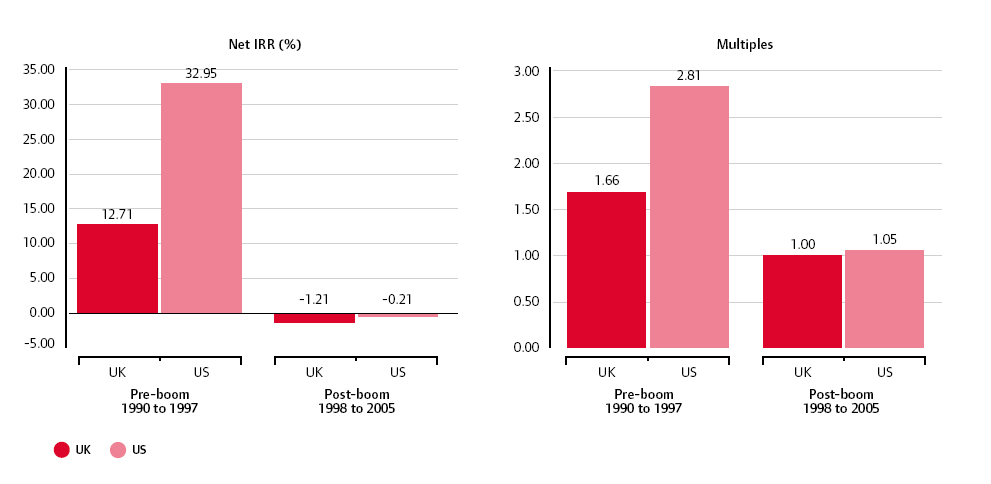
1. The returns performance of UK and US VC funds in recent years has been very similar. UK funds have historically underperformed US funds, but this gap has significantly narrowed. The gap in fund returns (net IRR) between the average US and UK fund has fallen from over 20 percentage points before the dotcom bubble (funds raised in 1990-1997) to one percentage point afterwards (funds raised in 1998-2005). However, this convergence has been driven by declining returns in the US after the burst of the dotcom bubble, rather than by increasing returns in the UK. Average returns for funds raised after the bubble in both the UK and the US have been relatively poor, but VC performance is likely to move upwards as VC funds start to cash out their investments in social networks (particularly in the US).

2. The wider environment in which UK funds and the companies they finance operate was a major contributor to the historical gap in VC returns. While there are some large differences in the observable characteristics of VC funds between both countries, they cannot account for the historical returns gap.

3. Average returns obscure the large variability in returns within countries. The dispersion in returns across funds was highest during the pre-bubble years, and has fallen significantly since then. But in both periods the gap in returns between good and bad performing funds within a country was much larger than the gap in the average returns across countries. Thirteen per cent of UK funds established since 1990, would have got into the top quartile of US funds by returns (this has increased to 22 per cent for funds established in the post bubble period), while 45 per cent of UK funds outperformed the median US fund. Selecting the right fund manager is thus more important than choosing a particular country.

4. The strongest quantifiable predictors of VC returns performance are

(a) whether the fund managers’ prior funds outperform the market benchmark;

(b) whether the fund invests in early rounds;

(c) whether the fund managers have prior experience; and

(d) whether the fund is optimally sized (neither too big nor too small).

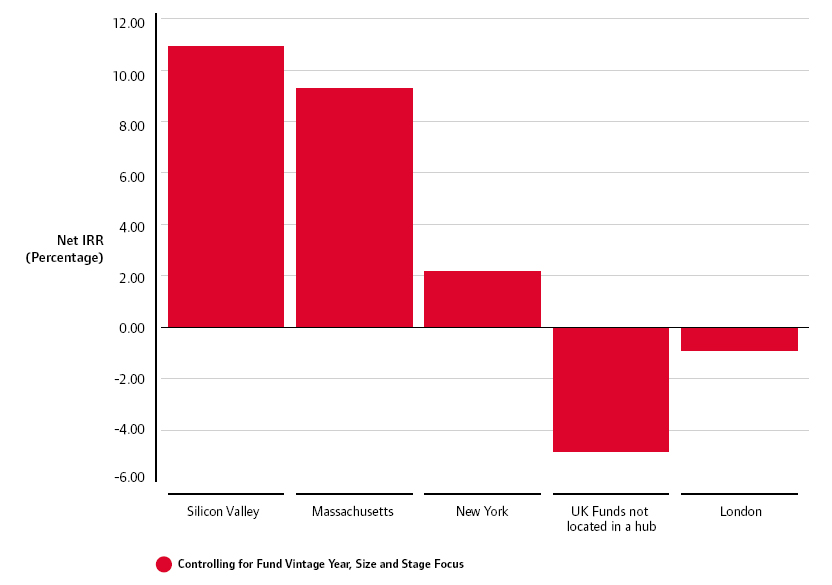
Moreover, historical performance has been higher for funds located in one of the four largest investor hubs (Silicon Valley, New York, Massachusetts and London) and for investments in information and communication technology.

5. UK government-backed funds have historically underperformed their private counterparts, but the gap between public and private returns has narrowed in recent periods. This suggests that in later years governments have become savvier when designing new VC schemes.

Most US funds have traditionally only invested locally, with less than a third of US funds raised between 1990 and 2005 having invested in one or more companies outside the US. In contrast, the majority of European funds have invested outside of their home market.

The situation has changed somewhat in recent times. A higher proportion of European funds raised in 2006-2009 have chosen to invest locally while US-based funds are becoming more global. As a result, the proportion of European VC capital being invested in the US has halved, falling to 10 per cent, and a slightly larger share of US VC capital is coming to Europe.

Overall, this analysis suggests that Europe does not offer an attractive proposition to US VC funds. Europe has a less developed VC market than the US, so attracting US funds (their money but also, crucially, their expertise) ought to benefit European economies. Instead, the opposite is happening. A much larger share of European VC funds invest in the US than the other way around. While Europe is likely to benefit from its funds investing in the US (for the returns it provides, the network it builds and the experience it generates), the small flow in the opposite direction is a cause for concern.

In conclusion

– The global venture capital industry is concentrated in very few hubs (and does not exist in a vacuum)

– The convergence in returns is not the result of changes in the characteristics of UK funds

– Small funds underperform medium sized funds, but larger is not always better

– More experienced fund managers achieved higher returns

– Past performance predicts future performance

– Funds in investor hubs had better returns

Investing in earlier rounds leads to better performance

– But much of the variability in returns is not explained by these factors

Finally some advice on Policy:

Remember venture capital activity does not exist in a vacuum.

Resist the temptation to overengineer public support schemes

Avoid initiatives that are too small.

I also found interesting two figures:

Bubble? You said bubble. Just read about it….

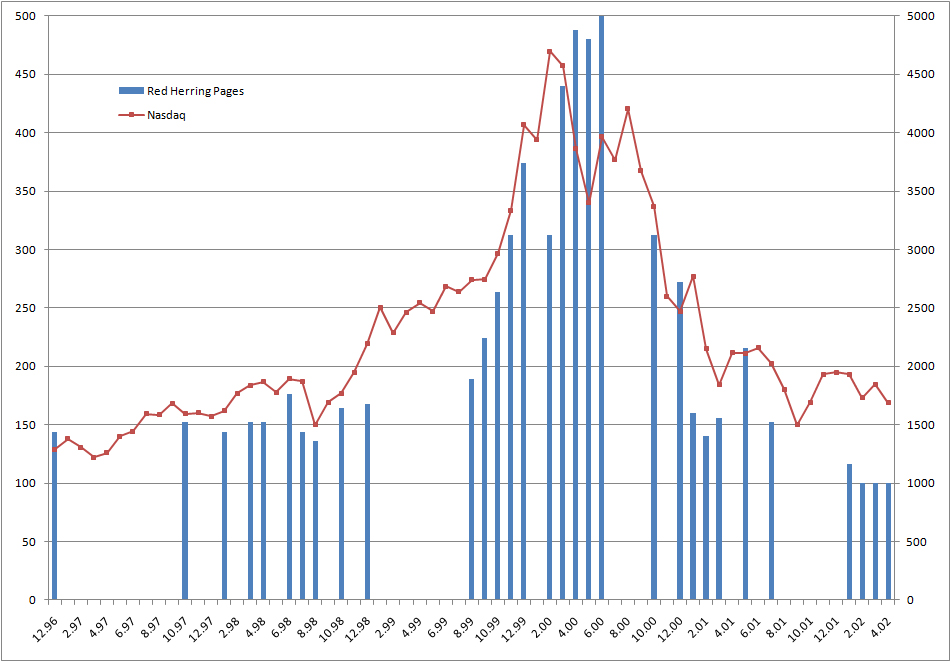
As I mentioned recently, a friend of mine gave me a collection of old Red Herring magazines. A funny byproduct of this gift is that I noticed that the number of pages of the Red Herring seemed to follow closely the Internet bubble. A decent number of pages before 1999, a peak in early 2000 and then a crash. I quickly did the exercise of comparing and here is the result!

A look back at equity and Cap. Tables

I have been producing many Cap. Tables in my book first and in this blog second. I thought it was a good time to give the full list up to now, classified by general fields, Internet, Software, Hardware / Computers / Telco /Networks, then Semiconductors, Biotech/Medtech. So here are the equity tables for:

Internet:

You should notice that this document is updated with the new cap. tables being added from time to time…

– Alibaba
https://www.startup-book.com/2011/06/09/going-public-when-you-are-not-a-us-start-up-part-34-alibaba/
– Baidu
https://www.startup-book.com/2011/06/14/going-public-when-you-are-not-a-us-start-up-part-44-baidu/
– eBay
https://www.startup-book.com/2008/10/30/equity-split-in-start-ups/
– Facebook
https://www.startup-book.com/2010/10/19/the-social-network/
– Google
https://www.startup-book.com/2008/10/30/equity-split-in-start-ups/ also in book Table 3-14
– Groupon
https://www.startup-book.com/2011/06/04/the-ipo-fever-goes-on-groupon-files-to-go-public/
– Kelkoo
https://www.startup-book.com/2008/05/06/cap-table-kelkoo/
– LinkedIn
https://www.startup-book.com/2011/05/09/linkedin-prices-ipo/
– Pandora
https://www.startup-book.com/2011/02/15/pandora-wants-to-go-public/
– Paypal
https://www.startup-book.com/2010/03/24/maxlinear-ipo-and-shareholders/
– Rediff
https://www.startup-book.com/2011/06/16/going-public-when-you-are-not-a-us-start-up-part-54-india
– Skype
https://www.startup-book.com/2010/08/16/skype-ipo-filing/ and https://www.startup-book.com/2008/04/17/cap-table-skype/
– Twitter
https://www.startup-book.com/2011/03/01/if-twitter-was-going-public-some-far-fetched-assumptions/
– Yahoo
https://www.startup-book.com/2008/10/30/equity-split-in-start-ups/ also in book Table 3-15
– Zillow
https://www.startup-book.com/2011/07/20/the-z-ipos-zynga-zillow-zipcar-and-zuckerberg/
– Zipcar
https://www.startup-book.com/2011/07/20/the-z-ipos-zynga-zillow-zipcar-and-zuckerberg/
– Zynga
https://www.startup-book.com/2011/07/20/the-z-ipos-zynga-zillow-zipcar-and-zuckerberg/

Software:

– Adobe
https://www.startup-book.com/2009/03/17/a-success-story-adobe-systems-john-warnock-and-charles-geschke/
– Business Objects:  in book Table 8-11
– CheckPoint
https://www.startup-book.com/2011/02/22/check-point-the-israel-success-story/
– Microsoft
https://www.startup-book.com/2011/03/30/the-deal-that-made-bill-gates-rich/ as well as in book Table A-2
– mysql
https://www.startup-book.com/2008/04/10/cap-table-mysql/
– Oracle Corporation: in book Table A-4
– Selectica
https://www.startup-book.com/2011/06/16/going-public-when-you-are-not-a-us-start-up-part-54-india

Hardware, Computers, and Telco/Networks:

– A123
https://www.startup-book.com/2010/02/26/a123-boston-and-atlas/
– Apple Computers:  in book Table 3-17
– Cisco: in book Table A-3
– Carbonite
https://www.startup-book.com/2011/08/04/ipo-again-carbonite-is-the-new-star/
– Envivio
https://www.startup-book.com/2011/06/08/going-public-when-you-are-not-a-us-start-up-part-24-envivio/
– Fusion-Io
https://www.startup-book.com/2011/04/05/wozniak-is-back/
– Gemplus: in book Table 8-12
– Isilon
https://www.startup-book.com/2010/11/17/a-typical-success-story-not-silicon-valley-though/
– Logitech, https://www.startup-book.com/2008/10/30/equity-split-in-start-ups/ also in book Table 8-10
– ONI Systems: in book Table 3-8
– Riverbed
https://www.startup-book.com/2008/10/30/equity-split-in-start-ups/ also in book Table 3-16
– Sun Microsystems: in book Table 3-13
– Tesla Motors
https://www.startup-book.com/2010/03/24/maxlinear-ipo-and-shareholders/
– Transmode
https://www.startup-book.com/2011/06/07/going-public-when-you-are-not-a-us-start-up-part-14-transmode/
– Wavecom
https://www.startup-book.com/2011/07/01/when-wavecom-was-surfing/

Semiconductor and EDA:

– Apache Design
https://www.startup-book.com/2011/03/22/the-return-of-electronic-design-automation-apache-ipo-filing/
– Arm Holdings
https://www.startup-book.com/2008/10/30/equity-split-in-start-ups/ also Table 8-13 in book
– Atheros
https://www.startup-book.com/2011/01/14/success-is-management-of-failure/ and https://www.startup-book.com/2008/10/30/equity-split-in-start-ups/ also in book Table 3-10
– Cambridge Silicon Radio: in book Table 8-16
– Centillium
https://www.startup-book.com/2011/01/14/success-is-management-of-failure/
– Intel  Corporation: in book Table A-1
– Magma Design Automation:  in book Table 6-3
– Maxlinear
https://www.startup-book.com/2010/03/24/maxlinear-ipo-and-shareholders/
– MIPS Computer:  in book Table 3-11
– Numerical
https://www.startup-book.com/2008/10/30/equity-split-in-start-ups/ also in book Table 3-9
– Rambus
https://www.startup-book.com/2008/10/30/equity-split-in-start-ups/ also in book Table 3-12
– Sequans
https://www.startup-book.com/2011/05/11/a-french-start-up-goes-public-on-nyse/
– Soitec: in book Table 8-14
– Synopsys
https://www.startup-book.com/2009/12/11/a-european-in-silicon-valley-aart-de-geus/ also in book Table A-5
– Virata
https://www.startup-book.com/2008/10/30/equity-split-in-start-ups/ also in book Table 8-15

Biotech/Medtech:

– Actelion
https://www.startup-book.com/2008/10/30/equity-split-in-start-ups/
– Chiron
https://www.startup-book.com/2011/03/09/biotech-data-part-13-chiron/
– Genentech
https://www.startup-book.com/2009/06/11/bob-swanson-herbert-boyer-genentech/
– Genzyme
https://www.startup-book.com/2011/03/14/biotech-data-part-23-genzyme/
– Intuitive Surgical
https://www.startup-book.com/2010/08/26/intuitive-surgical/

Misc:

– RPX Corp
https://www.startup-book.com/2011/01/27/is-there-something-rotten-in-the-kingdom-of-vc/
– The Active Network
https://www.startup-book.com/2011/02/18/when-a-cap-table-is-a-nightmare/

A French start-up goes public on NYSE

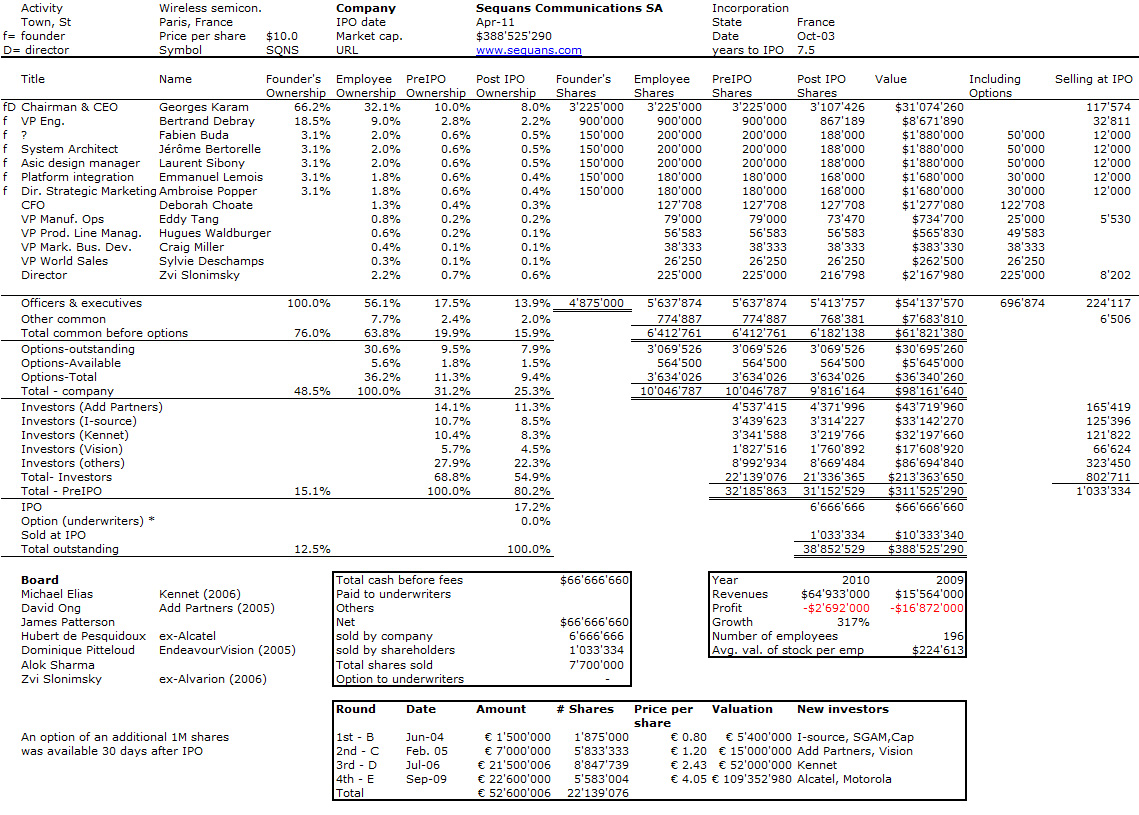
Sequans is a wireless chip company which went public last month. This is a rare enough event to be worth a post. All the more as the start-up is French and it went public on the New York stock exchange. It may not look like a great IPO but for a non-US company, it is a real achievement (there had been Ilog, Business Objects and a few other French start-ups). What is also interesting is that it did not have US VCs and the company was founded in 2003, less than 8 years to go public.

What else worth commenting?
– the company had raised more than €50M prior to IPO and $66M at IPO.
– the founding team had experience with another US company (Juniper)
– VCs come from France (i-source, SGAM) and the UK (Add Partners, Kennet). Later on, it added strategic investors (Swisscom, Alcatel, Motorola).
– All shareholders sold a little piece of their stake (about 3-5%)

Europeans and Silicon Valley

Silicon Valley is well known for its immigrants, particularly those from Asia (India, China, Taiwan, Korea, etc). AnnaLee Saxenian is famous for her books on the topic. The European migrants are lesser known and I think it is a little unfair. Let me first illustrate it with famous examples and then with statistical data.

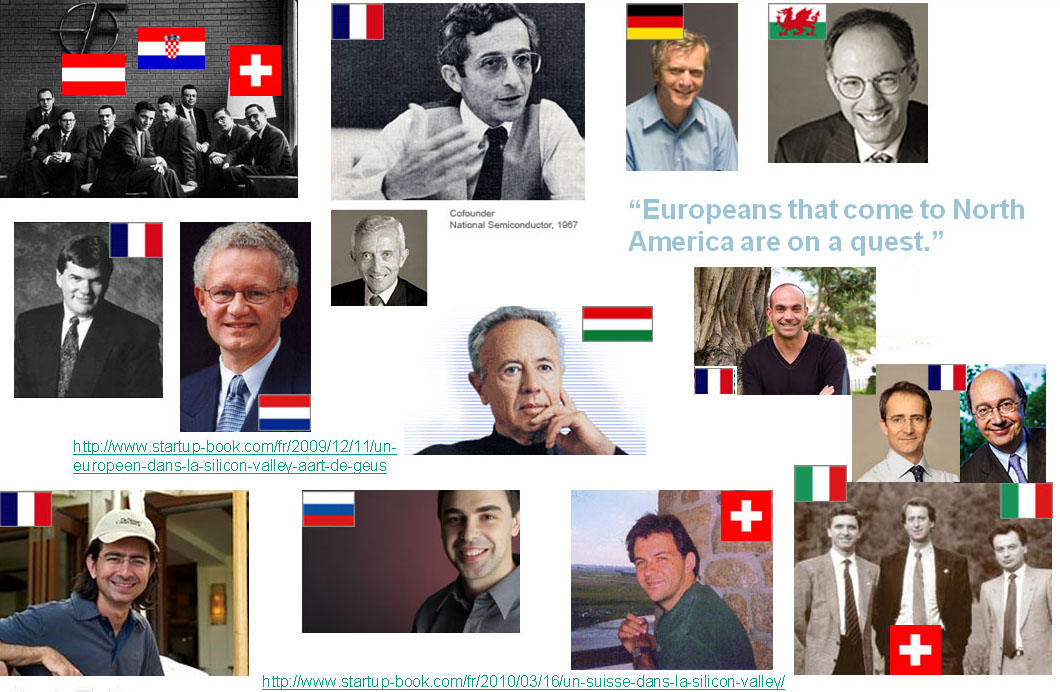
I have been using this picture for some years now to show that Europe also counts famous Silicon Valley migrants that should be used better as role models. Do you know them? Take a little time to check how many you know and then have a look at the answer.

First row

On the top left, here are the famous Traitorous Eight, the founders of Fairchild in 1957 who can be considered as the fathers of Silicon Valley. Jean Hoerni was from Switzerland, Eugene Kleiner from Austria, and Victor Grinich’s parents from Croatia (he was born Grgunirovich). You may want to know more at https://www.startup-book.com/2011/03/02/the-fathers-of-silicon-valley-the-traitorous-eight.

On the right is Pierre Lamond, founder of National Semiconductor and then a partner with Sequoia Capital. As you may imagine, he is a specialist of semiconductors. More at http://en.wikipedia.org/wiki/Pierre_Lamond.

Then comes Andy Bechtolsheim, from Germany. A founder of Sun Microsystems and a business angel in Google (there is the legend he wrote a $100k to Google whereas the company did not exist yet ; a good investment, worth more than $1B a few years later !). http://en.wikipedia.org/wiki/Andy_Bechtolsheim

Finally on the top row is Michael Moritz, from Wales. He was a journalist with Time Magazine when Don Valentine hired him at Sequoia. A good choice, just for two investments he made, Yahoo and Google… http://en.wikipedia.org/wiki/Michael_Moritz

Second row

Philippe Kahn is probably less famous except in France where he was an icon in the 80’s. He left his motherland when he understood his work would not be appreciated and flew as a tourist in 1982 to the USA. A few months later, he founded Borland. http://en.wikipedia.org/wiki/Philippe_Kahn

The Dutchman is Aart de Geus. He did his undergrad at EPFL where I work and his PhD in the USA. He is the founder and current CEO of Synopsys, the leader in Electronic Design Automation (6’700 employees, $1.4B in revenue). https://www.startup-book.com/2009/12/11/a-european-in-silicon-valley-aart-de-geus/

Andy Grove flew Hungary under the Communist regime and arrived in New York without speaking English. He can be considered as a founder of Intel and would later become its CEO. http://en.wikipedia.org/wiki/Andrew_Grove

Third row

Pierre Omidyar, half French, his family has Iranian roots but he was born in Paris, moved to the USA when he was 6… founder of eBay. http://en.wikipedia.org/wiki/Pierre_Omidyar

Serguei Brin, founder of Google, born in Moscow, also moved in the USA when he was 6. http://en.wikipedia.org/wiki/Sergey_Brin

Edouard Bugnion, from Switzerland, is a founder of VMware. More on https://www.startup-book.com/2010/03/16/a-swiss-in-silicon-valley/

The last examples have more of a Europe-USA-Europe background:

The three founders of Logitech are Daniel Borel, Pierluigi Zappacosta and Giacomo Marini. “The idea for Logitech was spawned in 1976 at Stanford University, in Palo Alto, Calif. While enrolled in a graduate program in computer science at Stanford, Daniel Borel and Pierluigi Zappacosta formed a friendship that would become a business alliance. While completing their education, Borel, a Swiss, and Zappacosta, an Italian, identified an opportunity to develop an early word-processing system (therefore the name which means Software Technology in French). The pair spent four years securing funding and eventually built a prototype for the Swiss company Bobst.” The rest is history.
http://en.wikipedia.org/wiki/Daniel_Borel
http://en.wikipedia.org/wiki/Pierluigi_Zappacosta
http://en.wikipedia.org/wiki/Giacomo_Marini

Some similarities with the next story: Bernard Liautaud studied at Stanford before working for Oracle in Europe. A founder of Business Objects with Denis Payre who moved very early in the USA as he had understood that IT = USA. http://en.wikipedia.org/wiki/Bernard_Liautaud

Pierre Haren, founder of Ilog, got his PhD at MIT. No Silicon Valley here but Pierre told me once the importance of the American culture in his entrepreneurial venture. http://en.wikipedia.org/wiki/ILOG

I finish with Loic Lemeur, a friend of Sarkozy, who has left France to launch Seesmic in SV. One of the latest European migrants who show that the flow never stops. https://www.startup-book.com/2010/06/21/why-silicon-valley-kicks-europes-butt

🙂 or 🙁 ?

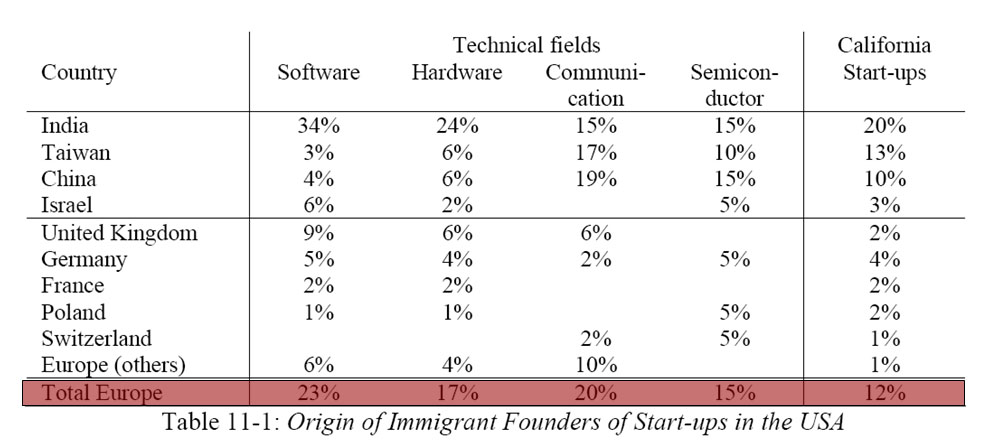
Now the stats. One could always argue that those were only a few examples / exceptions. The table which follows is in my book but comes indirectly from a study by AnnaLee Saxenian. She and her co-authors analyzed where were SV foreign entrepreneurs coming from.I do not think they had compiled Europe as a group which I did from her data. The result is quite impressive because Europe is very similar to China or India. I am not sure this is that well known…

Source: AnnaLee Saxenian et al. “America’s New Immigrant Entrepreneurs” Duke University and UC Berkeley, January 2007.